
Read the first chapter
The whole of chapter one, free. About 7 min. Turn the pages with the arrows, your keyboard, or a swipe.
Chapter 1
Career Vision and North Star
Why Your Career Needs a North Star
What would change if every major business decision had to pass one clear test: “Does this move me toward the career and business I actually want?” Without that test, entrepreneurs often accept profitable work that drains them, hire into roles they never wanted to manage, or grow a business that leaves them with less control over their time.
This problem affects the owner who started a plumbing company for independence but now spends every evening handling emergency calls. It affects the gym owner who wants a respected local brand but keeps adding low-priced memberships that attract customers who do not fit the business. It affects the tradesperson who wants to become an owner but keeps taking jobs that build technical skill without building leadership, sales, or financial judgment.
A clear career vision solves this by giving your choices a direction. After completing the work here, you will be able to describe the role you want to hold, the kind of business you want to build, the customers you want to serve, and the boundaries you need to protect. You will also have a simple way to test opportunities before they consume your time, money, or attention.
I learned the cost of unclear direction through work with owners who had strong skills and steady demand but no agreed destination. They made decisions based on the loudest customer, the next invoice, or the newest opportunity. Once they wrote down the future they wanted, their decisions became easier: some offers disappeared, certain hires became obvious, and growth stopped meaning “more of everything.” The method below turns that clarity into a working tool rather than a statement framed on a wall.
Build the North Star Clarity Map
The North Star Clarity Map connects your desired career with the business choices that support it. It has four parts: Role, Results, Rules, and Route. The order matters. You first define who you want to become at work, then describe what success must produce, set limits that protect the vision, and choose the next route toward it.
1. Role: Write the work you want to do most often three years from now. Be specific about your responsibilities. “Business owner” tells you very little. “Owner who spends two days a week on sales, one day training supervisors, and no evenings on routine customer calls” gives you something to plan around. This matters because your business will naturally fill the role you leave undefined.
2. Results: Name the outcomes that make the role worthwhile. Include money, time, work quality, and personal standards. For example: “Generate $240,000 in annual owner income, take four weeks away from daily operations, and serve commercial clients who value scheduled maintenance.” Results prevent you from confusing activity with progress.
3. Rules: Set the conditions you will not trade away. These may include no Sunday work, no projects below a certain margin, no customers who repeatedly ignore payment terms, or no growth funded by personal debt. Rules matter because pressure will make almost any opportunity look reasonable.
4. Route: Choose the skills, relationships, systems, and milestones that move you toward the role and results. If you want to lead a team instead of doing every job yourself, your route may include hiring a field supervisor, documenting common tasks, and reserving four hours each week for sales training. A route turns a vision into scheduled work.
Use one sentence to combine the map: “I am building a [type of business] so I can work as a [desired role], produce [measurable results], and protect [non-negotiable rules] by developing [next skills and milestones].” Keep the sentence visible when you review new opportunities. The sentence does not need to sound impressive. It needs to help you decide.
Your vision should also distinguish career direction from business size. A larger company may support your goals, but it may also create more hiring, compliance, and management work. A smaller specialist firm may produce more control and stronger margins. Ask which structure supports your chosen role. If you want to be a master craftsperson with a small team, pursuing ten locations may pull you away from the work that gives your career meaning.
The map works because it links ambition to trade-offs. Every vision excludes something. If you want predictable weekdays, you may decline urgent after-hours work. If you want premium positioning, you may stop competing for the cheapest customers. If you want to become a manager, you must give other people room to perform tasks you currently control. A vision becomes useful when it changes decisions.
Apply the Map to a Real Business Decision
Consider a local commercial cleaning owner who currently works 55 hours each week, produces about $18,000 in monthly revenue, and takes home roughly $4,500 after expenses. The owner wants to become a sales-and-training leader within three years, reach $8,000 in monthly owner income, work no more than 40 hours each week, and stop accepting overnight jobs.
The owner can use the North Star Clarity Map this way:
1. Write the Role. The target role becomes: “I sell recurring contracts, train two team leads, review quality, and work Monday through Friday.” This removes daily cleaning from the center of the career plan.
2. Set the Results. The owner records three measures: $8,000 monthly owner income, a 40-hour workweek, and two trained team leads by December 2027. The numbers create a way to check progress instead of relying on a feeling of growth.
3. Set the Rules. The owner writes: “No overnight contracts after June 2027; no contract below a 35 percent gross margin; no customer receives a discount without a written trade-off.” These rules protect both the desired schedule and the income target.
4. Choose the Route. During the next 90 days, the owner will raise prices on new quotes, reserve Tuesday and Thursday mornings for sales calls, document the five most common cleaning tasks, and train one experienced cleaner as a lead. Each action supports the future role.
5. Test every opportunity. A $6,000 monthly overnight contract arrives. It would increase revenue, but it violates the schedule rule and requires hiring before the owner has trained a lead. The owner declines it and instead pursues three daytime contracts worth $2,000 each. The second option better supports the stated career.
6. Review monthly. At month-end, the owner checks hours worked, owner income, daytime recurring revenue, lead-training progress, and accepted contracts that broke the rules. If revenue rises but work hours reach 62, the owner does not call the plan successful. The results must match the vision.
The expected outcome after 90 days is not a complete transformation. It is evidence: a written role, clearer pricing decisions, documented work, protected sales time, and one person beginning leadership training. That evidence tells the owner whether the route works before the business becomes harder to change.
Quick checklist
• Write the role you want to hold three years from now. - Set three measurable results for income, time, and work quality. - Record the rules that protect your health, schedule, and standards. - Select three actions that build the skills or systems your future role requires. - Test each new opportunity against the full map. - Review progress on the same date every month. - Change the route when evidence shows a problem, but keep the destination clear.
Avoid Vision Traps That Distort Your Decisions
Mistaking revenue for career progress
More sales can hide a worse career. A business may grow from $18,000 to $30,000 in monthly revenue while the owner works longer hours and earns less per hour. Revenue matters only when it supports the role and results you chose.
Do this: Track revenue alongside owner income, weekly hours, customer fit, and progress toward your desired role.
Not this: Accept every sale as proof that the business is moving in the right direction.
Writing a vision that describes an image instead of a working life
“Build a respected brand” sounds positive but does not tell you what to do on Monday. It cannot guide hiring, pricing, or customer selection. Replace broad language with observable details: the work you perform, the hours you keep, the customers you serve, and the money the business must produce.
Do this: Describe a normal week in your target role, including the tasks you do and the tasks you no longer do.
Not this: Copy a goal that sounds impressive but does not match your preferred work.
Changing the destination whenever pressure appears
A difficult month can make a clear vision feel unrealistic. That does not mean you should abandon it immediately. First check whether the problem sits in the route. Perhaps your pricing is too low, your sales skill needs work, or you hired before defining the role. Change tactics before changing the destination.
Do this: Hold a monthly review and ask, “Which assumption failed, and what adjustment would protect the vision?”
Not this: Let one difficult customer, slow month, or tempting offer rewrite your entire career plan.
Your practical action is simple: schedule 60 uninterrupted minutes this week and complete the four parts of the North Star Clarity Map. Then place the finished sentence beside your calendar, quoting tool, or customer pipeline. The broader work of career development starts here: once you know where you are going, you can choose growth that takes you there rather than growth that merely keeps you busy.
End of chapter one. 39 more chapters in the full book.
Swipe or use the arrows to turn the page

PRESIDENT DONALD TRUMP: FACT OR FICTION?

Ashfall at Point Meridian Master Manuscript

THREE PRESIDENCIES, ONE AMERICA
What's inside: 40 chapters
- 1. Career Vision and North Star
- 2. Assess Strengths with Skill Inventory
- 3. Market Reality via Role Demand Scan
- 4. Set SMART Goals for Career Moves
- 5. Build a Career Roadmap Timeline
- 6. Choose a Growth Strategy Mix
- 7. Create Your Personal Brand Statement
- 8. Update Your LinkedIn Headline and About
- 9. Portfolio Proof for Business Outcomes
- 10. Networking with Intentional Outreach
- 11. Master Informational Interviews
- 12. Build a Referral Engine System
- 13. Negotiate Like a Business Owner
- 14. Pricing Your Expertise for Career Leverage
- 15. Create a Learning Plan with Time Blocks
- 16. Choose Courses That Build Transferable Skills
- 17. Apply the 70-20-10 Skill Method
- 18. Run Experiments with Skill Sprints
- 19. Get Feedback Using the SBI Framework
- 20. Track Progress with Career Metrics
- 21. Build Your Resume with Achievement Bullets
- 22. Create a One-Page Career Summary
- 23. Tailor Applications with Role Fit Mapping
- 24. Win Interviews with STAR Stories
- 25. Handle Tough Questions with PREP
- 26. Lead with Confidence in Career Pivots
- 27. Use Mentors and Advisors Strategically
- 28. Find Your First Mentor Through Warm Leads
- 29. Delegate to Grow Your Career Bandwidth
- 30. Build a Team Skill Matrix
- 31. Create Your Succession Plan for Yourself
- 32. Manage Work-Life Boundaries for Sustained Growth
- 33. Avoid Burnout with Energy Management
- 34. Create Weekly Review and Next-Step Planning
- 35. Use OKRs to Align Career and Business
- 36. Plan for Promotions with Competency Proof
- 37. Handle Career Setbacks with Recovery Plans
- 38. Rebrand After a Pivot or Layoff
- 39. Scale Your Career Through Thought Leadership
- 40. Long-Term Career Maintenance Calendar
About this book
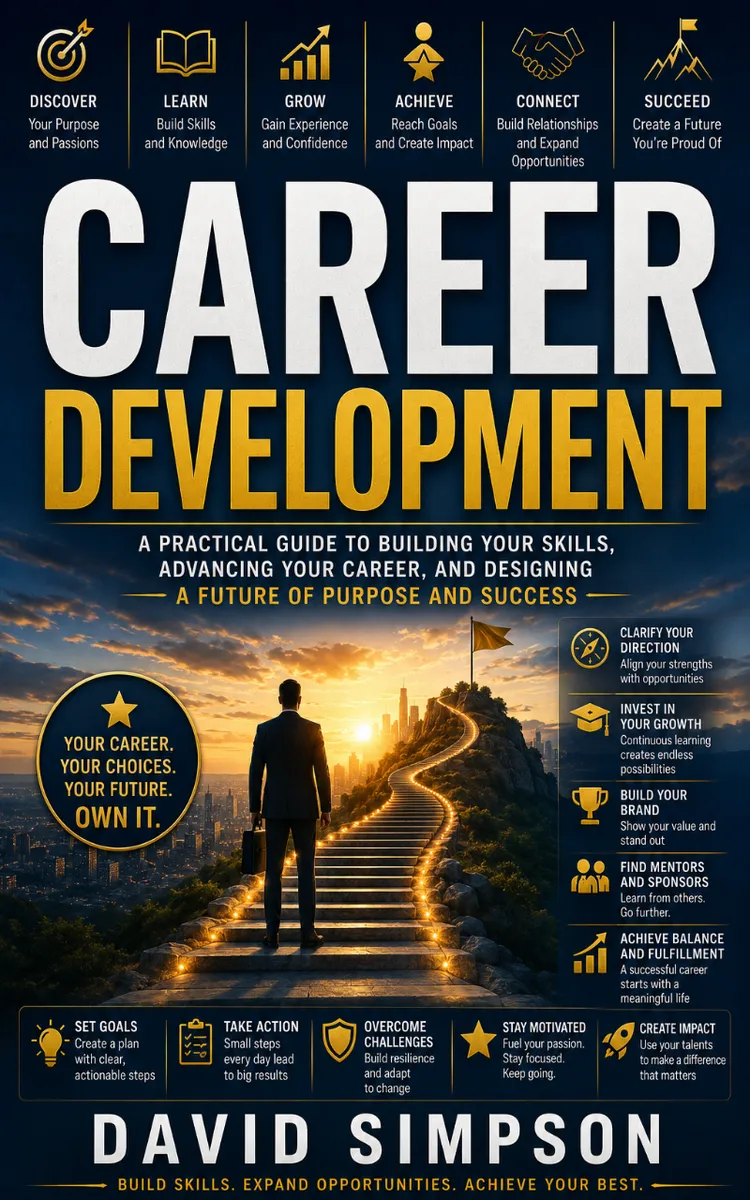
"Career Development" is a business book by David Simpson with 40 chapters and approximately 73,206 words. Strategies for career growth, planning, and professional advancement.
This book was created using Inkfluence AI, an AI-powered book generation platform that helps authors write, design, and publish complete books. It was made with the AI Business Book Writer.
Frequently Asked Questions
What is "Career Development" about?
Strategies for career growth, planning, and professional advancement
How many chapters are in "Career Development"?
The book contains 40 chapters and approximately 73,206 words. Topics covered include Career Vision and North Star, Assess Strengths with Skill Inventory, Market Reality via Role Demand Scan, Set SMART Goals for Career Moves, and more.
Who wrote "Career Development"?
This book was written by David Simpson and created using Inkfluence AI, an AI book generation platform that helps authors write, design, and publish books.
How can I create a similar business book?
You can create your own business book using Inkfluence AI. Describe your idea, choose your style, and the AI writes the full book for you. It's free to start.
Write your own business book with AI
Describe your idea and Inkfluence writes the whole thing. Free to start.
Start writingCreated with Inkfluence AI


