
Read the first chapter
The whole of chapter one, free. About 5 min. Turn the pages with the arrows, your keyboard, or a swipe.
Chapter 1
Foundations: Your Content System, Audience, and Offer
Overview:
If your content direction is fuzzy, you’ll feel busy but stuck - posting “good ideas” that don’t build momentum because they’re aimed at the wrong people or measured with the wrong yardstick. This chapter builds the blueprint for your content system by locking in your niche, audience, and measurable goals, then turning your promise and differentiators into something you can repeat without sounding like everyone else.
You’ll also map where your audience actually hangs out, so you stop guessing and start showing up in the right places. Ask yourself as you read: “Could a stranger tell who I help, what I help them do, and how I’ll measure progress?”
The Breakdown
#1: Choose a Niche You Can Explain in One Sentence
Problem: If your niche is “content creation” or “marketing tips,” you’ll attract random browsers and struggle to build trust. You’ll also produce content that sounds useful but doesn’t match a specific person’s job-to-be-done, so engagement stays flat for weeks.
Solution: Write a one-sentence niche statement using this fill-in format: “I help [specific audience] achieve [specific outcome] using [your method or angle].”
• Example: “I help local gym owners reduce no-shows by turning class schedules into simple weekly promos.”
• Then test it: say it out loud and see if it takes you under 10 seconds. If you need more, you’re probably too broad.
Result: You’ll know what to create (and what to skip), which makes your posting schedule easier and your content feel more “for me.”
Takeaway prompt: What’s your niche sentence right now - can you say it in under 10 seconds?
#2: Define Your Audience by Roles, Not Demographics
Problem: Demographics like “women 25-34” don’t tell you what people are trying to solve today. Without role clarity, you’ll write generic posts, and your CTAs (calls to action) will land weakly - because your audience doesn’t feel seen.
Solution: Define your audience with 3 role-based bullets:
• Their current situation (what they’re dealing with weekly)
• Their goal (what “better” looks like in plain words)
• Their constraint (time, budget, skill, tools - pick one)
Use a quick check: open your notes and write one sentence starting with “They need help because…” If you can’t finish that sentence, your audience isn’t defined yet.
Result: Your content topics will start coming naturally because you’ll write to specific problems, not broad categories.
Quick comprehension check: Who is your audience in “role words” (owner, manager, coach, operator), and what’s their weekly constraint?
#3: Set Measurable Goals That Match the Stage You’re In
Problem: If you set goals like “get more followers” or “go viral,” you can’t tell what worked. In the early weeks, that leads to random posting and constant rewrites, because you’re measuring the wrong signals.
Solution: Pick one primary goal and one secondary goal, then tie them to a number you can track for 30 days. Use this simple stage guide:
Stage
Primary goal (pick 1)
Track weekly
Example target (30 days)
Learning & traction
Content saves/shares
saves per post
20+ saves on 8 posts
Trust building
Clicks to one offer
link clicks
50 link clicks
Conversion
Leads/sales
sign-ups or purchases
10 sign-ups from content
Choose your targets based on reality: if you’ve posted twice a month, aim low-but-specific (like saves or clicks).
Result: You’ll make faster decisions because every post either supports the goal or doesn’t - no guessing.
Takeaway prompt: What’s your number for the next 30 days: saves, clicks, or sign-ups?
#4: Write Your Content Promise (What You’ll Deliver Every Time)
Problem: Without a content promise, your audience has to “decode” you. That slows trust because people don’t know what they’ll get when they follow you, and you’ll feel tempted to chase whatever trend is loudest.
Solution: Create a promise statement in this structure: “I help [audience] by delivering [content format/type] that leads to [outcome], without [common frustration].”
• Add one repeatable format: checklists, short breakdowns, before/after examples, templates, or “step-by-step in 10 minutes.”
• Add one “without” line that matches their pain: “without fluff,” “without complicated setups,” or “without needing a big budget.”
Keep it consistent for 4 weeks - don’t rewrite it every time you post.
Result: Your followers know what to expect, so your content becomes easier to market and easier to binge.
Quick check: Does your promise sound like something you can deliver weekly, not just once?
#5: Identify 3 Differentiators You Can Prove
Problem: “I’m authentic” and “I have experience” are hard to verify, so your differentiation won’t stick. When competitors cover similar topics, you’ll blend in, and your posts will compete on effort instead of value.
Solution: List three differentiators that meet both tests:
• Specific: tied to a method, tool, or workflow
• Provable: you can show evidence in posts (screenshots, examples, numbers)
Try this template: “Unlike [common approach], I do [your specific approach] using [tool/workflow], which results in [measurable outcome].”
Concrete example: “I write content briefs using a 1-page template and publish with a weekly schedule, so posts stay consistent.”
Then pick one differentiator to highlight first for the next 2 weeks, not all three at once.
Result: Your content stops sounding interchangeable, and people start recognizing your “signature” quickly.
Reflection prompt: What can you show on your screen (tool, template, numbers) to prove your differentiators?
#6: Map Where Your Audience Hangs Out and Build a Posting Route
Problem: If you post everywhere, you’ll dilute focus and burn time formatting. If you post in the wrong places, you’ll get low reach even when your content is solid - because it isn’t meeting people where they already pay attention.
Solution: Create a posting route with two layers:
• Primary platform (1): where your audience actively consumes and saves content
• Secondary platform (1): where you can repurpose and drive clicks back
Then define your “hangout proof” using one data point:
• Examples: “My target role engages with posts using X keywords,” “Top accounts they follow post on Mondays,” or “Their community shares these resources weekly.”
Use a simple tool to speed this up: YouTube search suggestions, TikTok/Instagram keyword search, or Google “People also ask” to find repeated questions your audience is already asking.
Build a 2-week route: 3 posts on the primary platform + 2 repurposed posts on the secondary, and track results by platform separately.
Result: Your content gets a fair chance to perform because you’re showing up in the same places your audience already invests attention.
Takeaway prompt: Name your primary and secondary platforms - and what specific evidence tells you your audience is there?
What Comes Next
Now that your niche, audience, goals, promise, differentiators, and posting route are locked in, you’re ready to turn this blueprint into content you can plan and produce consistently. Next, you’ll build your first content map: topics, angles, and formats that match your promise and move your chosen metrics.
End of chapter one. 6 more chapters in the full book.
Swipe or use the arrows to turn the page


What's inside: 7 chapters
- 1. Foundations: Your Content System, Audience, and Offer
- 2. Research That Produces Ideas: Keywords, Topics, and Proof
- 3. Planning for Consistency: Calendars, Pillars, and Batching
- 4. Writing and Storytelling: Hooks, Structure, and Clarity
- 5. Visual and Format Mastery: From Scripts to Assets
- 6. Distribution and SEO: Getting Discovered on Purpose
- 7. Engagement and Community: Turning Viewers into Followers
About this book
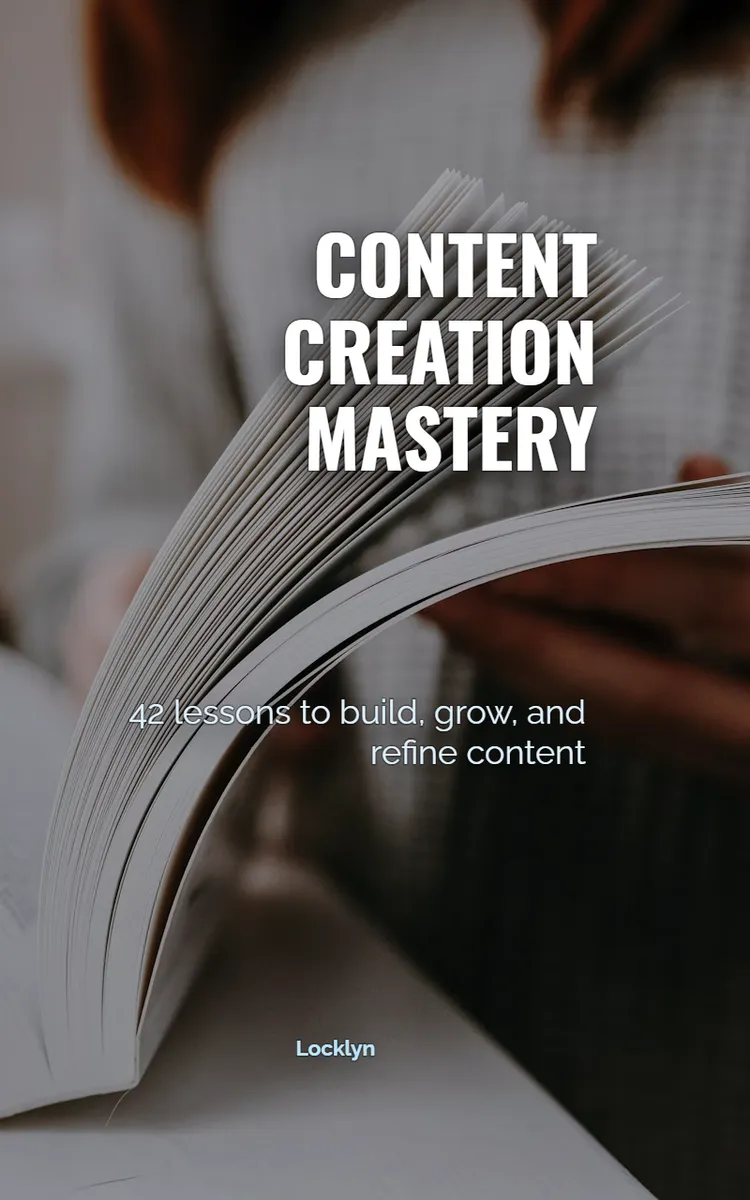
"Content Creation Mastery" is a list book by Locklyn with 7 chapters and approximately 8,134 words. Content creation lessons for building and improving content.
This book was created using Inkfluence AI, an AI-powered book generation platform that helps authors write, design, and publish complete books.
Frequently Asked Questions
What is "Content Creation Mastery" about?
Content creation lessons for building and improving content
How many chapters are in "Content Creation Mastery"?
The book contains 7 chapters and approximately 8,134 words. Topics covered include Foundations: Your Content System, Audience, and Offer, Research That Produces Ideas: Keywords, Topics, and Proof, Planning for Consistency: Calendars, Pillars, and Batching, Writing and Storytelling: Hooks, Structure, and Clarity, and more.
Who wrote "Content Creation Mastery"?
This book was written by Locklyn and created using Inkfluence AI, an AI book generation platform that helps authors write, design, and publish books.
Write your own list book with AI
Describe your idea and Inkfluence writes the whole thing. Free to start.
Start writingCreated with Inkfluence AI


