
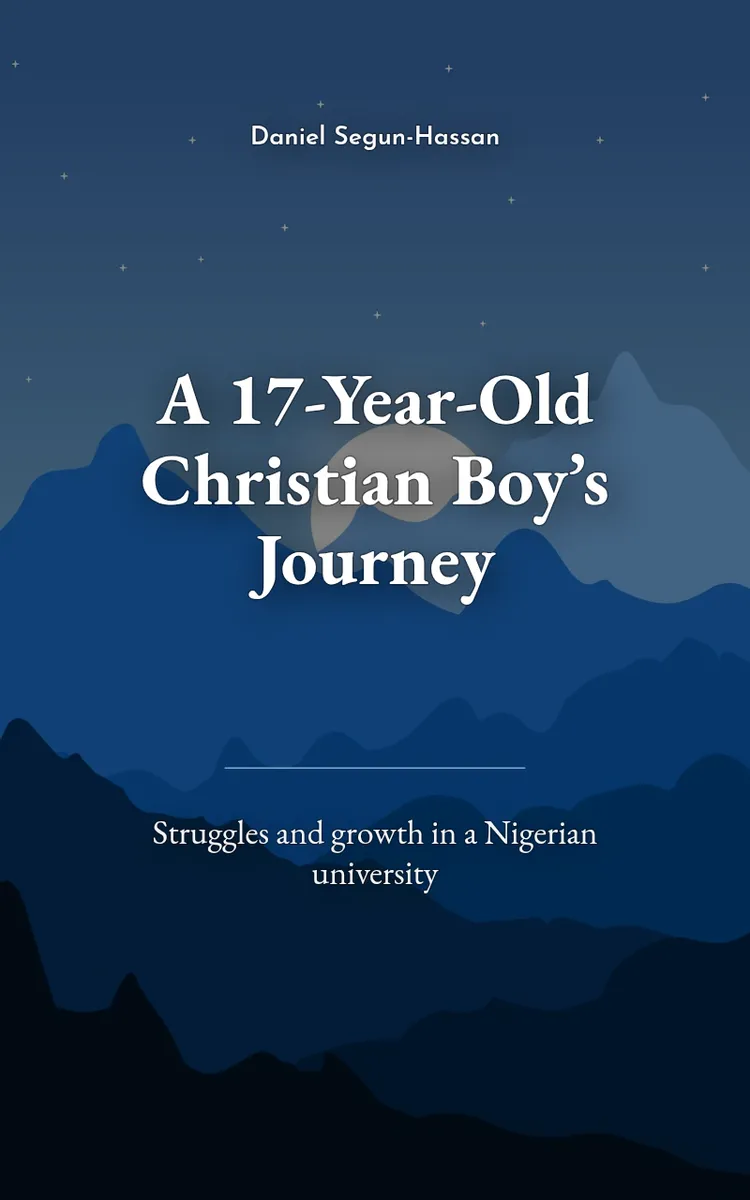

Read the first chapter
The whole of chapter one, free. About 12 min. Turn the pages with the arrows, your keyboard, or a swipe.
Chapter 1
Freshman Faith Under Pressure
The first thing Tobi heard on campus was the generator’s cough — steady, metallic, and stubborn — before the morning sun even cleared the edge of the hostel roof. Somewhere nearby a tap ran with a thin hiss, and the air carried fried akara from a kiosk that had no business being that early. He stood just outside the gate, one strap of his bag cutting into his shoulder, and watched new students drift in like a tide. Boys in crisp shirts argued over directions to the faculty offices. Girls laughed too loudly, as if volume could keep fear away. Tobi swallowed the dryness in his throat and tightened his grip on the small Bible he’d packed in his bag like a passport.
His mother had hugged him at dawn, her wrapper smelling faintly of camphor and pepper soup. “Don’t let them make you small,” she’d said, as if the university could shrink him by force. Now the campus noise pressed against his ears, and the heat rose from the ground in wavering waves. He could almost feel the old life fall behind him — the church youth programme, the familiar sanctuary coolness, the way prayers used to land softly in his chest. Here, everything sounded louder than his faith.
A man in a blue vest walked past with a clipboard and a whistle that hung around his neck like a threat. “Freshers! Move with your department!” he called, and the word freshers sounded like a label on a product. Tobi adjusted his bag and hurried after a stream of students toward the administrative block. His phone buzzed with a message from his admission group: Meet at the faculty portal by 8am. Don’t be late. He checked the time again. 7:41. His stomach tightened, not from lateness alone, but from the fear that if he missed something small, he would miss everything.
He wanted this day to feel like a beginning, not a test. He wanted to walk into his first lecture hall and not act like someone who had been admitted by mistake. When he pictured himself in classes, he saw himself raising his hand confidently, taking notes neatly, and going back to his room to pray without shame. That picture was bright in his mind, and he held it close as he followed the crowd past posters plastered on walls — some about student elections, others about “freshers’ week” parties that promised music until late at night.
At the faculty portal, a long line of students stood beneath a ceiling fan that never turned fast enough. The air smelled of sweat and paper dust. Tobi joined the back of the queue, his Bible tapping lightly against the side of his bag each time he shifted his weight. A boy ahead of him wore a wristwatch too big for his arm and kept checking his reflection in a glass panel. When Tobi glanced at him, the boy noticed and smirked.
“You dey early?” the boy asked, voice dripping with amusement.
“Just trying to be on time,” Tobi answered, keeping his tone calm. He didn’t want to fight this new place with defensiveness.
The smirk widened. “On time no mean anything. Na God go help you. That one you carry?” He jerked his chin at Tobi’s bag.
Tobi’s fingers tightened around the strap. “It’s my Bible.”
“Abi,” the boy said, leaning closer as if sharing a secret. “I like your confidence. But make you no carry am go class come write like pastor. Lecturers no dey respect that thing.” He turned away before Tobi could reply, already absorbed in someone else’s conversation.
Heat climbed Tobi’s neck. He wanted to say, God can handle academics. He wanted to say, My faith isn’t decoration. But the truth was, even as he stood in the line, he felt his faith wobble under the pressure of being watched.
When his turn came, the officer behind the desk barely looked up. “Name?”
“Tobi Adeyemi.”
“Course?”
“Computer Science.”
The officer’s pen scratched across paper. “O level?”
Tobi answered smoothly, reciting numbers he’d memorised during long nights. The officer stamped his form with a thick thud, then slid it across. “Go to the Department. Next.”
Tobi stepped away into the corridor, relief flooding him for a few seconds. Then the corridor swallowed him again. Students walked past in groups, their laughter sharp and quick. A poster by the stairs advertised a church event for later in the week — he noticed it like a lifeline — and beside it another poster for a “welcome party” with a photo of people dressed in shiny outfits. The contrast made his chest tighten. He wondered how those two things would fit together. He wondered if he would have to choose.
At the Department office, the lecturer on duty was a thin man with gold-rimmed spectacles. He spoke fast and didn’t smile much. Tobi listened, trying to catch everything. When the lecturer asked for a quick introduction, Tobi stood, palms slightly damp.
“My name is Tobi Adeyemi. I’m from Lagos State. I-”
The lecturer cut in. “Christian? Muslim? Mention it later. We don’t need religion here.”
The words landed like stones. Tobi blinked once, confused by the bluntness. Before he could recover, another student — tall, broad-shouldered — laughed softly in a way that made the sound travel.
Tobi forced himself to continue. “I’m interested in-”
The tall student leaned toward him, whispering just loud enough for nearby ears. “You go survive this place? Make you no start preaching for tutorial class.”
Tobi swallowed. He wanted to show he could handle it, but his tongue felt thick. He finished his introduction with a few sentences that sounded smaller than he intended. When he sat down, he felt the eyes of strangers on his back like heat.
After the meeting, he found himself outside the lecture theatre, waiting for the timetable to show on a screen. The loudspeaker crackled and a student leader’s voice floated across the courtyard. “Freshers! Tonight is welcome party. Dress well. No dulling. Come and have fun!”
Tobi imagined his room later: the small mattress, the thin blanket that wouldn’t keep out the cold at night, the Bible he’d promised himself he’d read daily. He imagined skipping church service because he didn’t want to be the only one left behind. He imagined joining in late-night laughter because it would be easier than staying quiet.
The fear wasn’t just of failing academically. It was of losing himself in the process of letting the university’s noise drown out the voice he recognised as God.
He checked his phone again. A message from his church friend in the city: How far? Are you settling? Don’t let the pressure shake you. Tobi stared at the words until the screen dimmed. Pressure. Shake. Lose footing. He understood those words too well.
A boy who’d been standing near him stepped closer, holding a plastic bag of groundnuts. “Wetin you dey think?” he asked.
“Just… thinking,” Tobi said.
The boy laughed. “Na thinking keep people for wrong place. You go join us for party tonight?” He waved the bag slightly. “Come. We go take pictures, chop, dance. No wahala.”
Tobi hesitated. “I have to-”
“Church?” the boy interrupted, like he already knew the answer.
Tobi nodded, feeling exposed.
The boy’s eyes flicked over him with mock curiosity. “You sabi talk. But you go manage night? You go manage noise? You go manage when people dey tease you?” He popped a groundnut into his mouth, chewing loudly. “Some Christians for here dey pretend. By second week, na you go start doing what others do. You just dey behave like say school no go test you.”
Tobi’s cheeks burned. He wanted to leave, but his feet stayed. He imagined what it would feel like to be teased every time he refused. He imagined walking into lectures the next day with a dull mind, because he’d stayed up. He imagined the guilt that would follow, not because he wanted to sin, but because he couldn’t bear being misunderstood.
His Bible inside his bag felt heavier. He pulled it out, not to wave it, but to hold something solid. The leather cover was warm from his body.
“I don’t want to pretend,” he said quietly. “And I don’t want to be tired in my spirit.”
The boy snorted. “Spirit? Your spirit go survive party. Na academic make sense, not Bible. You go see.”
Tobi wanted to argue. He wanted to tell the boy that his faith wasn’t a decoration. But he also knew arguing would only make him look like he was trying to win. His stomach tightened with the fear of failing at both academics and faith.
The loudspeaker crackled again. “All freshers for Computer Science should report to Lecture Hall B for orientation.”
Tobi turned toward the hall with a sudden urgency, as if the announcement had dragged him by the sleeve. Inside, the air was cooler but smelled of dust and old chalk. Students filled seats quickly, talking over one another until the lecturer arrived. Tobi slid into a row near the front, trying to keep his posture straight.
When the lecturer began, he wrote on the board with fast strokes. The pen squeaked across the surface. “First, pay attention. Second, don’t miss lectures. Third…” He listed requirements quickly, and the words blurred into a storm of terms Tobi didn’t fully grasp. His mind scrambled to keep up. He copied what he could, but the chalk dust made his eyes sting.
Halfway through, he caught himself staring at the board without understanding. His pen moved, but his thoughts drifted to the welcome party poster outside, to the boy’s laughter, to the lecturer’s comment about religion. The moment he noticed the drift, shame rose in him like nausea.
He tried to pray silently under his breath, forming words without sound: God, help me. Strengthen me. Let me not lose my spiritual footing.
But the classroom noise swallowed his prayer, and his fear returned louder than before. What if his faith couldn’t compete with academic pressure? What if he were only strong when things were easy?
At the break, he stepped outside into the corridor and leaned against the wall. The sun hit his face through the open windows. His skin felt too warm. He opened his Bible to a familiar passage, the pages falling into place like they had been waiting for his hands. He read a line, then lost it again because his mind kept replaying the tall student’s whisper: You go survive this place?
A girl passing by glanced at his Bible and slowed. “You still dey read?” she asked, not unkindly.
“Yes,” Tobi said.
She nodded. “Good. I’m in Business Admin. Some people don’t like it, but e no go kill you.” She shrugged like she’d learned to carry it lightly. “My roommate said we should come party tonight. But I told her I’m going for fellowship after orientation. She called me ‘holy girl’ like it’s an insult.”
Tobi let out a breath he didn’t know he was holding. “It’s not easy, though.”
“Na true,” she said. “But if you no hold your stand, everybody go push you.”
Her words settled in him, gentle but firm. He looked down at the Bible again. For a moment, the fear didn’t disappear, but it no longer felt like the only voice.
When the lecturer called everyone back, Tobi returned to his seat and forced his mind to follow the lesson. The chalk squeaked again. This time, when he didn’t understand a line, he didn’t freeze. He wrote down the question in the margin and waited until the lecturer allowed students to ask.
After class, instead of joining the crowd to go wherever the loudest group went, Tobi walked toward the notice board he’d seen earlier. His feet moved with intention, not escape. He scanned the posted events until he found the church fellowship time. He circled it with a pen from his bag. Then he turned and headed toward the hostel direction, the heat pressing on his shoulders.
On the way, the tall student caught up to him near the parking lot where a generator hummed and a group of boys were already talking about party music. “Oya,” the tall student said, eyes narrowing. “You no go come? You still want to be saint?”
Tobi didn’t stop walking, but he slowed enough to face him. “I’m going for fellowship.”
The tall student scoffed. “Fellowship? Tomorrow na test. You want come listen to nonsense while other people enjoy themselves?”
Tobi’s throat tightened. The words sounded reasonable in a dangerous way. He could almost feel the temptation to trade fellowship for comfort. To be liked. To blend. But he remembered the feeling in the classroom when he couldn’t hold his mind steady, and how prayer had been a lifeline even when he felt weak.
“I don’t want to enjoy and then wake up empty,” he said. His voice surprised him with its steadiness.
The tall student stared at him for a second, then laughed. “See you tomorrow. If you fail, don’t come cry.”
Tobi kept walking. The ground beneath his slippers was dusty, and the sun made the air shimmer. His heart beat faster as he reached the hostel gate. Inside, the corridor smelled of bleach and sweat. Boys shouted greetings that held a challenge in the tone. He found his room number, pushed the door open, and was hit by stale air and the faint smell of someone’s cologne.
His roommate wasn’t in yet, but a radio somewhere down the hall was already playing a song with heavy bass. Tobi sat on the edge of his bed and placed his bag carefully, like he didn’t want to disturb something sacred. The Bible lay open on his lap again. His hands trembled slightly, not from cold, but from the effort of choosing.
He looked at the poster he’d circled in his notebook. Tonight’s party. Tomorrow’s orientation. Tests that would arrive like footsteps in the dark. He could feel the pressure building, the way water gathers behind a dam.
He closed the Bible, then opened it again, searching for the words he needed. When he found them, he didn’t read fast. He read slowly, letting each sentence land. His fear didn’t vanish, but it shifted — less like a monster and more like a weight he could carry with God’s help.
From the window, he heard laughter rising from the courtyard and the thud of music. The sound was tempting, but it also felt far away, as if it belonged to a different life.
Tobi stood, pulled out his notebook, and wrote his class notes neatly while the radio’s bass pulsed through the walls. When his hand cramped, he paused and prayed again, shorter this time, honest. He wasn’t trying to sound holy. He was asking to stay.
By the time the room quieted enough for him to hear his own breathing, his doubts had not disappeared. They sat with him, stubborn and real. Still, he had done one thing the fear wanted to steal from him: he had chosen fellowship over applause, prayer over pretending.
He lay down with the Bible beside him, listening to the distant sound of students celebrating somewhere outside. For the first time since he arrived, the celebration didn’t feel like a threat. It felt like a test he was willing to walk into tomorrow — God first, even when his mind shook.
End of chapter one. 4 more chapters in the full book.
Swipe or use the arrows to turn the page

What's inside: 5 chapters
- 1. Freshman Faith Under Pressure
- 2. When Lectures Make Him Doubt
- 3. The Roommates’ Pull Toward Sin
- 4. A Broken Promise and Real Repentance
- 5. Graduating to Courage in Christ
About this book
"A 17-Year-Old Christian Boy’s Journey" is a fiction book by Daniel Segun-Hassan with 5 chapters and approximately 13,171 words. A 17-year-old Christian boy overcomes university struggles.
This book was created using Inkfluence AI, an AI-powered book generation platform that helps authors write, design, and publish complete books. It was made with the AI Novel Writer.
Frequently Asked Questions
What is "A 17-Year-Old Christian Boy’s Journey" about?
A 17-year-old Christian boy overcomes university struggles
How many chapters are in "A 17-Year-Old Christian Boy’s Journey"?
The book contains 5 chapters and approximately 13,171 words. Topics covered include Freshman Faith Under Pressure, When Lectures Make Him Doubt, The Roommates’ Pull Toward Sin, A Broken Promise and Real Repentance, and more.
Who wrote "A 17-Year-Old Christian Boy’s Journey"?
This book was written by Daniel Segun-Hassan and created using Inkfluence AI, an AI book generation platform that helps authors write, design, and publish books.
How can I create a similar fiction book?
You can create your own fiction book using Inkfluence AI. Describe your idea, choose your style, and the AI writes the full book for you. It's free to start.
Write your own fiction book with AI
Describe your idea and Inkfluence writes the whole thing. Free to start.
Start writingCreated with Inkfluence AI


