
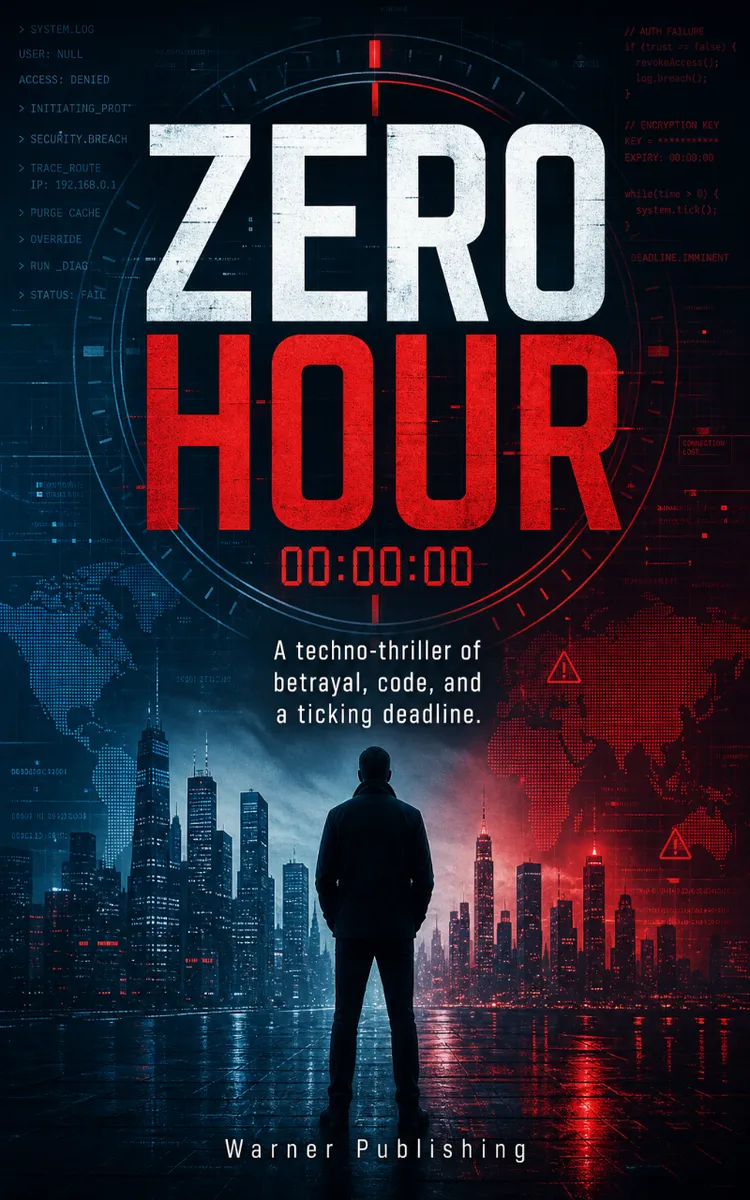

Read the first chapter
The whole of chapter one, free. About 9 min. Turn the pages with the arrows, your keyboard, or a swipe.
Chapter 1
The Message From Marcus Kane
The phone on Marcus Kane’s floor began vibrating at 3:17 a.m., walking itself in short, angry circles across the hardwood.
He woke before the second buzz. Years of conditioning had left him with a nervous system that treated silence as a warning and electronics as potential weapons. The apartment was dark except for the blue pulse beneath his desk, where his laptop had powered itself on.
Marcus reached for the pistol taped beneath the mattress.
The phone stopped.
On the laptop screen, a black window waited over the locked desktop. No logo. No cursor. Just a line of white text.
MARCUS - DO NOT CALL ANYONE UNTIL YOU VERIFY THE ROOM.
He slid from the bed, bare feet meeting cold floorboards. The pistol stayed low in his hand as he checked the bedroom, bathroom, kitchen, and narrow hallway. Nothing moved. The deadbolt was still thrown. The chain hung undisturbed.
Washington slept beyond the windows, its streetlights washing the apartment walls in a dull amber. Somewhere below, a delivery truck groaned through an intersection.
He returned to the desk and studied the screen.
“Verify the room,” he murmured.
The command was familiar. Not the words, but the structure. Whoever had written it knew how he worked.
He unplugged the router first, then the modem. The laptop remained lit. Its battery indicator showed seventy-eight percent. He checked the apartment’s smart thermostat, the television, the old tablet he used only for banking, and the cheap digital clock beside the bed.
All were displaying the same time.
3:18.
The laptop chimed.
A file appeared on the desktop. Its name was a string of hexadecimal characters followed by a timestamp: 20260905T031700Z.
Marcus didn’t touch it. He photographed the screen with a second phone, then pulled the battery from that one too. The laptop’s wireless indicator was off. The file had arrived through a channel that should not have existed.
He opened the system logs. The record showed a local process had mounted an encrypted volume at 3:16:42. The process had then erased itself.
Clean work. Too clean.
Marcus had spent twelve years inside intelligence services learning that perfect traces were usually fingerprints left by someone who wanted credit. He had spent the last three learning not to trust his own instincts when sleep-deprived, angry, or reminded of Nadia Cross.
The file opened with a passphrase prompt.
He typed the first phrase that came to mind: a street in Prague, a year, and a name he had not spoken aloud since the extraction went bad.
The file decrypted.
A document filled the screen.
Marcus,
If this reaches you, the first layer held. You have forty-eight hours until the attack.
Do not go to the authorities. Do not contact Elias Grant. Find the source in your apartment. The first clue is beneath the place where you kept the photograph of David.
The signature waited below.
MARCUS KANE
He stared at it until the letters blurred.
Then he looked toward the living room.
The photograph of David had been in a silver frame on the bookshelf, taken when they were boys at the Chesapeake shoreline. David had been fourteen, grinning through a split lip after Marcus taught him how to throw a punch. Their father had taken the picture. Marcus had kept it through three deployments, two identities, and the quiet wreckage afterward.
He crossed the room without turning on the lights.
The frame was still on the shelf.
He lifted it. Dust marked the wood beneath, but the back was clean. The photograph slid free. A thin black memory card had been taped into the frame’s cardboard backing.
Marcus’s hand tightened around the pistol.
The card was the size of a fingernail. No label. No manufacturer mark.
His first thought was that the message had been planted by someone who had entered the apartment. His second was worse: someone had known where he kept the photograph and had counted on him finding the card.
He carried the frame to the kitchen, placed it on the counter, and pulled a forensic reader from the drawer beneath the sink. He had bought it after a surveillance team spent three weeks using his own television as a listening post. The device was isolated, air-gapped, and ugly enough to discourage casual use.
The card contained one encrypted archive.
Its creation date was three years old.
Marcus stared at the metadata. Three years ago, he had still been working under Grant. Three years ago, Nadia had walked out of his life after telling him he had become indistinguishable from the people he hunted.
He inserted the card into the reader.
A second screen opened.
A map appeared, centered on Washington, D.C. A red marker pulsed over his apartment building. Beneath it, a countdown began.
47:59:12
The seconds moved.
Marcus felt the room contract around him.
He checked the archive’s encryption signature. It used a key derived from an old internal system, one he had helped design before leaving government service. The key had never been public. It was not stored on any of his current devices.
He copied the archive to a clean drive and shut down the reader.
His phone vibrated from the bedroom.
Marcus froze.
The phone had no battery.
The vibration came again, sharper this time. He moved through the apartment with the pistol raised and found the device lying on the floor beside the bed. Its battery was still removed. The sound came from the laptop.
A new line had appeared.
YOU HAVE NINE MINUTES BEFORE THEY KNOW YOU OPENED IT.
He checked the apartment door. No sound in the corridor. He checked the windows. The fire escape below was empty, slick with night rain.
A notification appeared in the corner of the screen. His own email account had sent a message to an address at the Department of Homeland Security. The subject line read: ATTACK WINDOW CONFIRMED.
The attachment was the encrypted file.
Marcus opened the sent-mail record. It showed his credentials, his signature certificate, and an originating address assigned to the apartment’s internet connection.
Someone had built a trail that led directly to him.
He reached for the router, remembered it was unplugged, and looked at the laptop again. The local clock had changed to 3:22.
Nine minutes had become five.
A knock sounded at the door.
Three taps. Evenly spaced.
Marcus moved behind the wall beside the entrance. The pistol sight settled toward the peephole.
“Who is it?”
No answer.
He waited. The apartment seemed to amplify every small sound: water ticking through the radiator, tires hissing on wet pavement, the faint electrical whine from the laptop.
Another three taps.
Marcus approached the door and looked through the peephole.
The corridor was empty.
He opened the door a fraction, keeping the chain engaged. A brown envelope lay on the mat. No stamp. No name.
He pulled it inside with the barrel of the pistol and shut the door.
The envelope contained a single sheet of paper and a brass key.
The paper carried one sentence in block capitals.
THE SOURCE IS NOT IN THE NETWORK.
Marcus turned the key over. A number had been scratched into its head: 4B.
His apartment was 6C.
He went to the utility closet and examined the building directory taped inside the door. Apartment 4B had been vacant for eight months, according to the faded list. Marcus had never noticed. He had never had reason to.
A soft click came from the laptop.
The countdown vanished. In its place appeared a photograph.
David, older now, standing outside a train station in Baltimore. The image had been taken from across the street. David was looking over his shoulder, unaware of the camera.
Marcus’s throat tightened.
A second line appeared beneath the photograph.
THE ATTACK WILL BEGIN IN FORTY-EIGHT HOURS. THE TARGET MOVES THROUGH THREE INTERNATIONAL LOCATIONS. STOP THE FIRST HANDOFF, NOT THE LAST.
He picked up his phone battery and slid it into place. The screen lit with missed alerts. His email account had sent the warning to three government addresses and one private address belonging to Nadia Cross.
Marcus called her.
She answered on the first ring.
“Tell me you didn’t open it,” Nadia said.
Her voice was rough with sleep, but the fear beneath it was awake.
“You sent me a message.”
“I received one from you.”
“I didn’t send it.”
“That’s what I assumed until I checked the certificate.” A pause. Keys clicked in the background. “It’s signed with your old operational credential.”
“That credential was revoked.”
“Revoked by whom?”
Marcus looked at the brass key in his palm.
“Elias Grant.”
Nadia stopped typing.
“Marcus, listen to me. The message is using a valid chain. Not just your credential. It’s referencing a certificate authority that was decommissioned after the Prague operation.”
“I know.”
“How?”
“Because I built the validation layer.”
Silence stretched between them.
“Is the warning real?” he asked.
“I’m correlating the timestamps now. Don’t move anything else in the apartment.”
“Too late.”
“What did you find?”
“A key to 4B. And a photograph of David taken tonight.”
Nadia swore under her breath. “Leave. Now.”
“If someone is watching the building - ”
“They already know you opened the file. The outgoing email gave them that.”
Marcus looked at the door. The hallway beyond it remained still.
“Can you trace the source?”
“Not from here. Whoever did this bounced the traffic through your own hardware, then staged the email locally. But the archive has a creation timestamp from three years ago.”
“So it was prepared in advance.”
“Or backdated.”
“Can you tell which?”
“I can tell you in ten minutes.”
“We have less than forty-eight hours.”
“Forty-seven hours and fifty-two minutes,” Nadia said. “And Marcus?”
“What?”
“If this is a trap, it’s built around your habits. If it isn’t, someone has been planning for you to receive it.”
He glanced at the screen. The last line remained beneath David’s photograph.
THE FIRST SOURCE IS BELOW YOU.
A sound came through the wall.
Not from the corridor.
From somewhere beneath the apartment.
Metal scraped against metal. Then came a muffled thud, followed by the brief whine of a power tool.
Marcus took the key.
“Where are you going?” Nadia asked.
“To 4B.”
“That’s below you.”
“I know.”
“Marcus, wait for me.”
He opened the apartment door and stepped into the corridor, pistol concealed beneath his jacket. The elevator display showed it descending from the sixth floor.
Someone had called it from below.
He took the stairs.
By the time he reached the fourth floor, the elevator doors opened behind him with a soft chime. Marcus turned, expecting a face.
No one stood inside.
The door to 4B was ajar.
He pushed it open.
The apartment was empty except for a folding table, a monitor, and a camera aimed directly at the entrance. On the monitor, his own apartment appeared from above, every room visible through hidden angles.
The camera feed showed Marcus standing in 4B.
A message blinked beneath the image.
AUTHENTICITY CONFIRMED.
Then the monitor displayed a detail no one outside his family should have known: the Chesapeake photograph had not been taken by their father.
It had been taken by Marcus himself, using a disposable camera he had stolen from an embassy safe during his first field assignment. He had never told David. He had never told Nadia. He had never recorded it in any file.
The message continued.
YOU REMEMBER THE WRONG PERSON TAKING THE PHOTOGRAPH. THAT IS WHY THEY CHOSE IT.
Marcus stepped closer to the monitor.
A second countdown appeared.
47:48:03.
He had found the source.
The source had found him first.
End of chapter one. 37 more chapters in the full book.
Swipe or use the arrows to turn the page


What's inside: 38 chapters
- 1. The Message From Marcus Kane
- 2. The Clockwork Timeline Check
- 3. Nadia’s Dead Drop Key
- 4. The Burner Phone That Calls Back
- 5. Rotterdam Port, Hidden Access
- 6. The Empty Container’s Malware Trace
- 7. High-Speed Run Through Dock Cameras
- 8. Nadia Spots the Pivot Domain
- 9. Elias Grant’s Call to Silence
- 10. The Meeting Room With No Exit
- 11. The Stranger’s Handshake Code
- 12. Marcus Kane Framed in Public Records
- 13. David Kane’s Unexpected Contact
- 14. The Relay That Shouldn’t Exist
- 15. Eidolon Systems’ Fake Clean Room
- 16. The Payload Moved Again
- 17. Marcus Kane Becomes a Person of Interest
- 18. Nadia Cross’s Rescue That Fails
- 19. The Architect Leaves a Breadcrumb
- 20. A Chase Through the Berlin Server Vault
- 21. Marcus’s Confession Offer
- 22. The Convoy That Vanishes From Maps
- 23. Satellite Link to Nadia’s Counterplan
- 24. The Global Node List
- 25. David Kane’s Relay Room
- 26. Marcus Cuts the Wrong Wire
- 27. The Architect’s Identity Hint
- 28. Eidolon Team Lead’s Vanishing Laptop
- 29. Marcus Kane Hits the Bottom
- 30. Breaking Into Transit Control
- 31. Token Theft From the Contractor Van
- 32. The Countdown Mode Trap
- 33. The Third-Act Twist: Elias’s Signature
- 34. Marcus Kane Chooses the Lesser Disaster
- 35. Controlled Shutdown on the Live Grid
- 36. Nadia Cross Clears Marcus Kane
- 37. The Architect’s Final Broadcast
- 38. Zero Hour, Self-Authored Logic
About this book
"Zero Hour" is a fiction book by Warner Publishing with 38 chapters and approximately 70,066 words. A message at 3:17 a.m.
This book was created using Inkfluence AI, an AI-powered book generation platform that helps authors write, design, and publish complete books. It was made with the AI Novel Writer.
Frequently Asked Questions
What is "Zero Hour" about?
A message at 3:17 a.m. tells Marcus Kane not to call anyone until he verifies the room. Then his laptop boots itself, his apartment goes quiet, and someone else is already inside his timeline. Marcus is a retired intelligence officer, but the instructions are written in the language only he understands. When Nadia pulls him into a secure lab and a dead-drop key points to a cache that may be watching, the clock stops being metaphor and starts being lethal. Every choice tightens the net, every delay costs seconds, and the next twist could be the one that proves the attack is not the only thing they planned. Read now, before the next “verify” becomes your last.
How many chapters are in "Zero Hour"?
The book contains 38 chapters and approximately 70,066 words. Topics covered include The Message From Marcus Kane, The Clockwork Timeline Check, Nadia’s Dead Drop Key, The Burner Phone That Calls Back, and more.
Who wrote "Zero Hour"?
This book was written by Warner Publishing and created using Inkfluence AI, an AI book generation platform that helps authors write, design, and publish books.
How can I create a similar fiction book?
You can create your own fiction book using Inkfluence AI. Describe your idea, choose your style, and the AI writes the full book for you. It's free to start.
Write your own fiction book with AI
Describe your idea and Inkfluence writes the whole thing. Free to start.
Start writingCreated with Inkfluence AI


