
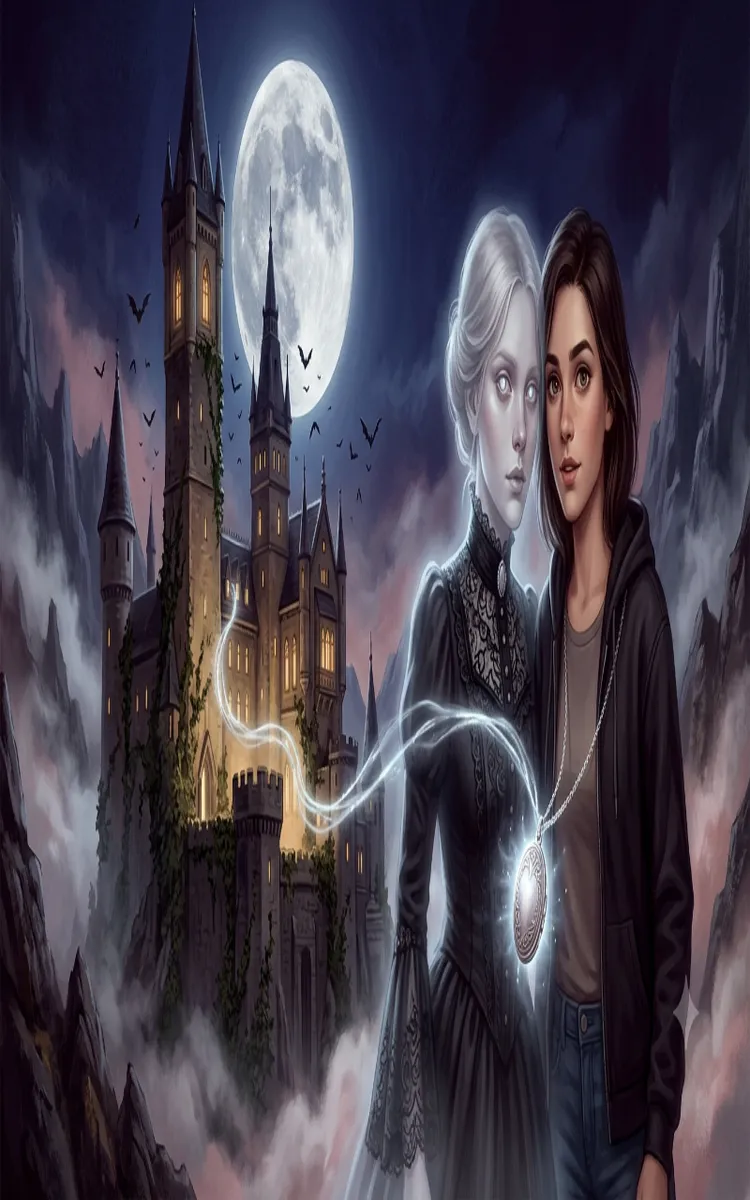
Read the first chapter
The whole of chapter one, free. About 10 min. Turn the pages with the arrows, your keyboard, or a swipe.
Chapter 1
The House of Echoes
The van’s tires struck the last strip of broken road, and Patricia’s phone lost its signal.
One gray bar flickered above the screen, then vanished as the wild mountains of Transylvania rose around them. Pines crowded the slopes like dark bristles. Beyond them, stone peaks cut into a pale October sky.
Her father tightened both hands on the steering wheel.
“We’re going home.”
Patricia looked up from the message she had been trying to send. “Home?”
“Yes.”
“Dad, we’ve never even seen this house.”
“That doesn’t make it less ours.”
“It’s been empty since - what, forever?”
“Since 1897, actually.”
He said it as if he were announcing the age of a bottle of milk. Then he reached beside his seat and lifted a leather journal from a canvas bag. The cover was cracked, the corners worn smooth by hands long gone.
Patricia stared at it. “You brought that?”
“I brought several things.”
“Such as?”
“Clothes. Food. A flashlight.”
“Chargers?”
His silence lasted half a second too long.
“Dad.”
He smiled at the road. “There may be electricity.”
“That wasn’t my question.”
The van rounded a bend, and the house appeared between the trees.
Patricia’s complaint died before it reached her mouth.
The Varga house stood on a rise above the road, tall and narrow, its stone walls nearly black beneath the wet sky. Two pointed towers framed the roof. Ivy climbed across the upper windows, and iron balconies curled out from the second floor like frozen vines. A weather vane shaped like a crow turned slowly overhead, though the trees below barely moved.
No lights shone behind the glass.
Patricia pressed her palm against the cold window. “That’s not a house.”
“It has rooms.”
“It has a face.”
Her father parked beside a collapsed stone wall and switched off the engine. For a moment, the only sound was the ticking of the cooling van.
Then something tapped the window behind Patricia.
She spun around.
Nothing waited outside except a branch scraping over the glass.
“Very funny,” she said.
Her father opened his door. “I didn’t do it.”
“That’s exactly what someone who did it would say.”
“Come on. Help me with the bags.”
The gravel shifted beneath Patricia’s boots as she climbed out. Cold slipped through her jacket at once. The mountains seemed closer on foot, their slopes disappearing into low clouds. Somewhere deep in the forest, a bird called once and stopped.
Her father carried two suitcases toward the house. Patricia dragged the third behind him, its wheels catching on stones.
“You said we were visiting,” she called. “Visiting means three days. Maybe four. It does not mean moving into a haunted fortress.”
“Temporary relocation.”
“That sounds worse.”
“Your school is online for the rest of the term.”
“Because you decided to take a research leave.”
“Because the university approved it.”
“Because you asked.”
He glanced back at her. “You’re sixteen. You can survive a little inconvenience.”
“I survived turning sixteen last week. I don’t think I should be punished for it.”
His expression softened, but only briefly. “This matters, Patricia.”
She knew that tone. It was the voice he used when speaking about family documents, vanished relatives, and locked archive rooms. It was the reason their apartment contained more old papers than photographs.
“What matters?” she asked.
He looked toward the house.
“Finding out what happened here.”
The front door groaned when he pushed it open. Dust lifted from the threshold and spun through the air. Inside, the entrance hall stretched beneath a ceiling painted with faded gold stars. A grand staircase rose along one wall, its banister polished in places by countless hands. Portraits watched from the paneling.
Patricia stopped just inside.
The largest portrait showed a girl in a high-necked black dress. She stood beside a stone balustrade, one hand resting on a closed book. Her face was turned slightly away, but Patricia could see the pale oval of it, the dark braid over one shoulder.
The girl’s eyes seemed fixed on the doorway.
Patricia shifted left.
The eyes seemed to follow.
“Dad.”
“Hmm?”
“Who is she?”
He set the bags down and studied the portrait. The leather journal hung from his fingers.
“That may be Stella.”
The name touched something inside Patricia - not recognition, exactly. More like a word heard through a wall.
“May be?”
“She was part of the family history.”
“What kind of part?”
He opened the journal, but the pages were too dark to read in the hall’s weak light. “A complicated one.”
“That’s your favorite kind.”
“Usually.”
“Was she the reason the house was abandoned?”
His fingers tightened around the journal. “Not the only reason.”
Before Patricia could ask what that meant, a door slammed somewhere above them.
The sound rolled through the house and came back thinner, farther away.
Patricia grabbed the handle of her suitcase. “Tell me that was a window.”
“It was probably a door.”
“Much better.”
Her father took a flashlight from his coat pocket. “The place has been closed for more than a century. Things shift.”
“Doors don’t shift.”
“Wood does.”
“Wood also doesn’t slam itself.”
He clicked on the flashlight. The beam trembled slightly over the staircase.
Patricia noticed.
“You’re nervous,” she said.
“I’m cold.”
“You’re holding the flashlight upside down.”
He looked at it, turned it around, and cleared his throat. “The library is through there.”
“Of course it is.”
The room beyond the archway was enormous. Shelves filled every wall, climbing nearly to the ceiling. Books leaned against one another in sagging rows, their spines cracked and faded. A rolling ladder stood beneath a web of dust. The air smelled of paper, dry wood, and something floral buried beneath both.
Her father moved toward the nearest shelf with sudden purpose.
Patricia dropped her suitcase beside a velvet chair. “I’m going to find my room.”
“Second floor, left corridor. The room with the blue curtains.”
“Do the curtains still exist?”
“I saw them in the inventory.”
“That is not reassuring.”
He pulled a book from the shelf. A cloud of dust burst into his face.
Patricia laughed despite herself.
He coughed. “Thousands of books.”
“Zero chargers.”
“I said I was sorry.”
“You said, ‘Digital detox.’”
“It’s good for us.”
“It’s a punishment with better branding.”
Her phone vibrated in her hand. She looked down quickly, hopeful.
No signal. The screen showed only the time: 4:17 p.m.
She lifted it toward the ceiling.
Nothing.
“Maybe upstairs,” she muttered.
The house gave a long, low creak.
Patricia looked at the dark archway behind her. “This place is listening.”
“Buildings don’t listen.”
“Then why did it creak right after I said that?”
“Coincidence.”
“Convenient.”
She picked up her suitcase and headed for the staircase.
The first step dipped beneath her weight. The second groaned. On the third, a cold draft slid over her ankles.
Patricia glanced down.
The wood was carved with a pattern of twisting vines. Near the edge of one step, someone had scratched a single letter into the varnish.
S.
She brushed her thumb over it. The mark was old, but the cut beneath it looked strangely clean.
“Dad?” she called.
“What?”
“Who was Stella?”
The library fell quiet.
When he answered, his voice had lost its teasing edge.
“She was seventeen when she came here.”
“Here?”
“Not exactly here. The family stayed at Hotel Transylvania in 1897. This house belonged to them, but it was empty by the time the year ended.”
Patricia turned on the staircase. “What happened?”
Her father closed the journal.
“No one knows.”
“That’s not true.”
He looked at her.
“People always know something,” she said. “They just don’t want to say it.”
For several seconds, neither of them moved.
Then he tucked the journal beneath his arm. “Unpack first. Investigate later.”
“That’s not an answer.”
“It’s the only one I have.”
He returned to the shelves.
Patricia climbed the stairs, listening to the soft drag of his footsteps below. The corridor above was colder than the hall. Dust filmed the floor, but a narrow line near the wall looked disturbed, as if something had passed through recently.
She followed it to the blue-curtained room.
The curtains were blue once. Now they hung gray and stiff, their hems brushing the floor. A narrow bed stood beneath the window. Beside it waited a wardrobe with a tarnished mirror.
Patricia set her suitcase down and opened it.
Her favorite hoodie lay on top, folded exactly as she had packed it. She pulled it on and sat on the bed. The mattress gave a tired sigh.
From somewhere inside the walls came a faint sound.
Not a creak.
A hum.
Patricia held still.
The melody had only three notes, soft and wavering, like someone humming from the bottom of a well.
She stood.
The sound stopped.
“Dad?” she called again.
No answer.
She stepped into the corridor. The house seemed larger now, the doors stretching away beneath the dim windows. At the far end, one stood open by a few inches.
Patricia walked toward it.
The hum returned.
She reached for the door.
A sudden gust rushed down the corridor, lifting her hair and snapping the curtains behind her. The door swung shut with a hard crack.
Patricia stumbled back.
For one breath, she saw a shape reflected in the glass of the nearest window: a girl in a dark dress, standing directly behind her.
Patricia spun.
The corridor was empty.
Her pulse hammered in her throat. She grabbed the doorknob and yanked the door open.
Inside was a small storage room filled with broken chairs, rolled carpets, and covered furniture. No girl. No hiding place.
Only a thin trail of dust disturbed near the back wall.
Patricia backed away.
“This is historical,” she whispered. “Old house. Old pipes. Old drafts.”
The words sounded weak in the corridor.
By evening, she had unpacked half her clothes, lost all hope of finding a signal, and learned that the kitchen faucet produced brown water for exactly three seconds before turning clear.
Her father had claimed the library as his office. He sat beneath a green-shaded lamp, reading the leather journal with a frown.
Patricia stood in the doorway. “I’m going to sleep.”
“Already?”
“There’s no Wi-Fi.”
“You have books.”
“I have a phone.”
“You have no signal.”
“I’m aware.”
He closed the journal. “Patricia, I know this isn’t what you wanted.”
“No, you’re right. I wanted a birthday dinner, a working phone, and walls that don’t make noises when I’m alone.”
“I’m sorry.”
The apology disarmed her.
She leaned against the doorframe. “Why did you bring me?”
His gaze moved to the journal.
“Because this family has spent a long time avoiding the truth.”
“What truth?”
“I don’t know yet.”
“That’s a terrible reason to drag me across an ocean.”
“You’re not being dragged.”
“I’m sixteen. I had to come with you.”
His mouth tightened. “I thought you deserved to know where you came from.”
Patricia looked past him at the shelves. The books rose into darkness, their titles too faded to read.
“I came from you.”
“Yes,” he said quietly. “But not only me.”
The house creaked overhead.
Neither of them spoke.
Her father opened the journal again. “Get some rest.”
Patricia turned away before he could see her expression. “If the ghost starts charging my phone, wake me.”
“I’ll ask politely.”
She climbed the stairs with her arms folded tight across her chest.
In her room, the moon had risen behind the clouds. Its weak light silvered the floorboards. Patricia changed into her hoodie and sat on the edge of the bed, staring at the window.
The glass rattled.
She told herself it was the wind.
The rattling became a sharp, violent bang.
Patricia stood.
The latch jumped.
Another bang shook the frame, and the window burst open. Cold air tore into the room, whipping the curtains toward the ceiling. The flame of the candle on the bedside table went out.
Patricia covered her face as grit and dead leaves flew past her.
Then the wind stopped.
The curtains fell.
On the outer sill lay a rose.
It was crimson, darker than any rose Patricia had ever seen, its petals smooth and perfect beneath a dusting of moonlight. No frost touched it. No leaf clung to its stem. A single thorn glistened near the base.
Patricia approached slowly.
Beyond the window, the mountains vanished into blackness.
She reached for the rose.
The moment her fingers closed around its stem, something moved far below in the trees.
Not a branch.
Not an animal.
A figure, standing where the road disappeared into the forest.
Patricia released the rose. It remained upright on the sill, untouched by the wind.
From the wall behind her came the three-note melody.
This time, beneath the hum, a voice whispered one word.
“Stella.”
End of chapter one. 4 more chapters in the full book.
Swipe or use the arrows to turn the page
What's inside: 5 chapters
- 1. The House of Echoes
- 2. Hotel Transylvania’s Crimson Invitation
- 3. A Heart Returns in the Silent Years
- 4. Silver Ink Names the Successor
- 5. Stella’s Grave Opens the Door
About this book
"The Vampire Of Transylvania" is a fiction book by Anonymous with 5 chapters and approximately 10,082 words. A teen discovers a centuries-old vampire legacy.
This book was created using Inkfluence AI, an AI-powered book generation platform that helps authors write, design, and publish complete books. It was made with the AI Novel Writer.
Frequently Asked Questions
What is "The Vampire Of Transylvania" about?
A teen discovers a centuries-old vampire legacy
How many chapters are in "The Vampire Of Transylvania"?
The book contains 5 chapters and approximately 10,082 words. Topics covered include The House of Echoes, Hotel Transylvania’s Crimson Invitation, A Heart Returns in the Silent Years, Silver Ink Names the Successor, and more.
Who wrote "The Vampire Of Transylvania"?
This book was written by Anonymous and created using Inkfluence AI, an AI book generation platform that helps authors write, design, and publish books.
How can I create a similar fiction book?
You can create your own fiction book using Inkfluence AI. Describe your idea, choose your style, and the AI writes the full book for you. It's free to start.
Write your own fiction book with AI
Describe your idea and Inkfluence writes the whole thing. Free to start.
Start writingCreated with Inkfluence AI


