

Read the first chapter
The whole of chapter one, free. About 9 min. Turn the pages with the arrows, your keyboard, or a swipe.
Chapter 1
Eleanor in the Forbidden Park
The teaspoon in Bernard’s hand struck the china cup just as the door to the communal lounge opened.
Arthur looked up from the plate of custard creams. Cyril stopped halfway through a sentence about the council’s latest planning notice. Beyond the windows, rain stitched the park into a grey blur, turning the paths to brown ribbons beneath the bare trees.
“David’s late,” Arthur said.
“He is a police constable,” Cyril replied. “They are trained to arrive after the interesting part.”
Bernard glanced at the clock above the television. Ten past eleven. Their monthly Thursday tea had begun at eleven precisely for the past three years, and David Miller had never been more than five minutes late. Bernard had been about to refill the pot and settle the argument over whether Richard Thorne’s proposed development would include “affordable” homes in any meaningful sense when the door opened again.
David stepped inside without removing his wet coat. Mud darkened the cuffs of his trousers. His face had the flat, careful look Bernard had seen on doctors delivering bad news.
Bernard put down the spoon.
“Sit down,” he said.
David did not sit. “I’m afraid I can’t stay for tea.”
Cyril pushed the biscuit plate aside. “That sounds ominous.”
Arthur’s fingers closed around the edge of the table. At seventy-three, he still had the habit of bracing himself before difficult information, as if expecting the floor to move. “What’s happened?”
David looked at Bernard first. It was a small thing, but Bernard noticed. Friends knew where to place their eyes when they had something painful to say.
“It’s Eleanor,” David said.
The room seemed to shrink around the four men. The radiator clicked beneath the window. Somewhere along the corridor, a trolley rattled over a threshold.
Bernard stood. “Is she ill?”
David’s mouth tightened. “Eleanor Valance is dead.”
For a moment none of them moved.
Cyril’s chair scraped sharply against the floor. “Dead?”
“I’m sorry.”
“How?” Arthur asked.
“We found her in the park.”
Bernard heard the words, but they refused to settle into sense. Eleanor did not go to the park. She disliked the uneven paths, complained about the mud, and had once described the woodland as “a damp trap for sensible footwear.” Her life ran between the library, the records room at the council offices, and the neat red-brick terraces of the sheltered scheme.
“She was in the park?” Bernard said.
David nodded. “Near the woodland boundary. A dog walker saw her shortly after nine.”
“Found her?” Cyril said. “Or found a body?”
“Cyril,” Bernard said quietly.
“No, I want the exact wording.”
David removed his cap and held it against his chest. “She was dead when we arrived.”
Arthur rose so quickly his chair bumped the table. Tea spilled into the saucer. “What happened to her?”
“I can’t discuss details.”
“You’ve just told us she’s dead.”
“And I’m telling you there’s an investigation.”
Bernard stepped around the table. His first instinct was to examine the facts as he would have examined a patient: establish what was known, what was assumed, and what required immediate attention. But the familiar method faltered when the patient was Eleanor, who had once kept a spare key to the library for him and never failed to correct Cyril’s dates.
“When did she die?” Bernard asked.
“We don’t know yet. The path is cordoned off. The scene examiner is on the way.”
“Where exactly?”
“Bernard.”
“I’m not asking to interfere. I want to understand where she was found.”
David’s gaze hardened. “You are asking because you want to go there.”
“I want to see the place.”
“You will do no such thing.”
Cyril leaned forward. “Why was she there?”
“That is what we’re trying to establish.”
“She never went there,” Arthur said. “Not voluntarily.”
David glanced towards the rain-blurred windows. “That much is clear.”
Bernard felt a coldness beneath his shirt collar. “Was she alone?”
“I can’t answer that.”
“Were there signs of a struggle?”
“Bernard.”
The warning was gentle, but firm. David had known him long enough to understand that firmness worked better than sympathy. Bernard also knew that David’s refusal concealed something more than professional caution.
“What do you need from us?” Bernard asked.
“For now, nothing. I wanted you to hear it from me before rumours began. You all knew Eleanor. You used the library. You were her friends.”
Cyril’s expression changed at that. The journalist in him remained, but grief had pushed it back. “She was working on something.”
David looked at him. “What do you mean?”
“She was distracted last week. Kept checking the door whenever anyone entered the reading room.”
Arthur folded his arms. “She told me the council archive had gaps.”
“What sort of gaps?” David asked.
Arthur hesitated.
Bernard saw the hesitation and understood that he was not the only one who had noticed Eleanor’s unease.
“She mentioned old land records,” Arthur said. “Plans, deeds, that sort of thing.”
“Did she say why?”
“No.”
Cyril gave a humourless laugh. “Eleanor did not waste information. She rationed it.”
David replaced his cap. “If either of you remembers anything useful, tell me. Not the other way round.”
“Where are you going?” Bernard asked.
“To the park.”
Bernard looked past him, towards the rain. The park lay beside the scheme, separated from the lounge windows by a low iron fence and a strip of sodden grass. He could see the yellow tape now, faint between the trees.
“I’ll come with you,” he said.
“No.”
“I can stay outside the cordon.”
“No.”
“If there is anything about her health - ”
“I know what you are trying to do.”
“And what is that?”
“Make yourself useful because you can’t bear not to be.”
The words landed cleanly. Bernard felt Arthur watching him. Cyril, too, had gone still.
David softened. “I’m sorry. But this is a crime scene, and you are not part of the investigation.”
Bernard looked at the untouched tea, the damp cap in David’s hands, and the park beyond the glass. His immediate wish had been simple: to understand how Eleanor had come to be there. Now even looking at the place had become a boundary he was forbidden to cross.
“I’ll stay clear,” he said.
David nodded, though he did not look convinced. “That would help.”
He turned towards the door.
“David,” Cyril called. “Was she killed there?”
David stopped.
The silence that followed was answer enough.
Then he said, “I can’t tell you that,” and left.
Arthur reached for his coat. “I’m going to see.”
“So am I,” Cyril said.
Bernard watched them move towards the door. Practicality told him to stop them. Friendship told him he would be no use alone in the lounge, staring at a cup of tea that had gone cold.
“Stay on the path,” he said. “Do not cross the tape.”
Arthur gave him a sideways look. “That sounded almost like an order.”
“It was advice.”
“From a retired doctor.”
“From the only one here who can still recognise a bad idea before it develops.”
Cyril opened the door. Wet air swept into the lounge, carrying the metallic smell of rain and the distant hiss of traffic. “Come along, then.”
They crossed the short lawn beneath three umbrellas, Arthur’s black, Cyril’s green, and Bernard’s old navy one with a broken rib. Mud sucked at their shoes near the fence. The park looked different from the other side: less like a pleasant patch of green and more like a place that had been caught concealing something.
Yellow police tape stretched between the railings and a tree trunk. Beyond it, the path disappeared into churned mud. Two uniformed officers stood near the woodland edge, their boots dark with clay. A white tent had been raised beneath the trees.
Bernard stopped at the tape.
“Here,” he said. “She was found here?”
David, now several yards ahead, turned. “Near the path. That’s all I’m saying.”
Bernard studied the ground without stepping forward. Rain had softened everything. Footprints overlapped in the mud: broad soles, narrow trainers, the sharp impression of a bicycle tyre. Near the tape, a broken branch lay across the path, its pale wood exposed.
“Which way does the path lead?” he asked.
“Back to the main road,” David said. “And towards the old boundary wall.”
Arthur crouched, ignoring the mud soaking into his trouser knees.
“Arthur,” Bernard warned.
“I’m not crossing.”
He pointed beneath the low hedge. Something pale showed between the wet leaves.
Cyril leaned closer. “Paper?”
David came back at once. “Don’t touch it.”
“I wasn’t going to,” Arthur said, though his hand had already begun to move.
David took a pair of gloves from his pocket and crouched beside the hedge. He lifted the object carefully. It was a torn corner of cream paper, marked with blue ink. Bernard recognised the colour immediately. Eleanor used a fountain pen with blue-black ink and wrote in a narrow, precise hand.
David turned the fragment over. His expression altered.
“What does it say?” Cyril asked.
David did not answer.
“David,” Bernard said.
The constable held the paper where they could see it. Only part of a line remained, but the words were legible.
Council records. Ask about - The rest had been torn away.
Arthur’s face tightened. “That was what she was working on.”
“Perhaps,” David said.
Cyril looked beyond the cordon towards the trees. “And perhaps she was brought here because someone wanted those records to disappear.”
“Do not start inventing theories.”
“I’m not inventing anything. I’m looking at the evidence.”
“You’re looking at a scrap of paper in the rain.”
Bernard kept his eyes on the tent. “Was she carrying anything?”
David’s pause was brief, but it was there.
“Her bag was missing,” he said.
Cyril’s head came up. “Missing?”
“I said I can’t discuss details.”
“You have just discussed - ”
“Enough.” David’s voice cut across the park. “Go back to the scheme. All three of you.”
Bernard felt the familiar pull to resist. Eleanor had been found in a place she hated, beside a woodland she avoided, with a note about council records and no bag. The facts did not form a picture yet, but they were pieces from the same box.
He stepped away from the tape.
Arthur looked at him in surprise. “You’re leaving?”
“We are.”
Cyril frowned. “Bernard - ”
“David is right. We will only contaminate the scene and make his work harder.”
David’s shoulders eased, though his eyes remained wary. “Thank you.”
Bernard turned towards the scheme. The rain had strengthened, tapping against the umbrella like impatient fingers.
“Before we go,” he said, “tell me one thing. Had Eleanor mentioned anyone by name?”
David’s gaze moved from Bernard to the paper in his gloved hand.
“Joanne Clark had been asking about old property records,” he said at last. “Richard Thorne has been pressing the council over the park. And Markus Corvin has been signing off the relevant papers.”
Cyril’s expression sharpened. “That is quite a list.”
“It is not a list of suspects,” David said. “It is a list of people connected to the records Eleanor was examining.”
“Which makes it a list,” Cyril replied.
David ignored him. “Stay out of this.”
Bernard looked back at the yellow tape, the muddy path, and the quiet tent beneath the dripping trees. Then he thought of Eleanor at the library desk, lifting her head whenever the door opened, her blue-black pen poised above a page.
“I will,” he said.
It was the sensible answer. The responsible answer.
But as they walked towards the sheltered scheme, Bernard realised that Eleanor’s death had already crossed the boundary David had drawn. It had entered their lounge, their Thursday tea, and the careful lives they had built after retirement.
And somewhere among the council records Eleanor had been pursuing, there was an answer to why she had gone into a park she never visited.
End of chapter one. 4 more chapters and about 10,298 words in the full book.
Swipe or use the arrows to turn the page
What's inside: 5 chapters
- 1. Eleanor in the Forbidden Park
- 2. The House in the Archive
- 3. The Deed That Lied
- 4. The Park Deed Trap
- 5. A Quiet Thursday Again
About this book
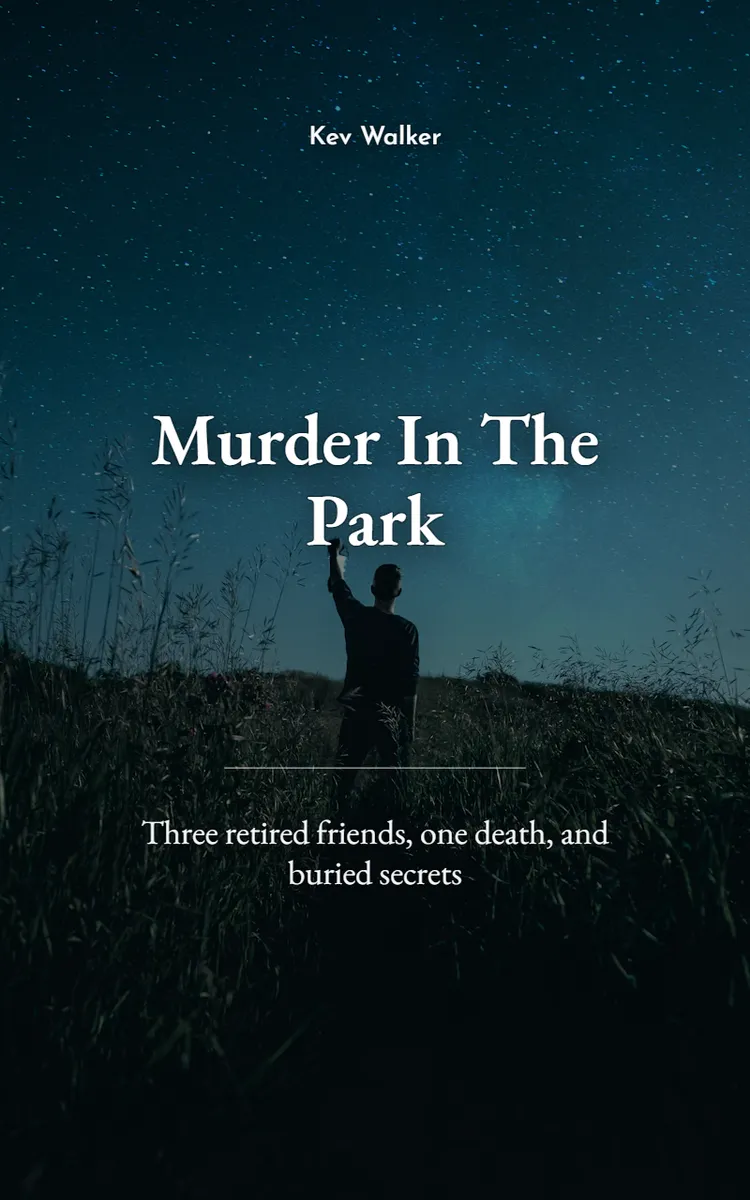
"Murder In The Park" is a fiction book by Kev Walker with 5 chapters and approximately 10,298 words. Retired friends investigate a librarian's murder and uncover local corruption.
This book was created using Inkfluence AI, an AI-powered book generation platform that helps authors write, design, and publish complete books. It was made with the AI Novel Writer.
Frequently Asked Questions
What is "Murder In The Park" about?
Retired friends investigate a librarian's murder and uncover local corruption
How many chapters are in "Murder In The Park"?
The book contains 5 chapters and approximately 10,298 words. Topics covered include Eleanor in the Forbidden Park, The House in the Archive, The Deed That Lied, The Park Deed Trap, and more.
Who wrote "Murder In The Park"?
This book was written by Kev Walker and created using Inkfluence AI, an AI book generation platform that helps authors write, design, and publish books.
How can I create a similar fiction book?
You can create your own fiction book using Inkfluence AI. Describe your idea, choose your style, and the AI writes the full book for you. It's free to start.
Write your own fiction book with AI
Describe your idea and Inkfluence writes the whole thing. Free to start.
Start writingCreated with Inkfluence AI


