
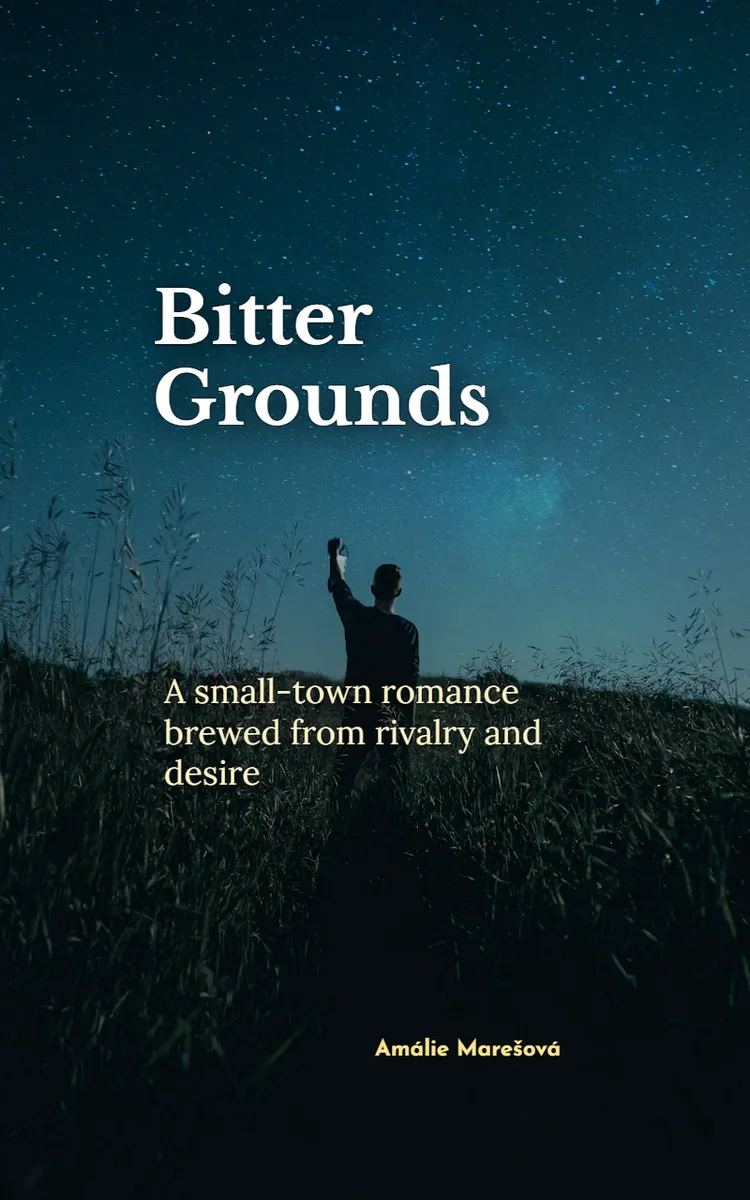
Read the first chapter
The whole of chapter one, free. About 10 min. Turn the pages with the arrows, your keyboard, or a swipe.
Chapter 1
The Market Stall Collision
Rain punched through the covered market roof in silver needles, splattering Mara Bell’s face as she wrestled the canvas flap over her coffee stall.
“Come on,” she muttered, hauling the rope tight. “Just stay up until noon.”
The knot slipped.
A gust shoved the canvas inward, and cold water poured across the counter, over the chalkboard menu, into the wooden crate where she kept her paper cups. Mara caught the crate before it tipped, pressing her shoulder against the stall frame. The smell of wet canvas and ruined cardboard filled her nose.
She had planned to work alone. Alone meant no arguments, no Theo Voss leaning against her counter as if he owned the market, no customers comparing her coffee to whatever polished nonsense he served at Voss & Vine.
Most of all, alone meant she could keep the weekend sales.
Her shop had limped through two slow months. If the market failed her now, Bellwether Coffee would have to choose between its rent and its winter stock. Mara had not yet decided which loss she could bear.
A crack split the air overhead.
The market roof sagged.
Mara looked up just as a sheet of water burst through the torn seam above her stall.
“Perfect.”
She snatched the cash tin and tucked it beneath her coat. The first table skidded sideways in the flooding aisle, its legs scraping against the concrete. Boxes of apples rolled past her boots. Somewhere beyond the rows of stalls, a child cried, and the market organizer shouted for everyone to move toward the east entrance.
Mara grabbed the espresso machine’s power cord and yanked it free.
“Mara!”
She turned.
Theo stood three stalls away, soaked through his dark wool coat, one hand gripping a wooden display rack before it could topple. His hair was plastered to his forehead. Water ran from the end of his nose, and he looked infuriatingly composed for a man standing ankle-deep in a river that had not existed five minutes earlier.
“What?” she called.
“The breaker’s gone.”
“I can see that.”
“You’re welcome.”
“For what?”
“For telling you before you electrocute yourself.”
Mara glanced at the cord in her hand. The insulation had split near the plug, exposing a thread of copper.
She dropped it.
Theo’s mouth tightened, as if he had won something. “You’re welcome.”
“Don’t enjoy it.”
“I’m enjoying the weather.”
“You always did prefer a disaster you could blame on somebody else.”
His expression shifted, only slightly. “Still blaming me for the council vote?”
“You opened across from me six months ago and undercut every price on my menu.”
“I opened the shop my father left me.”
“And changed the sign before the paint on mine dried.”
“That sign was there before you moved in.”
Mara stepped around the counter, boots slipping on the wet concrete. “You had a whole town to choose from.”
“So did you.”
The answer landed harder than it should have. She hated that he remembered. Hated that he knew she had come to Briar Glen because Bellwether’s old owner had offered her a chance when no one else would.
Another section of canvas tore loose with a gunshot snap.
Theo crossed the flooded aisle toward her. “Move.”
“I can handle it.”
“You’re standing under a roof that’s coming down.”
“I said I can handle it.”
He reached past her anyway, not touching her, and caught the stall’s front beam as it lurched. His sleeve brushed her wrist. Heat lived beneath the wet wool, startling against the cold.
For one suspended second, they held the beam together.
His face was close enough for her to smell rain, coffee, and the cedar soap he used. She had noticed that scent before, usually when he passed her shop carrying crates of beans. She had told herself it was only because he walked too close.
“Your hand,” he said.
Mara looked down. A thin line of blood ran from her palm where the rope had burned her skin.
“It’s nothing.”
“It’s bleeding.”
“That tends to happen when skin breaks.”
Theo released the beam with one hand and pulled a clean white handkerchief from his pocket. He held it out.
She stared at it.
“What?” he said. “It’s not a marriage proposal.”
“Wouldn’t want to encourage you.”
“Press it against the cut.”
“I know how to use a handkerchief.”
“Then this should be easy.”
She took it. The cloth was warm from his pocket. That detail bothered her most.
A crash sounded behind them. The aisle filled with a fresh surge of water, carrying a basket of pears toward their feet. Mara stepped back, and her heel struck the stall’s wooden riser. Theo caught her elbow.
His fingers closed firmly, carefully.
“Easy,” he said.
“I’m fine.”
“You’re very committed to that lie.”
She pulled free. “And you’re very committed to touching things that aren’t yours.”
His gaze dropped to her mouth before returning to her eyes. “You’re the one holding my handkerchief.”
The market organizer appeared through the rain curtain, clutching a ring of keys and shouting into a phone. Mrs. Vale was seventy if she was a day, but she moved with the fierce purpose of someone who had personally bullied every leak in the building.
“There you are!” she called. “Both of you. Leave the stalls.”
“I’m not leaving,” Mara said.
Mrs. Vale planted herself in the flooded aisle. “You are unless you want the roof to finish the job.”
“My machine - ”
“Unplugged?”
“Yes.”
“Then it can survive a little rain. Your insurance company may not, but that is between you and your paperwork.”
Mara looked toward her stall. The canvas roof sagged over the counter. Her chalkboard menu had dissolved into gray streaks. The coffee grinder sat in a shallow pool.
The weekend market was her best chance to make back the money she had spent on a new shipment of beans. If she lost the stall, she lost the customers who came only on Saturdays, people who bought bags for home and pastries for their families. She could not simply wait for the storm to pass.
“I need somewhere dry,” she said.
Mrs. Vale’s gaze moved to the far end of the market. “There’s one stall.”
Theo followed her look.
Mara did too.
The old flower stall stood beneath the only section of roof that had not collapsed. Its painted shutters were intact, and its counter was broad enough for one espresso machine, perhaps two if they worked shoulder to shoulder.
“No,” Mara said.
Theo gave a short laugh. “For once, we agree.”
“You’ll have to,” Mrs. Vale said. “Every other dry space is being used for emergency storage.”
“I can set up outside,” Mara said.
“In this?” Mrs. Vale gestured toward the rain hammering the open entrance. “Your customers would need a boat.”
“I’ll find one.”
“You’ll share.”
Mara and Theo spoke at the same time.
“Absolutely not.”
“Not happening.”
Mrs. Vale folded her arms. “Then neither of you trades here this weekend. I’ll refund the stall fees when the roof repairs are paid for.”
Mara felt the words like a stone dropping through her stomach.
“Refund?” she said. “That doesn’t replace the sales.”
“No. It doesn’t.”
Theo’s face had gone still. He understood the cost. Maybe his shop could absorb it. Voss & Vine had polished brass fixtures, imported chocolate, and customers who thought twelve dollars was a reasonable price for foam shaped like a leaf.
Bellwether had Mara, one battered machine, and a ledger that had begun to look like a threat.
Mrs. Vale softened, but only a little. “You can have the flower stall. Together. The market takes twenty percent of joint sales for emergency use of the space.”
“Twenty?” Mara said.
“Thirty if you argue.”
Theo glanced at her. “Don’t.”
She ignored him. “And we need a tasting tomorrow morning to make up for the canceled opening today. A public one. Both menus.”
Mara laughed once, without humor. “You want us to serve together?”
“I want the market to survive the storm. You want your businesses to survive the season. Those goals are not strangers.”
“They’re not friends either,” Theo said.
Mrs. Vale pointed toward the dry stall. “Decide before the water reaches the back room.”
A current curled around Mara’s boots. Cold seeped through her socks.
Theo leaned closer, lowering his voice. “Take the stall.”
She looked at him. “You’re eager.”
“I’m practical.”
“You’re afraid your shop can’t afford to lose the weekend.”
Something flickered in his eyes. Anger, perhaps. Or recognition.
“Are you saying yours can?”
“No.”
The admission escaped before she could dress it in something sharper.
Theo studied her. Rain drummed against the roof between them. “Then stop making this about winning.”
“It is about winning.”
“Against me?”
“Against the empty tables. Against rent. Against every person who thinks a small shop is charming until it asks them to pay for coffee.”
His expression changed. The teasing edge disappeared.
Mara pressed Theo’s handkerchief harder against her palm. “I don’t need you feeling sorry for me.”
“I don’t.”
“Good.”
“I know what it’s like to count the till before deciding whether you can order beans.”
She stared at him.
Theo looked away first, toward the ruined stalls and the water threading between them. “My father left me the building. He didn’t leave me a working business. I spent a year keeping the doors open while everyone in town waited for me to fail.”
The rain seemed louder.
Mara had known about his father’s death. Everyone in Briar Glen knew. She had not known Theo had nearly lost the shop afterward. She had assumed Voss & Vine had been handed to him whole, polished and profitable, like everything else about him.
“Why didn’t you say?” she asked.
His mouth curved without amusement. “You never asked.”
“You never made yourself easy to ask.”
“Neither did you.”
Mrs. Vale cleared her throat. “The water is now in the back room.”
Mara closed her eyes for one breath.
Then she held out her injured hand, still wrapped in Theo’s handkerchief. “Fine. We share.”
Theo looked at her hand instead of taking it. “That’s not a handshake.”
“It’s not an invitation.”
“Pity.”
He took the cash tin from beneath her coat before she could stop him. “I’ll carry this.”
“I can carry my own money.”
“I know.”
“Then give it back.”
“No.”
Mara stepped after him as he waded toward the dry stall. “You are impossible.”
“You’ve said that before.”
“And you keep proving me right.”
At the stall, they worked without speaking for several minutes. Theo dragged a table into place. Mara wiped rain from the counter with a stack of ruined napkins. He found a dry outlet and tested it with a borrowed lamp. She salvaged two bags of beans from a crate while he lifted the espresso machine with both hands.
“On three,” he said.
“I don’t need counting.”
“You nearly dropped it last time.”
“That was because you pulled too soon.”
“I pulled when you said three.”
“I said, ‘one, two - ’”
“You said three.”
“I was going to say three.”
“That is generally how numbers work.”
Despite herself, Mara almost smiled.
Theo noticed. His hands remained on the machine, but his attention settled on her face.
The almost-smile vanished.
“Don’t look so pleased,” she said.
“I’m not.”
“You are.”
“I’m surprised.”
“By what?”
“That you have a sense of humor.”
She set the coffee scoop down with a sharp click. “I have one. You’re simply rarely worth using it on.”
His gaze held hers. “Tomorrow, then.”
“What?”
“The tasting. You handle the espresso. I’ll handle the pour-over.”
“I’m not letting you put your beans beside mine.”
“Why? Afraid people will taste the difference?”
“I’m afraid people will taste your arrogance.”
“That’s not usually in the cup.”
“No. It’s in the price.”
He leaned against the counter, close enough that his knee brushed hers. Neither of them moved away immediately.
“Tomorrow at eight,” he said. “We make them choose.”
Mara looked at the narrow stall, the two machines, the single dry roof above them. Their shoulders would touch every time they turned. Their customers would watch. Their failures would belong to both of them.
Twenty percent of every sale. One public tasting. One weekend forced into the hands of the man she had spent six months trying to outpace.
She should have refused.
Instead, she reached for the chalkboard and wrote across the top in thick white letters:
BELLWETHER & VOSS - STORM SPECIAL
Theo came to stand beside her. “You spelled Voss wrong.”
“I did not.”
“You added an extra s.”
“I’m considering a rebrand.”
He took the chalk from her fingers. Their hands met. His thumb grazed the cut in her palm, careful enough to ask permission without words.
Mara did not pull away.
He corrected the sign, then wrote beneath it:
JOINT TASTING - TOMORROW, 8 A.M.
The word joint looked too intimate on the board.
Mara stared at it while the storm battered the market and Theo’s shoulder warmed hers.
They had saved the stall.
Tomorrow, they would have to decide whether saving it together was worth what it might cost them both.
End of chapter one. 4 more chapters and about 11,576 words in the full book.
Swipe or use the arrows to turn the page
What's inside: 5 chapters
- 1. The Market Stall Collision
- 2. A Recipe for Reluctance
- 3. The Ledger Behind the Lease
- 4. The Night the Roaster Failed
- 5. Choosing the Same Corner
About this book
"Bitter Grounds" is a romance book by Amálie Marešová with 5 chapters and approximately 11,576 words. Rival coffee shop owners fall in love in a small town.
This book was created using Inkfluence AI, an AI-powered book generation platform that helps authors write, design, and publish complete books. It was made with the AI Romance Novel Writer.
Frequently Asked Questions
What is "Bitter Grounds" about?
Rival coffee shop owners fall in love in a small town
How many chapters are in "Bitter Grounds"?
The book contains 5 chapters and approximately 11,576 words. Topics covered include The Market Stall Collision, A Recipe for Reluctance, The Ledger Behind the Lease, The Night the Roaster Failed, and more.
Who wrote "Bitter Grounds"?
This book was written by Amálie Marešová and created using Inkfluence AI, an AI book generation platform that helps authors write, design, and publish books.
How can I create a similar romance book?
You can create your own romance book using Inkfluence AI. Describe your idea, choose your style, and the AI writes the full book for you. It's free to start.
Write your own romance book with AI
Describe your idea and Inkfluence writes the whole thing. Free to start.
Start writingCreated with Inkfluence AI


