
Read the first chapter
The whole of chapter one, free. About 9 min. Turn the pages with the arrows, your keyboard, or a swipe.
Chapter 1
Mapping Your Educator Skills to Roles
Why Your Teaching Duties Need a Role Bridge
What does “managed a classroom of 30 students” tell a hiring manager about your ability to design training, support performance, or manage a learning project? Very little - until you translate the duty into the language of the role you want.
Educators often lose credit for valuable work because school terms hide the business skill underneath. “Created unit plans” can mean learning design. “Tracked student progress” can mean data-informed performance support. “Worked with families, counselors, and administrators” can mean communication across several groups with different needs. The work already exists; the translation makes it visible.
The Role-Bridge Matrix gives you a repeatable way to make that translation. You will break a teaching duty into its action, audience, tool, result, and business connection. Then you will match the resulting competency to a corporate role category such as instructional design, Learning and Development (L&D), EdTech project management, or training facilitation. The goal is not to make school experience sound corporate. The goal is to show what your experience proves.
Takeaway: stop listing school duties as job titles in disguise. Start naming the work, the skill behind it, and the role that needs that skill.
Build Your Role-Bridge Matrix
The Role-Bridge Matrix connects one teaching duty to one corporate competency. Build it with the following five columns:
| Teaching duty | Action | Evidence | Corporate competency | Target role | |---|---|---|---|---| | Created a unit on persuasive writing | Designed lessons, practice, and assessment | Six-week sequence, rubrics, student work samples | Learning experience design | Instructional designer | | Reviewed weekly reading data | Analyzed progress and adjusted instruction | Progress tracker and intervention notes | Performance analysis | L&D specialist | | Coordinated a field trip | Managed schedule, communication, vendors, and safety requirements | Timeline, permission process, attendance records | Project coordination | EdTech project coordinator |
Start with the duty, but do not copy it directly into your résumé. Ask what you actually did. “Created a unit” may include identifying a learning need, setting objectives, sequencing content, creating practice activities, and checking whether learners met the objective. Those actions map directly to instructional design work because instructional designers create learning experiences that move people toward a defined outcome.
Use this sequence:
1. Choose one teaching duty. Select a duty that connects to the job you want. If you want instructional design, choose lesson planning, assessment creation, remediation, or digital resource development rather than listing every classroom responsibility. 2. Name the action. Start with a strong verb such as designed, analyzed, facilitated, coordinated, revised, or evaluated. The action shows your contribution. 3. Add the evidence. Record the scale, frequency, tools, timeline, or deliverable. “Used a weekly tracker for 120 learners” carries more weight than “monitored progress” because it shows the work’s size and structure. 4. Name the corporate competency. Translate the action into a skill used in the target role. “Built differentiated practice” may become “designed learner-centered activities.” “Adjusted instruction from assessment results” may become “used performance data to revise training.” 5. Choose the role category. Match the competency to a role, not to every possible job. One bullet aimed at an instructional designer should not try to sound like a project manager, recruiter, and trainer at the same time.
The matrix works because it forces a connection between evidence and role. A hiring manager can understand “designed a four-week onboarding course with practice activities and knowledge checks” faster than “taught workplace readiness.” The first statement names a product, a timeline, and design choices. The second sounds like a subject area.
Ask yourself: could a recruiter identify the work product, the people served, and the result from my translated statement? If not, return to the evidence column. Add a number, a time frame, a tool, or a visible deliverable. You do not need to invent business revenue or claim results you cannot verify. You can use accurate measures such as class size, number of modules, completion of a project, assessment improvement, or reduced revision time.
Your target role determines the translation. For an instructional design role, emphasize objectives, content structure, practice, assessment, accessibility, and authoring tools. For an L&D role, emphasize needs analysis, facilitation, coaching, onboarding, and performance support. For an EdTech project role, emphasize timelines, testing, documentation, communication, issue tracking, and coordination with technical or content teams.
A single duty can produce different bridges. “Created online lessons for 85 students” could become “Designed and published 12 asynchronous learning modules with guided practice and knowledge checks” for instructional design. For an EdTech role, the same work could become “Coordinated content production, testing, and release of 12 online modules for 85 learners.” The facts stay consistent; the competency changes to fit the role.
Takeaway: build one matrix for each target role. Translation becomes accurate when you choose the destination before you rewrite the experience.
Apply the Matrix to One Teaching Duty
Use this scenario to complete a working example. The educator has taught seventh-grade science and wants an instructional design role. Their strongest evidence includes a three-week ecology unit, 96 students, Google Classroom, a spreadsheet progress tracker, and a final project rubric.
1. Select the duty. Write: “Planned and taught a three-week ecology unit for 96 seventh-grade students.” This gives you a starting point, but it still describes a school task. 2. Separate the actions. List the work underneath it: reviewed required standards, wrote learning objectives, sequenced five lessons, created slides and guided notes, built two practice activities, wrote a quiz, and scored a final project. 3. Identify the evidence. Record the concrete details: five lessons, two practice activities, one quiz, one project rubric, 96 learners, and a Google Classroom delivery space. These details show a complete learning product rather than a single presentation. 4. Connect the competency. Map the work to “learning experience design and assessment.” The educator did more than explain ecology; they created a structured path from objective to practice to evaluation. 5. Write the corporate version. Use: “Designed and delivered a five-lesson digital learning sequence for 96 learners, including guided practice, a knowledge check, and a project rubric; used progress data to revise support materials.” 6. Adjust for the job description. If the posting emphasizes asynchronous learning, replace “delivered” with “published” only if the materials existed for learners to complete independently. If the posting emphasizes assessment, place “knowledge check,” “rubric,” and “progress data” earlier in the bullet. 7. Check the claim. Compare the statement with your actual materials. Keep the numbers you can support. Remove any claim about improved performance unless you have records showing that improvement.
The expected outcome is a résumé bullet that answers three employer questions: What did you create? Who used it? How did you check learning? It also gives you a portfolio starting point. The five-lesson sequence, one practice activity, and rubric can become a work sample after you remove student names and school-specific information.
Now apply the same duty to an L&D role. You might write: “Analyzed weekly progress data for 96 learners and revised practice materials, examples, and support instructions to address recurring misconceptions.” The focus shifts from the course product to the performance problem and the response. For an EdTech project role, you might write: “Coordinated the release of five digital lessons, tracked learner questions and content issues in a spreadsheet, and revised materials with input from a department team.” The focus shifts again toward coordination and issue tracking.
Complete your first matrix in 20 minutes. Spend five minutes listing three duties, five minutes identifying evidence, five minutes matching competencies, and five minutes writing role-specific versions. Then read each version aloud. If it still sounds like a lesson plan, add the deliverable, workflow, or decision you managed. If it sounds inflated, return to the facts.
Quick checklist
• Choose one target role before translating the duty. - Record the original teaching duty without polishing it. - Break the duty into actions and deliverables. - Add accurate numbers, tools, timelines, or audiences. - Match the evidence to one corporate competency. - Rewrite the duty for the target role. - Remove student names and confidential school information from work samples. - Check every claim against a real artifact, record, or result.
Takeaway: one duty can support several career paths, but each version needs a clear role destination and evidence that proves the connection.
Avoid Weak Bridges and Unsupported Claims
Mistake: Listing responsibilities instead of competencies
“Managed classroom behavior, planned lessons, graded assignments, and contacted families” gives a recruiter a task list but no clear match to a corporate role. The reader must do the translation, and many will not spend time doing it.
Do this: “Facilitated learning for 30 students, maintained weekly progress records, and communicated action steps to families and support staff.”
Not this: “Responsible for classroom management and parent communication.”
The revised version shows facilitation, tracking, and communication across groups. Those competencies connect to training delivery, learner support, and project coordination.
Mistake: Using corporate language without proof
Terms such as “stakeholder management” or “performance optimization” do not strengthen a résumé when the evidence remains hidden. A hiring manager may see the language as decoration.
Do this: Name the people, decision, and artifact: “Coordinated weekly updates with two department leads and a counselor, documented learner needs, and revised support plans.”
Not this: “Managed stakeholders and optimized learner outcomes.”
Concrete evidence makes the competency believable. If you worked with a subject matter expert (SME), identify the person’s role and explain what you produced together. For example: “Partnered with a science department lead to review content accuracy and revise four digital lessons.” The phrase “subject matter expert” means a person with deep knowledge of a topic; use it only when that description fits.
Mistake: Claiming results you cannot verify
Educators sometimes convert a positive classroom outcome into a business result without records. “Increased engagement by 40 percent” creates a credibility problem if no measurement supports it. You can still show impact without inventing precision.
Do this: “Used exit-ticket results from 96 learners to identify two recurring misconceptions and added targeted practice before the final project.”
Not this: “Drove a 40 percent increase in engagement.”
The first statement shows a decision based on evidence. It also gives an employer a clear example of how you diagnose and improve learning.
Edge case: Your experience spans several role categories
A large teaching duty may contain design, facilitation, analysis, and coordination. Do not force every part into one résumé bullet. Create separate bridges from the same project, then choose the strongest one for each application. Keep instructional design evidence under design roles, facilitation evidence under L&D roles, and scheduling or testing evidence under EdTech project roles.
Your final test is simple: a reader unfamiliar with schools should understand the work without needing to decode terms such as “IEP,” or Individualized Education Program, “grade-level team,” or “PLC,” meaning professional learning community. Spell out any term that matters, then connect it to the corporate competency it demonstrates.
A strong Role-Bridge Matrix does more than improve wording. It gives you a map for selecting résumé bullets, preparing interview examples, and choosing portfolio pieces. Your teaching history contains more than duties; it contains designed learning, tracked performance, coordinated work, and solved problems. The bridge makes those capabilities legible to the roles waiting on the other side.
End of chapter one. 7 more chapters in the full book.
Swipe or use the arrows to turn the page
What's inside: 8 chapters
- 1. Mapping Your Educator Skills to Roles
- 2. The Jargon Translation Framework
- 3. Andragogy vs Pedagogy Resume Signals
- 4. Portfolio Blueprint for Non-Designers
- 5. Designing a Storyboard Stakeholder Walkthrough
- 6. Writing Corporate-Ready Learning Objectives
- 7. Corporate Stakeholder Management Mindset Shift
- 8. EdTech Project Management Escape Plan
About this book
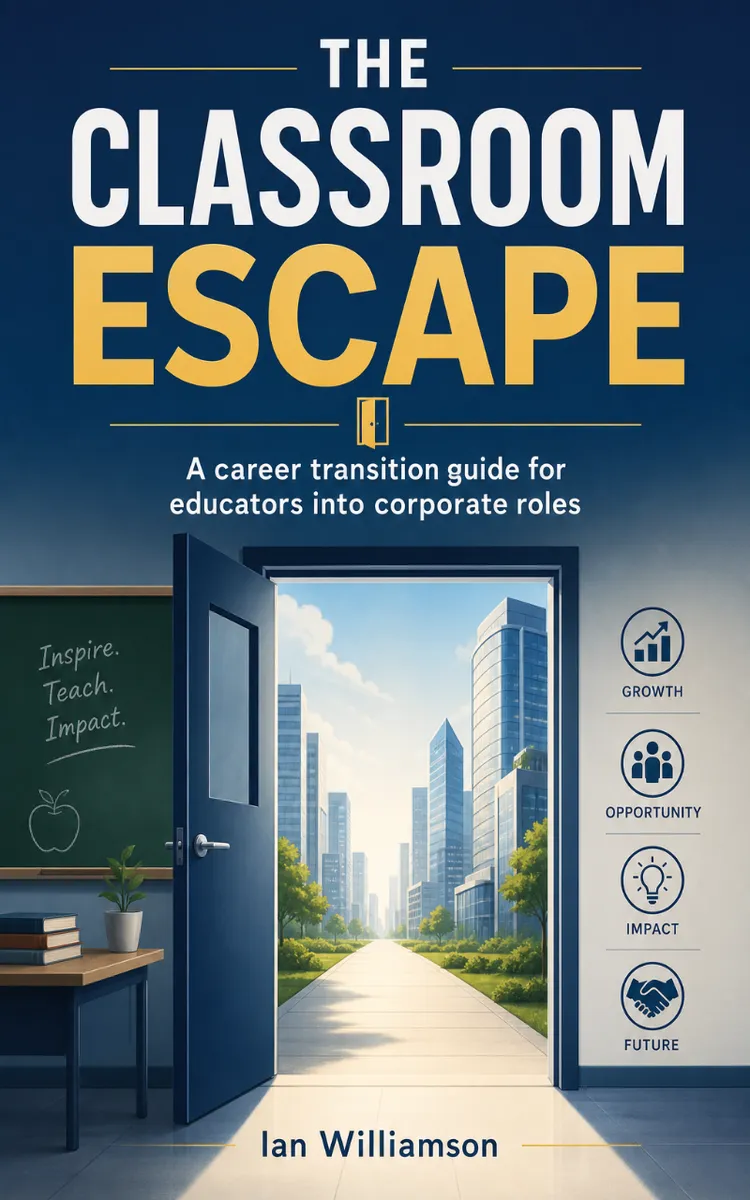
"The Classroom Escape" is a how-to guide book by Anonymous with 8 chapters and approximately 15,501 words. Educator-to-corporate career transition for instructional design and L&D.
This book was created using Inkfluence AI, an AI-powered book generation platform that helps authors write, design, and publish complete books. It was made with the AI Ebook Generator.
Frequently Asked Questions
What is "The Classroom Escape" about?
Educator-to-corporate career transition for instructional design and L&D
How many chapters are in "The Classroom Escape"?
The book contains 8 chapters and approximately 15,501 words. Topics covered include Mapping Your Educator Skills to Roles, The Jargon Translation Framework, Andragogy vs Pedagogy Resume Signals, Portfolio Blueprint for Non-Designers, and more.
Who wrote "The Classroom Escape"?
This book was written by Anonymous and created using Inkfluence AI, an AI book generation platform that helps authors write, design, and publish books.
How can I create a similar how-to guide book?
You can create your own how-to guide book using Inkfluence AI. Describe your idea, choose your style, and the AI writes the full book for you. It's free to start.
Write your own how-to guide book with AI
Describe your idea and Inkfluence writes the whole thing. Free to start.
Start writingCreated with Inkfluence AI


