
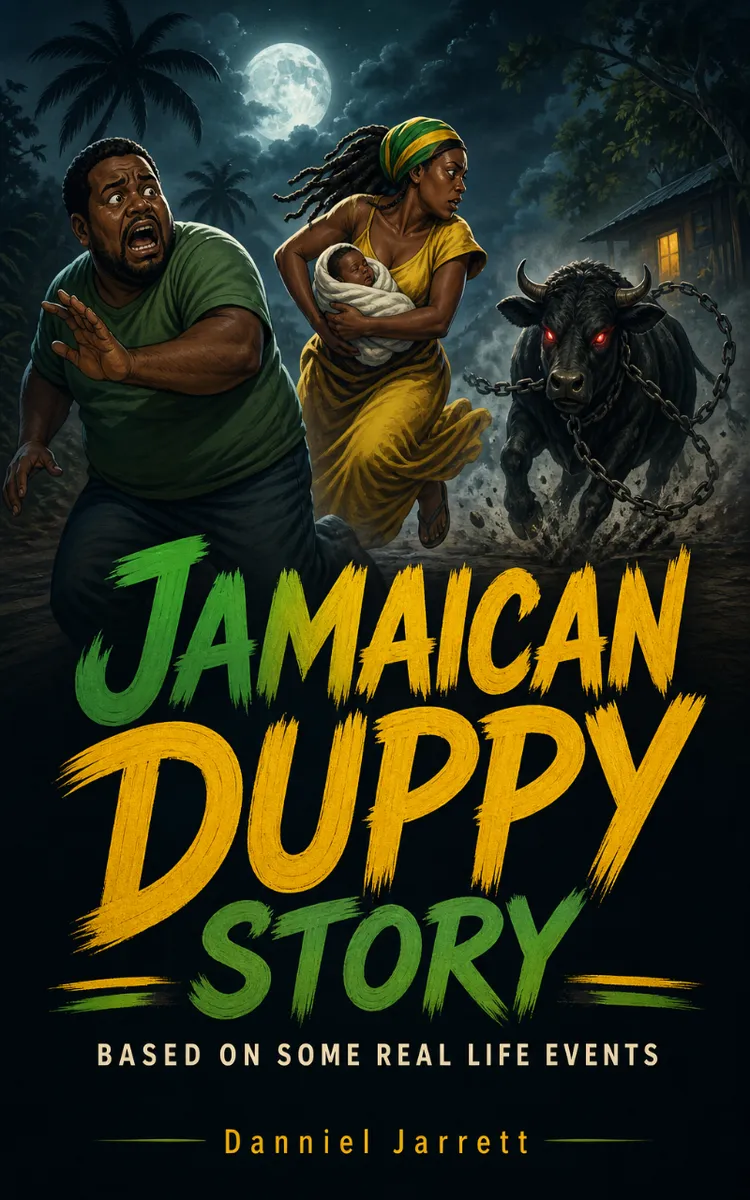
Read the first chapter
The whole of chapter one, free. About 8 min. Turn the pages with the arrows, your keyboard, or a swipe.
Chapter 1
Portland Road and the Clanking Chains
The last rum bottle rolled beneath the bench just as Micah stepped into Portland Road, and the bottle’s hollow clunk followed him into the night.
It was well past midnight. The shop shutters had come down, the churchyard gate leaned open on one hinge, and every house along the road had pulled its light indoors. Micah tightened his grip on the small cloth bag tucked beneath his shirt. Inside it sat his mother’s salt, wrapped in paper and tied with blue thread.
“Don’t take the silk cotton way,” she had warned him before he left.
He’d laughed then. Not loudly. Just enough to make her frown.
Now he wanted one thing: to reach home before she woke and found him stumbling through the yard like a thief. His boots were damp from the grass, his head carried the warm, foolish wobble of too much rum, and his little sister’s schoolbooks waited on the table. He’d promised to help her with fractions in the morning.
A simple promise. A simple walk.
Then something scraped behind him.
Micah stopped.
The road ran pale beneath the moon, bordered by cane, low houses, and the crooked silhouettes of trees. Farther ahead, the silk cotton tree stood beside the bend, its trunk thick enough to swallow a doorway. Nobody walked beneath it after dark unless the matter was urgent or the person had misplaced his good sense.
Micah looked over his shoulder.
Nothing moved.
A cricket chirped from the ditch. Somewhere down toward the sea, a dog barked once and thought better of continuing.
He faced forward again.
Clank.
The sound came from behind him, heavier now. Metal dragging over stone.
Micah’s mouth went dry.
“Who’s there?” he called.
His voice traveled along the road and came back smaller.
Clank.
He began walking. Not running. Running would make the sound chase him faster, and besides, his knees had already started behaving like loose hinges. The cloth bag pressed against his ribs.
At the bend, the moon slipped behind a cloud.
The road darkened.
Micah heard breathing.
Not the quick breathing of a man hurrying to catch up. This was slow and rough, pulled through a throat that seemed too narrow for it.
He turned.
A shape stood in the middle of Portland Road.
At first Micah saw only the chains. They hung from the figure’s shoulders, crossed its chest, and looped around its legs. The links dragged along the road with every small movement. Then the moon returned, and the face appeared.
Two red eyes watched him.
Not bright like a lantern. Glowing. Deep and hot, as if coals had been buried behind them.
Micah forgot the rum, the schoolbooks, his mother’s warning. His body knew before his mind did. It leaned backward, ready to flee, but his heels stayed planted.
The figure tilted its head.
The chains answered with a soft, patient rattle.
“Good night,” Micah managed.
The thing took one step.
The metal struck the road.
Micah stumbled back. “I didn’t mean any trouble.”
Another step.
Its shape looked almost human beneath the chains, though the darkness around it seemed to cling in the wrong places. The shoulders were too wide. The arms hung too long. Its eyes fixed on the cloth beneath Micah’s shirt.
The salt.
He felt the paper packet shift as his breathing quickened.
“Stay where you are,” he said, and heard how useless the words sounded.
The figure stopped.
For a moment, nothing moved except the chain sliding against its ankle.
Then it spoke.
“Come closer.”
The voice was low and cracked, like stones grinding under water.
Micah’s fingers found the knot in his shirt. He could hear his mother’s voice as clearly as if she stood beside him.
If something follows you, don’t invite it home.
He pulled the packet free.
The figure’s red eyes sharpened.
Micah tore the blue thread with his teeth. The paper split. Salt spilled into his palm, cold and gritty.
“Don’t,” the figure said.
That frightened him more than the voice had.
Micah flung the salt across the road.
The grains struck the dirt in a thin white line.
The chains screamed.
There was no better word for it. Metal shrieked against metal, and the sound punched through Micah’s skull. The figure jerked backward. Its red eyes flared once, then folded inward like sparks swallowed by wind.
The body vanished.
The chains dropped with a hard crash.
Micah stood alone.
For several seconds he couldn’t move. His palm burned where the salt had rested. The road seemed wider than before, and the silk cotton tree leaned over it, its branches clawing at the moon.
Then something tugged at his ankle.
Micah shouted and kicked.
His boot struck a length of chain.
It lay across the road, black and thick, still trembling.
He ran.
He ran past the tree, past the closed shop, past the churchyard where the gate scraped in the breeze. He ran until the first house with a lamp in its window appeared, then nearly fell through the gate of Miss Etta’s yard.
She opened her door before he knocked.
“What foolishness is this?” she demanded.
Micah bent over, hands on his knees.
Miss Etta held a candle in one hand and a kitchen knife in the other. She was a small woman with silver hair tied beneath a scarf, but she carried that knife as if it had opinions.
“Micah?”
“Salt,” he gasped. “Give me salt.”
Her eyes moved over his face. “What happened?”
“Salt, Miss Etta.”
She reached behind her without looking and grabbed a jar from the shelf. “You drink rum and come frightening decent people?”
“On the road. At the bend.”
“The silk cotton?”
Micah nodded.
Her expression changed.
That was worse than anger.
She shoved the jar into his hands. “Fling it around your feet.”
“I already did.”
“Then fling more.”
He scattered salt over the doorstep, his boots, the packed earth between them. Miss Etta watched the road while he worked.
“Did it touch you?”
“No.”
“Did you answer when it called?”
Micah swallowed. “It told me to come closer.”
“That wasn’t what I asked.”
He stared at her.
“Did you go closer?”
“No.”
“Good.” She took back the jar. “A man can be drunk and still have sense. Sometimes.”
Micah straightened. His breath came unevenly. “It had chains.”
Miss Etta shut the door halfway, leaving only her face in the gap. “Rolling Calf.”
The name seemed to settle over the yard.
Micah looked toward the darkness. “You saw it?”
“I’ve lived here longer than you’ve been alive. I’ve seen people see it.”
“That doesn’t answer me.”
“No,” she said. “It doesn’t.”
By dawn, the story had traveled faster than Micah’s legs.
He sat on an overturned crate outside the cookshop while the village gathered around him in pieces. Mr. Baines arrived first, wearing one slipper and one shoe. Then came the baker, two fishermen, Miss Etta, and Micah’s mother, who stood with her arms folded so tightly that the blue veins showed in her hands.
His friend Leon appeared last, smelling of sleep and fried dumplings.
“So,” Leon said, leaning against the shop wall, “the rum has started telling stories now?”
Micah gave him a flat look. “I saw what I saw.”
“You saw a chain.”
“I saw a man covered in chains.”
“Man?”
Micah hesitated.
The morning sun had made the whole thing sound foolish. The road was only a road. The silk cotton tree was only a tree. Even the chain he’d found was gone when they searched the bend. Still, he could feel the rough scrape of it against his boot.
“It had red eyes,” he said.
Leon snorted. “Rum can make a goat look like the governor.”
“Then why was there salt on the road?” Miss Etta asked.
Nobody answered.
A white line still marked the dirt near the bend. It had been scattered wide, as if someone had thrown it in a panic. The grains glittered under the sun.
Mr. Baines rubbed his chin. “Could’ve been a prank.”
“At midnight?” the baker asked.
“People do foolish things at midnight.”
“People do foolish things in daylight too,” Miss Etta said. “You’re proof.”
A few people laughed, but the laughter thinned quickly.
Micah’s mother stepped closer. “Tell them exactly what happened.”
He glanced at her. She had warned him. He’d laughed. Now he wished she would stop looking as if she’d known the road was waiting.
“I was coming home,” he said. “I heard metal. I turned and saw it by the silk cotton tree.”
“Did it have hooves?” asked one of the fishermen.
“I don’t know.”
“Did it speak?”
“Yes.”
“What did it say?”
Micah looked at the white salt on the road.
“Come closer.”
The cookshop went quiet.
Leon’s smile faded. “And you didn’t?”
“I’m here, aren’t I?”
“That isn’t always proof,” Miss Etta murmured.
Micah’s mother reached into her dress pocket and pulled out a fresh packet of salt. She pressed it into his hand.
“Keep this,” she said.
Leon glanced at it. “For seasoning?”
“For sense,” she replied.
The baker crossed himself. Mr. Baines muttered that the old stories had grown legs. Someone else said Rolling Calf only came for people carrying guilt. Another insisted it was a duppy in darkness, and duppy love darkness because daylight gave them nowhere to hide.
Leon shook his head. “You all hear yourselves?”
Miss Etta looked at him. “You plan to walk Portland Road tonight?”
Leon opened his mouth.
Nothing came out.
That evening, Micah returned to the bend with Leon and three other men. They carried lanterns, machetes, and enough confidence to make a bad decision feel respectable.
The silk cotton tree stood quiet above them. Its roots broke through the earth like knuckles. Micah kept his hand around the salt packet.
“See?” Leon said. “Nothing.”
A breeze moved through the branches.
Clank.
The men stopped.
The sound came from beneath the tree.
Clank.
Leon’s lantern shook. “That could be a loose gate.”
“There’s no gate,” Micah said.
The chain dragged once across the ground.
The lantern flame went blue.
Then, from somewhere behind the trunk, two red points opened in the dark.
Leon whispered, “Micah.”
Micah stepped forward before he could think better of it. The salt packet crackled in his fist.
The eyes rose above the roots.
A chain slid into view.
This time, the presence did not speak to him.
It spoke to Leon.
“Come closer.”
Leon backed away.
Micah tore open the packet and flung salt across the road. The red eyes vanished at once. The chain collapsed into the grass, leaving only a shallow groove in the dirt.
No one moved.
Then Leon grabbed Micah’s shirt.
“You heard it,” he said.
Micah nodded.
Leon’s fingers tightened. “Tell them I didn’t imagine it.”
Micah looked at the empty place beneath the silk cotton tree.
“You didn’t,” he said.
Behind them, far down Portland Road, metal began to drag again.
End of chapter one. 6 more chapters in the full book.
Swipe or use the arrows to turn the page


What's inside: 7 chapters
- 1. Portland Road and the Clanking Chains
- 2. The Lane That Stretches Too Far
- 3. Before Sunrise, the Baby’s Cry
- 4. A Spirit That Rides Daily
- 5. My Room, My Night, My Exit
- 6. Waves, Water, and Ancestors in Sleep
- 7. Witches, Obeah Men, and the Thin Line
About this book
"Salt in the Moonlight" is a fiction book by Danniel Jarrett with 7 chapters and approximately 14,985 words. A conversational fiction journey through Jamaican folklore as one narrator collects unsettling encounters, dreams, and warnings—learning what fear demands and what faith can answer..
This book was created using Inkfluence AI, an AI-powered book generation platform that helps authors write, design, and publish complete books. It was made with the AI Novel Writer.
Frequently Asked Questions
What is "Salt in the Moonlight" about?
A conversational fiction journey through Jamaican folklore as one narrator collects unsettling encounters, dreams, and warnings—learning what fear demands and what faith can answer.
How many chapters are in "Salt in the Moonlight"?
The book contains 7 chapters and approximately 14,985 words. Topics covered include Portland Road and the Clanking Chains, The Lane That Stretches Too Far, Before Sunrise, the Baby’s Cry, A Spirit That Rides Daily, and more.
Who wrote "Salt in the Moonlight"?
This book was written by Danniel Jarrett and created using Inkfluence AI, an AI book generation platform that helps authors write, design, and publish books.
How can I create a similar fiction book?
You can create your own fiction book using Inkfluence AI. Describe your idea, choose your style, and the AI writes the full book for you. It's free to start.
Write your own fiction book with AI
Describe your idea and Inkfluence writes the whole thing. Free to start.
Start writingCreated with Inkfluence AI


