
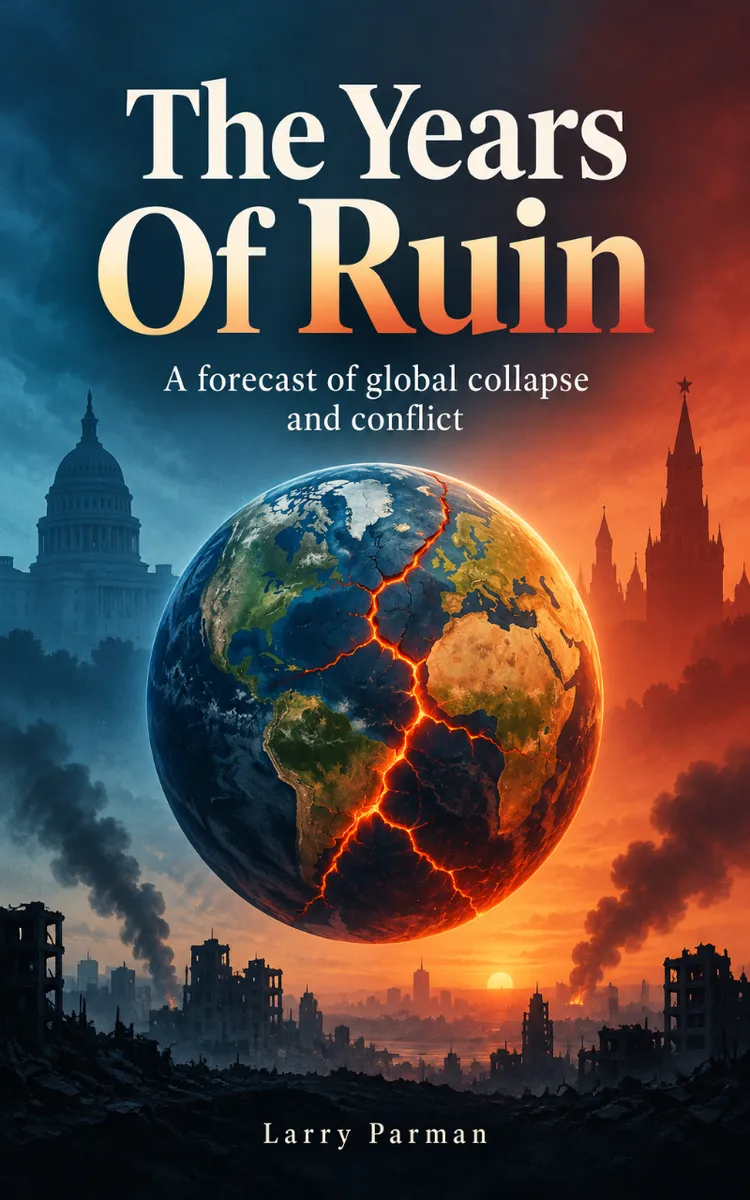
Read the first chapter
The whole of chapter one, free. About 7 min. Turn the pages with the arrows, your keyboard, or a swipe.
Chapter 1
World wide economic collapse across the developed world in 2027
The first sign of an economic collapse is rarely a dramatic crash on a stock exchange. More often, it appears as a delay: a payment that does not arrive, a shipment that remains stuck at a port, a bank that quietly tightens its lending rules, or a government that postpones a decision because the cost has become impossible to hide. By the time the public recognizes a crisis, the machinery beneath ordinary life may already be failing.
The prophecy examined here places a worldwide economic collapse across the developed world in 2027. That claim is not a proven forecast, and no single event can guarantee it. Economic breakdowns are produced by interacting pressures - debt, fragile financial markets, energy costs, political decisions, supply disruptions, and declining trust. The important question is not whether one dramatic prediction comes true exactly as stated. It is how a wealthy society could move from strain to paralysis when several weaknesses begin operating at the same time.
How Prosperity Becomes Dependent on Debt
Modern prosperity rests on promises about the future. A household borrows to buy a home, a company borrows to build a factory, and a government borrows to maintain services while waiting for future tax revenue. Credit allows activity to occur before all the money needed to pay for it has been collected. This is one of the most useful inventions in economic life, but it also creates a chain of obligations.
The chain becomes dangerous when income grows more slowly than the debt used to obtain it. Interest payments then take money away from wages, investment, public services, and everyday spending. A business may remain profitable on paper while having too little cash to pay suppliers. A government may continue collecting taxes while devoting an increasing share of its budget to earlier borrowing. A household may own valuable property yet struggle each month because its loan payments have risen.
For years, low interest rates made borrowing appear inexpensive. Cheap credit supported housing markets, business expansion, government spending, and the value of financial assets. When interest rates rise, the old loans do not all become expensive at once. The pressure arrives unevenly. Some borrowers refinance immediately; others are protected for a time by fixed-rate agreements. That delay can make the system look stable just before the weaknesses become visible.
A collapse in 2027, under this prophecy, would therefore not need to begin with a single failed institution. It could begin with a large number of ordinary borrowers reaching the point at which their income can no longer cover the cost of keeping earlier promises. Banks would then face losses, companies would reduce hiring and investment, and governments would confront demands for support at the same moment that tax revenue weakened.
Why Banks Can Spread a Local Shock
Banks are built to transform short-term deposits into longer-term loans. This arrangement supports homes, factories, shops, and public projects. It also means that a bank can be vulnerable when many depositors want their money at the same time or when the loans on its books lose value.
Confidence is central. Depositors do not normally withdraw all their funds because they assume the bank can meet ordinary demands. If that assumption changes, withdrawals can accelerate rapidly. Digital banking makes transfers faster than in earlier eras, allowing fear to move through a financial system before officials can explain what is happening. A rumor, a disappointing earnings report, or the failure of a prominent lender can become a test of every institution that appears similar.
Banks are connected through loans, payment systems, investment funds, and shared markets. A problem at one institution may cause another bank to question the safety of its counterparties. Lending between banks can contract, not because every bank is insolvent, but because no institution wants to be left holding an uncertain claim. Businesses then find that credit lines are reduced or withdrawn. A company that depended on regular borrowing to cover payroll or inventory can be pushed into failure even when its underlying trade remains sound.
The same process can affect governments. Banks and investment funds often hold public debt, while governments may be expected to support banks during a crisis. If investors begin doubting a government's ability to borrow, the cost of that borrowing rises. Higher costs weaken public finances, which can further damage the banks holding government debt. The relationship becomes a loop rather than a safety net.
How Supply Chains Turn Shortages into Recession
Economic systems are often described in national terms, but production is spread across borders. A vehicle may depend on components made in several countries. Medicines, machine tools, computer equipment, food packaging, and industrial chemicals may cross multiple borders before reaching their final user. The system is efficient when transport, finance, energy, and communications work smoothly. It is exposed when several of them falter together.
A disruption does not have to eliminate a product entirely to cause serious damage. A missing component can halt an entire production line. A delay in shipping can force a manufacturer to hold more inventory, pay more for transport, or turn away customers. When businesses respond by ordering extra supplies, the shortage can worsen because many buyers are competing for the same limited goods.
Energy is particularly important because it enters nearly every stage of production. Factories need power, transport requires fuel, and farms depend on machinery, fertilizer, storage, and refrigeration. Higher energy costs spread through prices, but the effects do not stop there. Families reduce discretionary spending, companies postpone investment, and governments face pressure to subsidize bills. Inflation and recession can therefore arrive together: prices rise while the amount of economic activity falls.
The developed world has advantages in technology, infrastructure, and access to capital, but those advantages can conceal dependence. A country may be wealthy while relying on distant suppliers for essential parts. It may have advanced hospitals while depending on international production for basic medical materials. Wealth reduces some risks; it does not remove the need for functioning networks.
Why Asset Prices Can Fall Before Daily Life Changes
Financial markets are forward-looking. Investors buy and sell according to expectations about future profits, interest rates, political decisions, and risk. This is why markets can decline before unemployment rises or shops close. Prices begin reflecting the possibility that earnings, property values, and government finances will deteriorate.
A long period of rising asset prices can create a misleading sense of security. Homes become collateral for loans. Shares support retirement plans and business financing. Commercial property is valued on the assumption that offices, shops, and warehouses will remain occupied. When expectations change, the value of those assets can fall faster than debts do. A borrower may owe the same amount while the property securing the loan is worth much less.
The consequences reach beyond investors. Pension funds, insurers, local governments, and ordinary savers may all be exposed to falling asset values. Companies that once raised money easily may find that investors now demand higher returns or refuse new financing. Construction slows when property prices no longer justify new projects. Small firms suffer when customers become cautious and lenders become selective.
This is the difference between a market correction and a broader economic collapse. A correction lowers prices but leaves the basic machinery of credit intact. A collapse damages the machinery itself. Payments are delayed, lending freezes, contracts are renegotiated, and institutions begin conserving cash simply to survive. At that point, the central problem is no longer the price of an asset. It is the ability to carry out ordinary transactions.
The Role of Government in a 2027 Crisis
Governments are usually expected to stop a financial panic from becoming a depression. They can guarantee deposits, provide emergency loans, support critical industries, reduce taxes, increase spending, or allow troubled institutions to fail in a controlled way. Each response has costs, and the available choices depend on the government's financial position and public legitimacy.
A government entering a crisis with heavy debt has less room to act. Emergency spending may calm the public but alarm lenders. Spending cuts may reassure markets but deepen unemployment and weaken demand. Raising taxes may protect public finances while placing additional pressure on households and companies already struggling with higher prices.
Political disagreement can make the economic damage worse. Financial rescue plans often require rapid decisions, yet democracies may be divided over who should receive support and who should bear the cost. If citizens believe that losses are being protected for powerful institutions while ordinary incomes are left exposed, trust can decline. Once trust weakens, even a technically sound policy may fail to calm the public.
The proposed collapse in 2027 should therefore be understood as a possible convergence of pressures rather than a date stamped on a calendar. Debt can make the system fragile. Higher interest rates can reveal that fragility. Banking stress can restrict credit. Supply disruptions can raise costs. Falling confidence can turn caution into panic. None of these forces alone guarantees worldwide collapse across the developed world. Together, however, they describe a path by which a rich and highly connected economy could become unexpectedly brittle.
Economic order depends on millions of promises being kept at roughly the expected time: wages paid, loans serviced, goods delivered, invoices settled, and public institutions trusted. When those promises begin failing together, collapse does not look like one falling tower. It looks like a landscape of small failures spreading until the connections between them become impossible to ignore.
End of chapter one. 3 more chapters and about 6,800 words in the full book.
Swipe or use the arrows to turn the page
What's inside: 4 chapters
- 1. World wide economic collapse across the developed world in 2027
- 2. World wide famine and epidemics in whole world with 70 percent death rate
- 3. American and European civil wars in 2028
- 4. Use of nuclear weapons in sporadic wars across globe in 2029 and 2030
About this book
"The Years Of Ruin" is a curiosity book by Anonymous with 4 chapters and approximately 6,800 words. A prophecy of economic collapse, famine, epidemics, civil wars, and nuclear conflict.
This book was created using Inkfluence AI, an AI-powered book generation platform that helps authors write, design, and publish complete books.
Frequently Asked Questions
What is "The Years Of Ruin" about?
A prophecy of economic collapse, famine, epidemics, civil wars, and nuclear conflict
How many chapters are in "The Years Of Ruin"?
The book contains 4 chapters and approximately 6,800 words. Topics covered include World wide economic collapse across the developed world in 2027, World wide famine and epidemics in whole world with 70 percent death rate, American and European civil wars in 2028, Use of nuclear weapons in sporadic wars across globe in 2029 and 2030.
Who wrote "The Years Of Ruin"?
This book was written by Anonymous and created using Inkfluence AI, an AI book generation platform that helps authors write, design, and publish books.
Write your own curiosity book with AI
Describe your idea and Inkfluence writes the whole thing. Free to start.
Start writingCreated with Inkfluence AI


