
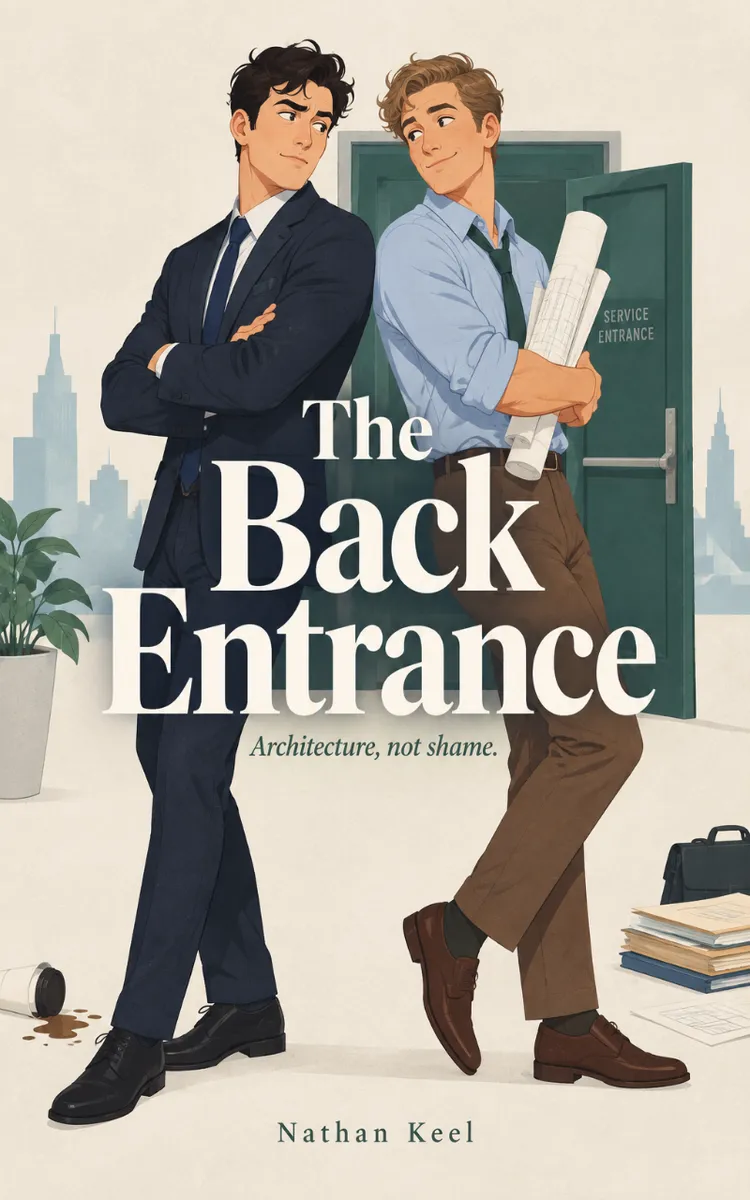

Read the first chapter
The whole of chapter one, free. About 9 min. Turn the pages with the arrows, your keyboard, or a swipe.
Chapter 1
Chapter 1: Dead, 1987–1994
The Well looked like a mouth that had given up on smiling.
Ellis Ward stood in what had been the center of the room and tried to decide whether the smell was beer, bleach, or grief. After two weeks with the doors locked, it had settled into a fourth thing: dust with a social life. Sunlight came through the front windows in cheap rectangles and laid itself across the scarred floor as if it still expected a crowd. The bar itself remained, a long dark rib, taps capped, the mirror behind it filmed gray. Someone had unplugged the neon over the backbar. The apostrophe in June’s had been the last to go. It hung there dead, a little black hook, like the sentence had been interrupted.
He had brought the good labels. Acid-free. Archival. The kind you used when you intended to outlast the people you were describing.
The first box was easy.
MATCHBOOKS. 1974–1991.
The second required a decision.
PHOTOS — UNIDENTIFIED. (SEE ALSO: FUNERALS.)
He wrote it, looked at it, and felt the small professional shame of a man who had just organized longing. He put the lid on anyway. That was the job. The city did not fund feelings. The city funded folders.
Ellis was thirty-five and already had the posture of someone late to a memorial. He dressed like it too: dark trousers that had been pressed on a Sunday, a shirt that believed in buttons, a jacket he did not take off indoors because the Well, even gutted, still felt like a place you should not get comfortable. His hair was the color of wet sidewalk. His face had the particular Midwestern quality of looking younger in photographs than in person, which was a trick grief played, or sleep.
On the bar sat Frank’s mug.
He had not meant to bring it. He had meant to bring Sharpies and a legal pad and the grant binder Marlene kept calling “the bible,” as if God were a reimbursement schedule. The mug had climbed into the tote by itself, the way certain objects did once they understood they were all that was left. It was white, chipped at the rim, printed with a faded map of Lake Michigan that made Milwaukee look like a thumbprint. Frank had drunk coffee from it as if coffee were a moral position.
Ellis turned the mug so the chip faced the wall.
“You don’t get a vote,” he told it.
The register was still on the backbar, a squat metal relic with a drawer that stuck. June had refused a computer until the world made refusal expensive. Ellis had been told this by four different people, each of them certain they were the only one who remembered. He worked the drawer with two hands. It opened on a protest of rust and old grease and yielded: petrified rubber bands, a roll of receipt tape gone the color of nicotine, a plastic saint with his face worn off, and, taped to the underside of the cash tray, a photograph.
He sat down on the floor to look at it. The floor was colder than it had any right to be in September.
Christmas, 1971. The date was written on the back in ballpoint that had decided to live forever. On the front: the Well with its lights on. Paper garland. A fake tree on the pool table. Men in collars and men in sweaters and one man in a coat he had not taken off, as if he might need to leave through a different door than the one he used to enter. In the center, June Keller wore a paper crown and an expression of ferocious hospitality, the look of a woman who had decided that if the world would not set a table, she would steal one. She was not pretty in the way photographs liked. She was better. She looked like she could end an argument with a ladle.
Ellis knew most of the faces the way a historian knew weather: by pattern, not by name. Two were still alive. One was on the board. One sent a check every December with no note. The rest were in the boxes.
He held the photo by the edges.
“Hello,” he said, which was not professional, and then, because no one was there to stop him, “You look busy.”
The back door, down the short hall past the restrooms, gave its usual opinion of the wind. It was a thick door with a window the size of a prayer book, wire in the glass, a deadbolt that had been replaced more often than some marriages. Regulars still called it the back entrance with a seriousness other people reserved for sacraments. Ellis had written three grant sentences about it and deleted all of them. The truth did not like being bullet-pointed.
He taped the photograph to the inside of the register lid, where June had kept it. Then he labeled the next box.
DEAD, 1987–1994.
The Sharpie squeaked. He sat with the sound.
That decade was a hallway in him. He had been a child for most of it, which did not exempt him from inheriting the furniture. Frank had been twenty-three in 1991 and spoke of that year the way other men spoke of weather they had barely survived: lightly, and only after the second drink. Ellis had learned the names from programs and from the wall in the project office and from the way certain older men still looked at a door when it opened. He was good at the work because he was willing to be accurate about other people’s losses. His own he filed under ongoing.
A key turned in the front lock.
He stood too fast. The blood left his head in a petty little rush. He put a hand on the bar as if the Well might still offer service.
Marlene Kovacs came in with two paper cups and the expression of a woman delivering news to a building. She was fifty-eight and lacquered in the specific way of women who had attended too many benefits and all of the funerals. Her hair was a structured bronze. Her coat was better than the neighborhood. She had been beautiful at thirty in a loud, inconvenient style; at fifty-eight she was handsome, which she considered a promotion.
“You’re on the floor,” she said. “That’s never a grant strategy.”
“I found June.”
“June is on every wall I own. Drink this. It’s coffee in the academic sense.”
He took the cup. It was hot and faintly wrong, like most kindness. Marlene set her own on the bar beside the mug, saw the mug, and did not comment, which was how he knew she had seen it.
She looked around with the satisfaction of a landlord and the grief of a parishioner. “They took the stools.”
“Developer. Inventory.”
“Inventory. Christ. As if a stool were a stapler.” She peeled the lid off her coffee and blew on it, a dainty act that fooled no one. “I have news. You’re going to make that face.”
“I have one face.”
“You have a citation face and a funeral face. This will require both.”
Ellis waited. Marlene liked a runway.
“The Coalition is coming,” she said. “National conference. Here. Milwaukee. Don’t look at me like I arranged the weather. They want a Midwestern story that isn’t a tragedy with a barn. PrideFest dates, hotel blocks, a gala. They’ve already sold the gala.”
“To whom?”
“To people with lanyards, Ellis. Try to keep up.” She sipped. “There’s more. The developer isn’t waiting for our marker like a gentleman. He’s retained someone. Chicago. An experience architect.” She said the title the way she said colonoscopy. “The Coalition’s events underwriter loves him. They want to ‘activate the site.’ Those were the words. I wrote them down so I could hate them accurately.”
Ellis set his cup on the bar. A little coffee leapt over the rim and made a map of nothing.
“Activate,” he said.
“I know.”
“It’s a bar.”
“It was a bar. Now it’s a sentence they haven’t finished.” Marlene’s mouth tightened. “We keep our seat if you co-author the public narrative. Ten days to a deck.”
Ellis looked at her.
“A presentation,” she said, already annoyed at having to translate. “Slides. Pretty ones. The kind of thing you send people who will not read a grant unless it comes with a photograph and a conclusion they can repeat in a meeting. You and the coat from Chicago write it together. What the room was. What they intend to do to it. Why anyone should give us a chair at our own table. Ten days. Then four weeks to the gala and the hearing.”
“They want the Well in PowerPoint.”
“They want the Well in a form they can forward. Don’t make that face at the software. Make it at the caption.”
Ellis looked at DEAD, 1987–1994 and wanted, childishly, to sit on the lid.
“What’s his name?”
“Julian Voss. Jules, if you want to be Darling. I looked him up. He does joy for a living. Can you imagine. Joy, itemized.”
“I don’t want a partner.”
“You have a mug,” Marlene said, not unkindly. “You have a wall of photocopies. You have me, which is not the same as a life. Do this so the bronze isn’t a cocktail napkin with a QR code.”
He almost smiled. It felt like a leak.
“The marker committee still exists?”
“Until someone with better catering says it doesn’t.” She tapped a nail on the bar. “You can write the truth into their pretty paragraph or they will write a pretty paragraph on top of the truth. Those are the options. There is not a third option in which we are left alone with our boxes.”
She allowed herself, briefly, to look tired. “I loved this room. I loved it in a way that made me ridiculous. I am trying very hard not to be ridiculous in front of national money. Help me.”
Ellis picked up the Sharpie, then put it down. The Well ticked, old wood, old pipes, the sound of a place that had not agreed to be over.
“If he says resilience,” Ellis said, “I walk.”
“If he says resilience, you smile and write raid in the footnote. Preferably a footnote they cannot delete when they turn it into slides.” Marlene smoothed her coat. “He’s due now. I told him eleven. It’s eleven-twelve. Chicago people think punctuality is a hobby.”
“You invited him here?”
“I invited him to the asset.” She grimaced at her own mouth. “Their word. I wanted you to meet him in the room, not in a file they can forward. Files lie. Rooms only exaggerate.”
The front door opened as if it had been waiting for a cue.
The coat arrived first.
It was the color of an expensive hour after midnight, cut like an argument against weather. The man inside it was thirty-seven and assembled with the kind of care that looked accidental only to people who had never tried. Dark hair, precise. A face that had learned what lighting wanted and then gotten bored of giving it. He stood on the threshold and did not knock, because the door was already open and because some men treated thresholds as a formality.
He took in the gutted Well the way a person took in a floor plan: exits, sightlines, what the money would have to forgive.
Then he looked at Ellis, and the look was not unkind. That was the problem. Unkind would have been easier to file.
“So this is the asset,” Jules Voss said.
Ellis heard Marlene inhale, a small liturgical sound.
He did not pick up the mug. He did not pick up the Sharpie. He put one hand on the bar, on the scar where a thousand glasses had landed, and heard himself say, with a courtesy so dry it could have been packed in acid-free paper:
“It’s a door. You should come all the way in before you name it.”
End of chapter one. 28 more chapters and about 34,494 words in the full book.
Swipe or use the arrows to turn the page
What's inside: 29 chapters
- 1. Chapter 1: Dead, 1987–1994
- 2. Chapter 2: The Asset
- 3. Chapter 3: Cream City Memory
- 4. Chapter 4: Authentic Queer Joy™
- 5. Chapter 5: The Inscription Committee
- 6. Chapter 6: Bennett, Tastefully
- 7. Chapter 7: Pride Is a Weather System
- 8. Chapter 8: The Deck
- 9. Chapter 9: Regional Voices
- 10. Chapter 10: The Patron
- 11. Chapter 11: Calvin’s Key
- 12. Chapter 12: The Rule About Nights
- 13. Chapter 13: B-roll
- 14. Chapter 14: Stuart at the Front Door
- 15. Chapter 15: Thanksgiving Was a Liturgy
- 16. Chapter 16: June Lied a Little
- 17. Chapter 17: Harlan Makes an Offer
- 18. Chapter 18: The Softening
- 19. Chapter 19: Caprice Works the Room
- 20. Chapter 20: Lorraine Shops the Wound
- 21. Chapter 21: Two Speeches
- 22. Chapter 22: The Mannequin
- 23. Chapter 23: Missing
- 24. Chapter 24: The Gala, Part One: Doors
- 25. Chapter 25: The Gala, Part Two: The Sentence
- 26. Chapter 26: After Last Call
- 27. Chapter 27: The Hearing
- 28. Chapter 28: The Unofficial Sentence
- 29. Coda: Architecture
About this book
"The Back Entrance" is a romance book by Nathan Keel with 29 chapters and approximately 34,494 words. A dead bar. A locked archive.
This book was created using Inkfluence AI, an AI-powered book generation platform that helps authors write, design, and publish complete books. It was made with the AI Romance Novel Writer.
Frequently Asked Questions
What is "The Back Entrance" about?
A dead bar. A locked archive. And a stranger who walks in like he owns the past. Ellis Ward has spent years filing other people’s lives into labeled boxes, keeping grief from spilling into the present. Then Jules arrives, polished and unsettling, and the Cream City Memory Project becomes something else entirely: a job that needs more than paperwork. When a set of slides appears with a message that feels like a dare, Ellis is pulled toward a question he cannot file away. What if the history they are preserving is also the history they are trying to erase, and the wrong person is holding the key?
How many chapters are in "The Back Entrance"?
The book contains 29 chapters and approximately 34,494 words. Topics covered include Chapter 1: Dead, 1987–1994, Chapter 2: The Asset, Chapter 3: Cream City Memory, Chapter 4: Authentic Queer Joy™, and more.
Who wrote "The Back Entrance"?
This book was written by Nathan Keel and created using Inkfluence AI, an AI book generation platform that helps authors write, design, and publish books.
How can I create a similar romance book?
You can create your own romance book using Inkfluence AI. Describe your idea, choose your style, and the AI writes the full book for you. It's free to start.
Write your own romance book with AI
Describe your idea and Inkfluence writes the whole thing. Free to start.
Start writingCreated with Inkfluence AI


