

Read the first chapter
The whole of chapter one, free. About 6 min. Turn the pages with the arrows, your keyboard, or a swipe.
Chapter 1
AI Service Business Blueprint
A local contractor once handed a freelancer a folder containing three months of customer questions, missed follow-ups, and unfinished marketing drafts. The freelancer did not sell “AI.” The freelancer sold a cleaned-up response system, approved message templates, and a weekly delivery process. The client understood the purchase immediately: fewer loose ends and faster customer communication.
That distinction defines an AI service business. Clients do not buy prompts, models, or clever demonstrations. They buy a business result delivered through a dependable process. Your job is to turn AI-assisted work into a clearly packaged service that someone can approve, pay for, and use without managing your technology.
The Box-to-Book Blueprint
The Box-to-Book Blueprint gives you the complete path from a client problem to a repeatable service. The “box” represents the contained offer: one problem, one deliverable, one price, and one delivery promise. The “book” represents the operating system behind that offer: intake, production, review, approval, handoff, and retention.
Start with the client’s repeated task, not the tool. A gym owner may need weekly member emails. A plumber may need faster replies to quote requests. A property manager may need consistent tenant notices. These needs differ, but each one can become a service when you define the work tightly.
Write the offer in one sentence:
> I help [specific business type] produce [specific deliverable] so they can [practical business outcome], delivered [on a clear schedule].
For example: “I help independent gyms produce four weeks of member communication so staff can stay in touch without writing from scratch, delivered every Monday for approval.” The sentence identifies the buyer, the output, the reason to care, and the delivery rhythm. If you cannot write this sentence clearly, the service remains an idea rather than an offer.
Next, set the box boundaries. State what the client receives, what information you need, how many revisions you include, when you deliver, and what the client must approve. A monthly content service might include twelve captions, four email drafts, and one approval round. It might exclude posting, paid advertising, photography, and emergency requests. Boundaries protect your margin because they prevent a small package from turning into unlimited custom work.
The book behind the box contains your internal checklist. Record the client’s intake answers, source materials, draft versions, review notes, approval status, and delivery date. Every AI-produced business deliverable requires human review before you send it to a client or publish it. That review checks facts, tone, names, prices, dates, promises, and unsupported claims. AI can accelerate production, but your judgment remains part of the product.
Turning a Task Into a Paid Offer
Choose a task that meets three conditions: the client performs it often, the task consumes noticeable time, and a better version creates a visible business benefit. Repeated work creates room for a process. Time pressure creates willingness to pay. A visible benefit makes the price easier to defend.
Avoid selling a vague “AI consulting” package to a local business unless the buyer already understands the need. A small business owner usually responds better to “a ready-to-use follow-up message pack” than “AI-powered customer engagement optimization.” Name the finished item and show how the owner will use it.
Build three versions of the same outcome rather than three unrelated services. The entry-level package should solve the immediate problem with a narrow deliverable. The standard package should add useful depth, such as more variations, a review call, or implementation guidance. The premium package should add speed, customization, monitoring, or an ongoing delivery schedule.
Price the work around responsibility, not typing time. If you spend two hours producing drafts but must verify customer-facing claims, organize source material, handle revisions, and meet a deadline, charge for the complete service. A practical starting structure might look like this:
• Entry-level: one defined deliverable with one revision round. - Standard: a larger deliverable with customization and a short handoff call. - Premium: recurring production, priority turnaround, and performance review.
Use a fixed price when the scope stays predictable. Use a monthly recurring option when the client needs the same type of output repeatedly. Do not promise results you cannot control, such as guaranteed bookings or guaranteed revenue. Promise the work you can deliver: accurate drafts, organized assets, clear approval steps, and dependable timing.
Moving From Intake to Delivery
Your first client conversation should uncover the current process. Ask what happens now, where work gets delayed, what customers receive, who approves the final material, and what information must never change. These answers shape the service more effectively than a generic questionnaire.
Request only the information required for the agreed deliverable. For a customer email package, you may need the business description, offer details, service area, booking link, preferred tone, prohibited claims, and approval contact. Do not collect unrelated customer records simply because an AI tool can process them. Limit access to the people and systems that need it, and explain how you will handle the material.
After intake, create a production brief. Keep the brief in one working document or controlled workspace with the client’s facts, audience, format, deadline, and acceptance rules. Generate a draft from that brief, then review it against the source material. Mark uncertain items instead of guessing. Ask the client to resolve missing prices, dates, policies, or service details before final delivery.
Send the deliverable in a format the client can use immediately. Include a short handoff note that explains what changed, what requires approval, and how the client should request revisions. A clean handoff reduces back-and-forth and shows that your service includes implementation support, not merely generated text.
Building Retention Into the Offer
Retention starts when the first package solves a problem the client expects to face again. A one-time deliverable can become recurring revenue when you identify the natural repeat cycle. Monthly promotions, weekly follow-ups, seasonal updates, staff materials, and ongoing content all create legitimate reasons for continued work.
At the end of each delivery, record three items: what the client approved, what required revision, and what the next delivery needs. Use that record to improve the next cycle. If the owner repeatedly corrects service descriptions, add a verified service sheet to the client’s source materials. If approvals arrive late, set a fixed approval deadline and explain how delays affect delivery.
Offer a renewal based on continued usefulness, not pressure. Tell the client what the next cycle includes, when you need their inputs, and what improvement you can make based on the previous delivery. You can also offer relevant add-ons, but keep them connected to the original problem. Do not turn every client conversation into a catalog of unrelated AI services.
Protect trust through clear limits. Never fabricate reviews, send spam, impersonate a person, copy another business’s work, claim credentials the client does not possess, or use confidential data without authorization. These practices may create short-term output, but they damage the client’s reputation and your own service business.
The strongest AI service business looks simple from the client’s side: a defined problem enters, an approved deliverable leaves, and the next delivery arrives on schedule. Behind that simplicity, the Box-to-Book Blueprint gives you the structure to package useful work, price it responsibly, deliver it with human judgment, and turn one successful project into a dependable business relationship.
End of chapter one. 39 more chapters in the full book.
Swipe or use the arrows to turn the page

Civilian Airgun Safety & Maintenance

Mail-Order Defense Bible

Airgun & Defense Equipment Master Reference
What's inside: 40 chapters
- 1. AI Service Business Blueprint
- 2. AI Fundamentals for Nontechnical Owners
- 3. Choosing the Right AI Tools
- 4. Prompt Engineering That Delivers
- 5. Hallucination Control and Verification
- 6. Intellectual Property and Usage Rights
- 7. Client Confidentiality and Data Handling
- 8. Privacy Compliance for Local Businesses
- 9. Cybersecurity Basics for Freelance AI
- 10. Automation Platforms and Workflow Orchestration
- 11. Spreadsheets as Your Data Backbone
- 12. CRMs, Content Pipelines, and Reporting
- 13. Review-Response System for Google
- 14. Social Media Calendar for 30 Days
- 15. Newsletter Drafts and Send-Ready Copy
- 16. Sales Script for Phone Appointments
- 17. SOP Manual for AI-Assist Workflows
- 18. Employee Training Slides for New SOPs
- 19. Customer Support Knowledge Base Drafts
- 20. FAQ System for Website and Sales
- 21. Lead Research for Local Service Prospects
- 22. Customer Reactivation Email Sequences
- 23. CRM Cleanup and Pipeline Standardization
- 24. Spreadsheet Categorization for Client Data
- 25. Contractor Follow-Up Message Pack
- 26. Real-Estate Marketing Support Pack
- 27. Restaurant Promotions and Event Copy
- 28. Service Reminders for Appointments
- 29. Proposal Creation for Local Services
- 30. Meeting Summaries and Action Items
- 31. Competitor Research for Local Markets
- 32. Local-Market Report for Expansion
- 33. Job Description and Hiring Packet
- 34. Onboarding Package for New Clients
- 35. Presentation Development for Proposals
- 36. Direct-Mail Copy for Local Campaigns
- 37. Advertising Concepts and Ad Copy
- 38. Referral Campaign Kit for Customers
- 39. Customer Survey Design and Analysis
- 40. Appointment Scripts and Confirmation Pack
About this book
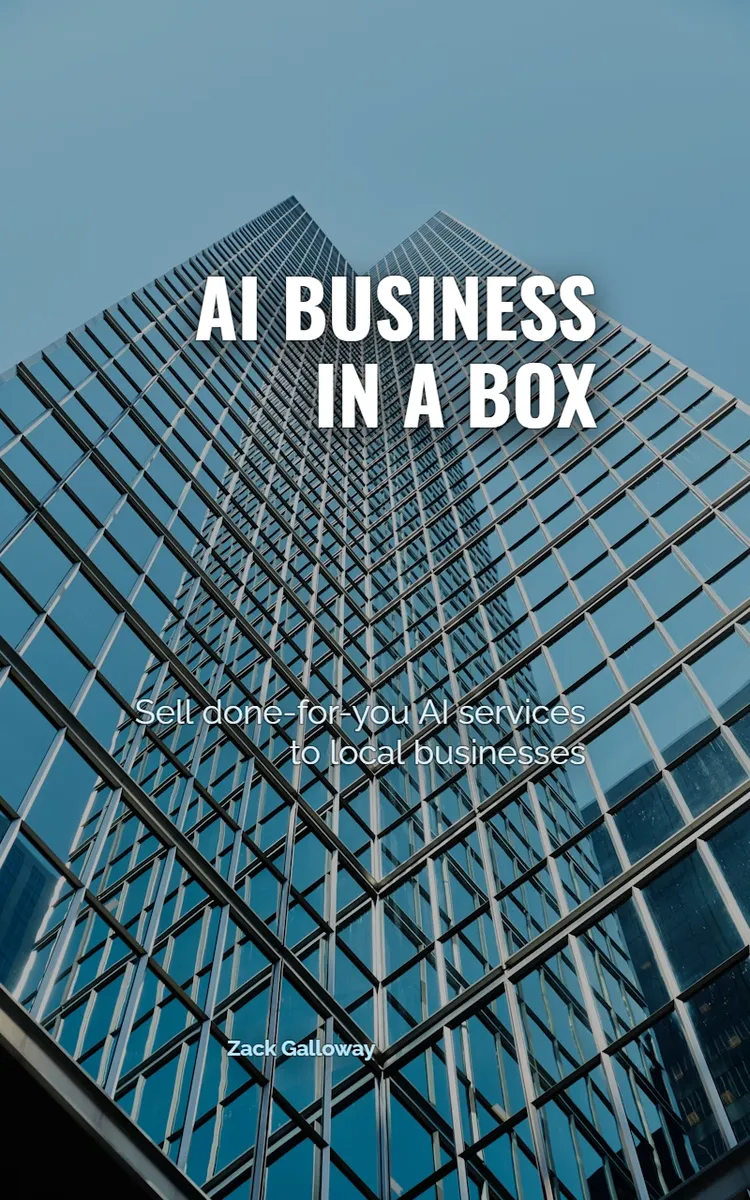
"AI Business In A Box" is a business book by Zack Galloway with 40 chapters and approximately 62,951 words. Creating and selling AI-assisted services for local businesses.
This book was created using Inkfluence AI, an AI-powered book generation platform that helps authors write, design, and publish complete books. It was made with the AI Business Book Writer.
Frequently Asked Questions
What is "AI Business In A Box" about?
Creating and selling AI-assisted services for local businesses
How many chapters are in "AI Business In A Box"?
The book contains 40 chapters and approximately 62,951 words. Topics covered include AI Service Business Blueprint, AI Fundamentals for Nontechnical Owners, Choosing the Right AI Tools, Prompt Engineering That Delivers, and more.
Who wrote "AI Business In A Box"?
This book was written by Zack Galloway and created using Inkfluence AI, an AI book generation platform that helps authors write, design, and publish books.
How can I create a similar business book?
You can create your own business book using Inkfluence AI. Describe your idea, choose your style, and the AI writes the full book for you. It's free to start.
Write your own business book with AI
Describe your idea and Inkfluence writes the whole thing. Free to start.
Start writingCreated with Inkfluence AI


