
Read the first chapter
The whole of chapter one, free. About 6 min. Turn the pages with the arrows, your keyboard, or a swipe.
Chapter 1
The Mountain That Rang
The first toll struck while Cassian Rook was still crossing the last bridge into Orrel Reach.
It came through the stone beneath his boots rather than through the air: a deep, metallic note that made the bridge chains tremble and sent a flock of white cliff-crows bursting from the ravine. Cassian stopped with one hand on the rail. Far below, the river flashed between black walls of rock, its surface shivering in rings though no wind touched it.
A second toll followed.
This time the mountain answered.
The pass ahead lurched. Pebbles skipped across the road. Somewhere beyond the bend, a horse screamed.
Cassian tightened the strap of his instrument case and ran.
The settlement of Bellwether had been built in the throat of the pass, its slate roofs wedged beneath cliffs that leaned toward one another like closing jaws. By the time Cassian reached the first houses, people were spilling into the road. A woman dragged two children from beneath a sagging awning. A mule kicked through its traces, eyes rolling white.
“Get them away from the cliff!” Cassian shouted.
A man in a dark wool coat seized his sleeve. “You’re the engineer?”
“Cassian Rook.”
“Then tell them it’s only an echo.”
The man’s badge showed the silver wheel of Orrel Reach. His face was narrow and bloodless, his hair plastered to his forehead by the rain.
“An echo doesn’t move foundations,” Cassian said.
“It has moved nothing.” The official glanced toward the mountain. “The pass has always rung.”
“Not in the summons I received.”
The official’s mouth tightened. “I am Prefect Halven. You were called because the council wants a report, not a panic.”
Another vibration rolled through the road. Dust sifted from the eaves. A chimney cracked with a sound like a snapped bone.
Cassian looked up. The cliffs were streaked with old snow and threaded by dark seams. No loose rock fell. That bothered him more than the tremor. The mountain was not collapsing. It was transmitting force.
“Where is the source?” he asked.
Halven pointed into the narrowing pass. “Three miles beyond the shrine. You’ll find nothing there but stone.”
“Then it won’t take long to prove you right.”
He pushed past before the prefect could answer.
The road climbed between walls of granite polished smooth by centuries of rain. Each toll arrived at uneven intervals, sometimes minutes apart, sometimes close enough that the second vibration seemed to ride inside the first. Cassian counted under his breath, marking duration and direction. The sound was not merely loud. It had a body. A rise, a sustained note, and a fading tremor that traveled beneath the soles of his boots.
At the shrine, a cluster of villagers had tied red cords around the old stone posts. A priest stood beneath the carved lintel, chanting against the mountain.
“Does this happen every season?” Cassian asked.
The priest stared at him. “It happens when the Reach is displeased.”
“Stone doesn’t become displeased.”
“Stone remembers.”
Halven caught up, breathing hard. “Enough. The shrine marks the old boundary. Past it, the pass is unstable.”
Cassian crouched beside one of the posts. Its base had shifted half an inch, but the movement was clean and horizontal. The post had been pushed from below, not struck by falling rock. He drew a brass caliper from his case and measured the gap.
“Your harmless echo is applying lateral force.”
“Your tools don’t make you the mountain’s master.”
“No,” Cassian said, rising. “They make me less likely to lie about it.”
Halven’s expression hardened. “Turn back. I will report that you inspected the shrine and found no immediate threat.”
Cassian looked beyond him. The pass narrowed ahead until the sky became a thin blue blade. Somewhere in that throat, metal was tolling beneath the earth.
“If the sound is coming from the rock,” he said, “then the settlement is already beside the source.”
“The settlement has stood here for six hundred years.”
“And the mountain has only recently begun ringing.”
That silenced the prefect.
Cassian continued alone.
Rain began as he entered the narrowest section. It struck his coat in cold needles and ran into his gloves. The walls rose so steeply that the road seemed cut through the bottom of a dry well. He kept one palm against the stone as he walked. The granite vibrated faintly, not continuously but in pulses, each one arriving from deeper below.
At the next toll, the ground tilted.
Cassian dropped to one knee as his instrument case slid downhill. He caught its handle just before it struck the wall. The sensation lasted only three breaths, but during those breaths the loose stones on the road rolled uphill toward him.
Then gravity settled.
Cassian stared at the stones.
He had seen gravity falter once before, in a quarry outside Veyr’s eastern border. There, the change had been local and brief, an invisible slope imposed across the ground. The quarry master had blamed a buried spring. Cassian had found no spring, only a pattern in the failures: every disturbance had followed the same direction.
He retrieved the case and opened it beneath the shelter of an overhang. A small weighted pendulum hung from its frame. It swung east, stopped, then swung north as the mountain gave another low metallic note.
The sound was closer now.
Cassian packed the instrument and pressed onward.
The road ended at a wall of fallen stone. Beyond it, the pass continued as a narrow cleft, but the collapse was too fresh to climb safely. He examined the debris. The blocks had not fallen from above. Their faces were clean, their edges squared, and beneath them the road showed a long, shallow groove.
Something had pushed through.
He cleared a section with both hands, scraping his knuckles against grit. Under the stones lay a slab of black material unlike the surrounding granite. It was smooth, cold, and faintly warm at its center. A narrow line crossed it from edge to edge.
Cassian placed his ear against the slab.
The next toll came through it.
Not an echo. Not a natural resonance. The note carried the measured impact of a great mechanism: a strike, a pause, and a returning vibration from something farther below.
He stood and drew his hammer.
“Cassian!”
Halven’s voice bounced through the cleft. The prefect appeared at the edge of the collapse with two armed wardens behind him.
“What have you found?” Halven demanded.
“Something built.”
“Nothing is built here.”
Cassian struck the slab lightly with the hammer. The metal rang with a thin, precise tone. Far beneath them, the mountain answered in a different register.
One of the wardens crossed himself.
Halven went pale. “Cover it.”
Cassian turned. “You knew.”
“I knew there were old workings. Abandoned tunnels. Nothing more.”
“Then why did you order me away?”
“Because people live below this pass.”
“People live below it because you’ve kept them ignorant.”
The prefect stepped closer. “You think knowledge will save them? If the council learns there is a fault beneath Bellwether, they will evacuate the Reach. Trade will stop. Winter stores will never arrive. Thousands will suffer because you wanted a satisfying explanation.”
Cassian looked at the black slab. Its seam had widened by the thickness of a fingernail.
He knelt and brushed away the wet grit around its edge. Beneath the mud, a symbol emerged: three concentric arcs crossed by a straight vertical line, all cut with impossible precision. At the center sat a tiny recessed mark shaped like a closed eye.
His fingers went cold.
The pattern was not a mason’s sign. It was an access mark.
He had seen a similar design stamped on a broken pressure regulator years ago, though the maker’s name had been filed away. At the time, he had assumed it belonged to some extinct guild. Now the mark sat beneath an entire mountain.
“Cassian,” Halven said, quieter. “Step away.”
Cassian traced the outer arc with one gloved finger. The stone beneath it thrummed.
“What does it open?” he asked.
Halven did not answer.
A fresh tremor began.
It rose from under the pass with a slow, grinding force. The black slab shifted. The cliffs groaned, and somewhere far below, something enormous began to turn. The access mark brightened with a dull amber glow, one arc at a time.
Cassian braced himself against the wall as the road buckled.
Then, from beneath the mountain, the tolling answered - not once, but from three distant peaks.
The sound was spreading.
End of chapter one. 4 more chapters and about 6,557 words in the full book.
Swipe or use the arrows to turn the page
What's inside: 5 chapters
- 1. The Mountain That Rang
- 2. The Weightless Bell
- 3. The River’s Missing Current
- 4. The Station Beneath Orrel
- 5. A Map of Hidden Bearings
About this book
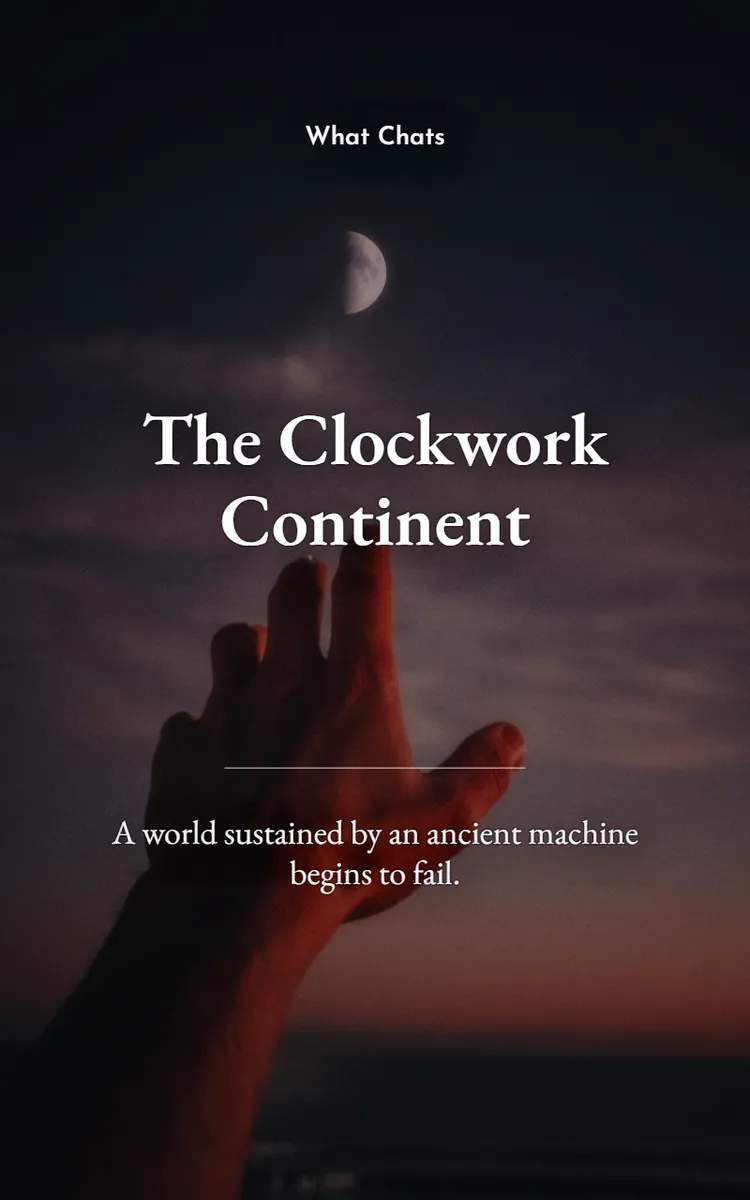
"The Clockwork Continent" is a fiction book by What Chats with 5 chapters and approximately 6,557 words. An engineer investigates the failing machine that governs a fantasy continent’s natural laws..
This book was created using Inkfluence AI, an AI-powered book generation platform that helps authors write, design, and publish complete books. It was made with the AI Novel Writer.
Frequently Asked Questions
What is "The Clockwork Continent" about?
An engineer investigates the failing machine that governs a fantasy continent’s natural laws.
How many chapters are in "The Clockwork Continent"?
The book contains 5 chapters and approximately 6,557 words. Topics covered include The Mountain That Rang, The Weightless Bell, The River’s Missing Current, The Station Beneath Orrel, and more.
Who wrote "The Clockwork Continent"?
This book was written by What Chats and created using Inkfluence AI, an AI book generation platform that helps authors write, design, and publish books.
How can I create a similar fiction book?
You can create your own fiction book using Inkfluence AI. Describe your idea, choose your style, and the AI writes the full book for you. It's free to start.
Write your own fiction book with AI
Describe your idea and Inkfluence writes the whole thing. Free to start.
Start writingCreated with Inkfluence AI


