

Read the first chapter
The whole of chapter one, free. About 6 min. Turn the pages with the arrows, your keyboard, or a swipe.
Chapter 1
Review Without Repeating Yourself
By now, the Sound-Spot routine should feel familiar. You show a letter, help the child say its sound, connect that sound to a known word, and listen for it again. In Volume 1, this routine gave children a steady path from seeing a letter to hearing what it does.
Now the goal is changing.
In this volume, children will begin using sounds together to read simple words. That means the Sound-Spot routine still matters, but it no longer needs to take up the whole lesson. Think of it as a quick warm-up rather than the main event.
The helpful mindset for this week is:
Same routine, new goal.
You are not starting over. You are briefly waking up a skill children already know, then using it for something new.
A Short Sound-Spot Refresh
Choose two or three familiar letters. Use sounds the child has practiced successfully, such as m, s, f, t, or p. Hold up one letter at a time and move through the familiar pattern:
• Look at the letter.
• Say the sound.
• Connect it to a familiar word.
• Listen for the sound again.
Keep this review to a minute or two. You might hold up m and say, “This letter is m. Its sound is /m/, as in moon. Can you say /m/?” Then invite the child to listen for /m/ in a word such as map or mouse.
After two or three letters, stop. The purpose is not to practice every letter or prove that the child remembers everything. The purpose is to make sure the sounds needed for the next activity are ready to use.
If you are working with the letters m, a, and t, for example, a quick review might sound like this:
• “What sound does m make?”
• “What sound does a make?”
• “What sound does t make?”
Then move toward the new goal: “Let’s see what happens when we put some of those sounds together.”
Review Only What You Need
One common mistake is reviewing too much. An adult may think, “Before we read words, we should go through all the sounds again.” That can turn a quick warm-up into a long drill. Children may lose interest before they reach the part that matters most.
Instead, choose sounds based on the activity ahead.
If you plan to read sat, review s, a, and t. If you plan to read map, review m, a, and p. This approach keeps review useful and gives children an immediate reason to remember the sounds.
You can think of each sound as a tool. You do not unpack every tool before hanging one picture. You select the few you need, check that they work, and begin.
Let the child show readiness
During the review, notice how the child responds.
• If the child gives the sound quickly, keep moving.
• If the child hesitates, repeat the cue once and offer a familiar example.
• If the child gives the letter name instead, calmly return to the sound.
• If the child seems tired or frustrated, reduce the number of letters and begin the word activity another time.
A quick check might be as simple as holding up p and asking, “Sound?” If the child says “pee,” respond, “Yes, the letter is called p. Its sound is /p/, as in pop.” Then continue. There is no need to stop for a long explanation.
Change the Question, Not the Routine
In Volume 1, you often asked children to find a sound in a word. Now you can keep the same listening habit while asking a new kind of question.
For example, after reviewing m, a, and t, say:
“We know these sounds. What word might they make together?”
This question shifts attention from one sound to a group of sounds. The routine remains steady, but its purpose expands. Children are no longer only identifying a sound. They are preparing to combine sounds into a word.
You can also say:
• “Listen to this sound. Which letter could show it?”
• “We have three letters. Let’s say each sound.”
• “What do you notice when we put the sounds close together?”
These questions help children understand that letters are not isolated facts. Letters work together to represent the spoken words they already know.
A Five-Minute Routine for the Week
Use this simple structure during the week ahead. Adjust the timing to fit the child and the setting.
Minute 1: Wake up the sounds
Show two or three known letters. Ask for their sounds. Give a brief, familiar word connection when needed.
Minute 2: Put the letters in a row
Place two or three letters from left to right. Do not ask the child to read the word immediately. First, point to each letter and invite the child to say the sounds.
For example:
m - a - t
“Say each sound with me: /m/... /a/... /t/.”
Minute 3: Move closer together
Point to the letters again, this time with less space between each sound. Encourage the child to say the sounds in a smooth sequence.
“Let’s try it again without stopping so long: /m/ /a/ /t/.”
At this stage, the child may not yet hear the complete word. That is fine. The aim is to help the sounds stay connected.
Minute 4: Say the word
Model the blend if necessary: “/m/ /a/ /t/... mat.” Then invite the child to try. Keep your voice natural and encouraging.
Minute 5: Celebrate the new use
Point out what happened: “You used the sounds to read a word.” This is more helpful than saying only, “Good job.” It tells the child which action mattered.
Keep the Old Habit Gentle
As children begin reading simple words, it can be tempting to correct every small mistake. Try to keep the calm style from Volume 1. A mistake is information, not a failure.
If a child reads mat as “map,” you might say, “You started with the right sounds. Let’s look at the last letter. Is it t or p?” Then return to the sound and try the word again.
If the child guesses a word from a picture, cover the picture for a moment and say, “Let’s use the letters. What sounds do you see?” This gently brings the child back to the print without making guessing feel shameful.
If the child becomes stuck, provide the first sound or blend the word yourself. The goal is to build a reliable path, not to make the child struggle alone.
The Week Ahead: Same Routine, New Goal
For this week, keep the Sound-Spot habit brief and purposeful. Review only the sounds that will support the next activity. Then use those sounds to help children notice a new idea: letters can be put together to make words.
You might follow this pattern:
• Day 1: Review two sounds and match them to letters.
• Day 2: Review three sounds and say them in order.
• Day 3: Blend two or three sounds with your help.
• Day 4: Read one familiar simple word.
• Day 5: Repeat the word and try another word using the same sounds.
Short practice is enough. End while the child is still comfortable. A successful two-minute activity is more valuable than a long session that feels like a test.
The Sound-Spot routine has not disappeared. It has become a foundation. You are still helping children look closely, hear accurately, and connect sound with print. The difference is that now those connections can begin to travel together, from separate sounds toward simple words.
End of chapter one. 6 more chapters in the full book.
Swipe or use the arrows to turn the page

1. Volume 1: The Sound-Spot Routine

Learn To Read Understand Phonics

First Grade Spanish Word Builder
What's inside: 7 chapters
- 1. Review Without Repeating Yourself
- 2. Blending: Push, Slide, Smile
- 3. Segmenting for Spelling Success
- 4. Word Reading with CVC Flash Cards
- 5. Tricky Words: Spot, Practice, Move On
- 6. Reading Mini-Messages, Not Worksheets
- 7. A Two-Part Practice Plan for the Week
About this book
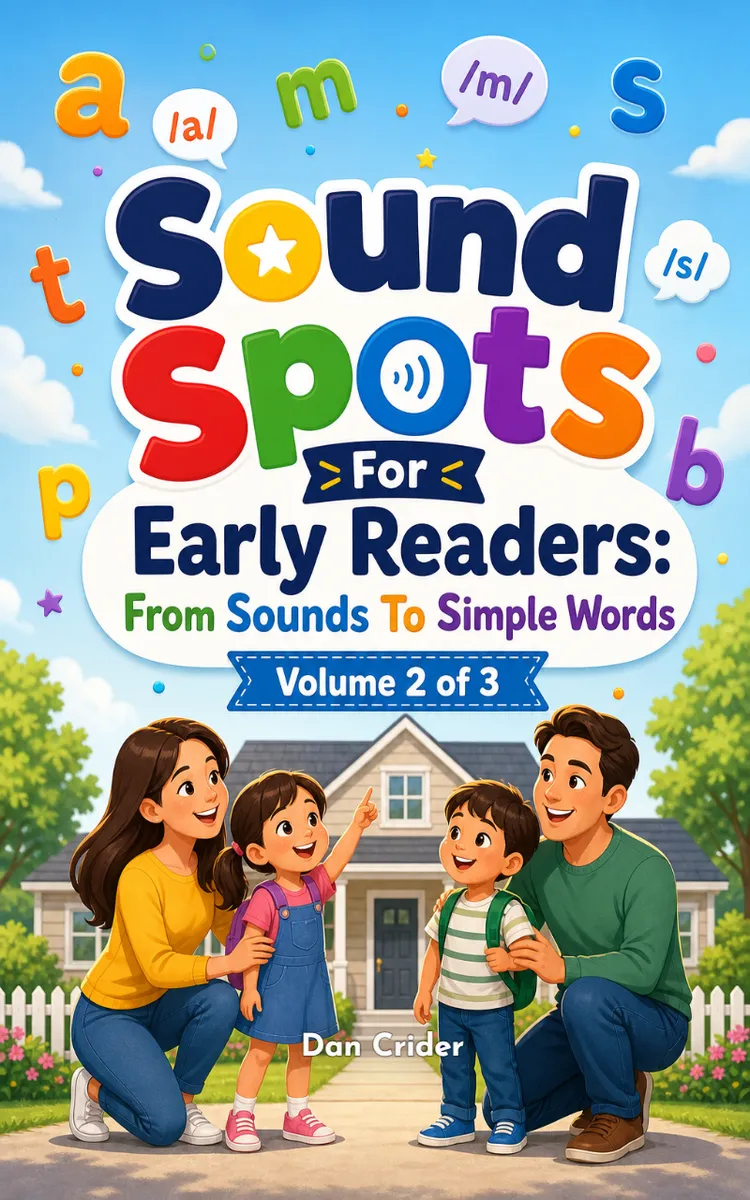
"Sound Spots for Early Readers: From Sounds to Simple Words" is a how-to guide book by Dan Crider with 7 chapters and approximately 10,370 words. Volume 2 turns the Sound-Spot routine into confident blending and early word reading, so learners can read and spell short, everyday words..
This book was created using Inkfluence AI, an AI-powered book generation platform that helps authors write, design, and publish complete books. It was made with the AI Ebook Generator.
Frequently Asked Questions
What is "Sound Spots for Early Readers: From Sounds to Simple Words" about?
Volume 2 turns the Sound-Spot routine into confident blending and early word reading, so learners can read and spell short, everyday words.
How many chapters are in "Sound Spots for Early Readers: From Sounds to Simple Words"?
The book contains 7 chapters and approximately 10,370 words. Topics covered include Review Without Repeating Yourself, Blending: Push, Slide, Smile, Segmenting for Spelling Success, Word Reading with CVC Flash Cards, and more.
Who wrote "Sound Spots for Early Readers: From Sounds to Simple Words"?
This book was written by Dan Crider and created using Inkfluence AI, an AI book generation platform that helps authors write, design, and publish books.
How can I create a similar how-to guide book?
You can create your own how-to guide book using Inkfluence AI. Describe your idea, choose your style, and the AI writes the full book for you. It's free to start.
Write your own how-to guide book with AI
Describe your idea and Inkfluence writes the whole thing. Free to start.
Start writingCreated with Inkfluence AI


