

Read the first chapter
The whole of chapter one, free. About 6 min. Turn the pages with the arrows, your keyboard, or a swipe.
Chapter 1
Why Letter Names Aren’t Enough
One morning, Talia, a preschool teacher, held up a small card with the letter m. Several children called out, “M!” They knew the letter. They recognized its shape. They knew its name.
Then Talia asked, “What sound does m make?”
The room became quiet.
This small pause is common. A child may know that a letter is called “em” without knowing that it usually stands for the sound /m/, as in moon, milk, or map. The child has learned something important, but not yet everything needed for early reading.
Letter names and letter sounds work together, but they are not the same thing. When children begin to read, they need to look at a printed letter and connect it with the sound that belongs in a word. That connection is one of the first steps toward decoding.
The Name-Sound Mix-Up
Imagine showing a child the letter s. The child may confidently say, “Ess.” That answer tells you the child recognizes the letter name. But if you ask, “What sound do you hear at the beginning of sun?” the child may hesitate or repeat, “Ess.”
The child is not being careless. The letter name is simply the response that has become most familiar. In everyday alphabet activities, adults often ask, “What letter is this?” Children learn to answer with a name. Later, when reading instruction asks for a sound, the child may need help understanding that the task has changed.
This is why it helps to make the difference clear:
• Letter name: what we call the letter, such as “em” or “ess.”
• Letter sound: the sound the letter commonly represents in a word, such as /m/ or /s/.
In this book, slashes show a sound rather than a letter name. So /m/ means the sound at the beginning of moon, not the word “em.”
Why the Difference Matters
Reading requires children to pay attention to the sounds inside spoken words and connect those sounds to print. If a child sees the word map, the goal is not to say the names “em,” “ay,” and “pee.” The child needs to connect the letters with their sounds and blend those sounds together.
That work begins with a simpler question: Can the child hear and say a sound when shown one letter?
Children who know letter names but have limited sound knowledge may appear ready because they can recite much of the alphabet. They may identify uppercase and lowercase letters, match letters in a puzzle, or sing the alphabet song. Those are useful skills. Still, they do not automatically show that the child can use letters to read words.
A child might say:
• “That is t.”
• “This one is f.”
• “I know that letter. It is p.”
The next step is helping the child say:
• “ t says /t/.”
• “ f says /f/.”
• “ p says /p/.”
This does not mean letter names should be ignored. Names help children talk about letters and remember them. The point is to add sound knowledge deliberately instead of assuming it will appear on its own.
What Is a Sound Spot?
A sound spot is the sound children are asked to find, say, and hear. For example, if the sound spot is /m/, children look at the letter m, say /m/, connect it to a familiar word such as moon, and listen for /m/ again.
The sound spot gives practice a clear focus. Rather than asking children to remember many letters and sounds at once, you invite them to notice one sound carefully. This makes the activity easier to follow and easier to repeat.
The routine uses the same four-part pattern:
• Look: Show the letter.
• Say: Give or ask for the letter sound.
• Connect: Link the sound to a familiar word.
• Listen: Find or notice the sound again.
For example, you might hold up m and say, “Look. This is m. Its sound is /m/. Moon begins with /m/. Can you hear /m/ in moon?”
Then you might offer another word: “What about sun? Do you hear /m/ in sun?” The child is not only repeating a sound. The child is listening for it and deciding whether it is present.
Start with Sounds Children Can Hold
Some sounds are easier to practice than others. At the beginning, choose sounds that children can stretch, repeat, or hear clearly. Useful starter letters include m, s, f, t, and p.
The sounds /m/, /s/, and /f/ can be held for a moment: “mmmm,” “ssss,” and “ffff.” This gives children time to notice what their mouths are doing and to listen to the sound itself. The sounds /t/ and /p/ are short, but they are common and easy to practice in familiar words such as top, tap, pig, and pan.
Choose words children already know. A familiar word gives the sound a place to live. Instead of presenting a sound as an isolated noise, you connect it to something children can picture, name, and discuss.
For /s/, you might use sun, sock, or snake. For /f/, try fish, fan, or frog. For /p/, use pig, pizza, or pan.
Keep the Routine Predictable
Young children learn more easily when they know what will happen next. A predictable routine lowers the amount of attention needed for directions, leaving more attention for the sound.
Use the same short cues each time:
• “Look at the letter.”
• “Say the sound.”
• “Connect it to a word.”
• “Listen for it again.”
You do not need to make every practice session exciting or different. In fact, changing the steps constantly can make the activity harder. The interest comes from the letters, words, pictures, voices, and discoveries within a familiar structure.
A routine also helps adults respond consistently. If a child gives the letter name instead of the sound, you can calmly say, “Yes, that is the letter name, em. The sound we are practicing is /m/.” Then invite the child to try again.
Practice Without Turning It into a Test
Sound practice works best when it feels like noticing, not proving. Give children time to look at the letter and listen to the model. If a child is unsure, provide the sound instead of waiting through a long silence.
You might say, “This letter is m. I say /m/. Now you try.” If the child says “em,” respond without criticism: “You named the letter. Now let’s say its sound together: /m/.”
Short practice is often enough. A few careful turns can be more useful than a long drill. Stop while children are still attentive, and return to the same sounds on another day. Repeated, successful practice helps the connection become quicker and more dependable.
The purpose of the Sound-Spot Routine is not to rush children through the alphabet. It is to build a strong bridge between print and speech, one sound at a time. In the chapters ahead, you will learn how to choose sound spots, give clear cues, listen for understanding, and correct mistakes in ways that keep children engaged.
For now, remember the central idea: knowing a letter’s name is a beginning, not the finish line. When children learn to look at a letter, say its sound, connect it to a word, and listen for it again, letters begin to do useful work. They become tools for hearing, speaking, and eventually reading words.
End of chapter one. 6 more chapters in the full book.
Swipe or use the arrows to turn the page


What's inside: 7 chapters
- 1. Why Letter Names Aren’t Enough
- 2. Meet the Sound-Spot Starter
- 3. Choose Sounds That “Fit”
- 4. Practice It Like a Script (Not a Test)
- 5. The Matching Game: Sound to Letter
- 6. Quick Checks and Gentle Fixes
- 7. Build a Week of Sound Spots
About this book
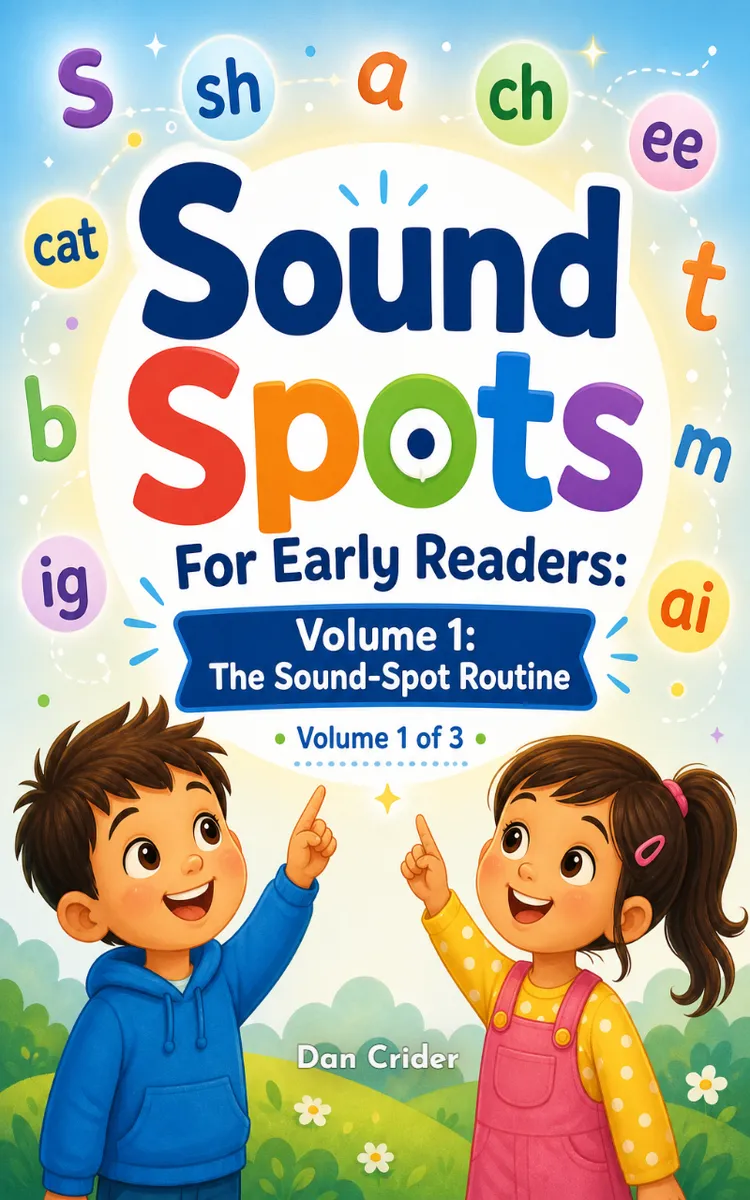
"Sound Spots for Early Readers: Volume 1: The Sound-Spot Routine" is a how-to guide book by Dan Crider with 7 chapters and approximately 10,504 words. Volume 1 teaches preschool and early learners how to catch letter sounds reliably using a simple, repeatable Sound-Spot routine—before they worry about letter names or spelling..
This book was created using Inkfluence AI, an AI-powered book generation platform that helps authors write, design, and publish complete books. It was made with the AI Ebook Generator.
Frequently Asked Questions
What is "Sound Spots for Early Readers: Volume 1: The Sound-Spot Routine" about?
Volume 1 teaches preschool and early learners how to catch letter sounds reliably using a simple, repeatable Sound-Spot routine—before they worry about letter names or spelling.
How many chapters are in "Sound Spots for Early Readers: Volume 1: The Sound-Spot Routine"?
The book contains 7 chapters and approximately 10,504 words. Topics covered include Why Letter Names Aren’t Enough, Meet the Sound-Spot Starter, Choose Sounds That “Fit”, Practice It Like a Script (Not a Test), and more.
Who wrote "Sound Spots for Early Readers: Volume 1: The Sound-Spot Routine"?
This book was written by Dan Crider and created using Inkfluence AI, an AI book generation platform that helps authors write, design, and publish books.
How can I create a similar how-to guide book?
You can create your own how-to guide book using Inkfluence AI. Describe your idea, choose your style, and the AI writes the full book for you. It's free to start.
Write your own how-to guide book with AI
Describe your idea and Inkfluence writes the whole thing. Free to start.
Start writingCreated with Inkfluence AI


