
Read the first chapter
The whole of chapter one, free. About 6 min. Turn the pages with the arrows, your keyboard, or a swipe.
Chapter 1
SURVIVAL MINDSET: UNDERSTANDING THE STREETS
Why This Book Exists Homelessness is not just a lack of housing. It is a full-system survival environment where food, sleep, safety, hygiene, health, and mental stability must all be managed simultaneously. This book is not about fear. It is about clarity. Your goal is simple: Stay alive. Stay healthy. Stay aware. Stay moving forward.
Survival First, Comfort Later On the streets, comfort is not guaranteed. Survival comes first. That means: Food is fuel, not enjoyment Sleep is protection, not luxury Hygiene is defense, not appearance Awareness is safety, not paranoia Every decision should answer one question: “Does this help me stay stable or put me at risk?”
The Mental Shift That Keeps You Alive People who survive long-term on the streets develop one key trait: adaptability Not toughness. Not aggression. Not isolation. Adaptability. Things change daily: Safe spots disappear Resources run out People shift behavior Weather turns dangerous Police or security change patterns If you cannot adapt, you get trapped.
The Three Rules of Survival 1. Observe before acting Never rush into unknown situations. 2. Reduce exposure Less attention = less risk. 3. Maintain mobility If a place becomes unsafe, leave early—not late.
The Reality of the Streets Most danger does not come from movies-style threats. It comes from: exhaustion dehydration infection untreated injuries poor sleep exposure to weather bad decisions made under stress
Core Survival Principle You are not just surviving people—you are surviving conditions.
Why “Expand this section with more detail” matters for the survival mindset
The streets change minute to minute; a single decision can flip safe into dangerous. Expanding the survival mindset section gives you specific habits, concrete checks, and quick routines you can use every day to keep yourself alive and moving. You’ll stop guessing and start doing: knowing what to look for, how to act, and why those actions reduce risk.
After reading this expanded material you’ll be able to run a short daily “street check” that takes five minutes, make better short-term shelter choices, choose whom to trust and when to exit, and keep your energy and health on a practical, actionable level. You’ll also know why each recommendation matters so you can adapt it when conditions shift - because adaptability without clear rules becomes guesswork.
You’ve got this. Start small: one routine, one decision point, one clearer watch on risk - and build from there.
The survival-mindset technique: Practical checks and rules you can use right now
The technique breaks into five simple components you can perform quickly and repeatedly. Each component has a why (what it prevents) and a how (exact steps).
• Perimeter Scan - Why: catches changing threats early. How: when you approach a sleeping spot or service location, stop 15-20 feet back, look left-right-behind, note exits (two minimum), and count visible people. If you see more than three unknowns clustered near your intended spot, pick another location. Expectation: you reduce surprise encounters and give yourself escape options.
• Scent-and-sound check - Why: people nearby and hazards often announce themselves before you see them. How: pause for 30 seconds and listen for running water, voices, or glass breaking; inhale slowly to detect smoke, bleach, or alcohol smell. If you hear whispered conversations or repeated footsteps, treat the area as higher risk and move. Expectation: you avoid hidden confrontations and chemical exposures.
• Time-layering - Why: places behave differently at different hours. How: note what time you scout a spot (e.g., 8 p.m.) and revisit mentally how it behaved then; mark whether the area quiets at 11 p.m., or fills at 3 a.m. Use two rules: don’t sleep where activity increases after midnight; prefer spots that get predictable, gradual quiet. Expectation: fewer disturbances and better sleep cycles.
• Minimal exposure setup - Why: less visibility lowers targeting by predators and police. How: when you settle, angle your head toward exits, keep your bag between you and walking paths, and use clothing or tarp to break light silhouettes. Keep a small “ready kit” (phone, ID, cash, small knife or multi-tool, and a bus card) within arm’s reach. Expectation: you reduce attention and can move within 30 seconds.
• Trust-test interaction - Why: trust saves energy but costs safety if misplaced. How: when someone approaches offering help, ask two simple questions: “Where are you heading?” and “Can you wait while I check?” If the person hesitates, or becomes pressuring, end the exchange and move. If they answer clearly and offer a public meeting place or phone number, consider short engagement. Expectation: you lower chances of manipulation and retain control.
These five components create a repeated loop: scan, listen, evaluate time, reduce exposure, and test trust. Repeat the loop every time you change location or decide to sleep. Practice makes it fast - you’ll do this in under five minutes once you’ve run it a few times.
Applying it now: a realistic street scenario and step-by-step outcome
Scenario: You reach a park at dusk and need a place to sleep that’s quiet and reasonably safe. Follow these steps and note expected outcomes.
• Stop 20 feet from the park entrance (Perimeter Scan). Walk the edge path and count people - you see two dog-walkers and one group near a bench. Expected outcome: you identify three people and two likely exits from the area.
• Pause at the bench line and perform a Scent-and-sound check for 30 seconds. You hear a distant train and a faint smell of cigarette smoke from the west side. Expected outcome: you note ambient noise (train) that will mask small sounds, and cigarette smell indicating recent activity in one sector - avoid that sector for sleeping.
• Use Time-layering by asking someone on a dog walk, “Does this park get busy after midnight?” If they say yes, cross the park to the quieter side that local residents use and that seems to empty by 10 p.m. Expected outcome: you choose a spot that historically quiets down, improving chances of uninterrupted sleep.
• Set up Minimal exposure: pick a tree line that faces the path’s exit, place your bag between you and the path, and use your jacket to cover reflective items. Keep your ready kit in an inner pocket. Expected outcome: reduced visibility, quick access to essentials, and an option to stand and leave within 30 seconds.
• Handle a Trust-test: a stranger approaches offering a cigarette and asks to sit. You say, “Thanks, I’m turning in. I’m heading out in a bit.” If they insist, you pack and move to the nearby underpass you scoped earlier. Expected outcome: you avoid a prolonged interaction that could escalate; you still have an alternate spot already scanned.
Quick checklist:
• Stop 15-20 feet back and scan exits and people.
• Pause 30 seconds to listen and smell for hazards.
• Ask one local about night behavior (one question).
• Place bag between you and the path; keep ready kit at hand.
• Test offers with two short questions; leave on hesitation.
If you follow those steps, you reduce surprise risk, increase sleep quality, and keep mobility - each outcome you can measure immediately: ability to pack and move in under 60 seconds, no unexpected visitors during the first two hours of sleep, and waking feeling better rested than last time.
Common mistakes and how to fix them
Skipping the perimeter scan
If you walk straight into a spot without scanning, you lose time and options.
Do this: stop 15-20 feet back, count people, and note exits before committing.
Not this: choose a spot because it looks sheltered without checking who’s nearby.
Relying on one sense
People assume sight is enough. Streets give away danger through sound and smell first.
Do this: always pause 30 seconds for sound and scent; use your hands to test surfaces (hot metal, broken glass).
Not this: sit down immediately just because the area looks empty.
Trusting offers without a test
A friendly offer can be helpful - but it can also be a setup.
Do this: ask two clear questions and give yourself permission to walk away. Keep interactions short and public.
Not this: accept offered rides, packages, or invitations to secluded places without verification.
Every recommendation here has a reason: more time to escape, fewer surprise confrontations, and better sleep. Start running the five-component loop today and you’ll notice small gains fast - less interruption at night, fewer risky encounters, and clearer choices by daylight. Keep practicing; these steps become automatic and keep you safer. You’ve got this - one check at a time.
End of chapter one. 30 more chapters in the full book.
Swipe or use the arrows to turn the page
What's inside: 31 chapters
- 1. SURVIVAL MINDSET: UNDERSTANDING THE STREETS
- 2. FOOD SURVIVAL AND HUNGER MANAGEMENT
- 3. WATER, HYGIENE & DISEASE PREVENTION
- 4. SLEEP, SHELTER & SURVIVAL REST
- 5. SAFETY, PEOPLE, AND STREET AWARENESS
- 6. MONEY, RESOURCES & SURVIVAL ECONOMY
- 7. HEALTH BREAKDOWN, INFECTION, AND LONG-TERM STREET ILLNESS
- 8. MENTAL SURVIVAL, STRESS, AND LONG-TERM RESILIENCE
- 9. SHELTER SYSTEMS, SAFE SLEEPING STRATEGIES, AND URBAN NAVIGATION
- 10. RESOURCES: LEARNING TO USE THE SYSTEM WITHOUT LETTING IT USE YOU
- 11. MONEY, WORK, AND REBUILDING YOUR LIFE
- 12. Resources: Navigating the System Without Losing Your Dignity
- 13. Personal Safety: Protecting Yourself on the Streets
- 14. Mental Health: Winning the Battle Nobody Can See
- 15. Resources: Finding Help Without Losing Your Dignity
- 16. Rebuilding: From Survival to Stability
- 17. The Psychology of the Streets: Staying Sane in Constant Pressure
- 18. The Art of Asking: Resources, Aid, and No-Shame Survival
- 19. Boundaries While Asking
- 20. Reciprocity Builds Trust
- 21. Street Insight
- 22. Reflection
- 23. Safety and Street Awareness: Reading Risk Before It Becomes Danger
- 24. Street Insight
- 25. Reflection
- 26. HEALTH UNDER PRESSURE: WHAT THE STREETS DO TO YOUR BODY
- 27. SYSTEM NAVIGATION: USING RESOURCES WITHOUT GETTING LOST IN THEM
- 28. SURVIVAL SECURITY: PEOPLE, PLACES, AND POSITIONING
- 29. LONG-TERM STREET DAMAGE: WHAT ACCUMULATES OVER TIME
- 30. RESOURCE MASTERY: TURNING CHAOS INTO A MAP
- 31. EXIT STRATEGY: GETTING OFF THE STREETS FOR REAL
About this book
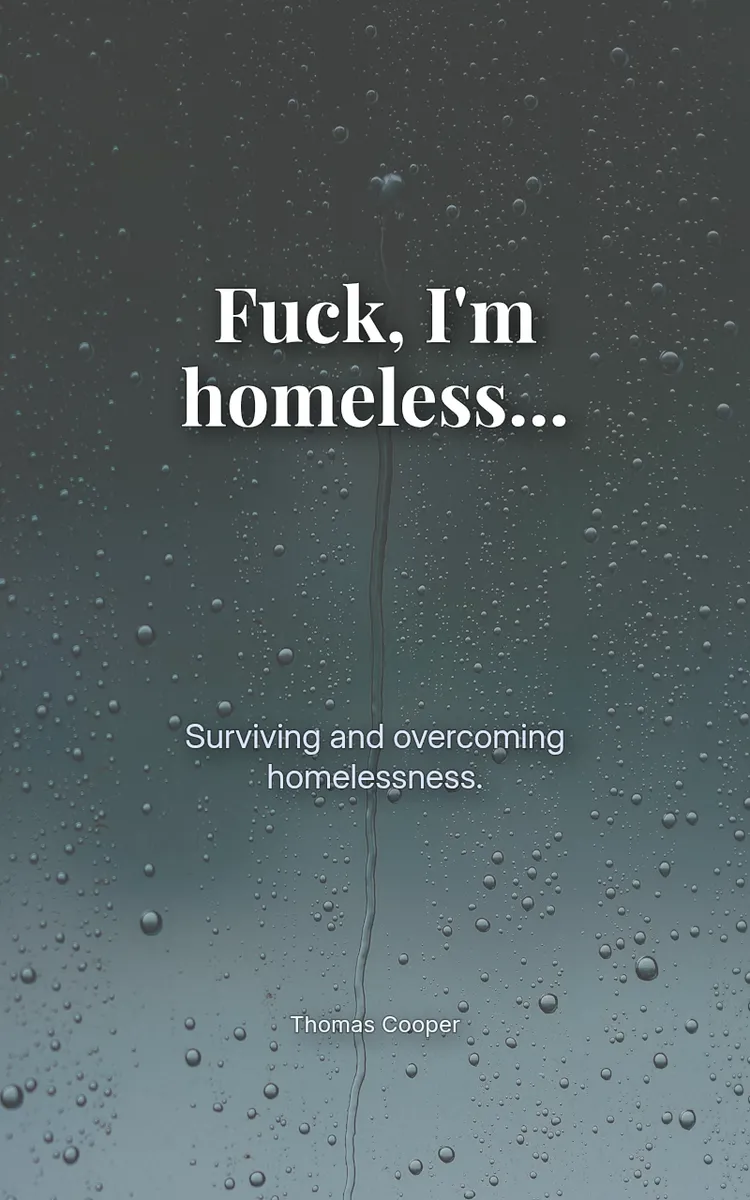
"Fuck, I'm homeless..." is a general book by Thomas Cooper with 31 chapters and approximately 11,817 words. It covers key insights and practical takeaways on the topic.
This book was created using Inkfluence AI, an AI-powered book generation platform that helps authors write, design, and publish complete books.
Frequently Asked Questions
What is "Fuck, I'm homeless..." about?
"Fuck, I'm homeless..." is a general book by Thomas Cooper covering key insights and practical takeaways on the topic.
How many chapters are in "Fuck, I'm homeless..."?
The book contains 31 chapters and approximately 11,817 words. Topics covered include SURVIVAL MINDSET: UNDERSTANDING THE STREETS, FOOD SURVIVAL AND HUNGER MANAGEMENT, WATER, HYGIENE & DISEASE PREVENTION, SLEEP, SHELTER & SURVIVAL REST, and more.
Who wrote "Fuck, I'm homeless..."?
This book was written by Thomas Cooper and created using Inkfluence AI, an AI book generation platform that helps authors write, design, and publish books.
Write your own book with AI
Describe your idea and Inkfluence writes the whole thing. Free to start.
Start writingCreated with Inkfluence AI


