
Read the first chapter
The whole of chapter one, free. About 7 min. Turn the pages with the arrows, your keyboard, or a swipe.
Chapter 1
Mapping Your Household Cash Flow
See the Path Before You Change It
On Friday morning, a paycheck can look large enough to solve everything. By Monday, rent, a phone bill, groceries, and a loan payment may have already claimed most of it. When the electric bill arrives midweek, the household may reach for a credit card again - not because the family spent carelessly, but because the timing stayed hidden.
The Paycheck Path Map makes that timing visible. It places each paycheck, bill, purchase, and debt payment on one simple calendar. You will see when money arrives, where it leaves, and which spending choices can change without putting food, housing, transportation, or utilities at risk. That clear picture gives you a workable starting point for debt repayment.
Build the Paycheck Path Map
Start with one month. Do not estimate from memory or use a normal month that leaves out a school fee, prescription, or annual bill. Use bank statements, pay stubs, receipts, and current bills. A month with real numbers shows the pressure your household actually faces.
Create four columns on paper, in a spreadsheet, or in a free notes app:
Date
Money in
Money out
What it covers
1st
$1,650
-
Paycheck
2nd
-
$1,200
Rent
4th
-
$85
Electric bill
7th
-
$140
Groceries
List income by the date it reaches your account, not the day your employer processes it. Include wages, child support, benefits, side work, or other regular deposits. If income changes, record the lowest amount you can reasonably expect. That choice prevents you from assigning bills to money that may not arrive.
Next, list every expense, including small purchases. Group each one into three useful categories: bills that must be paid, spending that supports daily life, and debt payments. Must be paid includes rent, utilities, insurance, minimum debt payments, and required transportation costs. Daily-life spending includes groceries, fuel, medicine, school needs, and household supplies. Debt payments include minimums and any extra amount you choose to send.
Use these steps to complete the map:
• Gather the records. Download the last 30 days of bank and card transactions, then collect current bills and pay stubs. Records catch charges that memory misses.
• Mark every income date. Write the amount you expect to receive beside each deposit date. This shows which money can cover each bill.
• Mark every due date. Include automatic payments and bills paid in cash. A bill still affects cash flow even when it does not appear on a bank statement.
• Add flexible spending. Record groceries, fuel, meals, school costs, medicine, and small purchases. These amounts often explain why a paycheck disappears early.
• Assign each expense to a paycheck. Draw a line from each bill to the money that will pay it. If one paycheck carries too much, the map will show the problem before the due date.
• Mark the changes you can control. Circle subscriptions, convenience purchases, extra trips, and payment dates you can move. Leave rent and required bills alone unless you have a specific way to reduce them.
Separate fixed costs from flexible costs. A fixed cost usually stays the same each month, while a flexible cost changes with your choices or needs. A $1,200 rent payment may not change quickly. A $75 weekly grocery trip may offer room to adjust, but only after you protect enough food for the household. This distinction keeps the map realistic instead of turning it into a list of wishes.
Also record irregular expenses by dividing the expected yearly amount across the months when you need to prepare. If car registration costs $240 once a year, mark $20 each month as a future car expense. The money may not leave every month, but the cost still belongs in your plan. This prevents an annual bill from forcing a new charge onto a credit card.
Follow One Month From Paycheck to Paycheck
Use this scenario to build a complete map. Assume a household receives $1,650 on the 1st and $1,550 on the 15th, for total monthly income of $3,200. The household pays $1,200 rent on the 2nd, $180 for electricity and water on the 6th, $140 for car insurance on the 10th, and $320 for a car payment on the 18th. Minimum credit-card payments total $170 and fall on the 20th. The household also needs groceries, fuel, medicine, and school supplies.
Follow these steps:
• Record the deposits. Mark $1,650 on the 1st and $1,550 on the 15th. The first paycheck must cover the rent and early-month bills.
• Assign the early bills. Set aside $1,200 for rent, $180 for utilities, and $140 for insurance. The first paycheck leaves $130 after those bills.
• Protect daily needs. Set aside $90 for groceries and $45 for fuel from the first paycheck. That leaves $-5, so the household must change the plan before the 2nd rather than discover the shortage after spending.
• Move what can move. Call the utility company to ask whether the due date can shift to after the 15th. If the company moves the $180 bill, the first paycheck has $175 left after rent, insurance, groceries, and fuel.
• Map the second paycheck. The $1,550 deposit covers the moved utility bill, the $320 car payment, $170 in minimum card payments, and the remaining groceries and fuel. If those needs total $520, $540 remains before any extra debt payment.
• Choose a safe change. Keep $300 for irregular needs and a small cash cushion. Send only the remaining $240 toward one selected debt, and record that payment on the map.
• Check the ending balance. Compare the planned ending amount with the actual bank balance. If the account falls short, find the exact transaction that caused the difference and correct the next map.
The expected outcome is not a perfect month. The expected outcome is a clear answer: the first paycheck cannot carry rent, every early bill, and all early spending without help. Moving one bill and controlling the timing of groceries creates room. The map also shows that an extra $240 payment works only after required costs and a cushion receive protection.
Repeat the map for two more months. Look for bills that change, paychecks that arrive early or late, and spending categories that regularly exceed the plan. Use the average of recent grocery or fuel spending only when the amount reflects actual needs. Do not lower a category simply because the lower number looks better.
Quick checklist
• Download bank and card records for the past 30 days.
• Write down each paycheck and deposit date.
• List every bill, automatic payment, and debt minimum.
• Mark groceries, fuel, medicine, school costs, and household supplies.
• Assign each bill to a specific paycheck.
• Separate fixed costs from flexible costs.
• Add a monthly amount for yearly or irregular bills.
• Circle spending you can change without risking basic needs.
• Compare the planned balance with the actual balance.
• Choose an extra debt payment only after required costs and a cushion.
Fix the Map When Real Life Interrupts
Using the balance as if all of it were available
A bank balance of $900 may look safe until $700 rent and $140 insurance leave the account. Treating the full balance as spendable causes overdrafts or new card charges.
Do this: Mark upcoming bills on the calendar and subtract them before deciding what you can spend.
Not this: Do not call the remaining bank balance extra money until every bill due before the next paycheck has a place.
Forgetting cash and automatic charges
A cash purchase does not disappear from the budget. Neither does a streaming charge, app renewal, or insurance payment that happens automatically. These missing items make the map look better than the account feels.
Do this: Review the bank statement line by line, check card statements, and write down cash purchases from receipts or notes.
Not this: Do not rely on memory or assume a small charge does not matter. Five purchases of $8 equal $40 that the map must explain.
Planning with income that may not arrive
Overtime, tips, side work, or an irregular benefit payment may help, but they cannot safely carry a required bill when the amount changes.
Do this: Build the map around dependable income. When extra money arrives, record it on that date and decide where it goes after necessities and overdue bills.
Not this: Do not promise rent, utilities, or debt payments from an unconfirmed shift or hoped-for deposit.
The Paycheck Path Map works when it matches the account, not when it produces an attractive plan. After each month, compare expected and actual amounts, update the dates, and mark one realistic change. A bill moved to a better date, a canceled charge, or a controlled grocery plan can create more breathing room than a promise to spend less everywhere. Once you can see the path, you can choose where the next dollar should go instead of guessing.
End of chapter one. 9 more chapters and about 15,266 words in the full book.
Swipe or use the arrows to turn the page
What's inside: 10 chapters
- 1. Mapping Your Household Cash Flow
- 2. Building a Bare-Bones Budget
- 3. Creating a Starter Emergency Fund
- 4. Choosing Your Debt Payoff Order
- 5. Making a Paycheck Bill Calendar
- 6. Cutting Costs Without Sacrificing Essentials
- 7. Negotiating Lower Rates and Payments
- 8. Handling Debt Collectors and Past-Due Bills
- 9. Increasing Income with Realistic Options
- 10. Staying Debt-Free After Payoff
About this book
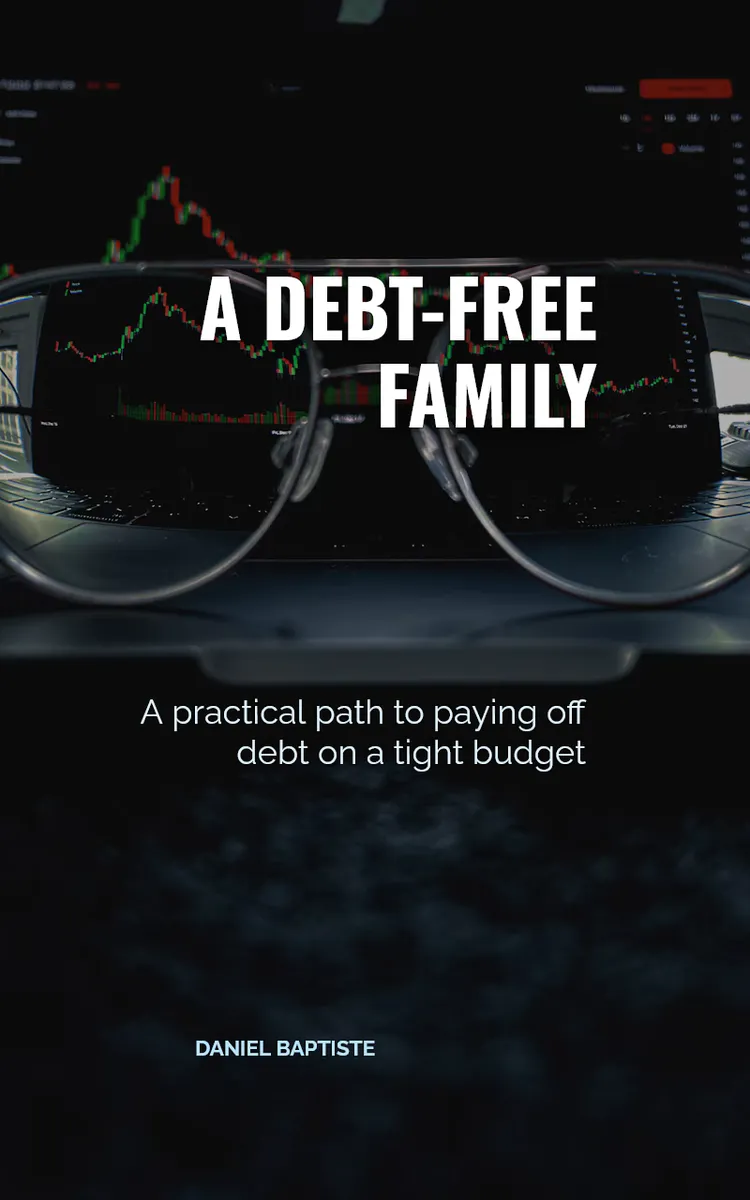
"A Debt-Free Family" is a finance book by DANIEL BAPTISTE with 10 chapters and approximately 15,266 words. Debt repayment strategies for families living paycheck to paycheck.
This book was created using Inkfluence AI, an AI-powered book generation platform that helps authors write, design, and publish complete books. It was made with the AI Ebook Generator.
Frequently Asked Questions
What is "A Debt-Free Family" about?
Debt repayment strategies for families living paycheck to paycheck
How many chapters are in "A Debt-Free Family"?
The book contains 10 chapters and approximately 15,266 words. Topics covered include Mapping Your Household Cash Flow, Building a Bare-Bones Budget, Creating a Starter Emergency Fund, Choosing Your Debt Payoff Order, and more.
Who wrote "A Debt-Free Family"?
This book was written by DANIEL BAPTISTE and created using Inkfluence AI, an AI book generation platform that helps authors write, design, and publish books.
How can I create a similar finance book?
You can create your own finance book using Inkfluence AI. Describe your idea, choose your style, and the AI writes the full book for you. It's free to start.
Write your own finance book with AI
Describe your idea and Inkfluence writes the whole thing. Free to start.
Start writingCreated with Inkfluence AI


