

Read the first chapter
The whole of chapter one, free. About 7 min. Turn the pages with the arrows, your keyboard, or a swipe.
Chapter 1
Days 1-7: Entrance - Naming Despair Under the Sovereign God
Scripture Focus
Psalm 42:5-11
> “Why art thou cast down, O my soul? and why art thou disquieted in me? hope thou in God: for I shall yet praise him for the help of his countenance. O my God, my soul is cast down within me: therefore will I remember thee from the land of Jordan, and of the Hermonites, from the hill Mizar. Deep calleth unto deep at the noise of thy waterspouts: all thy waves and thy billows are gone over me. Yet the LORD will command his lovingkindness in the daytime, and in the night his song shall be with me, and my prayer unto the God of my life. I will say unto God my rock, Why hast thou forgotten me? why go I mourning because of the oppression of the enemy? As with a sword in my bones, mine enemies reproach me; while they say daily unto me, Where is thy God? Why art thou cast down, O my soul? and why art thou disquieted within me? hope thou in God: for I shall yet praise him, who is the health of my countenance, and my God.”
Today’s theme is learning to name despair truthfully before the sovereign God who remains present when hope feels absent.
Despair often arrives as more than sadness. It can feel like spiritual abandonment, bodily exhaustion, mental fog, social withdrawal, and the loss of any believable future. Psalm 42 does not flatten these experiences into a quick religious answer. The psalmist speaks to his own soul, but he also describes tears, oppression, memory, accusation, and physical pain. “As with a sword in my bones” is not decorative language. It gives suffering a bodily location.
The psalm’s repeated question - “Why art thou cast down?” - is not a rebuke. It is an act of careful attention. The writer observes his inner life without pretending to control it. He remembers God, protests to God, and waits for God, all within the same prayer. That pattern matters in pastoral counseling. Faithful care begins by listening long enough to distinguish grief, depression, trauma, medical illness, moral injury, isolation, and spiritual confusion. These may overlap, but they aren’t identical.
The early church recognized this honest spiritual language. The desert fathers and mothers treated despondency, sometimes called acedia, as a serious disturbance affecting attention, desire, prayer, and ordinary work. They did not reduce every struggle to sin, nor did they dismiss spiritual practices. Later Christian writers, including Augustine, described the restless heart’s need for God while also acknowledging disordered loves and wounded habits. Reformed theology emphasized God’s providence and sustaining grace; Wesleyan pastoral practice stressed disciplined community, prayer, and works of mercy. Across these traditions, a sound Christian account refuses two errors: despair is not proof that God has lost sovereignty, and clinical suffering is not automatically evidence of weak faith.
A responsible evaluation therefore asks several questions. How long has this condition lasted? Has sleep, appetite, concentration, work, or personal care changed? Is there a history of trauma, medication use, substance use, or physical illness? Has the person thought about death or self-harm? These questions are not a failure of faith. They are forms of loving attention. If you may harm yourself or cannot stay safe, contact emergency services or a crisis line now, and tell a trusted person plainly what is happening. Prayer and professional care belong together.
The central insight is this: naming despair is not surrendering to it; it is bringing the truth of suffering into the presence of God. Psalm 42 moves between “my soul is cast down” and “hope thou in God.” That movement is not instant emotional recovery. It is a faithful refusal to let present darkness become the final interpreter of reality.
Reflection
Psalm 88 gives us an even darker register: “For my soul is full of troubles: and my life draweth nigh unto the grave” (Psalm 88:3). The psalm continues, “Thou hast laid me in the lowest pit, in darkness, in the deeps” (Psalm 88:6). Unlike many biblical prayers, Psalm 88 ends without a clear emotional resolution. Its presence in Scripture teaches us something essential for pastoral care: a prayer can be faithful even when it does not end with relief.
That matters when a depressed person cannot produce a hopeful testimony. We shouldn’t force a bright conclusion onto a dark morning. Lament is not unbelief dressed in religious language. It is speech directed toward God when suffering has made ordinary speech difficult. The psalmist still addresses the Lord. Relationship remains, even when comfort does not.
Lamentations 3:17-26 gives another careful movement:
> “And thou hast removed my soul far off from peace: I forgat prosperity. And I said, My strength and my hope is perished from the LORD: Remembering mine affliction and my misery, the wormwood and the gall. My soul hath them still in remembrance, and is humbled in me. This I recall to my mind, therefore have I hope. It is of the LORD’S mercies that we are not consumed, because his compassions fail not. They are new every morning: great is thy faithfulness. The LORD is my portion, saith my soul; therefore will I hope in him. The LORD is good unto them that wait for him, to the soul that seeketh him. It is good that a man should both hope and quietly wait for the salvation of the LORD.”
Notice the order. The writer first says that peace has been removed and hope has perished. Only then does he recall God’s mercies. This is not positive thinking. It is theological memory practiced inside grief. God’s sovereignty does not make pain unreal. It means pain is not ultimate, even when it feels total.
For counselors, this distinction protects against spiritual harm. Telling someone, “You simply need more faith,” may increase shame and conceal danger. A better response is to listen, assess, pray with consent, and help build a healing path. That path may include a physician’s evaluation, a licensed mental-health professional, pastoral companionship, medication when clinically appropriate, sleep and nutrition support, gentle movement, honest community, and Scripture-based prayer. These tools do not compete with divine sovereignty. They may be ordinary means through which God provides care.
For the reader who is suffering, begin with accuracy rather than performance. You might say, “I’m exhausted, isolated, and struggling to function,” or, “I’m afraid of what I may do tonight.” Specific language helps others respond. It also helps you notice whether the condition is changing. Despair should be spiritually discerned and clinically evaluated, not merely endured in silence.
Practice for Today
1. Complete a ten-minute despair inventory. Sit somewhere quiet, set a timer, and write brief answers to these questions: What am I feeling? Where do I feel it in my body? What has changed in my sleep, appetite, concentration, work, or relationships? What am I afraid to say aloud? End by writing Psalm 42:5: “Why art thou cast down, O my soul? and why art thou disquieted in me?” Don’t edit your answers into a respectable testimony. The purpose is truthful naming.
2. Pray the three movements of lament. Spend two minutes describing the pain to God, two minutes asking for help without pretending certainty, and two minutes sitting quietly before him. You might pray, “Lord, this is what despair feels like today…” Then name one concrete need: a safe conversation, medical advice, rest, protection from self-harm, or strength to complete one necessary task. Psalm 62:8 says, “Trust in him at all times; ye people, pour out your heart before him: God is a refuge for us.” Pouring out your heart includes the parts you wish were different.
3. Make one safety-and-care contact. Tell a trusted person your actual condition, not a softened version. If despair has brought thoughts of suicide, self-harm, or an inability to remain safe, say so directly and seek immediate professional or emergency help. If the symptoms have persisted for two weeks or more, schedule an appointment with a physician or qualified mental-health professional, while also contacting a pastor or mature Christian friend. Record the appointment or conversation in your journal. This small act turns private anguish into a shared care plan.
Closing Prayer
Lord Jesus, you know the difference between sorrow, illness, fear, and spiritual weariness, even when I cannot name them clearly. Help me speak truthfully about my despair without shame. Give wisdom to those who care for me, courage to seek appropriate help, and grace to remember that your sovereignty is present even here. Hold me through this day, and keep me safe. Amen.
End of chapter one. 7 more chapters in the full book.
Swipe or use the arrows to turn the page

Spirit-Led Whole-Person Renewal

ChurchBased Christian Biblical Counseling Ministry

Anxiety And Panic Counseling Desk Reference
What's inside: 8 chapters
- 1. Days 1-7: Entrance - Naming Despair Under the Sovereign God
- 2. Days 8-14: Trust - Theology of Divine Sovereignty in the Valley
- 3. Days 15-21: Lament and Prayer - Scriptural Pathways Through Darkness
- 4. Days 22-28: Hope - Theology of Resurrection and Practical Paths to Re-engagement
- 5. Days 29-35: Surrender and Trusting Prayer - Letting Go Into God’s Care
- 6. Days 36-42: Communion and Community - Pastoral Structures for Sustained Care
- 7. Quiet Trust in Dark Places
- 8. Days 43-49: Integration and Formation - Training Counselors and Empowering Believers
About this book
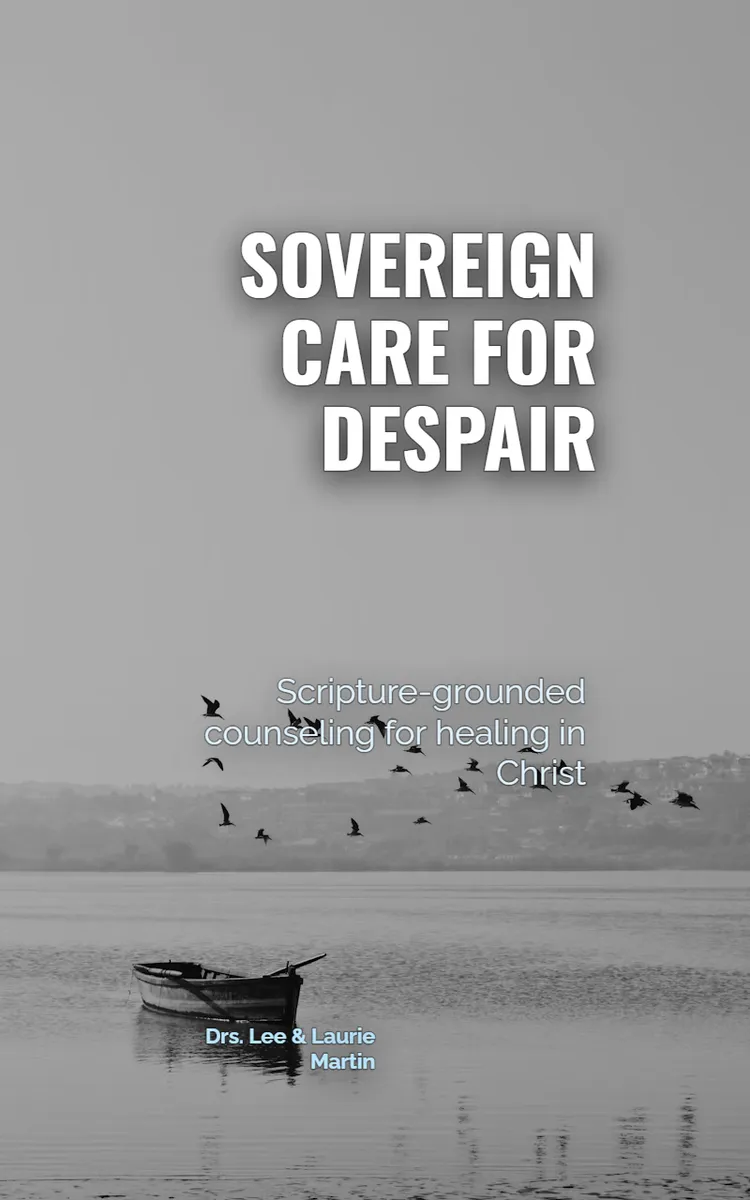
"Sovereign Care For Despair" is a religious devotional book by Drs. Lee & Laurie Martin with 8 chapters and approximately 9,775 words. Christian pastoral counseling for depression, despair, and suffering.
This book was created using Inkfluence AI, an AI-powered book generation platform that helps authors write, design, and publish complete books.
Frequently Asked Questions
What is "Sovereign Care For Despair" about?
Christian pastoral counseling for depression, despair, and suffering
How many chapters are in "Sovereign Care For Despair"?
The book contains 8 chapters and approximately 9,775 words. Topics covered include Days 1-7: Entrance - Naming Despair Under the Sovereign God, Days 8-14: Trust - Theology of Divine Sovereignty in the Valley, Days 15-21: Lament and Prayer - Scriptural Pathways Through Darkness, Days 22-28: Hope - Theology of Resurrection and Practical Paths to Re-engagement, and more.
Who wrote "Sovereign Care For Despair"?
This book was written by Drs. Lee & Laurie Martin and created using Inkfluence AI, an AI book generation platform that helps authors write, design, and publish books.
Write your own religious devotional book with AI
Describe your idea and Inkfluence writes the whole thing. Free to start.
Start writingCreated with Inkfluence AI


