
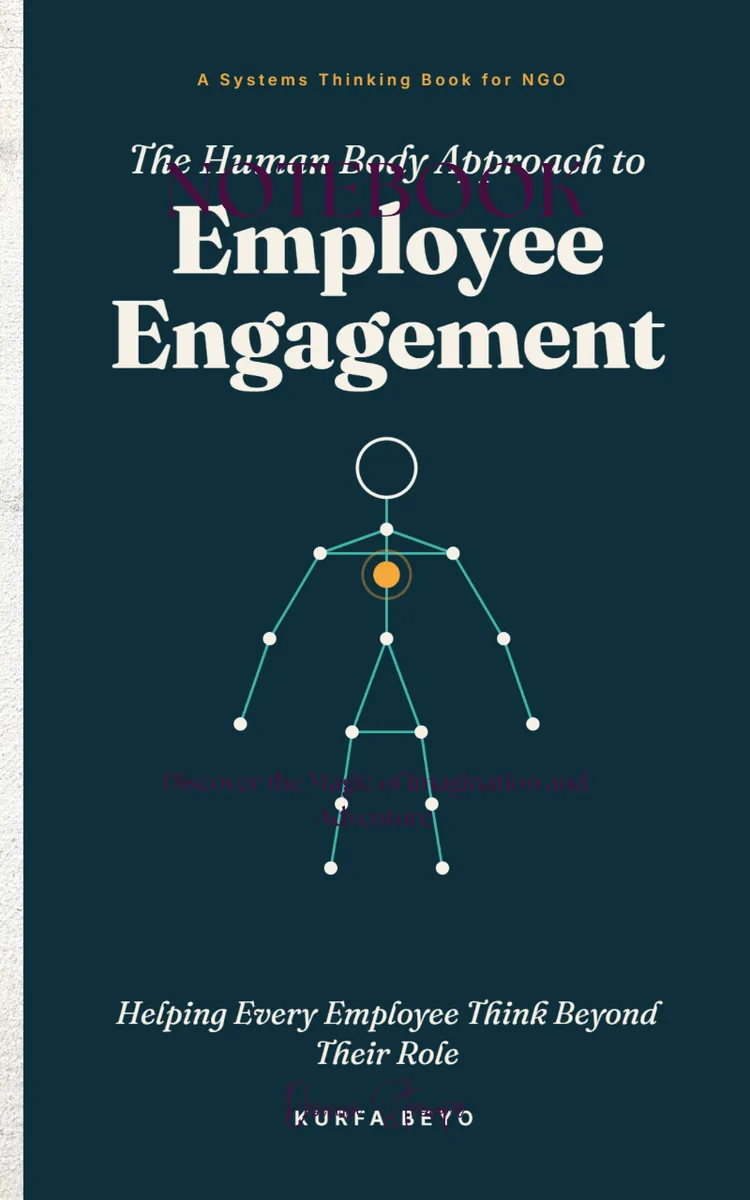
Read the first chapter
The whole of chapter one, free. About 4 min. Turn the pages with the arrows, your keyboard, or a swipe.
Chapter 1
Introduction: Beyond the Job Description
Picture an NGO at the end of a demanding quarter. The finance team has closed its books on time. Procurement has followed every rule. Logistics has met its dispatch targets, the program team has reported its numbers, and the MEAL unit has submitted its data. By every internal measure, each department has done its job. Yet households in a remote district waited three weeks longer than they should have for assistance, and nobody can say exactly why.
This is a challenge many NGOs know well. Employees perform their responsibilities competently and conscientiously, yet many cannot say how their work contributes to the organization's overall success. They see their own task clearly and the whole picture dimly. The result is not failure, which would be easier to notice. It is a quiet gap between effort and impact.
Employee engagement matters because it addresses that gap. Engagement is often mistaken for busyness, satisfaction, or high morale, and those things matter, but they are not enough. A truly engaged employee understands the purpose of the work, feels a sense of belonging, can speak up and be heard, and takes ownership of results that extend beyond their own desk. For NGOs, where resources are limited and the people served depend on every link in the chain, this kind of engagement is a practical necessity.
The scale of the gap is large. Gallup's 2026 global survey found that 20% of employees were engaged at work in 2025, the lowest share since 2020, while 64% were not engaged and 16% were actively disengaged.[1] Gallup defines engagement as the psychological attachment workers have to their work, their team, and their employer, and it estimates that low engagement cost the world economy about $10 trillion in lost productivity, or 9% of global GDP.[1] Across Gallup's studies, teams in the top quarter for engagement show about 14% higher productivity, 23% higher profitability, 78% less absenteeism, and between 21% and 51% less turnover than teams in the bottom quarter.[2] These are global and corporate figures, not NGO-specific ones, and they show an association, not proof of cause. They are best read as a signal of what is at stake.
Completing job responsibilities is therefore necessary but not sufficient. A job description tells people what to do. It rarely tells them what their work makes possible for others, or what happens when it is late, unclear, or incomplete. Over time, departments develop their own priorities, vocabularies, and measures of success. Information stays within teams, and decisions that improve one department can quietly burden another. These organizational silos seldom come from bad intentions. They grow from specialization, pressure, and narrow awareness, and their costs fall on colleagues, on morale, and ultimately on beneficiaries.
Systems thinking offers a way forward. It is simply the habit of seeing how parts connect, how actions ripple, and how the whole depends on its relationships. When employees learn to think this way, their work gains meaning because they can see where it leads. They communicate earlier, collaborate more readily, and solve problems at their roots. Engagement deepens as a result, since people who understand the whole are more likely to feel they belong to it.
The human body is a natural guide to this way of thinking. Every cell has a specialized function, yet none survives alone. Organs depend on one another, the brain gives direction, the nervous system carries signals, and the circulatory system delivers what each part needs. Healthy habits sustain the whole. The comparison has limits, since an organization is not a living organism and its employees are not organs. They can think, choose, and learn. But used carefully, the body makes the abstract idea of interdependence concrete and easy to remember.
Across seven chapters, this book will help you understand your place in the larger picture, strengthen communication and collaboration, follow how work and resources move through your organization, build daily habits of systems thinking, and take practical action. Each chapter includes realistic examples, reflection questions, and simple tools designed for organizations with limited resources.
The book is written for everyone. Board members can use it to consider the culture their oversight shapes. Executives and managers can use it to create conditions that support engagement and to coach their teams. Employees at every level can use it to understand their contribution and strengthen it. It works as an individual reading resource and as a guide for team discussion.
Systems thinking will not solve every workplace difficulty. Fair management, adequate resources, and healthy working conditions remain essential. But within those limits, a great deal can change when people look up from their tasks and see the whole.
So read with your own work in mind, and with your colleagues in mind. Ask who depends on you and whom you depend on. Then consider what it would mean to care not only for your own part, but for the health of the entire organization.
End of chapter one. 7 more chapters and about 22,850 words in the full book.
Swipe or use the arrows to turn the page
What's inside: 8 chapters
- 1. Introduction: Beyond the Job Description
- 2. Chapter 1: Understanding the Bigger Picture
- 3. Chapter 2: Creating Systems Thinking Awareness
- 4. Chapter 3: Improving Communication and Collaboration
- 5. Chapter 4: Keeping the Organization Alive
- 6. Chapter 5: Building a Healthy Organization
- 7. Chapter 6: Supporting Employees to Think Beyond Their Roles
- 8. Chapter 7: Actions for Immediate Change
About this book
"The Human Body Approach to Employee Engagement" is a business book by Anonymous with 8 chapters and approximately 22,850 words. It covers key insights and practical takeaways on the topic.
This book was created using Inkfluence AI, an AI-powered book generation platform that helps authors write, design, and publish complete books. It was made with the AI Business Book Writer.
Frequently Asked Questions
What is "The Human Body Approach to Employee Engagement" about?
"The Human Body Approach to Employee Engagement" is a business book by Anonymous covering key insights and practical takeaways on the topic.
How many chapters are in "The Human Body Approach to Employee Engagement"?
The book contains 8 chapters and approximately 22,850 words. Topics covered include Introduction: Beyond the Job Description, Chapter 1: Understanding the Bigger Picture, Chapter 2: Creating Systems Thinking Awareness, Chapter 3: Improving Communication and Collaboration, and more.
Who wrote "The Human Body Approach to Employee Engagement"?
This book was written by Anonymous and created using Inkfluence AI, an AI book generation platform that helps authors write, design, and publish books.
How can I create a similar business book?
You can create your own business book using Inkfluence AI. Describe your idea, choose your style, and the AI writes the full book for you. It's free to start.
Write your own business book with AI
Describe your idea and Inkfluence writes the whole thing. Free to start.
Start writingCreated with Inkfluence AI


