
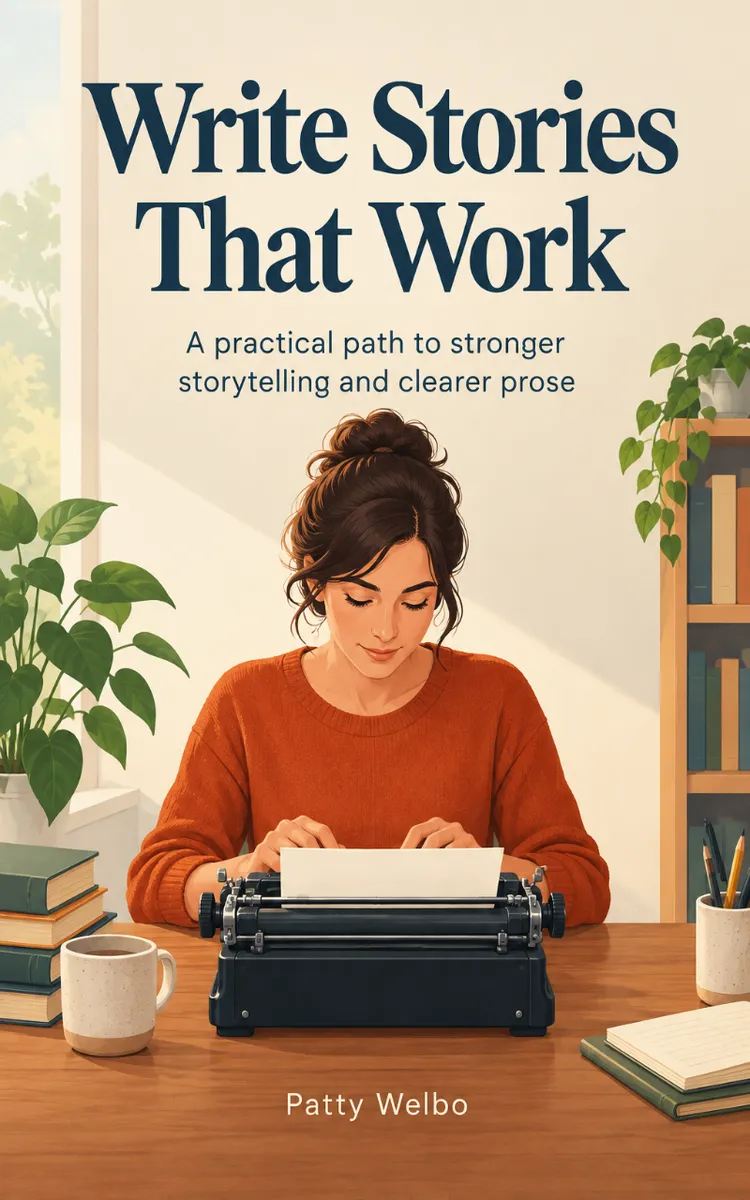
Read the first chapter
The whole of chapter one, free. About 8 min. Turn the pages with the arrows, your keyboard, or a swipe.
Chapter 1
Finding the Story Worth Telling
When an Ordinary Moment Opens a Story
At 7:42 on a Monday morning, a bakery owner found a handwritten note tucked beneath the till: “Please make the crust less perfect.” The note raised a question. Who wrote it? Why did an imperfect crust matter? That small discovery could lead to a customer story, a business essay, or a scene about a baker who must choose between pleasing an expert and feeding people who simply want comfort.
Strong stories often begin this way. They do not begin with a grand subject such as “the history of bread” or “a person learns to be brave.” They begin with a moment that changes something, a question that refuses to go away, or a detail that reveals a problem. Finding that starting point solves a common writing problem: having plenty to say but no clear story.
After using the Story Spark Scan, you will know how to examine an ordinary day and find usable material. You will learn to separate a report from a story, test whether an idea contains movement, and record enough detail to write the first draft. Your grammar does not need to be perfect at this stage. First, you need something worth saying.
The Story Spark Scan
The Story Spark Scan is a simple method for searching your memories, observations, research, or daily work. It looks for three story sparks: a meaningful moment, a strong question, and a real change. A spark does not need to contain drama. It needs to create movement. Something must become different, understood differently, or impossible to ignore.
Use these steps when you scan an event or subject:
1. Mark the moment. Find one specific point in time rather than covering a whole day, year, or project. “The meeting went badly” gives you little to work with. “At 3:15, the client removed one page from the proposal” gives you a place to begin. Specific moments help you choose details and keep the story from spreading in every direction.
2. Write the question. Ask what you still want to know. The question might concern a person’s choice, a hidden cause, or the result of an action. “Why did the baker follow the note?” creates more energy than “The bakery changed its recipe.” A question gives the reader a reason to continue.
3. Name the change. Complete this sentence: “Before this,; after this,.” The change might affect a plan, belief, relationship, skill, or public result. If nothing changes, you may have a topic or description, but you probably do not have a story yet.
4. Collect the revealing detail. Look for an object, sound, phrase, number, or physical action that shows the situation. A cracked phone screen, a returned invoice, or a child’s repeated question can carry more meaning than a paragraph of explanation. Details give the reader something to see and hear.
5. Test the pressure. Ask what could be lost, gained, repaired, or misunderstood. Pressure does not always mean danger. A nonfiction piece about a failed garden may involve wasted money and lost time. A fictional scene about a missed train may involve a promise that cannot be kept. Pressure gives the change a reason to matter.
Consider the difference between a subject and a story spark. “Training for a marathon” names a subject. “A runner must decide whether to stop after an injury appears six weeks before the race” contains a moment, a question, and a change. The second idea gives you choices, consequences, and a direction for the writing.
Ask yourself three quick questions: What happened at one exact point? What question does that event create? What will be different by the end? If you cannot answer one of them, keep scanning. You do not need to invent drama. You need to look more closely at what actually happened.
For fiction, you can begin with a spark and then create the people, setting, and result. For nonfiction, you must stay faithful to what you know and label uncertainty honestly. In both forms, the scan performs the same job: it finds movement inside material that might otherwise remain flat.
Before moving on, write one sentence in this form: “When _ happens, someone must decide _, and afterward ___ changes.” That sentence should point toward a story rather than merely describe a subject.
From Spark to Story Plan
A useful way to apply the scan is to work with a real situation that contains several possible directions. Consider a small repair shop that replaces a customer’s old bicycle chain. During the repair, the mechanic finds a folded photograph wedged inside the frame. The photograph shows the customer as a child beside the same bicycle.
Follow the process:
1. Record the exact moment. Write: “At 10:20 on Thursday, the mechanic removes the seat and finds a photograph inside the frame.” The expected outcome is a clear opening point, not a summary of the customer’s entire life.
2. List three questions. Write: “Why was the photograph hidden there?” “Did the customer know it remained in the bicycle?” “What does the bicycle mean to the customer now?” Three questions prevent you from accepting the first obvious explanation.
3. Choose the strongest question. Select the question that can support the most useful scenes or facts. “What does the bicycle mean now?” may lead to a richer story than “Did the customer know?” because it invites memory, conflict, and present-day choice.
4. State the before-and-after change. Write: “Before the photograph appears, the repair seems routine; afterward, the customer must decide whether to restore the bicycle or sell it.” The expected outcome is a direction for the ending.
5. Gather five concrete details. Record the chain grease on the photograph’s corner, the red paint under the new silver paint, the bent bell, the customer’s pause, and the price of the repair: $48. These details make the story particular and give you material for sentences.
6. Check the pressure. The customer has promised to sell the bicycle by Saturday, but the photograph connects it to a deceased parent. The pressure comes from a deadline and an emotional cost. The story now has more than a surprising object; it has a decision.
7. Choose the form. A nonfiction writer might interview the customer and explain how objects preserve family history. A fiction writer might invent a different owner, create a reason for the sale, and decide what the photograph reveals. The scan finds the spark, but the writer chooses how to shape it.
A first draft from this plan could open with the photograph, delay its explanation, and follow the customer’s decision. It should not begin with a general statement such as “Bicycles have always been important to families.” That statement explains before the reader has a reason to care. Begin with the object and the question it creates.
Quick checklist
• Choose one exact moment. - Write at least three questions about it. - State what changes before and after. - Record five physical details. - Identify what someone might lose, gain, or decide. - Separate facts from guesses. - Choose the question that can carry the whole piece. - Draft an opening that shows the spark instead of explaining its meaning.
Read your plan aloud. If the sentences sound tangled, shorten them. Write one idea per sentence: “The mechanic lifted the seat. A photograph slid onto the floor. The customer stopped talking.” Clear sentences help you see whether the story itself works. If the plan has no decision or change, return to the scan and search for a stronger moment.
Mistakes That Hide the Spark
Starting with a broad subject
A broad subject can swallow your story. “Moving to a new city” includes months of events, many people, and several possible endings. Readers cannot tell where to look.
Do this: Choose one moment, such as signing the first lease, missing the last bus, or receiving a message from home. Then ask what changed at that point.
Not this: Begin with “Moving is difficult” and continue with general statements.
The specific moment gives you a handle. You can add background later, after the reader understands the immediate situation.
Confusing surprise with meaning
A strange event may attract attention without leading anywhere. Finding a coin inside a loaf of bread is surprising, but the story needs a question and a consequence. Without them, the detail remains an odd fact.
Do this: Ask, “What did this discovery cause someone to do, understand, or risk?” If the answer involves a decision or a changed relationship, keep investigating.
Not this: Treat every unusual detail as a complete story.
A meaningful detail connects to the people or problem around it. The coin matters if it reveals a machine fault, exposes careless work, or reminds someone of a promise. The connection creates meaning.
Forcing a change that never happened
Beginning writers sometimes add a lesson because they think every story needs one. That choice can make nonfiction dishonest and fiction artificial. A meeting that ended without a decision should not become a sudden breakthrough just to create a neat ending.
Do this: State the true result plainly: “The answer remained uncertain, but the question changed the next step.” Small changes count. A person may become suspicious, revise a plan, notice a pattern, or choose to wait.
Not this: Claim that someone “learned everything happens for a reason” when the event only produced a new question.
A story can end with uncertainty if the uncertainty has shape. Show what the person knows now, what remains unknown, and what action follows.
Scanning too many moments at once
A journal entry may contain six possible sparks. If you include all six, the reader loses the main line. For example, a restaurant opening may involve a delayed permit, a broken freezer, a missing delivery, and a first customer. Each event could support a story, but one piece cannot give each equal weight.
Circle the moment that creates the strongest question. Use the other events only when they explain or increase the pressure around it. A focused story does not report everything. It selects what helps the reader follow the change.
The Story Spark Scan gives you a practical way to begin: find the moment, ask the question, name the change, and collect the detail that makes it visible. When you can describe those four parts, you have more than a topic. You have the first working shape of a story - and a clear place to put your next sentence.
End of chapter one. 11 more chapters and about 21,465 words in the full book.
Swipe or use the arrows to turn the page
What's inside: 12 chapters
- 1. Finding the Story Worth Telling
- 2. Building a Clear Story Spine
- 3. Choosing a Point of View
- 4. Creating Characters Readers Care About
- 5. Making Scenes Move
- 6. Using Detail to Bring Stories Alive
- 7. Writing Dialogue That Reveals
- 8. Telling True Stories Responsibly
- 9. Fixing Sentences for Clarity
- 10. Punctuating Dialogue and Pauses
- 11. Revising Drafts in Useful Passes
- 12. Finishing Stories for Readers
About this book
"Write Stories That Work" is a how-to guide book by Anonymous with 12 chapters and approximately 21,465 words. Practical writing skills for crafting fiction and nonfiction despite weak grammar.
This book was created using Inkfluence AI, an AI-powered book generation platform that helps authors write, design, and publish complete books. It was made with the AI Ebook Generator.
Frequently Asked Questions
What is "Write Stories That Work" about?
Practical writing skills for crafting fiction and nonfiction despite weak grammar
How many chapters are in "Write Stories That Work"?
The book contains 12 chapters and approximately 21,465 words. Topics covered include Finding the Story Worth Telling, Building a Clear Story Spine, Choosing a Point of View, Creating Characters Readers Care About, and more.
Who wrote "Write Stories That Work"?
This book was written by Anonymous and created using Inkfluence AI, an AI book generation platform that helps authors write, design, and publish books.
How can I create a similar how-to guide book?
You can create your own how-to guide book using Inkfluence AI. Describe your idea, choose your style, and the AI writes the full book for you. It's free to start.
Write your own how-to guide book with AI
Describe your idea and Inkfluence writes the whole thing. Free to start.
Start writingCreated with Inkfluence AI


