
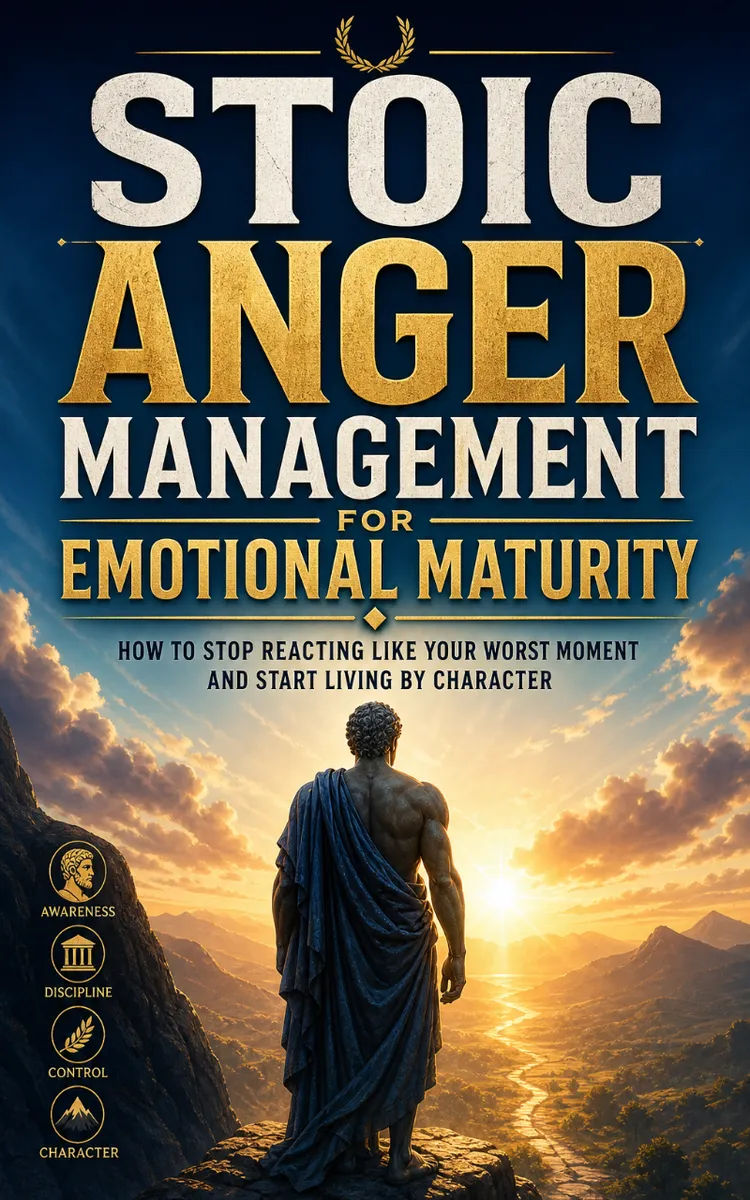
Stoic Anger Management For Emotional Maturity
Created with Inkfluence AI
Stoic-based strategies for managing anger and building emotional maturity
Table of Contents
- 1. Reclaiming Your Anger Narrative
- 2. The Stoic Control Map
- 3. Replacing Reactivity With Choice
- 4. Judgment vs. Event Clarity
- 5. The Virtue Lens for Anger
- 6. Building Emotional Maturity Standards
- 7. Stopping Mind-Reading Triggers
- 8. Using Negative Visualization Wisely
- 9. The Premeditation of Response
- 10. Interrupting Rumination Loops
- 11. Temperance in Speech and Timing
- 12. Boundary Setting Without Explosions
- 13. Repairing After You Slip
- 14. Turning Blame Into Accountability
- 15. Managing Anger in Relationships
- 16. Workplace Justice Without Resentment
- 17. Stress-Proofing Your Attention
- 18. The Night Review for Character Growth
- 19. Forging Resilience Through Adversity
- 20. Living by Character Under Pressure
Preview: Reclaiming Your Anger Narrative
A short excerpt from “Reclaiming Your Anger Narrative”. The full book contains 20 chapters and 28,333 words.
Picture This
The next time you feel anger spike, pause and notice what your mind tries to do with it. Does it rush you into action-texting back too fast, snapping a comment you’ll regret, slamming a door like the world needs to hear it? Or does it quietly slide a headline into your thoughts-They don’t respect you. You’re being played. This is unfair-and then act like that headline is the truth?
Darius knows that moment. He’s 34, a warehouse supervisor, and his day is full of small frictions: a missed delivery, a worker who “didn’t see” the updated schedule, a coworker who talks over him in front of others. Most days he can handle it. But every so often, something hits a nerve and his anger feels less like an emotion and more like a verdict. In his head, it’s not I’m angry-it’s I’m right to be angry. And once that switch flips, he starts living from the script of his worst moment: the one where he reacts first and figures out the damage later.
What if your anger isn’t a character you are-it’s a story your mind keeps rewriting in real time?
The Mindset Shift
Old Belief: Anger is who you are, so when it shows up, you just have to let it run.
New Reality: Anger is information, and your identity is the choice you make after you read it.
That shift sounds small, but it changes everything. If anger is information, then it has a job. It points to something that matters to you-respect, fairness, safety, competence, belonging. It’s your inner alarm system trying to get your attention. But alarms don’t get to drive the car. They don’t get to decide the destination. They only get to say, “Hey-pay attention.”
Now look at the concrete difference for someone like Darius. When a worker dismisses a safety concern with a shrug, his anger might tell him, “This is disrespect.” If he treats that as identity, he becomes “the angry supervisor,” and the interaction turns into a power struggle. But if he treats anger as information, he can ask: What exactly am I protecting right now? In that moment, he might realize it’s not just pride. It’s the risk of someone getting hurt, and his frustration is his mind trying to prevent that. The anger still shows up-but it stops demanding that he win the argument. He can respond with clarity instead of heat.
Here’s why this matters for long-term self-control: identity-based anger grows roots. When you believe “this is me,” you stop questioning it. You stop investigating it. You start defending it. Information-based anger, on the other hand, invites curiosity. It makes your next move a choice, not a reaction.
So the goal isn’t to kill anger or “be calm.” The goal is to treat anger like a signal and your identity like the driver’s seat.
Going Deeper
Anger becomes dangerous when it moves from message to identity. That’s where the “Anger Story Audit” comes in. Your anger story is the narrative your mind builds around the emotion-what happened, what it means, who is at fault, what should happen next. It often sounds like certainty. It feels like truth. But it’s still a story-constructed, repeated, and shaped by your past.
Think of it like this: anger doesn’t just rise. It explains itself. It adds characters (“they,” “the usual disrespect,” “people who don’t care”). It assigns motives (“they’re trying to undermine me”). It demands an outcome (“they need to learn,” “I need to put them in their place”). And the more convincing the story feels, the more it starts running your behavior automatically.
That’s why we audit it. Not to shame yourself. Not to pretend you’re above anger. But to see the pattern clearly enough to interrupt it.
Signs this pattern is running your life
1. Your anger comes with a built-in conclusion. Before you even calm down, you already know what it “means.” For Darius, it might be, “They’re ignoring me on purpose,” even before he has the full context.
2. You start arguing with the past, not the present. The emotion pulls old scenes into the current moment. A small comment becomes a replay of a bigger disrespect that happened months ago.
3. You protect your image more than your values. The anger pushes you toward being seen as “strong,” “in control,” or “not to be messed with,” even when your real value is safety, fairness, or teamwork.
4. You feel relief right after reacting-then pay a price later. That quick hit of “finally, that felt good” is the brain reinforcing the story. The next day brings the cost: regret, tension, or worse relationships.
En résumé: Anger isn’t your identity-it’s the story your mind tells so it can justify action.
The most important part of this isn’t blaming your mind. It’s noticing that your anger story has a rhythm. It forms. It tightens. It pushes. Once you can recognize the steps, you can choose a different ending.
In the Anger Story Audit, you’re going to map the exact story your anger creates-so you can stop living from the script of your worst moment....
About this book
"Stoic Anger Management For Emotional Maturity" is a self-help book by Socratic Mastery with 20 chapters and approximately 28,333 words. Stoic-based strategies for managing anger and building emotional maturity.
This book was created using Inkfluence AI, an AI-powered book generation platform that helps authors write, design, and publish complete books. It was made with the AI Self-Help Book Writer.
Frequently Asked Questions
What is "Stoic Anger Management For Emotional Maturity" about?
Stoic-based strategies for managing anger and building emotional maturity
How many chapters are in "Stoic Anger Management For Emotional Maturity"?
The book contains 20 chapters and approximately 28,333 words. Topics covered include Reclaiming Your Anger Narrative, The Stoic Control Map, Replacing Reactivity With Choice, Judgment vs. Event Clarity, and more.
Who wrote "Stoic Anger Management For Emotional Maturity"?
This book was written by Socratic Mastery and created using Inkfluence AI, an AI book generation platform that helps authors write, design, and publish books.
How can I create a similar self-help book?
You can create your own self-help book using Inkfluence AI. Describe your idea, choose your style, and the AI writes the full book for you. It's free to start.
Write your own self-help book with AI
Describe your idea and Inkfluence writes the whole thing. Free to start.
Start writingCreated with Inkfluence AI


