
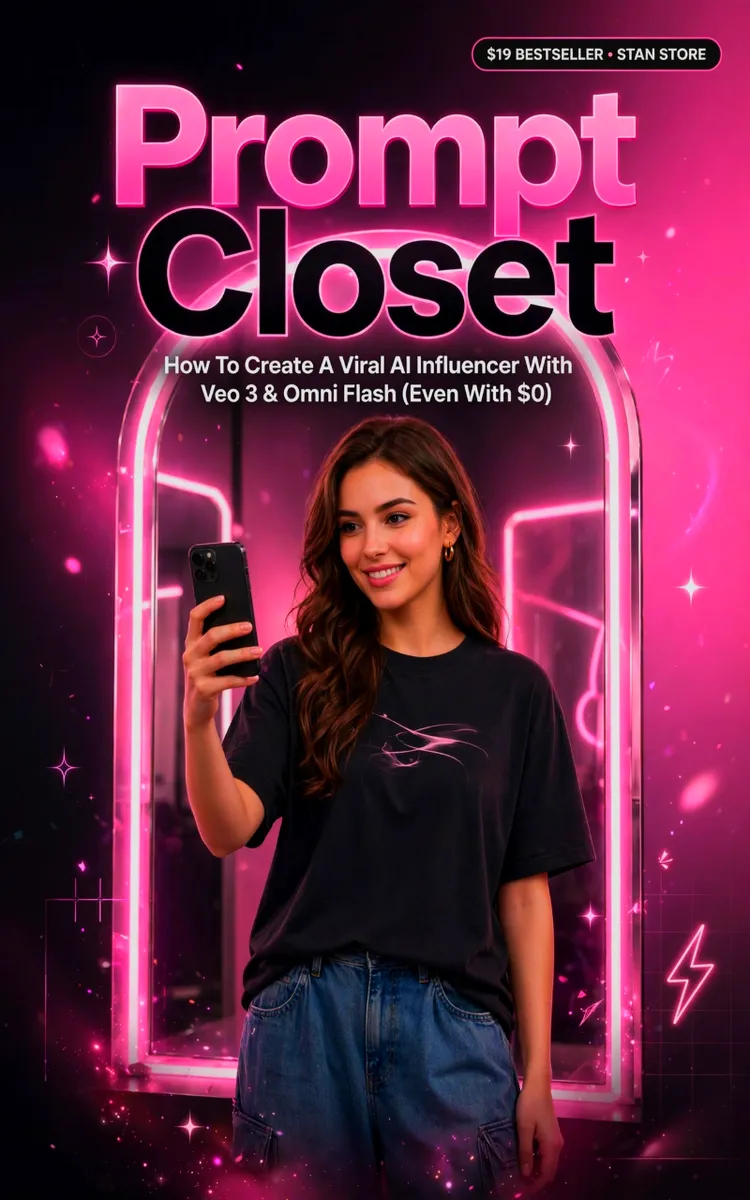
Read the first chapter
The whole of chapter one, free. About 8 min. Turn the pages with the arrows, your keyboard, or a swipe.
Chapter 1
Designing a Distinct AI Influencer
Make Recognition the First Design Goal
A creator can post a polished Veo 3 video and still lose attention before the viewer understands who they are watching. The problem usually starts before the prompt: the character has no clear niche, no defined audience, and no visual details that stay consistent from one image to the next. A neon jacket in one post, a business suit in the next, and a different hairstyle after that may look creative, but they make the account difficult to remember.
A distinct AI influencer solves that problem by making one clear promise to one clear group of people. A budget cooking character might help renters prepare one-pan meals in tiny kitchens. A fitness character might show short mobility routines for desk workers. Both ideas become stronger when the creator chooses a specific audience, gives the character a repeatable personality, and locks a small set of visual features. After making these choices, you can write more consistent prompts for Vwo 3 and judge new ideas against a simple question: does this look and sound like the same creator?
The goal is not to design every detail at once. Start with the character’s job, then connect the audience, personality, and appearance to that job. Your practical takeaway is simple: a recognizable AI influencer needs a narrow promise before it needs more content.
Build the Persona Anchor Method
The Persona Anchor Method gives your character four connected anchors: niche, audience, personality, and visual identity. Each anchor answers a different question, but all four must support the same promise. If your niche focuses on affordable streetwear while your visuals look like luxury fashion advertising, viewers may not understand what the account offers.
Use these steps to create the foundation:
• Choose the niche.
The niche names the subject and the useful angle. “Travel” is too broad. “Weekend train trips for people who live in large cities” gives you clear topics, locations, and limits. A narrow niche helps you decide what belongs on the account and what does not.
• Define the audience.
Describe the people you want to help or entertain. Include their situation, not only their age. “People who want to cook after work but hate washing dishes” gives you a better guide than “food lovers.” Their problem should shape the character’s posts.
• Set the personality.
Choose three traits that affect speech, reactions, and decisions. For example: practical, playful, and slightly impatient with complicated advice. Three traits create a usable direction without forcing every post into the same joke.
• Lock the visual identity.
Select details that viewers can recognize quickly: face shape, hair, skin tone, clothing category, two main colors, one accessory, and a usual setting. Keep these details stable so Vwo 3 has fewer opportunities to change the character.
• Write the character promise.
Combine the first three anchors into one sentence: “A practical, playful guide helps desk workers loosen stiff shoulders with short routines they can do beside a chair.” This sentence becomes a filter for ideas, captions, and visual choices.
The niche should create the character’s reason to exist. The audience should create the problems the character addresses. The personality should make the delivery enjoyable, while the visual identity should help viewers recognize the account before they read the username.
Now turn the visual identity into a short reference sheet. Avoid a long biography because extra details can compete with the features that matter on screen. Record the character’s age range, body type, hairstyle, clothing, colors, accessory, facial expression, and common location. For example, a home-repair AI influencer might use a cropped dark jacket, orange work gloves, a small tool pouch, and a bright workshop background. Those choices connect directly to the subject and give Veo 3 repeatable visual instructions.
Separate fixed details from flexible details. Fixed details should stay the same in nearly every post: hair, face, main colors, and accessory. Flexible details can change with the topic: shirt style, tool, background object, or facial expression. This balance prevents the character from looking frozen while protecting recognition. Ask yourself: if the face disappeared for a moment, would the colors, clothing, and setting still suggest the same account?
Use a simple design table before creating content:
Anchor
Decision
Why it matters
Niche
Five-minute mobility for desk workers
Creates a clear subject and repeatable problems
Audience
People who sit at a desk and skip long workouts
Shapes the length and difficulty of advice
Personality
Calm, direct, lightly humorous
Controls the wording and facial expressions
Fixed visuals
Short dark hair, teal shirt, silver watch
Helps viewers recognize the character
Flexible visuals
Office, train seat, or kitchen chair
Adds variety without changing the identity
A strong anchor sheet should let you describe the character in two or three sentences. If you need a full page to explain the idea, remove details that do not affect the niche, audience, personality, or appearance. The practical takeaway: build a small set of connected decisions that Vwo 3 can repeat clearly.
Apply the Anchors to a First Character
Consider a creator who wants to build an AI influencer for renters with very small kitchens. Instead of choosing the broad niche “food,” the creator selects “one-pan meals for renters who cook after work.” The audience includes adults who have limited counter space, basic cookware, and little patience for cleanup. That audience gives the character a clear point of view: recipes must use simple ingredients, take little time, and create few dirty dishes.
The creator chooses a personality that feels useful on a busy evening: practical, encouraging, and mildly sarcastic about unnecessary kitchen gadgets. The visual identity uses a warm yellow apron, short curly black hair, round glasses, and a compact apartment kitchen with white tile. The yellow apron and glasses remain fixed. The recipe, pan, and background ingredients can change.
Follow this setup process:
• Write the promise.
Use: “A practical, encouraging kitchen guide shows renters simple one-pan dinners with minimal cleanup.” Expected outcome: every future idea has a clear reason to exist.
• List five audience problems.
Write “small counter,” “late workday,” “limited cookware,” “small grocery budget,” and “too many dishes.” Expected outcome: you gain five reliable topic directions without copying random trends.
• Choose three personality rules.
The character gives direct instructions, uses short jokes about clutter, and never shames beginners. Expected outcome: captions and dialogue sound consistent.
• Create the visual reference.
Record short curly black hair, round glasses, a warm yellow apron, a dark green shirt, and a white-tile kitchen. Add one fixed prop: a blue enamel pan. Expected outcome: each Veo 3 prompt includes the same recognition signals.
• Test three sample prompts.
Prompt one shows the character chopping vegetables beside the blue pan. Prompt two shows the character stirring pasta. Prompt three shows the character holding the finished meal. Keep the face, hair, apron, shirt color, glasses, and kitchen style unchanged. Expected outcome: the three images look like posts from one account rather than three unrelated creators.
• Check the promise against each idea.
Remove any recipe that needs a large oven, advanced equipment, or a long preparation time. Expected outcome: the audience understands what the account consistently helps them do.
After these six steps, review the character at thumbnail size. Shrink the images on your phone until the face and body occupy only a small part of the screen. If the yellow apron, glasses, or blue pan still stand out, the identity has useful visual anchors. If the character becomes anonymous, strengthen the color contrast or simplify the clothing.
Quick checklist
• [ 1] The niche names one subject and one specific angle.
• [2 ] The audience has a clear problem or situation.
• [ 3] The personality uses three traits that affect the content.
• [4 ] The visual identity includes fixed hair, clothing, colors, and one accessory.
• [6 ] Flexible details add variety without changing the character.
• [7] The character promise fits every planned post.
• [8] Three test images look like they belong to one account.
• [9] The identity remains visible at phone-thumbnail size.
This test does not measure whether the character will become popular. It checks something more basic first: whether viewers can recognize what they are seeing and why the account exists.
Prevent Identity Drift Before It Starts
Changing the character to match every trend
A creator may change the hairstyle, clothes, colors, and setting whenever a new topic appears. That approach creates variety but removes recognition. Viewers need repeated signals before a character feels familiar.
Do this: Keep the face, hairstyle, main color, and signature accessory fixed. Change only the pose, topic prop, or background.
Not this: Give the character a new visual style for every post because the subject changed.
If the account covers both breakfast and dinner, keep the yellow apron and blue pan while changing the ingredients. The topic can move; the identity should not.
Choosing a niche that cannot produce specific posts
“Lifestyle,” “motivation,” and “fashion” may sound attractive, but they do not tell you what the character does for a viewer. A broad niche also makes the visual identity harder to connect to a useful promise.
Do this: Add a person, problem, and format. “Affordable outfit ideas for new office workers” gives you a group, a need, and a repeatable content shape.
Not this: Use a broad label and hope the character’s personality will explain everything later.
Test the niche by writing ten post ideas. If you cannot write ten ideas without repeating yourself, narrow the audience or add a clear problem. A good niche should create topics naturally.
Making the personality only a list of adjectives
Words such as “fun,” “cool,” and “relatable” do not tell you how the character should speak or react. Without behavior rules, one caption may sound serious while the next sounds like a completely different account.
Do this: Turn each personality trait into an action. “Direct” means the character gives the answer early. “Playful” means the character adds one light joke. “Encouraging” means the character corrects mistakes without insulting the viewer.
Not this: Add ten personality traits that compete with each other.
Keep three traits and write one example sentence for each. For the kitchen character, a direct line might say, “Use one pan and skip the extra bowl.” A playful line might add, “Your sink has done enough today.” An encouraging line might say, “If the vegetables look uneven, the meal will still work.”
A distinct AI influencer begins with a promise people can understand and a design they can recognize quickly. Use the Persona Anchor Method to connect the niche, audience, personality, and visual identity before you produce a large batch of content. Once those anchors hold steady, Vwo 3 can help you create variety without losing the character behind it.
End of chapter one. 4 more chapters and about 8,931 words in the full book.
Swipe or use the arrows to turn the page
What's inside: 5 chapters
- 1. Designing a Distinct AI Influencer
- 2. Creating Consistent Images with Veo 3
- 3. Making Short Videos with Omni Flash
- 4. Planning Viral Posts on a Zero Budget
- 5. Growing Through Analytics and Community
About this book
"Build A Viral AI Influencer" is a how-to guide book by Anonymous with 5 chapters and approximately 8,931 words. Creating and growing a viral AI influencer using Veo 3 and Omni Flash.
This book was created using Inkfluence AI, an AI-powered book generation platform that helps authors write, design, and publish complete books. It was made with the AI Ebook Generator.
Frequently Asked Questions
What is "Build A Viral AI Influencer" about?
Creating and growing a viral AI influencer using Veo 3 and Omni Flash
How many chapters are in "Build A Viral AI Influencer"?
The book contains 5 chapters and approximately 8,931 words. Topics covered include Designing a Distinct AI Influencer, Creating Consistent Images with Veo 3, Making Short Videos with Omni Flash, Planning Viral Posts on a Zero Budget, and more.
Who wrote "Build A Viral AI Influencer"?
This book was written by Anonymous and created using Inkfluence AI, an AI book generation platform that helps authors write, design, and publish books.
How can I create a similar how-to guide book?
You can create your own how-to guide book using Inkfluence AI. Describe your idea, choose your style, and the AI writes the full book for you. It's free to start.
Write your own how-to guide book with AI
Describe your idea and Inkfluence writes the whole thing. Free to start.
Start writingCreated with Inkfluence AI


