
Read the first chapter
The whole of chapter one, free. About 8 min. Turn the pages with the arrows, your keyboard, or a swipe.
Chapter 1
Opera Basics: What You’re Hearing
Finding Your Bearings Before the First Note
What do you listen for when a soprano sings a high note, the orchestra suddenly turns dark, and someone on stage reaches for a knife? If the answer is “I’m not sure,” you’re in exactly the right place. Opera throws several kinds of sound and action at you at once, but you don’t need to catch everything. You need a simple way to sort what you hear.
Opera combines sung speech, instrumental music and visible action. The voice tells you who feels what; the orchestra shows what sits underneath; the story gives those sounds a direction. Once you know those jobs, a long evening stops feeling like a wall of noise. You can follow a change in mood, recognise a relationship and understand why a musical moment matters, even when you miss a line.
The Three-Layer Listening Map: three simple questions to use from your seat, Who is singing and how? What is the orchestra doing? What has changed in the story? After reading, you should be able to identify the main voice types, listen for the orchestra’s useful clues and track the story engine - the chain of wants, choices and consequences that keeps an opera moving.
The Three-Layer Listening Map
Start with the voices. Opera singers receive labels based mainly on range, colour and the kind of character they often play. A soprano usually sings the highest female part, while a mezzo-soprano sings lower and often brings a warmer or heavier sound. A tenor usually sings the higher male part, and a baritone sits between tenor and bass. A bass supplies the lowest male sound. These labels do not tell you a character’s whole personality, but they give you a useful first clue.
You may also hear the terms aria, recitative and ensemble. An aria gives one singer space to explore a feeling or decision, often with a memorable melody. Recitative moves the conversation along in a more speech-like style, sometimes with light accompaniment. An ensemble lets several characters sing at once, often because they want different things. When the stage becomes musically crowded, listen for separate lines rather than trying to understand every word.
Use the map in this order:
• Voice: identify the sound and the speaker.
Ask whether the voice sounds high or low, then notice one quality such as bright, dark, smooth or forceful, Then look at the surtitles or programme to connect that sound with a character. This helps you follow who holds power or who has changed their mind.
• Orchestra: notice the musical weather.
Listen for changes in speed, volume, instruments and rhythm. A low repeated pattern often creates danger, a solo violin often suggests tenderness, and a sudden full-orchestra blast usually marks a decision or shock, You do not need to name every instrument. Notice what the music makes you expect.
• Story engine: track the want, the obstacle and the result.
Ask what each important character wants now, what blocks them and what changes after the scene. Opera often repeats this pattern: a promise is made, someone interrupts, a secret appears, and the next choice causes trouble.
The orchestra does more than decorate the singing. It can reveal information before a character does. In Mozart’s The Marriage of Figaro, quick, busy music can sharpen a scene of confusion, while a calmer phrase can give a character room to think. In Verdi’s La traviata, a repeated musical idea may return when love, illness or social pressure comes back into the foreground. You can listen for these returns without knowing their technical names.
A practical test works well during the performance: after each major musical section, ask, “What do I know now that I did not know before?”, If the answer is “a character has made a choice,” you have caught the story engine at work. If the answer is “the mood has changed but I do not know why,” check the surtitles and watch who has entered, left or stopped singing.
Applying the Map from Your Seat
Consider a first-act scene in Puccini’s La bohème. Four friends sit together in a cold Paris attic. One character wants warmth and company; another wants to finish his work; a visitor arrives looking for help; a lost key turns a small problem into a chance for intimacy. You do not need to memorise the plot to follow the scene. Work through the layers.
• Before the curtain rises, read the cast list and the first page of the programme.
Note the voice types beside the characters. If the programme lists a tenor poet, a baritone painter and a soprano neighbour, you already have three sound markers. Expected outcome: you can glance towards the right character when a new voice enters.
• During the first five minutes, listen for the group’s sound.
Several male voices may trade short phrases quickly. Treat this as an ensemble rather than one long tune. Watch the surtitles for the practical problem - the cold room and lack of firewood. Expected outcome: you understand the friends’ shared situation before the visitor arrives.
• When the soprano enters, note the change in musical colour, listen for shifts in tone, volume or accompaniment,
The pace and volume may shift as the scene becomes more private. Do not decide that a high voice automatically means happiness. Check the words and the singer’s physical behaviour. Expected outcome: you notice that the music gives the visitor and the tenor more space to focus on each other.
• When the key goes missing, follow the story engine.
The want is simple: the visitor needs a light or help finding her way. The obstacle is the dark room and the lost key. The result is that the two characters search together. Expected outcome: you see why a small stage business can lead into a major musical moment.
• During the following aria or duet, listen for repetition.
A melody, rhythm or phrase may return as the characters reveal more about themselves. Notice whether the voices match, answer each other or pull in different directions. Expected outcome: you hear the relationship developing rather than treating the section as a stand-alone song.
• At the end of the scene, write one sentence during the interval.
Use this pattern: “Character A wants, but happens, so ___ changes.” For the attic scene, your sentence might say that the pair want to know each other, but the evening’s interruptions and poverty shape what they can do next. Expected outcome: you carry a clear thread into the next act.
Quick checklist
• Read the cast list before the music starts.
• Match each voice type to a character.
• Listen for changes in speed, volume and instruments.
• Check surtitles when the musical mood changes sharply.
• Ask what each main character wants.
• Identify the obstacle in the current scene.
• Notice what changes after an aria, duet or ensemble.
• Write one sentence at the interval to hold the plot in your head.
This approach also works with a large chorus scene. First find one voice or group to follow, then listen to how the chorus supports, opposes or overwhelms that person. A crowd often represents public pressure rather than a collection of separate personalities. When you hear the orchestra grow louder beneath the chorus, look for a decision, accusation or arrival. The sound usually points towards a change on stage.
Common Listening Mistakes and Their Fixes
Treating voice type as a character label
A soprano does not always play a sweet young woman, and a bass does not always play a villain. Composers use voice types in familiar ways, but they also challenge those habits. A mezzo-soprano may play a teenage boy, while a tenor may play a foolish or frightened man.
Do this: use the voice type as a sound marker, then check the words, costume and actions.
Not this: decide what a character feels just because the voice is high or low.
That correction matters because opera often creates tension between sound and action. A beautiful melody can carry jealousy, and rough, loud music can hide fear.
Trying to identify every instrument
You may hear strings, woodwind, brass and percussion all working together. If you spend the evening naming each one, you can miss the scene’s direction. The orchestra’s job changes from moment to moment: it may support a singer, build suspense, mark a memory or interrupt a conversation.
Do this: choose one feature to track - a repeated rhythm, a low rumble, a solo instrument or a sudden silence.
Not this: worry that you have failed because you cannot name an oboe from a clarinet.
For example, if a soft solo woodwind line appears whenever a character remembers home, note the connection. You have learned something useful even if you never identify the instrument.
Following the subtitles but losing the stage action
Surtitles help with words, but they cannot show you who watches whom, who holds an object or who refuses to move. Reading every line can pull your eyes away from a crucial gesture or entrance.
Do this: read enough of the subtitle to catch the meaning, then look back at the stage during held notes, orchestral passages and repeated lines.
Not this: keep your eyes fixed on the text from the first note to the last.
The story engine often turns on a physical action: a letter is hidden, a door opens, a hand pulls away. If you miss that action, the next musical change may seem unearned. Keep the Three-Layer Listening Map in reach: identify the voice, notice the orchestra’s warning or support, then ask what the action has changed.
Opera becomes easier when you stop treating it as one enormous thing to understand at once. A voice gives you a person, the orchestra gives you the pressure around that person, and the story engine tells you where the pressure leads. Follow those three layers and even a complicated scene offers firm handholds. The rest - the grand gestures, strange customs and occasional daftness - becomes much easier to judge for yourself.
End of chapter one. 7 more chapters and about 13,860 words in the full book.
Swipe or use the arrows to turn the page
What's inside: 8 chapters
- 1. Opera Basics: What You’re Hearing
- 2. The Vocabulary Decoder for Beginners
- 3. Snobbery: What It’s Really About
- 4. How to Read a Programme Like a Pro
- 5. Your First Sit: Choosing Seats Smartly
- 6. Avoiding the Fleecing: Tickets and Fees
- 7. How to Follow the Plot During Acts
- 8. Etiquette That Doesn’t Make You Smaller
About this book
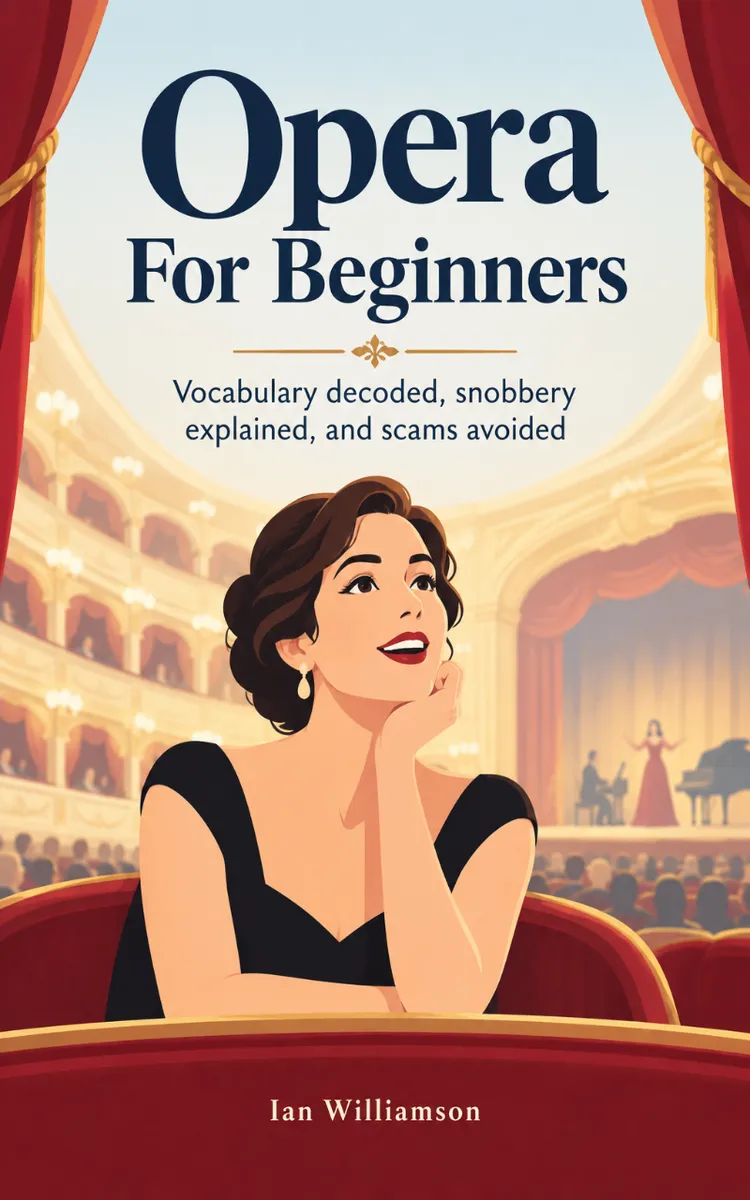
"Opera For Beginners" is a how-to guide book by Anonymous with 8 chapters and approximately 13,860 words. Beginner guide to opera vocabulary, culture, and avoiding scams.
This book was created using Inkfluence AI, an AI-powered book generation platform that helps authors write, design, and publish complete books. It was made with the AI Ebook Generator.
Frequently Asked Questions
What is "Opera For Beginners" about?
Beginner guide to opera vocabulary, culture, and avoiding scams
How many chapters are in "Opera For Beginners"?
The book contains 8 chapters and approximately 13,860 words. Topics covered include Opera Basics: What You’re Hearing, The Vocabulary Decoder for Beginners, Snobbery: What It’s Really About, How to Read a Programme Like a Pro, and more.
Who wrote "Opera For Beginners"?
This book was written by Anonymous and created using Inkfluence AI, an AI book generation platform that helps authors write, design, and publish books.
How can I create a similar how-to guide book?
You can create your own how-to guide book using Inkfluence AI. Describe your idea, choose your style, and the AI writes the full book for you. It's free to start.
Write your own how-to guide book with AI
Describe your idea and Inkfluence writes the whole thing. Free to start.
Start writingCreated with Inkfluence AI


