
Read the first chapter
The whole of chapter one, free. About 8 min. Turn the pages with the arrows, your keyboard, or a swipe.
Chapter 1
EIN Setup for Credit Eligibility
Why EIN Identity Matching Drives Credit Approval
When a lender or vendor pulls up your business, they don’t “feel out” who you are - they match records. If your EIN (Employer Identification Number) and business details don’t line up, you can lose time, get stuck in manual review, or get denied before anyone looks at your business story.
This chapter solves a common frustration: you applied for credit or trade terms, and the request came back with “can’t match business” or “information doesn’t verify.” Usually the issue isn’t your sales or your ability to pay - it’s that the EIN-to-business identity data doesn’t match across the places that matter. After this chapter, you’ll know how to confirm your EIN, your business name and address, and your legal structure so lenders and vendors can correctly match you.
You’ll also get a practical workflow you can run in under an hour, plus a realistic example using Tanya, 34, who owns an LLC and sells online. Tanya’s goal isn’t paperwork for its own sake - it’s getting approved for trade lines without bouncing between forms.
The EIN-to-Identity Checklist: Confirm Your Business the Way Lenders See It
Before you submit anything else, understand what “matching” means in plain terms. Lenders and vendors typically verify your EIN against government and business records, then they compare that to the name, address, and legal structure you provide on applications. If one piece is off - like a missing “LLC,” a suite number typo, or a mismatch between your EIN application and your current address - you force them to treat you as a risky “unknown” or send you back for corrections.
Use the EIN-to-Identity Checklist to confirm the exact identity details that should appear on applications. Think of it like you’re setting your business profile to the same version everywhere.
Follow these steps in order:
1. Confirm your EIN exactly as issued - Find the EIN confirmation notice from the IRS (or your EIN assignment letter/confirmation email if you received it that way). Copy the EIN digits carefully and keep them consistent on every application. - Why this matters: a single wrong digit turns your business into a different record. That’s not a “small mistake” - it creates a mismatch that slows approvals.
2. Lock your legal business name format (including “LLC”) - Use your legal name exactly as it appears on your LLC formation documents with your state. If your legal name includes “LLC,” include it. If it includes a comma, abbreviation, or punctuation, use the same format as closely as possible. - Why this matters: “Tanya’s Supply” and “Tanya’s Supply LLC” can be treated as different entities even if you run them as the same business.
3. Verify the business address you should use for matching - Use the address tied to your entity records (typically your registered business address and/or the address you used when you set up the business). Include the suite/unit number if you have one. - Why this matters: lenders and vendors often compare address lines. If you list “123 Main St” but the record shows “123 Main St Ste 4,” you can trigger manual review.
4. Match your legal structure to how you operate - Identify your legal structure: sole proprietor, single-member LLC, multi-member LLC, partnership, or corporation. - If you have an LLC, make sure you describe it correctly on applications. For example, a single-member LLC usually applies under the LLC’s EIN, but the “type” field must reflect the structure accurately. - Why this matters: the application’s structure dropdown drives how they interpret your tax setup and risk profile.
5. Use one “source” for each field and keep it consistent - Pick a source document for each item: - EIN → IRS confirmation - Legal name → your LLC formation paperwork - Address → your state entity record or your most consistently used matching address on IRS/tax filings - Structure → your LLC formation and operating agreement (or your IRS tax classification, if you’re familiar with it) - Why this matters: consistency prevents slow back-and-forth. If you copy from one form today and a different form tomorrow, you create avoidable mismatches.
If you want a quick comprehension check, ask yourself: “If a stranger searched my EIN, would they see the same legal name and address I’m about to enter?” If you can’t confidently answer that, you’re not ready to submit yet.
A quick example: Tanya’s LLC identity fields
Tanya, 34, runs an online retail business and formed an LLC. Her product labels show “Tanya’s Treasures,” but her LLC paperwork says “Tanya’s Treasures LLC.” When she fills out a vendor application, she must use the legal name format that matches her EIN record - not the nickname from her storefront.
Tanya also moved her shipping operation to a different warehouse after forming the LLC. She keeps her application identity fields aligned with the address tied to her LLC records for matching purposes, while she uses a separate shipping address only when the form specifically asks for “ship to” versus “business address.”
That one decision prevents the “can’t match” response she got the first time she applied.
Putting the EIN-to-Identity Checklist Into Practice (15-60 Minutes)
Grab your documents and do one clean pass. You’re not trying to perfect marketing details - you’re trying to make your business identity match across lender and vendor systems.
Use this scenario as your runbook. Tanya is applying for a net terms account (a trade line where the vendor invoices you and you pay within a set period, like “Net 30”). Her goal is to complete the application once and avoid follow-up questions.
Step-by-step scenario (with expected outcomes)
1. Pull your EIN confirmation - Locate the IRS EIN confirmation notice (paper or PDF). - Write the EIN down exactly. Don’t retype from memory. - Expected outcome: You eliminate the “fat-finger” problem that causes instant mismatches.
2. Open your LLC formation documents - Find the page that shows the legal entity name and the effective date. - Confirm whether your legal name includes punctuation, “LLC,” or any suffix. - Expected outcome: You stop using storefront names that don’t match your EIN record.
3. Confirm your matching address - Check your LLC record for the business address you used when forming the LLC or when you last updated your state filings. - If you have a suite/unit number, include it in the correct field. - Expected outcome: Your “business address” field matches what the system expects.
4. Set up your application fields before you start - Create a simple note on your phone or laptop with: - EIN - Legal name (exact format) - Business address (exact format) - Legal structure (for Tanya’s case: LLC; for single-member vs multi-member, follow your structure) - Expected outcome: You copy/paste the same values into every application.
5. Fill the vendor application using the right address type - When the form asks for “Business address,” enter the matching identity address. - If it asks for “Ship to” or “Remit to,” use your operational addresses for those purposes. - Expected outcome: The vendor can match your EIN to your legal record while still delivering to where you actually receive goods.
6. Double-check the “entity type” dropdown - Tanya selects the correct entity type that matches her LLC status. - If the form offers options like “LLC,” “Corporation,” or “Sole proprietor,” pick the option that matches your legal structure. - Expected outcome: The vendor doesn’t treat your application as the wrong kind of entity.
7. Submit and save your confirmation - Save a screenshot or PDF of what you entered (or the final submission page). - Expected outcome: If the vendor asks for corrections, you can respond quickly with the exact values you already used.
Quick checklist (Tanya’s version)
• Copy EIN from your IRS confirmation notice (no guessing) - Use your LLC’s legal name format exactly (include “LLC” if it’s in the legal name) - Use the matching business address for “Business address” fields (include suite/unit) - Select the correct legal structure in the dropdown - Use “Ship to” / “Remit to” fields for operational addresses only when those fields exist - Save your submitted application details so you can correct fast if needed
After you complete this once, you’ll notice something: approvals become smoother because you remove the “identity friction” that triggers manual reviews.
What to Watch For: Common EIN Matching Problems (and Fixes)
Even careful owners run into edge cases. Here are the ones that most often mess up EIN-based matching, along with clear fixes.
Suite number missing on the business address Do this: Include the suite/unit number exactly where the form shows it (for example, “123 Main St Ste 4”). If the form splits address lines, put “Ste 4” on the unit/suite line rather than the street line. Not this: Enter “123 Main St” when your records show “123 Main St Ste 4.” That difference can trigger a mismatch and slow your approval.
Using a nickname instead of the legal name Do this: Use your legal entity name from your LLC formation documents on every field labeled “Legal name,” “Business name,” or “Entity name.” Not this: Use your brand name (like “Tanya’s Treasures”) if your legal name is “Tanya’s Treasures LLC.” Vendors and lenders often match by legal entity data tied to your EIN.
Switching address types without realizing it Do this: Treat “Business address” as your matching identity address. Use “Ship to” or “Remit to” for your operational locations when the form clearly asks for those separate fields. Not this: Put your warehouse address into the “Business address” box when your EIN record points to a different address. You might still get approved, but you increase the chance of verification delays.
If you want a practical check before you hit submit, ask yourself: “Did I enter the same EIN-linked identity details into the fields that say business or entity, not shipping or remitting?”
Closing Takeaway: Build Credit With Clean Identity, Not Just Clean Applications
Getting your EIN, business name, address, and legal structure aligned isn’t paperwork busywork - it’s how you remove the mismatch that causes delays and denials before a lender or vendor even looks at your actual business. When your identity fields match what systems expect, you move faster through approvals and you spend less time answering “please correct” emails.
Run the EIN-to-Identity Checklist once, save your final values, and reuse them consistently. That simple habit becomes a foundation you can carry into every application for trade lines and business credit.
End of chapter one. 4 more chapters in the full book.
Swipe or use the arrows to turn the page

What's inside: 5 chapters
- 1. EIN Setup for Credit Eligibility
- 2. Business Credit File Building Steps
- 3. Choosing Trade Lines That Report
- 4. Secured Starter Accounts and Limits
- 5. Payment Strategy for Credit Growth
About this book
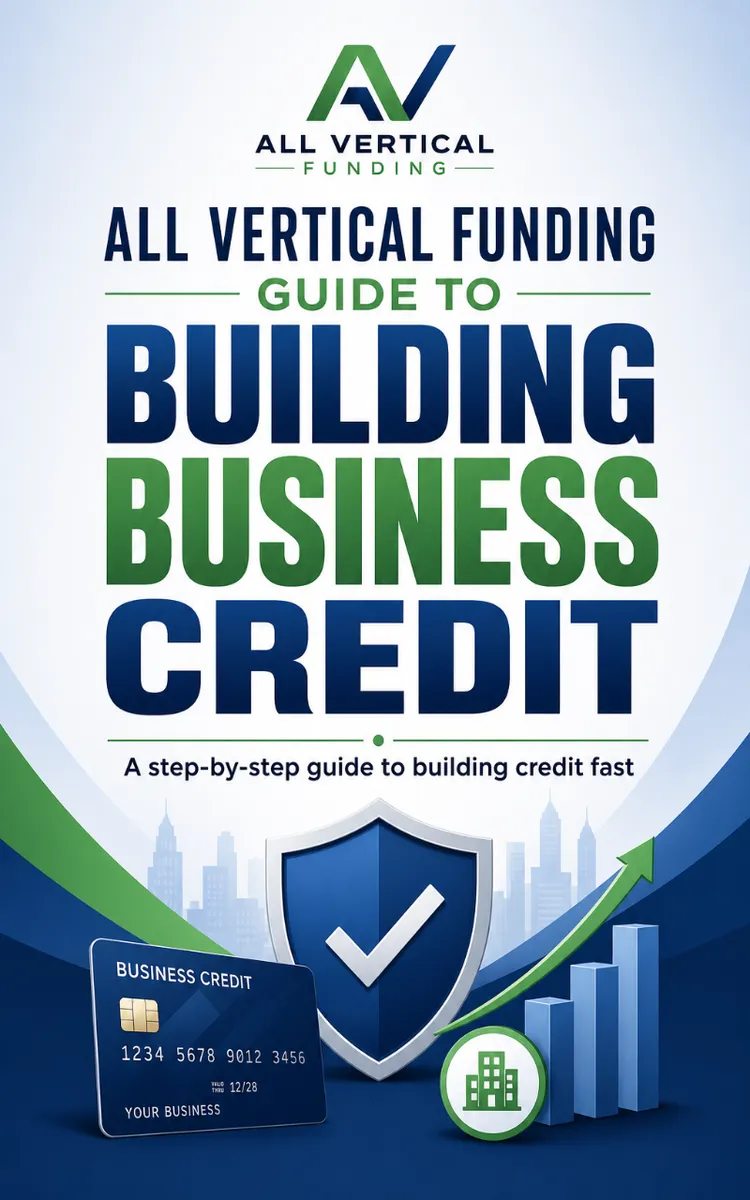
"All Vertical Funding Guide To Building Business Credit" is a how-to guide book by Andre Haynes with 5 chapters and approximately 9,580 words. Establishing business credit and trade lines using an EIN.
This book was created using Inkfluence AI, an AI-powered book generation platform that helps authors write, design, and publish complete books. It was made with the AI Ebook Generator.
Frequently Asked Questions
What is "All Vertical Funding Guide To Building Business Credit" about?
Establishing business credit and trade lines using an EIN
How many chapters are in "All Vertical Funding Guide To Building Business Credit"?
The book contains 5 chapters and approximately 9,580 words. Topics covered include EIN Setup for Credit Eligibility, Business Credit File Building Steps, Choosing Trade Lines That Report, Secured Starter Accounts and Limits, and more.
Who wrote "All Vertical Funding Guide To Building Business Credit"?
This book was written by Andre Haynes and created using Inkfluence AI, an AI book generation platform that helps authors write, design, and publish books.
How can I create a similar how-to guide book?
You can create your own how-to guide book using Inkfluence AI. Describe your idea, choose your style, and the AI writes the full book for you. It's free to start.
Write your own how-to guide book with AI
Describe your idea and Inkfluence writes the whole thing. Free to start.
Start writingCreated with Inkfluence AI


