
Read the first chapter
The whole of chapter one, free. About 8 min. Turn the pages with the arrows, your keyboard, or a swipe.
Chapter 1
Why Grandma Songs Stay With Us
The Tune That Outlives the Room
In 2018, researchers working with people living with dementia observed something that families had already known for years: a familiar song could bring back a voice, a rhythm, or a phrase long after ordinary conversation had become difficult. The words might be incomplete, but the melody often remained available, waiting beneath the silence.
That small mystery sits at the heart of Grandma songs. They are not merely old tunes passed down for entertainment. They carry the sound of a particular kitchen, church, porch, or family gathering; they preserve sayings that may never have been written down; and they give memory a shape that can be recalled through the body as much as through the mind.
The songs associated with Mrs. Johnson belong to this larger tradition of inherited knowledge. Their power comes partly from what they say, but also from who sang them, when they were sung, and how repetition made them feel almost permanent. A grandmother’s voice can turn a simple refrain into a family landmark.
Why does a melody sometimes remember what a person can no longer say?
How Repetition Turns Sound Into Memory
Before recorded music entered ordinary homes, songs traveled by voice. A melody could cross generations without sheet music, formal lessons, or a named composer. Children heard it while adults worked, prayed, cooked, traveled, or settled them for sleep. Its survival depended on repetition, but repetition did more than preserve the tune. It attached the tune to a pattern of daily life.
Grandma songs often grew inside these ordinary settings. A line might be sung while washing clothes, shelling peas, rocking a baby, or preparing food. The song became part of the activity, and the activity gave the song a place in memory. This is one reason such music can feel unusually vivid decades later. The recollection is not only auditory. It may include the smell of starch, the scrape of a chair, the light in a hallway, or the particular pause before a familiar verse.
The Memory Melody Map helps explain this layered quality. A Grandma song can be understood as having several connected routes into memory: melody, voice, words, setting, and relationship. The melody supplies the pattern. The voice identifies the person. The words carry the lesson or story. The setting anchors the moment. The relationship gives the whole experience emotional weight.
A child may forget the date of a family gathering but remember the tune sung there. That is not unusual. Music uses rhythm, pitch, timing, and expectation at once. Each return to the song strengthens its outline, much as footsteps wear a path across a familiar floor.
A surprising fact about memory is that accuracy is not always the same as completeness. Someone may lose individual words while retaining the rhythm that once held them together.
This helps explain why old songs can remain recognizable even when their lyrics have changed. Families often preserve a melody while adapting a phrase, shortening a verse, or replacing a word whose meaning has faded. The tune acts as a stable frame. It allows the family to alter the details without losing the identity of the song.
The Voice Behind the Song
A melody by itself is only part of the inheritance. The singer matters. People do not remember a Grandma song as an abstract sequence of notes; they remember it as something carried by a particular voice. The voice may have been low and measured, bright and quick, roughened by age, or marked by a regional accent. Those qualities become part of the song’s meaning.
This is why the same song can feel entirely different when performed by a stranger. A recording may reproduce the notes, but it cannot automatically reproduce the relationship. Mrs. Johnson’s version of a song might include a pause that no printed lyric records, a softened consonant, or a repeated line used to settle a room. Such details are not mistakes. They are evidence of the song’s life inside a family.
The science of music and memory offers a useful clue. Familiar music can engage brain systems involved in attention, emotion, movement, and autobiographical memory. It is not stored in one isolated mental compartment. A song is more like a bundle of linked experiences, which helps explain why it can open several doors at once.
Consider the difference between hearing a sentence and hearing a song. A sentence usually moves toward information. A song returns. Its chorus creates expectation, then fulfills it. That cycle gives the listener a sense of order, even when the surrounding world feels uncertain. For a child, repeated singing also makes language physical: syllables are stretched, accented, and placed inside a beat.
In many families, the grandmother’s voice served as an informal archive. She might preserve a hymn learned in childhood, a work song carried from another region, or a playful verse whose original author had disappeared from family knowledge. The archive was not silent or locked away. It was activated whenever someone sang.
Songs as Carriers of Inherited Wisdom
Grandma songs rarely announce themselves as philosophy. Their wisdom is usually folded into images, warnings, jokes, and repeated observations. A line about patience may be remembered because it rhymes. A warning about pride may survive because it arrives with a catchy refrain. The melody lowers the barrier between instruction and pleasure.
This was especially important in communities where formal records were incomplete, inaccessible, or controlled by others. Oral traditions carried family histories, religious beliefs, work knowledge, moral boundaries, and local language. A song could preserve a way of seeing the world without presenting itself as a lesson.
The African American spiritual tradition offers a powerful historical example. Songs such as “Wade in the Water” and “Go Down, Moses” carried biblical imagery, communal identity, and layered meanings through generations of forced displacement and racial violence. Their musical structure helped people remember them, while their words gave shape to endurance, hope, grief, and resistance. Not every Grandma song has such a public history, but many participate in the same basic process: memory becomes durable when it is made singable.
The same pattern appears in immigrant families. A grandmother may retain a song in a language that younger relatives no longer speak fluently. They may not understand every word, yet they recognize the cadence and emotional contour. The song becomes a bridge between language loss and cultural continuity.
Mrs. Johnson’s wisdom is best understood in this setting - not as a collection of detached sayings, but as knowledge carried through sound and relationship. The song teaches partly through its content and partly through the circumstances of its delivery. Advice heard from a trusted elder does not arrive as information alone. It arrives with evidence that someone lived long enough to repeat it.
The Counterintuitive Memory of a Song
The surprising connection is that a song may preserve identity even when its meaning is no longer fully understood. People can remember a melody, accent, or vocal pattern before they can explain the words attached to it.
This matters because it changes what counts as cultural inheritance. Transmission does not require perfect accuracy. A family may misremember a lyric and still preserve the emotional truth of the song: who sang it, what kind of moment it belonged to, and what values surrounded it.
Music’s structure makes this possible. Rhythm supplies a physical pulse, while melody provides a sequence of expectations. Even when language becomes unfamiliar, those patterns remain graspable. A child may hum a song long before understanding its message; an older adult may hum it after other forms of recall have weakened.
The Memory Melody Map therefore includes not only meaning but also sound, setting, and attachment. The map is not a filing cabinet of exact facts. It is a network of clues. One note can lead to a voice, one voice to a room, and one room to a piece of wisdom that seemed ordinary until the years made it precious.
Mrs. Johnson and the Living Archive
The figure of Mrs. Johnson belongs to a recognizable social world: the elder whose knowledge is distributed through everyday acts rather than formal instruction. Her authority does not depend on a podium or a published volume. It grows through familiarity. People hear her sing at family gatherings, during work, in worship, or while caring for children, and gradually learn which words carry special weight.
Picture the setting not as a stage but as a household in which music is woven into practical time. A song begins while hands are occupied. Someone nearby joins the refrain. A child hears the same line on several occasions and eventually supplies it without being asked. Years later, the child may remember the line but not the first time it was heard. The song has become part of the family’s internal soundscape.
That is how Mrs. Johnson’s wisdom can outlast a single conversation. Her words are attached to melody, and the melody is attached to her voice. When relatives repeat the song, they do more than perform an old tune. They recreate a small portion of the relationship that gave the tune its force.
The process is visible in communities as well as families. At church anniversaries, reunions, and neighborhood gatherings, older songs often draw people into a shared timing. Not everyone needs the same memory of the past. The chorus provides enough common ground for separate memories to overlap.
A Grandma song is therefore both personal and public. It may begin in one person’s voice, but each repetition gives others a place inside it. The inherited wisdom changes slightly as it travels, yet the central connection remains: sound carries what ordinary explanation might leave behind.
What the Melody Leaves Open
Human beings preserve meaning through more than records and monuments. We preserve it through patterns that can be repeated by an untrained voice, in an ordinary room, at the edge of a busy day. A melody gives memory a body, while a familiar voice gives it a home.
Mrs. Johnson’s songs reveal that wisdom is often less like a message delivered once and more like a tune returning until its shape becomes part of us. Somewhere inside that return is a question no archive can settle: how much of the singer remains in the song, waiting for the next voice to find it?
End of chapter one. 7 more chapters and about 12,215 words in the full book.
Swipe or use the arrows to turn the page
What's inside: 8 chapters
- 1. Why Grandma Songs Stay With Us
- 2. Mrs. Johnson’s Voice Behind the Songs
- 3. The Lessons Hidden in Each Lyric
- 4. How a Song Travels Through Generations
- 5. The Music of Comfort and Care
- 6. What Changes When Songs Are Remembered
- 7. Keeping Mrs. Johnson’s Wisdom Alive
- 8. The Wisdom We Carry Forward
About this book
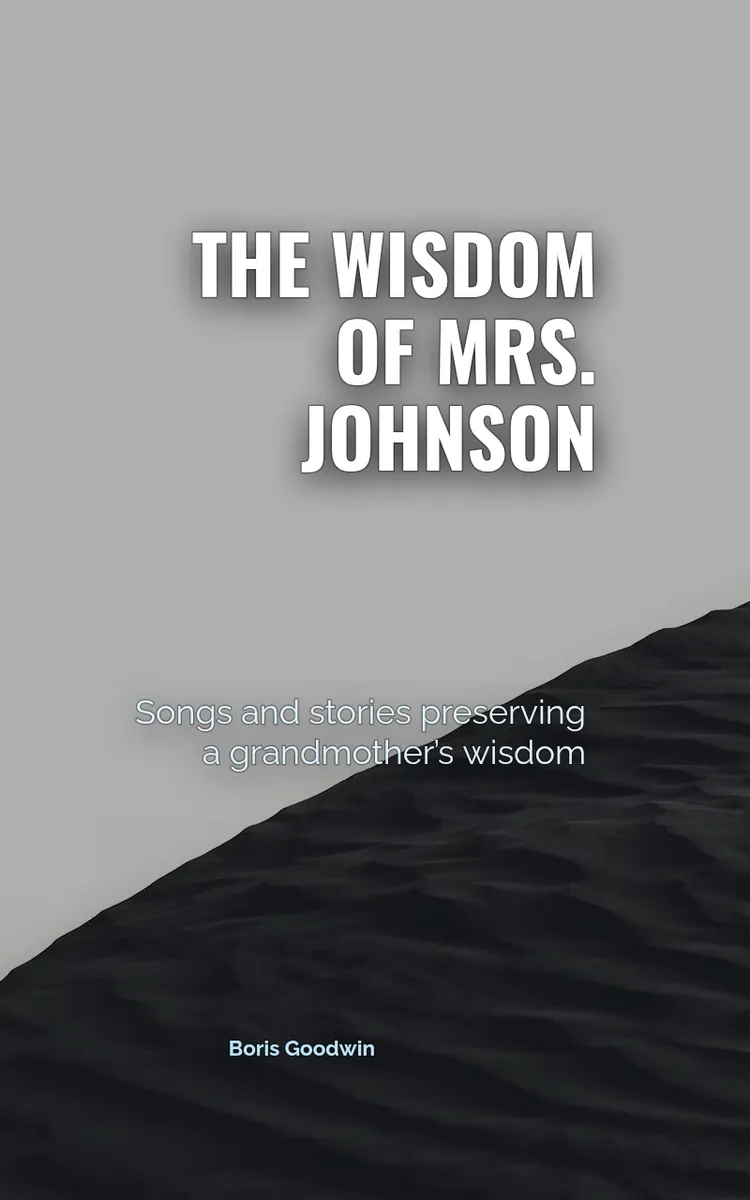
"The Wisdom Of Mrs. Johnson" is a curiosity book by Boris Goodwin with 8 chapters and approximately 12,215 words. Grandma songs and the wisdom associated with Mrs. Johnson.
This book was created using Inkfluence AI, an AI-powered book generation platform that helps authors write, design, and publish complete books.
Frequently Asked Questions
What is "The Wisdom Of Mrs. Johnson" about?
Grandma songs and the wisdom associated with Mrs. Johnson
How many chapters are in "The Wisdom Of Mrs. Johnson"?
The book contains 8 chapters and approximately 12,215 words. Topics covered include Why Grandma Songs Stay With Us, Mrs. Johnson’s Voice Behind the Songs, The Lessons Hidden in Each Lyric, How a Song Travels Through Generations, and more.
Who wrote "The Wisdom Of Mrs. Johnson"?
This book was written by Boris Goodwin and created using Inkfluence AI, an AI book generation platform that helps authors write, design, and publish books.
Write your own curiosity book with AI
Describe your idea and Inkfluence writes the whole thing. Free to start.
Start writingCreated with Inkfluence AI


