
Read the first chapter
The whole of chapter one, free. About 8 min. Turn the pages with the arrows, your keyboard, or a swipe.
Chapter 1
How an Airplane Rewrites Gravity
When the Ground Says No
A loaded airplane can weigh hundreds of thousands of kilograms, yet it leaves the runway and remains in the sky. Nothing about its mass has disappeared. Gravity has not weakened, and the atmosphere has not agreed to suspend it. Flight begins when an arrangement of material, motion, and control produces a capability that the separate parts do not possess.
That arrangement is infrastructure in its clearest form. The aircraft is not merely a collection of metal, engines, fuel, instruments, and passengers. It is a managed system that turns air from an obstacle into a working surface. Its wings, propulsion, control surfaces, navigation systems, maintenance routines, and operating rules cooperate closely enough to create a new physical possibility.
The airplane therefore offers more than a triumph of engineering. It provides a model for understanding how systems exceed the limits that appear to govern them. A capability can seem forbidden at one level of organization and ordinary at another. The question is not whether gravity exists. The question is what kind of structure can work through it.
When does an apparent law become only the boundary of an insufficient system?
The Airplane’s Argument with Gravity
For most of human history, sustained flight belonged to animals, seeds, and weather. Birds could rise because their bodies had evolved wings, muscles, feathers, and nervous systems as one integrated arrangement. Humans possessed none of those structures. Jumping, gliding, and falling were available; controlled, powered flight was not.
The early history of aviation is often told as a contest between inventors, but it was also a contest between models of the problem. A machine that merely imitated the appearance of a bird was unlikely to work, because feathers and muscles perform several functions at once. They generate lift, provide control, absorb vibration, and respond continuously to changing air. Engineers had to separate these functions, then reconnect them through manufactured parts and administrative routines.
The Wright brothers understood that control was as important as lift. Their 1903 Flyer used wing warping to alter the shape of the wings and help the aircraft roll. A front elevator controlled pitch, while the engine and propellers supplied thrust. The machine was fragile and difficult to operate, but its significance lay in the coordination of these systems. Flight was not produced by a wing alone. It emerged from a feedback relationship among airspeed, balance, propulsion, pilot input, and structure.
The physics is straightforward, though its consequences are not. A wing moves through air at an angle that redirects the airflow downward. The air exerts an opposing force upward, producing lift. Thrust keeps the aircraft moving fast enough for the wings to continue working, while drag resists that motion. Weight pulls downward. Flight is the maintained condition in which these forces are managed rather than eliminated.
That distinction matters. The airplane does not defeat gravity by escaping it. It uses gravity as one term in a larger arrangement of forces. The machine’s achievement is administrative as much as mechanical: it continuously allocates energy, responds to disturbance, and preserves a narrow operating condition.
A bird performs much of this administration biologically. An airplane externalizes it into infrastructure.
From Parts to a New Property
The phrase “heavier than air” sounds like a verdict because it compresses several different questions into one. Weight alone does not determine whether something can fly. A stone, a wing, and a balloon all occupy the atmosphere differently because their shapes, materials, and motions create different relationships with air.
This is a familiar pattern in complex systems. A single rivet cannot fly. Neither can a sheet of aluminum, a turbine blade, or a cockpit display. Yet when these elements are arranged into a functioning aircraft, flight becomes a property of the whole. The property is real, measurable, and repeatable, but it cannot be found by inspecting any isolated component.
The Infrastructural Leap Model names this transition: a system crosses into a new capability when its structure does more than support existing operations and begins to generate a new operating layer. Before the leap, gravity appears to define the outcome. After the leap, gravity remains present, but the system has acquired a way to administer its effects.
Aircraft development made this visible through successive layers. Better engines increased available thrust. Stronger materials reduced structural risk. Wind tunnels made airflow observable and adjustable. Instruments allowed pilots to operate beyond direct visual reference. Runways, fuel networks, maintenance standards, air-traffic control, and weather reporting extended the aircraft’s capability beyond the machine itself.
A modern flight is therefore not an isolated object moving through space. It is the visible tip of an administrative system. A landing depends on navigation data, trained personnel, communication protocols, inspection records, weather information, and coordinated timing. Remove enough of that surrounding infrastructure and the airplane’s physical ability remains, but its practical capability collapses.
The same point appears in evolution. DNA stores and transmits biological instructions, but organisms survive through bodies, environments, feedback, and inherited structures that are not reducible to a single molecule. In an aircraft, engineered infrastructure performs a comparable coordinating role. It becomes an intelligence layer: not intelligence as a private thought, but administration and control of processes, materials, energy, and information.
The Unexpected Lesson: Flight Is Mostly Feedback
The counterintuitive finding is that an airplane’s most important achievement is not producing lift. It is correcting deviations before they become failures. Flight is less a static victory over gravity than a continuous conversation with instability.
That changes how the airplane should be understood. The wing creates the possibility of flight, but control systems preserve it. A gust alters the aircraft’s attitude; the pilot or autopilot detects the change and adjusts the control surfaces. Instruments reveal speed, altitude, heading, and engine condition. Maintenance detects weaknesses before they become emergencies. The aircraft remains airborne because its infrastructure closes loops.
This is why flight belongs to a broader theory of evolutionary competition. Competition within an organization’s administration and intelligence can generate new capacities when systems learn to detect and manage their own conditions. The aircraft does not simply contain energy and structure; it measures, compares, and responds. Its survival in the air depends on feedback-driven investment.
The connection is easy to miss because the airplane looks like a finished object. In operation, it is closer to a process. Its wings are continuously negotiating with turbulence. Its engines are converting fuel into thrust while resisting heat and mechanical stress. Its control system is constantly adjusting its relation to the atmosphere. A plane parked on the ground still possesses the design for flight, but only the active system realizes it.
This is also why infrastructure can alter what seems to be a fixed boundary. The old boundary was not false; it described what an unengineered human body could do. The new capability arose when materials, energy, control, and knowledge were combined deeply enough to change the system’s effective parameters. Speed, altitude, range, and load were no longer limited to biological baselines.
The airplane did not replace natural intelligence. It built an artificial layer alongside it.
Kitty Hawk and the Administrative Machine
On December 17, 1903, at Kill Devil Hills, North Carolina, the Wright Flyer made four powered flights. The longest lasted less than a minute and covered a little more than half a kilometer. The machine was not a practical transport system. It had no enclosed cabin, no reliable route network, and no mature safety culture. Yet the event demonstrated that controlled, powered flight by a heavier-than-air machine was possible.
The site mattered because the Wrights had chosen it for its wind, open sand, and relative isolation. Their achievement depended on more than the final machine. They had built a wind tunnel to test wing shapes, developed propellers from their own calculations, studied previous gliding experiments, and created a method for controlling the aircraft in three dimensions. Their work was a small infrastructure surrounding a small aircraft.
The first flight therefore marked an administrative transition as much as a mechanical one. The air was no longer only a natural environment to endure. It had become an environment that could be measured, modeled, entered, and managed. Later generations extended that logic through airports, radio systems, weather services, standardized parts, flight schools, and global logistics. The aircraft’s capability expanded because the surrounding system expanded with it.
At every stage, the airplane remained subject to gravity. What changed was the depth of the structure operating within that constraint. A wing redirected air. An engine supplied motion. Controls preserved balance. Institutions maintained reliability. Networks supplied knowledge and resources. The apparent impossibility dissolved layer by layer, not because nature had been overruled, but because more of nature had been incorporated into an organized process.
The Boundary That Moves
The airplane reveals a recurring feature of evolution: limits often belong to a level of organization rather than to reality as a whole. A human body cannot fly by flapping its arms, but a human-built system can carry that body across oceans. A biological organism may have a limited lifespan, while medical, social, and technological infrastructures can extend its functional life beyond an untreated biological baseline.
Such changes are not magical exceptions. They are infrastructural leaps. New structures create new feedback cycles, and those cycles make previously unavailable parameters manageable. Physical parameters include speed, force, and energy control. Administrative parameters include resource allocation, timing, and coordination across distance. Once these become governable, the system’s environment is no longer merely inherited. It becomes partly constructed.
The airplane’s deepest lesson is therefore not that humans learned to imitate birds. It is that intelligence can be expressed as the construction of conditions under which a forbidden outcome becomes routine. Gravity still pulls. Air still resists. Machines still fail. But an organized system can work through those facts until the old boundary becomes the foundation of a new capability.
The sky did not open because gravity disappeared. It opened because matter, energy, information, and administration were assembled into a structure capable of answering gravity continuously. That answer remains incomplete, temporary, and dependent on maintenance - yet it is real enough to carry people above the clouds, where the next boundary begins to look less like a wall than a design problem.
End of chapter one. 4 more chapters and about 7,453 words in the full book.
Swipe or use the arrows to turn the page
What's inside: 5 chapters
- 1. How an Airplane Rewrites Gravity
- 2. When Maintenance Becomes Stagnation
- 3. Who Administers Intelligence?
- 4. The Infrastructure Behind Longer Life
- 5. Competition for New Cosmic Parameters
About this book
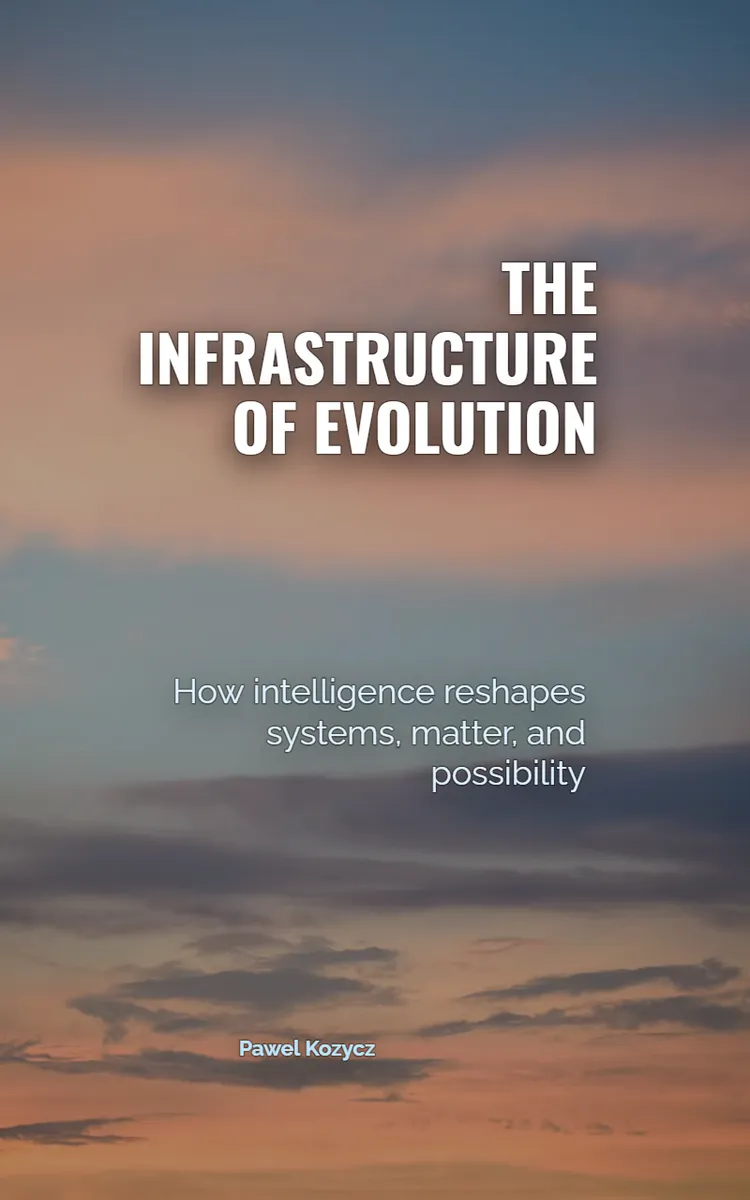
"The Infrastructure Of Evolution" is a curiosity book by Pawel Kozycz with 5 chapters and approximately 7,453 words. A theory of evolutionary competition through infrastructure, intelligence, and active administration.
This book was created using Inkfluence AI, an AI-powered book generation platform that helps authors write, design, and publish complete books.
Frequently Asked Questions
What is "The Infrastructure Of Evolution" about?
A theory of evolutionary competition through infrastructure, intelligence, and active administration
How many chapters are in "The Infrastructure Of Evolution"?
The book contains 5 chapters and approximately 7,453 words. Topics covered include How an Airplane Rewrites Gravity, When Maintenance Becomes Stagnation, Who Administers Intelligence?, The Infrastructure Behind Longer Life, and more.
Who wrote "The Infrastructure Of Evolution"?
This book was written by Pawel Kozycz and created using Inkfluence AI, an AI book generation platform that helps authors write, design, and publish books.
Write your own curiosity book with AI
Describe your idea and Inkfluence writes the whole thing. Free to start.
Start writingCreated with Inkfluence AI


