
Read the first chapter
The whole of chapter one, free. About 5 min. Turn the pages with the arrows, your keyboard, or a swipe.
Chapter 1
Days 1-6: Mapping Your Attention
At 8:47 a.m., a project manager opens her laptop to finish a proposal. By 9:03, she has answered two messages, checked a shipping update, skimmed a news alert, and opened a spreadsheet she doesn’t need until Friday. Nothing dramatic happened. Still, the proposal lost fifteen minutes before it had a chance.
That’s how attention usually slips: through small, ordinary openings. The Attention Map helps you see those openings without blaming yourself. Over the next six days, you’ll observe what pulls you away, when it happens, and what your work environment quietly teaches you to do.
Day 1: Catch the Drift
Tip of the Day:
You can’t change an attention pattern you haven’t noticed. Today isn’t about working perfectly or blocking every distraction. It’s about catching the moment your focus moves.
Keep a simple record during your workday. Each time you switch away from your intended task, note the time, what you were doing, and what pulled you away. “Opened email because a notification appeared” is useful. So is “Started cleaning up a spreadsheet to avoid writing the difficult section.” Don’t judge the reason. The point is to gather honest information.
Today's Action:
Record five attention shifts today, including the time, your original task, and what interrupted it.
---
Day 2: Find Your Pull Times
Tip of the Day:
Distraction often follows a schedule. You may be sharp early in the morning, restless after lunch, or especially vulnerable during the last hour before quitting time. Meetings, hunger, low energy, and accumulated decisions can all change how easily you stay with demanding work.
Look at today as a set of attention windows rather than one long workday. Notice when you can read, write, plan, or solve problems with less resistance. Also notice when you start reaching for your phone or opening unrelated tabs. This isn’t a test of discipline. It’s a way to stop assigning your hardest work to your least reliable hours.
Today's Action:
At three points today - morning, midday, and late afternoon - rate your focus from 1 to 5 and write one sentence explaining the rating.
---
Day 3: Separate the Trigger from the Task
Tip of the Day:
A distraction may look like a choice, but many begin with a trigger. A banner appears. Your phone vibrates. A coworker walks over. You hit a confusing paragraph and suddenly feel an urge to check messages. The trigger creates a small opening, and your attention steps through it.
Today, pay attention to what happens immediately before you switch tasks. External triggers are easy to spot, but internal ones matter just as much. Boredom, uncertainty, frustration, and the fear of making a mistake can push you toward easier work. Once you can name the trigger, you have more options than simply following it.
Today's Action:
When you switch tasks, write the first trigger you noticed and label it external or internal.
---
Day 4: Walk the Workplace
Tip of the Day:
Your surroundings make certain behaviors easier. An email tab left open invites checking. A phone placed beside your keyboard stays in your awareness, even when it’s silent. A chat status that signals instant availability can turn focused work into a stream of small responses.
Take a gentle tour of your actual work setup. Look at your desk, browser, phone, notifications, and communication tools. Ask, “What does this arrangement make easy?” Maybe it makes checking messages effortless but starting your proposal awkward. Maybe the document you need is buried under six windows. You’re not trying to create a perfect workspace. You’re looking for friction you can remove and interruptions you can make less automatic.
Today's Action:
Change one physical or digital feature of your workspace so your priority task is easier to start than a distraction.
---
Day 5: Ask the People Around You
Tip of the Day:
Not every interruption comes from technology. A teammate may stop by with a quick question. A client may expect an immediate reply. A manager may use chat for everything because that’s how the team has always worked. These interruptions can be reasonable and still make concentration difficult.
Today, ask one trusted coworker, manager, or client-facing partner what they believe requires an immediate response from you. Then compare their answer with your own assumptions. You may discover that you’re interrupting yourself to respond faster than anyone expects. Or you may uncover a real team norm that needs a clearer boundary.
Keep the conversation practical, not accusatory. Try: “I’m mapping when my focus gets broken. Which messages from me do you need answered right away, and which can wait a few hours?”
Today's Action:
Ask one person what they consider urgent communication and record their answer without defending your current habits.
---
Day 6: Draw Your Attention Map
Tip of the Day:
You’ve now collected more than a list of distractions. You have the early outline of your Attention Map: the times, triggers, settings, and tasks that shape your day.
Review your notes and look for patterns. Which task is most often interrupted? Which distraction repeats? Do you switch when work becomes unclear, when a notification appears, or when your energy drops? Also mark what supports focus. Perhaps closing email helps. Maybe a quiet room works better than headphones. Maybe writing the next physical step keeps you from wandering.
Your map doesn’t need to be polished. Divide a page into four areas: When, What pulls me, What I’m doing, and What helps. Fill it with specific observations from the past five days. “Afternoons are bad” is vague. “Between 2:00 and 3:00, I check chat whenever a report feels difficult” gives you something you can work with.
Today's Action:
Create a one-page Attention Map using your notes, then circle one repeating distraction and one condition that reliably supports focus.
---
The goal of these six days wasn’t to eliminate every interruption. It was to replace guesswork with a clearer picture of your professional day. Attention is shaped by timing, emotion, tools, expectations, and surroundings. Once those forces are visible, your next choices become much less mysterious.
End of chapter one. 4 more chapters and about 4,561 words in the full book.
Swipe or use the arrows to turn the page
What's inside: 5 chapters
- 1. Days 1-6: Mapping Your Attention
- 2. Days 7-12: Protecting Focus Sessions
- 3. Days 13-18: Taming Digital Interruptions
- 4. Days 19-24: Priorities, Routines, and Boundaries
- 5. Days 25-30: Sustaining Your Focus System
About this book
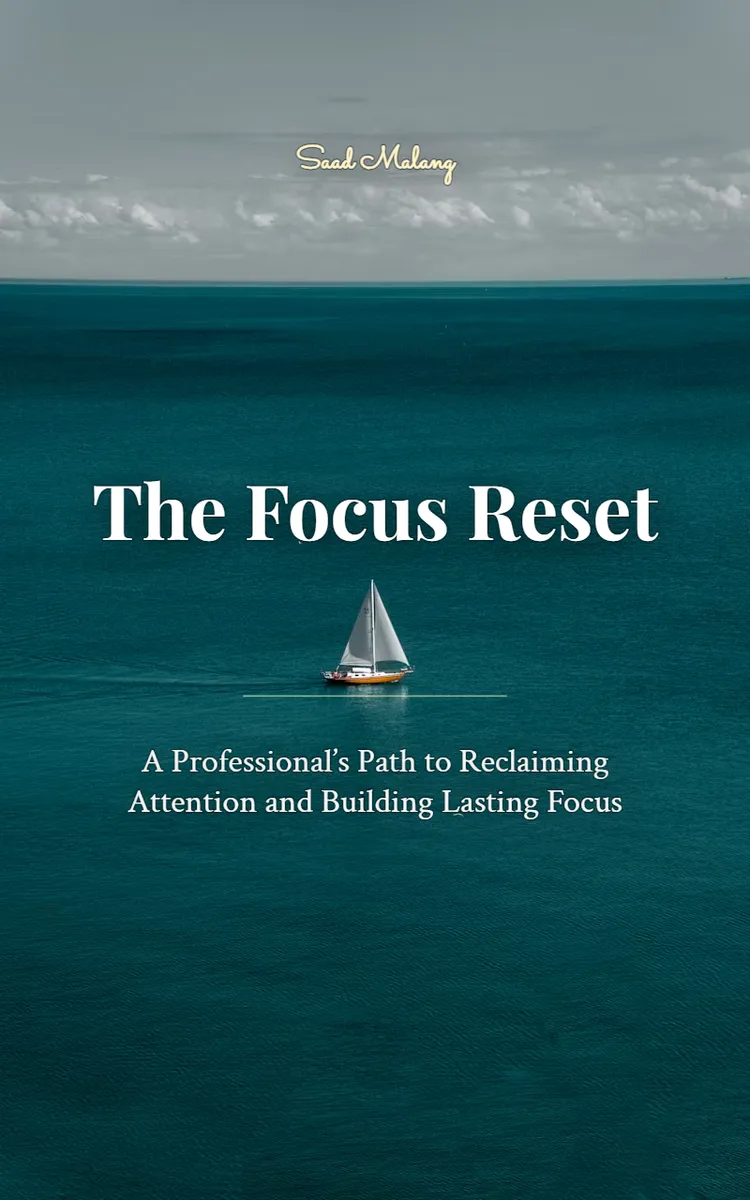
"The Focus Reset" is a day challenge book by Saad Malang with 5 chapters and approximately 4,561 words. Practical attention management, distraction reduction, and sustainable productivity habits for working professionals.
This book was created using Inkfluence AI, an AI-powered book generation platform that helps authors write, design, and publish complete books.
Frequently Asked Questions
What is "The Focus Reset" about?
Practical attention management, distraction reduction, and sustainable productivity habits for working professionals
How many chapters are in "The Focus Reset"?
The book contains 5 chapters and approximately 4,561 words. Topics covered include Days 1-6: Mapping Your Attention, Days 7-12: Protecting Focus Sessions, Days 13-18: Taming Digital Interruptions, Days 19-24: Priorities, Routines, and Boundaries, and more.
Who wrote "The Focus Reset"?
This book was written by Saad Malang and created using Inkfluence AI, an AI book generation platform that helps authors write, design, and publish books.
Write your own day challenge book with AI
Describe your idea and Inkfluence writes the whole thing. Free to start.
Start writingCreated with Inkfluence AI


