

Read the first chapter
The whole of chapter one, free. About 9 min. Turn the pages with the arrows, your keyboard, or a swipe.
Chapter 1
Bird Body Language Basics
Your bird can tell you a lot in seconds - often faster than you can notice what you did. A cockatiel that leans forward with bright, steady eyes and smooth feathers usually wants attention or is ready to explore. A parrot that fluffs up, pins its pupils (tiny “busy” eye changes), or turns its head away often signals discomfort or overload. If you learn these core posture, feather, and eye signals, you stop guessing and start responding.
Talia, a first-time parrot owner, learned this the hard way after she tried to “help” by talking louder and moving closer when her bird looked tense. The bird didn’t calm down. It got tighter, quieter, and more defensive. Once Talia switched from pushing her presence to reading the bird’s signals - then backing off on the exact moments the bird looked stressed - her bird’s body language changed right away. That’s the real payoff: you can prevent problems before they grow.
In this chapter, you’ll learn a simple way to read the signals birds use to communicate comfort, stress, and attention. You’ll be able to look at three things - posture, feathers, and eyes - and decide what to do next so your bird feels safe around you.
Core Signals: How Posture, Feathers, and Eyes Speak for Your Bird
Birds communicate with their bodies because they can’t “talk” the way we do. They also communicate fast. A tiny change in eye focus or a small puff of feathers can mean “I’m okay” or “I need space” depending on the rest of the body. When you ignore those signals, you often push the situation in the wrong direction - more handling, more noise, or more closeness - right when your bird is asking for the opposite.
Here’s the key: posture, feathers, and eyes don’t work alone. Read them together. A bird can look alert and still be uncomfortable if the eyes show stress signals and the body posture shows tension. Your job isn’t to memorize every bird mood. Your job is to notice the core signals and match your response to what your bird is saying with its body.
To make this practical, use the Bird Signal Decoder: you’ll check the bird in three quick passes - first posture, then feathers, then eyes. You’ll compare what you see to comfort, stress, and attention patterns. And you’ll act immediately with a small change, like stepping back, lowering your voice, offering a perch, or pausing movement.
Practical takeaway: When you can read three body areas quickly, you stop “training by accident” and start building trust on purpose. Ask yourself: “If I had to make one safe choice right now, would I move closer or give space?”
The Bird Signal Decoder: Comfort, Stress, and Attention Patterns
You don’t need special equipment to start. You need your eyes and a steady habit: look, decide, then act. Use this numbered decoder every time your bird’s behavior shifts.
• Check posture first (how the body sits and angles)
• Comfort often looks like a relaxed stance: feet stay steady, the body sits evenly, and the bird doesn’t hunch tight.
• Stress often shows tension: the bird stiffens, leans away, crouches low, or angles its body so it faces you less.
• Attention often shows readiness: the bird leans in, head tilts, and stays balanced rather than collapsing into a tight crouch.
Concrete example: If your parrot stands tall and relaxed while you talk softly, that posture usually supports calm interaction. If it stiffens and leans away when you reach, treat that as “back off.”
• Check feathers second (smooth, puffed, or flattened)
• Comfortable feathers usually look smooth or gently settled. Some species fluff naturally when they rest, but it should match the overall mood (eyes and posture matter).
• Stress often shows puffing up (a bigger, rounder look), fluffed body feathers that feel “too much,” or feathers pressed tighter than usual.
• Attention can show “interest fluff” sometimes - slight lift or active feather movement - usually paired with engaged posture and eyes.
Concrete example: A small puff can mean “cold” for some birds, but a puff combined with tight posture and hard eye focus often means “I’m not okay with this.”
• Check eyes last (attention vs. tension shows up here)
• Comfort eyes often look steady and “soft,” with normal pupil size for the lighting and a calm head position.
• Stress eyes often show pinning (rapid pupil changes), wide “staring” attention, or frequent turning away. Some birds also blink slowly when relaxed; fast, darting eye checks often mean arousal.
• Attention eyes usually track you or the target (your hand, a toy, a food dish) without looking panicked.
Concrete example: If your bird’s pupils jump smaller and larger while it presses away from your hand, treat it as stress even if it still seems “curious.”
• Match your response to the pattern (don’t guess)
• If you read comfort: continue calmly, keep your movement slower, and let the bird choose closeness.
• If you read stress: stop the triggering action, reduce movement, and give space.
• If you read attention: pause and offer a clear choice - talk softly, present a preferred item, or let the bird approach on its own.
Concrete example: If Talia sees puffed feathers + stiff posture when she reaches, she stops reaching immediately and rests her hand lower and farther away for 10-20 seconds. Her bird’s body usually loosens when she gives that exact break.
Mini recap: Posture tells you “how tense the body feels.” Feathers tell you “how big the bird feels in its skin.” Eyes tell you “how safe the bird feels in this moment.” When you combine all three, you get a clear direction.
Practical takeaway: Before you act, ask yourself one question: “Do my bird’s posture, feathers, and eyes agree - or are they sending mixed signals?” Mixed signals often mean you’re right at the edge of comfort. Slow down.
Put the Decoder to Work: A Real Morning Session with Talia
Let’s watch a realistic routine and apply the Bird Signal Decoder step by step. Talia plans a short interaction session after her parrot finishes breakfast. She keeps it simple: one goal (social time), one setup (same perch, same spot), and one safety rule (she watches body signals first).
Scenario goal: Talia wants to offer a calm greeting and a small interaction without triggering stress.
Step-by-step decoding and action
• Start from a stable position
• Talia stands beside the cage, not in front of it.
• She keeps her hands still for the first 30 seconds.
Expected outcome: The bird settles enough for Talia to read posture and feathers clearly.
• Decoder Pass #1: posture
• She looks at the bird’s stance. If the bird leans away or stiffens, she doesn’t “try harder.”
• If the bird leans in or stays balanced, she continues gently.
Expected outcome: She either pauses or proceeds based on posture, not on her own excitement.
• Decoder Pass #2: feathers
• She checks whether feathers look smooth, slightly puffed, or overly fluffed.
• If feathers puff up while the bird also holds a tight stance, she treats it as stress.
Expected outcome: If feathers puff, she stops reaching and keeps her hands low.
• Decoder Pass #3: eyes
• She watches for pupil pinning (rapid changes) or hard staring.
• If the bird’s eyes look tense while it turns its head away, she reduces stimulation immediately.
Expected outcome: If eye signals show stress, the bird gets a clear message: “I will not crowd you.”
• Choose one small action that matches the signal
• If comfort/attention: Talia speaks softly and offers a preferred food item near the perch, not toward the bird’s face.
• If stress: Talia stops the interaction and steps back half a pace, then waits 10-20 seconds.
Expected outcome: The bird either approaches the offered item or loosens its body language.
• End the session on a good note
• Talia stops while the bird still looks calm - before it shows the first signs of tension.
• She returns to her normal routine.
Expected outcome: The bird learns that calm signals lead to positive outcomes.
Quick checklist (use this every time)
• Watch posture: relaxed stance vs. stiff/lean-away.
• Check feathers: smooth vs. puffed/pressed tightly.
• Look at eyes: soft tracking vs. pinning/hard staring/turning away.
• Pick one action that fits: offer food calmly (comfort) or pause and create space (stress).
• Stop early if tension begins.
Practical takeaway: Your bird doesn’t need a long session. It needs the right response at the right moment. Ask yourself after each session: “Did I change my behavior when the bird’s eyes or feathers told me to?”
What to Watch For: Common Mistakes and Edge Cases
Even careful beginners run into predictable traps. Here are the most common ones, with clear fixes.
Mistake: “Fluffed feathers = happy bird”
Do this: Treat puffing as a question, not an answer. Check posture and eyes at the same time. If the bird fluffs while it stiffens, presses away, or shows eye pinning, you should treat it as stress or discomfort.
Not this: Assume every puff means contentment. Some birds puff from cold, but stress puffing usually comes with a tighter body and tense eye focus.
Fix in practice: When you see puffing, pause your movement for 10-20 seconds and check: posture (stiff or relaxed), then eyes (soft or pinned/hard).
Mistake: “Reaching forward always helps”
Do this: Offer your hand in a way that gives your bird a choice. Keep your hand lower than the bird’s face and far enough away that the bird can approach if it wants.
Not this: Extend your hand straight in toward the bird’s face while the bird leans away or turns its head. That often adds stress and teaches the bird to brace for contact.
Fix in practice: If the bird leans away, stop reaching. Wait. Then try a slower approach with your hand placed near the perch level, not over the bird.
Mistake: “My bird looks curious, so it’s fine” (mixed signals)
Do this: If curiosity and stress signals overlap, act like the bird is at the edge of comfort. For example, the bird may approach a toy but also pin its pupils or hold a tight posture.
Not this: Only track one signal (like eye brightness) and ignore the others (like stiff posture or fluffed feathers). Mixed signals often mean “I’m interested, but I don’t feel safe enough for what you’re doing.”
Fix in practice: When signals conflict, reduce intensity. Lower your voice, slow your movement, and shorten the interaction. Resume only if posture loosens and eyes look softer.
Practical takeaway: Trust grows when you respond to the whole picture. If two signals disagree, you choose the safer interpretation and you lower your pressure.
Closing Takeaway: Your Bird’s Body Is a Safety System
Once you start reading posture, feathers, and eyes together, you’ll notice something important: your bird already tells you what it can handle. You don’t have to invent a “perfect training plan” to make things better - you just match your actions to the signals in front of you.
As you practice, keep your sessions short and your observations honest. If you ever feel unsure, slow down and give space. Next, you’ll build on this foundation by learning how to interpret behavior changes over time - so your bird’s trust doesn’t just happen once, it keeps growing.
End of chapter one. 7 more chapters and about 15,739 words in the full book.
Swipe or use the arrows to turn the page


What's inside: 8 chapters
- 1. Bird Body Language Basics
- 2. Interpreting Vocalizations Clearly
- 3. Feeding for Health and Trust
- 4. Habitat Setup That Reduces Stress
- 5. Reading Fear, Aggression, and Avoidance
- 6. Training With Positive Reinforcement
- 7. Daily Trust-Building Routine
- 8. Troubleshooting Behavior With Data
About this book
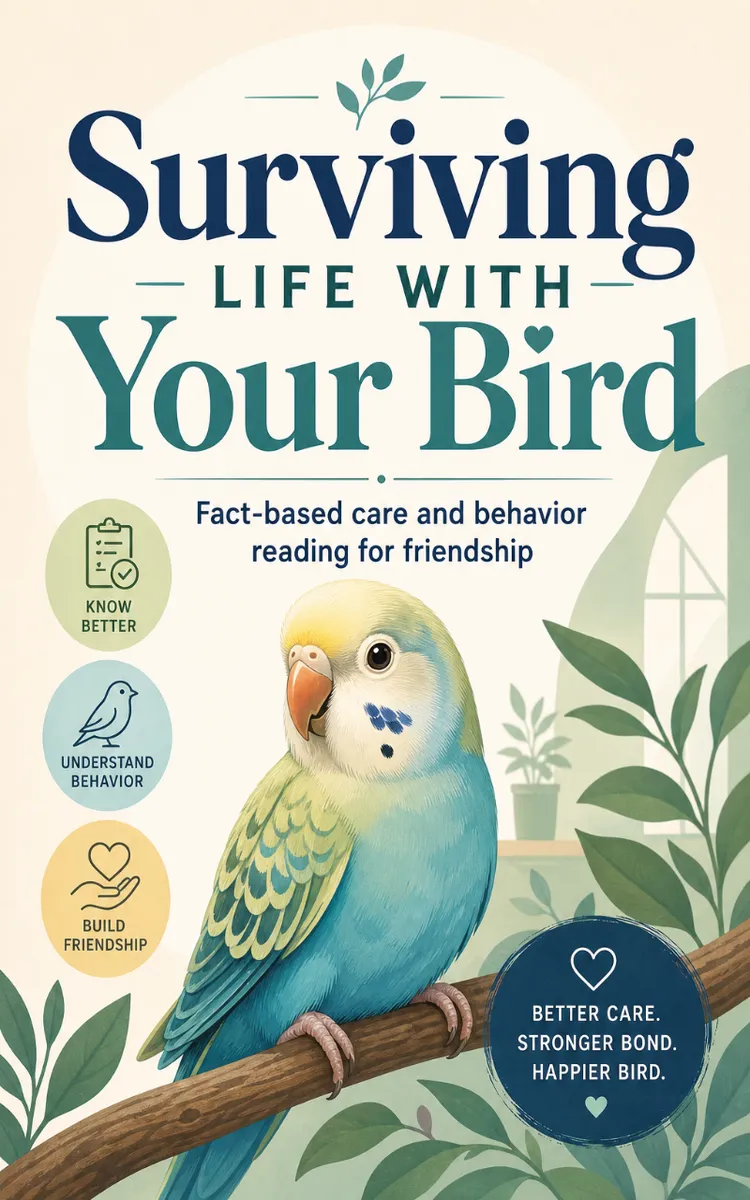
"Surviving Life With Your Bird" is a how-to guide book by Violet Powers with 8 chapters and approximately 15,739 words. Bird behavior basics, interpretation, and building trust.
This book was created using Inkfluence AI, an AI-powered book generation platform that helps authors write, design, and publish complete books. It was made with the AI Ebook Generator.
Frequently Asked Questions
What is "Surviving Life With Your Bird" about?
Bird behavior basics, interpretation, and building trust
How many chapters are in "Surviving Life With Your Bird"?
The book contains 8 chapters and approximately 15,739 words. Topics covered include Bird Body Language Basics, Interpreting Vocalizations Clearly, Feeding for Health and Trust, Habitat Setup That Reduces Stress, and more.
Who wrote "Surviving Life With Your Bird"?
This book was written by Violet Powers and created using Inkfluence AI, an AI book generation platform that helps authors write, design, and publish books.
How can I create a similar how-to guide book?
You can create your own how-to guide book using Inkfluence AI. Describe your idea, choose your style, and the AI writes the full book for you. It's free to start.
Write your own how-to guide book with AI
Describe your idea and Inkfluence writes the whole thing. Free to start.
Start writingCreated with Inkfluence AI


