
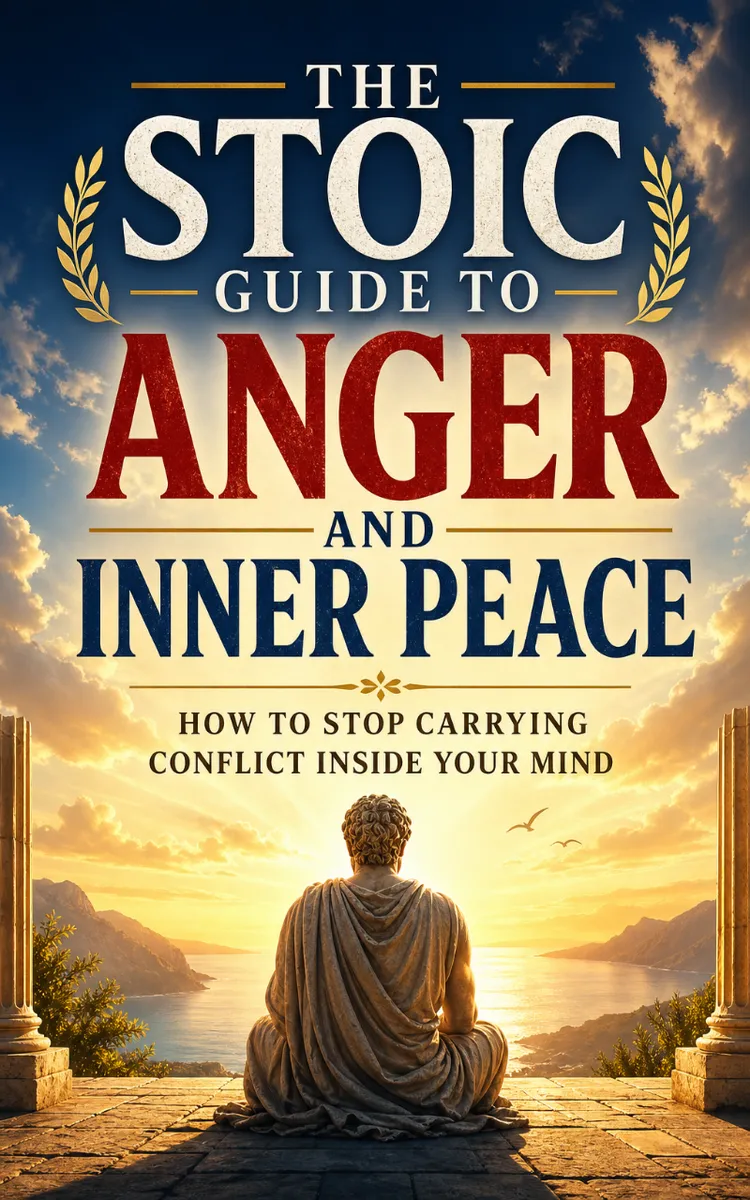
The Stoic Guide to Anger and Inner Peace
Created with Inkfluence AI
Stoic-based strategies to manage anger and find inner peace
Table of Contents
- 1. Recognize Anger’s Real Trigger
- 2. Stop Confusing Thoughts With Facts
- 3. Build Your Inner Peace Identity
- 4. Use the Dichotomy of Control Daily
- 5. Practice Negative Visualization for Calm
- 6. Turn “Should” Into “What Is”
- 7. Name the Judgment Behind Anger
- 8. Interrupt the Anger Spiral Early
- 9. Apply Stoic Premeditation Before Conflict
- 10. Set Boundaries Without Burning Bridges
- 11. Speak With Purpose, Not Reaction
- 12. Practice “Virtue First” Decision Making
- 13. Let Go of Resentment’s Hidden Payoff
- 14. Reframe “Disrespect” Into Meaning
- 15. Use Compassionate Detachment in Relationships
- 16. Train Your Body to Support Calm
- 17. Turn Mistakes Into Corrective Feedback
- 18. Practice Daily Stoic Journaling for Peace
- 19. Create a Personal Anger Recovery Plan
- 20. Live With Inner Stillness as Practice
Preview: Recognize Anger’s Real Trigger
A short excerpt from “Recognize Anger’s Real Trigger”. The full book contains 20 chapters and 28,890 words.
Picture This
Have you ever been mid-sentence-calm, even polite-when something small hits, and suddenly your body is already halfway into a full-on argument? Like your chest tightens, your thoughts start sharpening, and you can feel your mind reaching for “proof” that you’re right. Then you say something you don’t even fully mean… and later you replay it, angry all over again.
Leila, 34, runs customer support for a busy company. A customer calls in upset, and the first thing they say might be “You people never help.” Leila hears it and, before she can choose her response, her mind jumps to, Here we go. They’re disrespecting me. They’re blaming me for something I didn’t do. Her judgment shows up fast-too fast. By the time she tries to stay professional, she’s already defending, either in her tone or in her internal monologue. She doesn’t just feel annoyed. She feels wronged-and that feeling starts driving.
Can you catch anger at the moment it switches from “what happened” to “what it means about you”?
The Mindset Shift
Old Belief: The event is what makes you angry.
New Reality: The event is only the trigger; your judgment is what turns it into anger.
This shift sounds simple, but it’s the hinge your whole inner peace depends on. The event is real: the rude comment, the delay, the mistake, the missed call. But anger doesn’t come from the event alone. Anger comes from the story your mind writes immediately after the event-usually without asking your permission.
Here’s the concrete difference. If Leila hears “You people never help,” the event is: someone said a hostile generalization. That’s all. The trigger is the sound of it. The judgment is the next layer: They’re attacking my competence. Or They’re disrespecting me. Or They’re trying to make me look bad. When that judgment locks in, anger gets traction. It becomes fuel. It also becomes sticky-because once you’ve decided what it “means,” your mind will go hunting for more evidence.
So the goal isn’t “never get angry.” The goal is to separate the event from the judgment that follows it. In Stoic terms, you’re learning to notice the moment your mind adds an interpretation-and to see that interpretation as something you’re doing, not something that’s happening to you. Leila doesn’t need to stop hearing rude customers. She needs to spot the exact mental click where her mind converts a comment into an attack.
Try this with her most common pattern. When a customer snaps, Leila’s body reacts first. Then her mind supplies a verdict: I’m being blamed. If she can catch that verdict early-before she argues with it-she can choose a response that protects the work without feeding the fight. That choice is the beginning of calm.
Going Deeper
The reason this separation matters is because judgment is where the “should” and “must” live. Your mind doesn’t just notice the event. It judges it as unfair, disrespectful, humiliating, or dangerous. And once those words land, your nervous system treats it like a real threat-even if it’s “just” a customer being rude, a coworker being careless, or a partner missing the point.
Think about it like this: the event is the match. Judgment is the gasoline you pour on it. The match burns either way, but the size of the fire depends on how quickly you stop adding fuel.
When you separate trigger from judgment, you start seeing anger as a process with stages-not a single emotion that simply “happens” to you. That’s powerful, because processes can be interrupted. If you can locate the moment the mind adds meaning, you can reduce the heat.
Signs this pattern is running your life
1. You get angry fastest when the event feels personal-like criticism, blame, or disrespect-especially when it’s vague (“you never,” “you always”).
2. You replay the moment afterward, not to learn what happened, but to strengthen your verdict (“They had no right,” “That was unacceptable”).
3. Your mind uses quick labels that feel final, like lazy person, rude customer, incompetent, can’t be trusted. Labels are usually judgment wearing a costume.
4. You feel “forced” to respond a certain way-like you have to defend yourself, correct them, or punish them with silence or sarcasm.
En resumen: Anger doesn’t start with the event-it starts with the judgment that declares the event an attack.
Leila noticed her judgment by tracking what her thoughts sounded like right after the rude line. It wasn’t “I’m upset.” It was more like: They’re disrespecting me. They’re trying to get away with it. They’re making me look bad. Those phrases were her mind’s verdict. Once she recognized them as verdicts-not facts-she could slow down enough to respond with professionalism instead of proving a point.
And here’s another key detail: judgment often arrives in short, confident sentences. It rarely announces itself as “judgment.” It shows up as certainty.
Reflection & Self-Assessment
1....
About this book
"The Stoic Guide to Anger and Inner Peace" is a self-help book by Socratic Mastery with 20 chapters and approximately 28,890 words. Stoic-based strategies to manage anger and find inner peace.
This book was created using Inkfluence AI, an AI-powered book generation platform that helps authors write, design, and publish complete books. It was made with the AI Self-Help Book Writer.
Frequently Asked Questions
What is "The Stoic Guide to Anger and Inner Peace" about?
Stoic-based strategies to manage anger and find inner peace
How many chapters are in "The Stoic Guide to Anger and Inner Peace"?
The book contains 20 chapters and approximately 28,890 words. Topics covered include Recognize Anger’s Real Trigger, Stop Confusing Thoughts With Facts, Build Your Inner Peace Identity, Use the Dichotomy of Control Daily, and more.
Who wrote "The Stoic Guide to Anger and Inner Peace"?
This book was written by Socratic Mastery and created using Inkfluence AI, an AI book generation platform that helps authors write, design, and publish books.
How can I create a similar self-help book?
You can create your own self-help book using Inkfluence AI. Describe your idea, choose your style, and the AI writes the full book for you. It's free to start.
Write your own self-help book with AI
Describe your idea and Inkfluence writes the whole thing. Free to start.
Start writingCreated with Inkfluence AI


