
Read the first chapter
The whole of chapter one, free. About 8 min. Turn the pages with the arrows, your keyboard, or a swipe.
Chapter 1
The Great Firewall’s Strategic Shadow
The Question Behind the Wall
What does it mean for a country to control not only what its citizens read, but also how quickly information travels, which services remain reachable, and which companies can build their businesses around the network? The paradox is that the Great Firewall of China is often described as a barrier, yet its strategic power comes from being a traffic system: it blocks, slows, redirects, filters, and sometimes quietly changes the conditions under which digital life operates.
The system began taking shape as China connected more deeply to the global internet in the 1990s. Its purpose was never limited to removing a few politically sensitive pages. Internet governance became part of national security, economic planning, and political administration. Search engines, social platforms, cloud services, news sites, and private networks all entered an environment where technical access and political permission were closely related.
The result is not simply an isolated national internet. It is a managed information territory, one in which the state can protect certain priorities while making others expensive, uncertain, or invisible. The Shadow-Gate Model helps explain this arrangement: the gate is visible when a site is blocked, but its deeper influence lies in the shadows around the gate - delays, compliance demands, redirected users, altered incentives, and the knowledge that access can change.
When control over information becomes control over the conditions of connection, where does censorship end and strategy begin?
From Connection to Command
China’s early internet policy developed alongside a broader political concern: global networks could bring commercial opportunity and technical knowledge, but they could also carry political organization beyond the state’s immediate reach. The response was not to reject the internet. It was to build a national system in which connectivity could expand without surrendering control over information flows.
The Golden Shield Project, associated with the Ministry of Public Security and developed during the 1990s and 2000s, formed part of this effort. It combined databases, surveillance capabilities, and network controls. The Great Firewall became the public-facing expression of a wider architecture. Domain-name filtering, IP blocking, keyword inspection, and the disruption of circumvention tools allowed authorities to regulate access at several technical layers.
A blocked website is the most recognizable outcome, but blocking is only one instrument. A connection may fail because a domain is refused, because a server’s address is filtered, because a request is interrupted, or because traffic is made unreliable. The user may not receive a clear explanation. That ambiguity matters. A firm prohibition announces a boundary; an unstable connection creates uncertainty about where the boundary lies.
The technical foundation is less mysterious than its political consequences. Internet traffic travels through systems that identify destinations, route packets, and translate human-readable domain names into numerical addresses. Control points can inspect or interfere with these exchanges. Deep packet inspection, for example, can examine aspects of network traffic beyond its destination, although encryption limits what can be seen. Filtering systems can also respond to patterns, keywords, or known circumvention services.
The same network that carries a political article carries a bank transaction, a factory’s logistics data, or a government communication. That shared infrastructure gives censorship strategic reach. It also means that internet control is not merely a media policy. It is a form of infrastructure governance.
The Shadow-Gate Model and the Economics of Access
The central feature of the Shadow-Gate Model is that the gate does not need to close completely to shape behavior. If an overseas service is slow, unreliable, legally exposed, or difficult to use, domestic alternatives gain room to develop. This does not require every foreign competitor to be formally banned. The surrounding conditions can be enough.
China’s major internet companies grew within this managed environment. Baidu became a leading search provider, Tencent built a vast social and messaging ecosystem through QQ and WeChat, and Alibaba developed platforms that linked commerce, payments, logistics, and cloud services. Their success cannot be reduced to censorship; these firms also invested heavily in technology, user experience, and business infrastructure. Yet the restricted competitive field gave domestic platforms an important structural advantage.
The relationship between state control and private enterprise is therefore more complicated than a simple command economy. Companies operate commercially, but they also function within a regulatory system that requires content moderation, data management, and cooperation with state authorities. The network becomes an economic filter. It determines not only what users can access, but also which firms can scale, which data can be stored locally, and which business models fit national priorities.
Traffic shaping adds another layer. Network operators can influence speed, reliability, and routing. A service need not disappear to lose its practical value; repeated delays can make it unattractive for ordinary users and costly for businesses. This is especially significant in a digital economy where convenience is competitive power. A platform that loads instantly becomes part of daily life. One that repeatedly fails becomes an occasional tool.
The economic effect extends beyond consumer applications. Domestic cloud providers, data centers, payment systems, and content platforms benefit from an ecosystem in which data and services are more likely to remain inside national networks. This can support industrial policy and reduce dependence on foreign infrastructure. It can also give regulators more leverage over firms whose operations depend on continued access to the Chinese market.
A firewall, in this sense, behaves partly like a customs barrier. Customs officers do not need to inspect every object entering a country to influence trade; the existence of inspection changes the decisions of exporters, importers, and investors. Digital controls work similarly. The possibility of filtering, licensing, or sudden regulatory intervention becomes part of the cost of doing business.
Military Security in the Information Terrain
Military priorities give internet control a second strategic meaning. Modern armed forces depend on networks for logistics, communications, intelligence, navigation, and public messaging. Civilian digital infrastructure is deeply entangled with these systems. Protecting information flows is therefore not limited to guarding military websites. It includes controlling the broader environment in which military information might be collected, disrupted, or politically exploited.
China’s cybersecurity policy increasingly treats data as a national-security resource. The Cybersecurity Law of 2016, the Data Security Law of 2021, and the Personal Information Protection Law established a legal framework for network operators, data handling, and cross-border transfers. These laws address legitimate concerns such as fraud, espionage, and critical-infrastructure protection, but they also strengthen the state’s authority to define which data is sensitive and how it may move.
That authority has practical consequences for foreign companies and researchers. Access to data can become a regulatory issue rather than a purely technical one. A company may possess the ability to transfer information but lack permission to do so. A researcher may find that an online archive, platform, or database is available one day and restricted the next. The uncertainty itself becomes a strategic instrument because it encourages caution.
During periods of political tension, information control can also support crisis management. Authorities may limit the spread of rumors, remove material considered destabilizing, or promote official accounts of events. From a state perspective, this can reduce the risk that online networks will accelerate unrest or expose operational details. From the perspective of critics, it suppresses independent reporting and prevents citizens from comparing competing accounts.
The military and political dimensions overlap most clearly during conflict. A state that can shape domestic information flows can influence how its population interprets external events, foreign governments, and national sacrifice. It may also make it harder for outside actors to communicate directly with citizens. Information becomes a strategic environment rather than a neutral channel.
The Counterintuitive Power of Domestic Openness
The surprising finding is that China’s internet strategy has not depended on making the internet uniformly narrow. It has often produced a highly active, commercially sophisticated, and technically ambitious digital society inside the boundary. Control and innovation have developed together rather than appearing as simple opposites.
That connection changes the usual picture. The Great Firewall is not best understood as a wall separating a silent interior from a noisy outside world. It is closer to a selective membrane: restrictive in some directions, permissive in others, and capable of supporting intense internal circulation. Domestic competition, mobile payments, online retail, gaming, livestreaming, and artificial-intelligence development have expanded within the controlled environment.
This matters because economic vitality can make political control more durable. Users may tolerate restrictions when domestic services meet their everyday needs. Businesses may accept compliance costs when the market remains large and profitable. The state’s leverage is strengthened not by suppressing digital life altogether, but by helping define the platforms through which digital life takes place.
The same arrangement reshapes political leverage beyond China’s borders. Chinese technology firms carry platform designs, payment systems, surveillance products, and ideas about digital governance into international markets. Foreign governments may adopt some of these tools for reasons of security or administrative efficiency. In that way, the original boundary becomes less like a fence and more like a source of institutional influence.
The People Inside the Network
For a concrete view of this system, consider the experience of Chinese journalists and citizen reporters during the early months of the COVID-19 outbreak in Wuhan. Information circulated through WeChat, Weibo, video platforms, private groups, and reposted screenshots. Posts could spread rapidly, disappear without explanation, or be replaced by official narratives. The same digital platforms that allowed accounts from hospitals and neighborhoods to reach large audiences also provided mechanisms for deletion and monitoring.
The case of Fang Fang, whose Wuhan diary was published online during the lockdown, showed the tension clearly. Her entries described shortages, grief, fear, and the practical difficulties of life under quarantine. They attracted readers inside China and abroad, while also provoking intense debate over national image, criticism, and censorship. The diary’s circulation was not simply a contest between truth and falsehood. It was a struggle over who could define the meaning of a national emergency.
Wuhan made the Shadow-Gate Model visible at human scale. The gate did not prevent every account from appearing. It shaped the lifespan of accounts, the size of their audiences, the risks of sharing them, and the vocabulary people used to discuss them. A message could be technically posted yet politically fragile.
That fragility is central to the system’s power. Citizens, companies, and journalists do not need to know the exact rule behind every removal to understand that certain subjects carry greater danger. Over time, people learn to anticipate the boundary. Self-censorship becomes an extension of technical censorship, and political influence reaches into the choices made before a message is ever published.
What the Gate Reveals
Internet control shows that power in the digital age is not exercised only through dramatic acts of prohibition. It also operates through architecture, delay, uncertainty, and the quiet arrangement of alternatives. A state can influence public life by deciding which networks are dependable, which companies are indispensable, and which forms of speech remain costly to sustain.
The deeper question is not whether technology liberates or controls society. It is who designs the conditions under which connection becomes ordinary - and what new forms of power appear in the shadows around the gate.
End of chapter one. 7 more chapters and about 13,801 words in the full book.
Swipe or use the arrows to turn the page
What's inside: 8 chapters
- 1. The Great Firewall’s Strategic Shadow
- 2. AI Targeting Without the Headlines
- 3. Beidou Timing: The Invisible Advantage
- 4. Quantum Claims, Practical Power Plays
- 5. 5G Edge Networks as War Economy
- 6. Chip Supply Chains as Political Weapons
- 7. Information Operations in the Algorithmic Age
- 8. The Supra-Tech Deterrence Loop
About this book
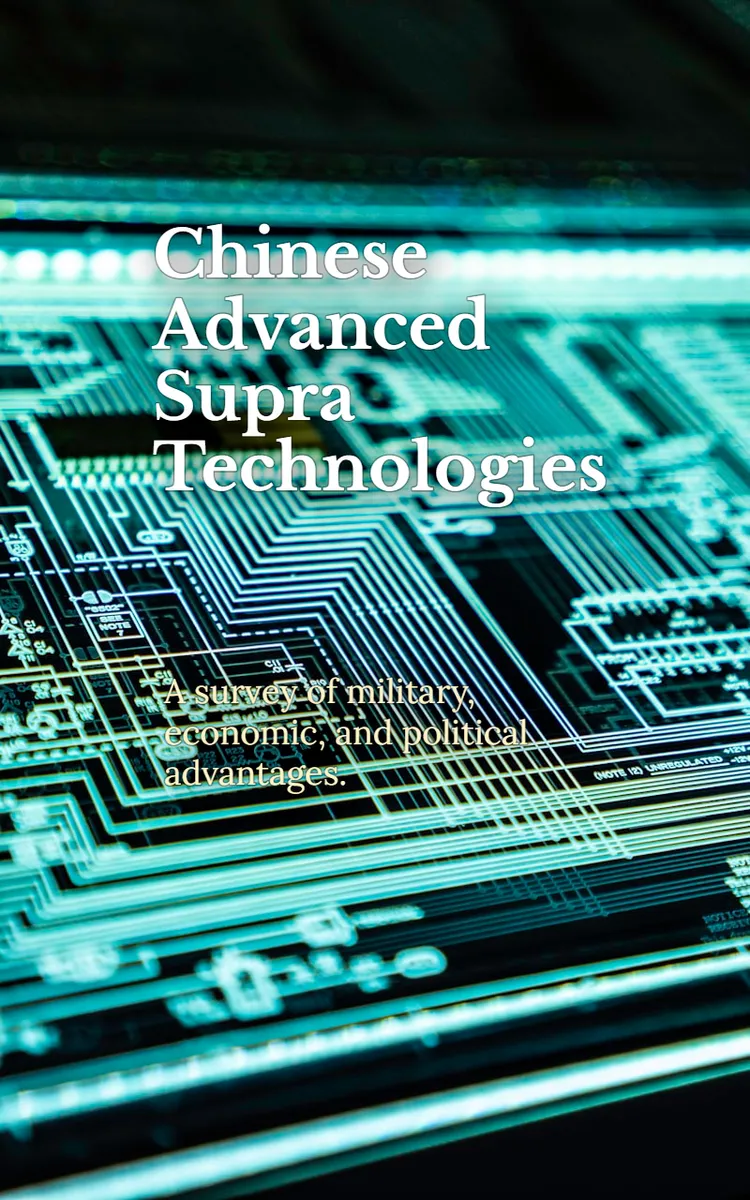
"Chinese Advanced Supra Technologies" is a curiosity book by Anonymous with 8 chapters and approximately 13,801 words. Overview of Chinese advanced technologies and strategic advantages.
This book was created using Inkfluence AI, an AI-powered book generation platform that helps authors write, design, and publish complete books.
Frequently Asked Questions
What is "Chinese Advanced Supra Technologies" about?
Overview of Chinese advanced technologies and strategic advantages
How many chapters are in "Chinese Advanced Supra Technologies"?
The book contains 8 chapters and approximately 13,801 words. Topics covered include The Great Firewall’s Strategic Shadow, AI Targeting Without the Headlines, Beidou Timing: The Invisible Advantage, Quantum Claims, Practical Power Plays, and more.
Who wrote "Chinese Advanced Supra Technologies"?
This book was written by Anonymous and created using Inkfluence AI, an AI book generation platform that helps authors write, design, and publish books.
Write your own curiosity book with AI
Describe your idea and Inkfluence writes the whole thing. Free to start.
Start writingCreated with Inkfluence AI


