
Read the first chapter
The whole of chapter one, free. About 8 min. Turn the pages with the arrows, your keyboard, or a swipe.
Chapter 1
The First Click That Changed Everything
The Click That Made the Web Feel Like a Marketplace
In 1994, Lena Park, a 34-year-old early web storefront owner, placed a small catalogue of products on a server and waited for strangers to find it. There was no shopping cart, no familiar payment button, and no guarantee that a visitor could even see the page correctly. Yet one browser click could make a distant business feel suddenly present.
That was the strange power of the early web. The technology was slow, awkward, and visually plain, but it changed the distance between interest and action. A customer no longer needed a printed catalogue, a telephone number, or a shop on the right street. A document on a computer could become an invitation to communicate, compare, order, and return.
The first commercial websites did not resemble the online stores that later became ordinary. They were closer to public notices pinned to a new kind of global wall. Their importance came less from what they could do than from what people began to expect them to do.
When did a click stop being a command and become a promise?
From Linked Documents to Open Doors
The web began as a system for linking documents, not as a marketplace. At CERN, the European particle-physics laboratory, Tim Berners-Lee proposed the World Wide Web in 1989 as a way for researchers to share information across different computers. Its basic ingredients were modest: addresses for documents, a language for marking them up, and a method for retrieving them.
The breakthrough was not that computers could store information. They had done that for years. The breakthrough was that a person could follow a link from one piece of information to another without knowing where the second document physically lived. The link hid the machinery of networks, servers, and file paths. It reduced a technical journey to a visible choice.
That reduction mattered. In 1993, the release of Mosaic, a graphical web browser developed at the National Center for Super computing Applications, made the web easier to approach. Mosaic displayed text and images together and allowed users to click through pages without learning specialist commands. The web became less like a laboratory instrument and more like a navigable place.
A browser click was therefore doing two jobs at once. Technically, it requested another document. Socially, it suggested that the requested document would be worth seeing. That small act trained users to expect immediacy from distant systems.
Early businesses noticed the change before they fully understood it. A company could publish its address, products, opening hours, or technical information to anyone with a connection. The website did not replace the shop or office. It extended their reach beyond the hours and geography that had previously contained them.
Lena Park’s storefront belonged to this transitional world. Her pages were not a polished digital shop in the modern sense. They were an experiment in making a business legible to people who had never visited its premises. A visitor arrived through a link, read a description, looked at an image, and learned how to make contact. The process was simple, but the underlying shift was large: information about a business had become available before a conversation with the business began.
The web’s first commercial language was therefore not persuasion but presence. A company did not need to shout across a crowded street. It needed only to be reachable.
The One-Click Threshold Model
The early web can be understood through the One-Click Threshold Model: the point at which a user’s curiosity becomes an action because the cost of crossing from one page to another is almost invisible.
Before hyperlinks became familiar, finding information required deliberate effort. A customer might search a directory, write a letter, make a telephone call, or travel to a shop. Each step introduced time and uncertainty. The link compressed those steps into a single gesture. It did not eliminate effort from commerce, but it moved the first effort to nearly zero.
That threshold changed the meaning of attention. A person could encounter a business while reading something else, follow a link, and arrive without having planned to shop. Discovery no longer depended entirely on location, advertising, or personal recommendation. It could happen through a chain of references that crossed industries and borders.
The model also explains why early websites could seem more important than their features justified. A page with a few paragraphs and one image was technically limited, but it occupied a new position in the customer’s path. It could be found at any hour. It could be copied, linked, and revisited. It could answer a question before a salesperson ever heard it.
The click was not yet a purchase. It was the first measurable sign that a stranger had crossed into a company’s world.
When Communication Became Part of Commerce
Email had already made digital communication useful before the web became popular. What the browser added was a shared visual surface. A company could present information in a form that customers, journalists, suppliers, and competitors could all inspect.
This altered the rhythm of business communication. Printed material was prepared, distributed, and replaced. A web page could be changed while remaining continuously available. That created a new expectation: if a company had information, perhaps it should publish it; if it published information, perhaps it should keep it current.
The effect was especially clear in customer support. Frequently asked questions, product specifications, maps, manuals, and contact details could be placed online for anyone to consult. The website became a quiet intermediary between a question and an employee. It did not converse in the human sense, but it changed when and how a conversation began.
For customers, this produced an unfamiliar form of independence. They could investigate a company before making contact. They could compare several businesses without visiting each one. The web did not merely give businesses another advertising channel; it gave customers a new way to withhold attention until they had gathered enough information to proceed.
A brief anecdote from the period captures the awkwardness of the transition. Many early sites displayed a small message asking visitors to send email for more information. The page looked complete, yet its most important function was to direct the visitor elsewhere - to a mailbox, a telephone, or a physical address. The web was not replacing older forms of communication. It was becoming the front door through which people reached them.
That front door changed expectations even when the room behind it remained the same.
The Surprising Invention Was Not the Store
The counterintuitive fact is this: the early web transformed commerce before it was good at selling anything. Its first commercial revolution was the separation of discovery from transaction.
That distinction matters because later accounts often treat online business as a story about electronic payment, shopping carts, and automated fulfilment. Those tools were important, but they arrived after the browser had already altered how people found companies and judged their availability. A business could benefit from the web before it could safely process a credit card online.
The change was psychological as much as technical. Once customers learned that a click could reveal a distant company, they began to expect more companies to be findable. Once a page could answer basic questions, a business without a page could appear harder to reach, even if its physical service was excellent.
The web therefore created pressure through comparison. A customer might not demand a digital storefront at first. But after encountering one company that published clear information, the customer carried that expectation to the next company. Availability became part of reputation.
This is where the One-Click Threshold Model reaches beyond the mechanics of a hyperlink. The threshold was not only the distance between two documents. It was the distance between a customer’s question and a company’s response. As that distance shrank, patience became less valuable and visibility became more important.
The commercial web began as a system for making information easier to reach. Its deeper consequence was making businesses easier to evaluate.
Lena Park and the First Digital Shopfronts
Lena Park’s early storefront can be placed within a wider community of small businesses, technical enthusiasts, designers, and independent publishers who treated the web as a public experiment. They worked with unfamiliar software, changing standards, and connections that could make a simple page feel slow. Images took time to load. Browsers interpreted pages differently. A broken link could send a visitor into an empty space with no explanation.
Yet the limitations were visible in a useful way. Every successful click demonstrated a chain of cooperation: a server had to respond, a browser had to interpret the page, a network had to carry the request, and a person had to decide that the next page deserved attention. The apparent simplicity of the interface concealed a new infrastructure of communication.
For Park, the storefront’s value was not that it made the business effortless. It made the business discoverable outside its immediate surroundings. A customer who found the page could learn what she offered, understand how to make contact, and return later without asking anyone to remember a street address. The page acted as a small, permanent representative - quiet, imperfect, and available across time zones.
Her experience reflected the larger transformation. Early web pioneers were not simply putting shops online. They were teaching the public to treat a screen as a place where commercial relationships could begin. A page could introduce a company, establish credibility, and invite a response before any sale occurred.
That sequence would later be surrounded by search engines, online payments, customer reviews, and real-time delivery systems. At the beginning, however, the central event was more basic: someone clicked, and a business appeared.
What the First Click Revealed
The first web clicks changed commerce because they changed what counted as proximity. A company no longer had to be physically near a customer to be present in the customer’s decision. It needed an address on the network, a page that could load, and enough information to make the next click seem worthwhile.
They also revealed something enduring about human behaviour. People are willing to cross remarkable distances when the first step is made small enough. A hyperlink did not persuade everyone, and it did not guarantee trust. It simply lowered the cost of looking.
That small reduction became a new social habit. We began to expect knowledge before contact, contact before commitment, and commitment with fewer visible barriers. The web’s most consequential invention may have been neither the page nor the browser, but the expectation that almost anything worth knowing might be one click away - and the unanswered question of what else could be waiting beyond it.
End of chapter one. 7 more chapters and about 14,859 words in the full book.
Swipe or use the arrows to turn the page


What's inside: 8 chapters
- 1. The First Click That Changed Everything
- 2. Why “Eyeballs” Beat Profit
- 3. The Bandwidth Race Behind the Hype
- 4. The Business Model That Failed Fast
- 5. The Bubble’s Hidden Math
- 6. When Liquidity Vanished, So Did Dreams
- 7. From Dot-Com Ashes to Practical Web
- 8. Dot-Com Lessons for the Fourth Industrial Revolution
About this book
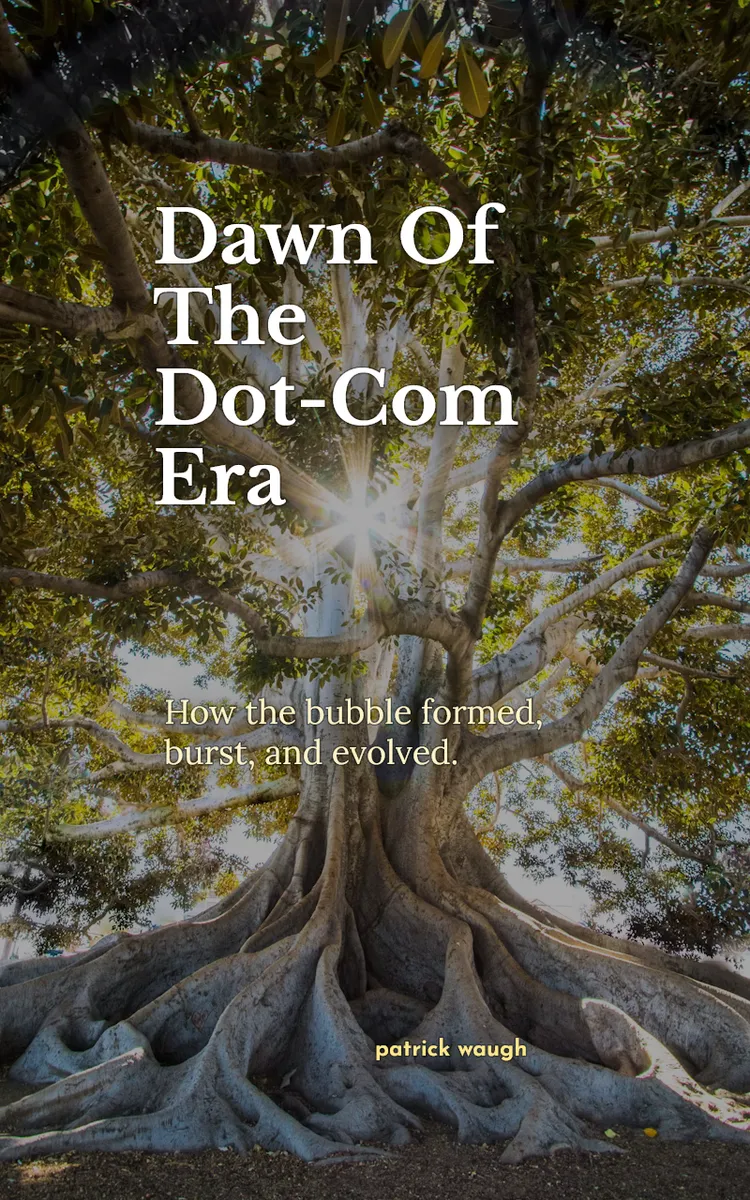
"Dawn Of The Dot-Com Era" is a curiosity book by patrick waugh with 8 chapters and approximately 14,859 words. Dot-com era origins, bubble crash causes, and tech evolution.
This book was created using Inkfluence AI, an AI-powered book generation platform that helps authors write, design, and publish complete books.
Frequently Asked Questions
What is "Dawn Of The Dot-Com Era" about?
Dot-com era origins, bubble crash causes, and tech evolution
How many chapters are in "Dawn Of The Dot-Com Era"?
The book contains 8 chapters and approximately 14,859 words. Topics covered include The First Click That Changed Everything, Why “Eyeballs” Beat Profit, The Bandwidth Race Behind the Hype, The Business Model That Failed Fast, and more.
Who wrote "Dawn Of The Dot-Com Era"?
This book was written by patrick waugh and created using Inkfluence AI, an AI book generation platform that helps authors write, design, and publish books.
Write your own curiosity book with AI
Describe your idea and Inkfluence writes the whole thing. Free to start.
Start writingCreated with Inkfluence AI


