
Read the first chapter
The whole of chapter one, free. About 7 min. Turn the pages with the arrows, your keyboard, or a swipe.
Chapter 1
Rewriting Your Identity Story
The Label Talia Carried Into Her First Semester
Talia was nineteen when she sat outside her first college presentation, rereading the same three sentences on her laptop.
Her slides were finished. Her notes were clear. Still, her stomach tightened every time she imagined standing in front of the room.
“I’m just bad at speaking,” she told a classmate.
The sentence sounded harmless.
It wasn’t.
She had turned one uncomfortable skill into a permanent description of who she was. Because Talia believed she was “bad at speaking,” every shaky practice session became proof. Every missed word confirmed the story. Even the moments when she explained an idea clearly seemed to disappear from view.
Most of us carry labels like that.
Bad with money. Not creative. Too disorganized. Not a leader. A slow learner. Awkward. Unconfident.
The label feels like a fact, but it often began with something much smaller: one difficult experience, one careless comment, one failure, or one season of struggle.
What if the identity you’ve been defending is the very thing keeping you from growing?
From Fixed Label to Growing Identity
Old Belief: I have a fixed trait, and my results prove who I am.
New Reality: I have practiced patterns, unfinished skills, and a story I can rewrite through new evidence.
That shift matters because the way you see yourself can influence what you attempt before effort even begins.
If you call yourself “not a people person,” you may avoid introducing yourself at an event.
If you call yourself “terrible with money,” you might avoid looking at your spending until the problem feels even bigger.
If you call yourself “not academic,” you may mistake unfamiliar study habits for a lack of ability.
Talia’s old belief was:
“I’m bad at speaking.”
Her new reality could be:
“I’m learning to explain ideas clearly under pressure.”
Notice what changed.
The new sentence doesn’t pretend she is already confident. It leaves room for the truth: speaking feels difficult, and she can improve.
That is the purpose of the Identity Rewrite Map. It helps you move from a fixed label to a more useful narrative by tracing four things:
• the old label,
• the evidence behind it,
• the skill underneath it, and
• the next identity-building action.
Identity Rewrite Map
Part of the Map
Talia’s Example
Old label
“I’m bad at speaking.”
Evidence she usually notices
She rushed, lost her place, and avoided eye contact.
Skill underneath
Organizing ideas, pacing, and practicing aloud.
New identity narrative
“I’m becoming someone who communicates clearly, even when nervous.”
Next action
Record a two-minute explanation and improve one part tomorrow.
The map doesn’t ask you to decorate your life with positive words. It asks you to tell the truth in a way that keeps the future open.
Talia still gets nervous.
She simply stops treating nervousness as a verdict.
How a Label Starts Running Your Life
A self-label usually begins as shorthand.
Maybe a teacher once called you careless. Maybe you froze during an interview. Maybe you struggled with algebra while the person beside you finished quickly.
Over time, the event gets compressed into an identity:
“That’s just who I am.”
Once you begin viewing yourself through that label, you may naturally pay more attention to experiences that fit the story and overlook experiences that challenge it.
A missed deadline stands out more than four completed tasks.
One awkward conversation can feel more important than several good ones.
One poor test result can seem like proof that you are “not academic.”
This isn’t necessarily a character flaw. It is a common pattern in how people interpret their experiences. The story you carry influences what you notice, and what you notice can begin to feel like proof.
The way out isn’t arguing with yourself in the mirror.
It’s collecting better evidence through small actions.
When Talia records herself explaining a concept for two minutes, she may still hear rushed sections. But she can also hear places where her explanation makes sense.
That evidence matters.
It gives her something more useful than a label: a skill she can practice.
Signs a Label Is Running Your Life
1. You use permanent language for temporary struggles.
“I’m disorganized” hides the more useful question:
Which part of planning keeps breaking down?
2. You avoid situations that could update your self-image.
You don’t apply, volunteer, ask, negotiate, or try because failure might seem to confirm the label.
3. You dismiss progress as luck or a one-off.
When something goes well, you say, “That doesn’t count,” instead of allowing it to become evidence.
4. You explain your behavior before anyone else can.
“I’m quiet.”
“I’m bad at numbers.”
“I’m not a leader.”
These statements can become warning labels you hand people before they ever get the chance to see the fuller version of you.
A limiting label feels like self-knowledge, but it often functions like a boundary.
Questions That Expose the Old Story
1. What label do you repeat most often when something goes wrong?
Write the exact sentence, not a polished version.
“I’m useless at this” tells you more than “I lack confidence.”
2. What specific event taught you to believe that label?
Separate the event from the conclusion.
Talia didn’t discover that she was permanently bad at speaking. She had several uncomfortable presentations without enough practice.
Those are two very different statements.
3. What skill is hiding underneath the label?
“Bad with money” might mean you need a simple spending system.
“Not creative” might mean you haven’t practiced generating rough ideas without judging them too early.
“Bad at speaking” might mean you need to work on pacing, preparation, or organizing your thoughts.
A label describes a person.
A skill describes something that can be practiced.
4. What evidence have you been ignoring because it doesn’t fit the story?
Look for small pieces of proof.
Maybe you explained a process to someone, handled a difficult conversation, fixed a mistake, learned something after struggling, or followed through when you wanted to quit.
Small evidence still counts.
5. What would a believable new identity say about your next step?
Keep it grounded.
Try:
“I’m someone who practices before I perform.”
Rather than:
“I’m naturally brilliant and fearless.”
The first statement gives you something to do.
Your answers don’t need to sound impressive. They need to sound usable.
A believable identity gives you somewhere to stand when the old label starts shouting.
The Seven-Day Identity Rewrite Challenge
Build Evidence for the Person You’re Becoming
For the next seven days, choose one limiting self-label and use the Identity Rewrite Map to update it.
• Write the old label at the top of a page.
• Name the specific experiences that fed it.
• Identify the skill underneath the label.
• Create a new identity sentence that includes growth and action.
• Spend five minutes each day doing one behavior that supports the new sentence.
• Record one piece of evidence afterward, even if the result feels ordinary.
• On Day 7, read the evidence aloud and revise the identity sentence if needed.
For Talia, the daily action might be recording a short explanation, asking one question in class, or practicing her opening sentence three times.
She doesn’t need a dramatic transformation.
She needs repeated evidence that “nervous” and “incapable” are not synonyms.
Expected difficulty: Medium
You’ll Know It’s Working When...
• You catch yourself replacing “I am” with “I’m practicing.”
• You attempt something before feeling completely ready.
• A mistake becomes information instead of a final judgment.
• You can name one real piece of evidence that challenges the old label.
• Your new identity sentence feels believable enough to act on.
Some days will feel almost laughably small.
That’s fine.
Identity doesn’t usually change because of one perfect declaration. It changes as your understanding of yourself comes into contact with new experiences, choices, and evidence.
Your Story Is Allowed to Grow
You don’t need to erase your past to change your identity.
Talia’s difficult presentations still happened. They simply no longer get to explain her entire future.
The same is true for you.
A label may describe where practice has been missing, where support was limited, or where one difficult experience affected the way you see yourself.
It doesn’t have to become your permanent name.
When you replace a fixed label with a skill-based identity, growth stops feeling like pretending to be someone else.
It becomes the natural next chapter of who you already are.
You are not trapped inside the story your hardest moments taught you to tell.
What You Take From This Chapter
• You learned to separate a past result from a permanent identity.
• You used the Identity Rewrite Map to find the skill beneath a limiting label.
• You saw how small actions can create evidence for a more useful self-story.
• You began a seven-day practice for making growth feel normal rather than forced.
The skills school never measured often begin quietly:
noticing patterns, communicating clearly, managing yourself, adapting after failure, and learning how to respond to your own mistakes.
Once your identity makes room for those skills, you can start seeing something important:
You may have been measuring yourself by the wrong scoreboard all along.
End of chapter one. 4 more chapters and about 7,481 words in the full book.
Swipe or use the arrows to turn the page
What's inside: 5 chapters
- 1. Rewriting Your Identity Story
- 2. Belief Calibration for Realistic Confidence
- 3. Building Habits That Stick Under Pressure
- 4. Communicating Needs Without Overexplaining
- 5. Turning Setbacks Into Purpose Fuel
About this book
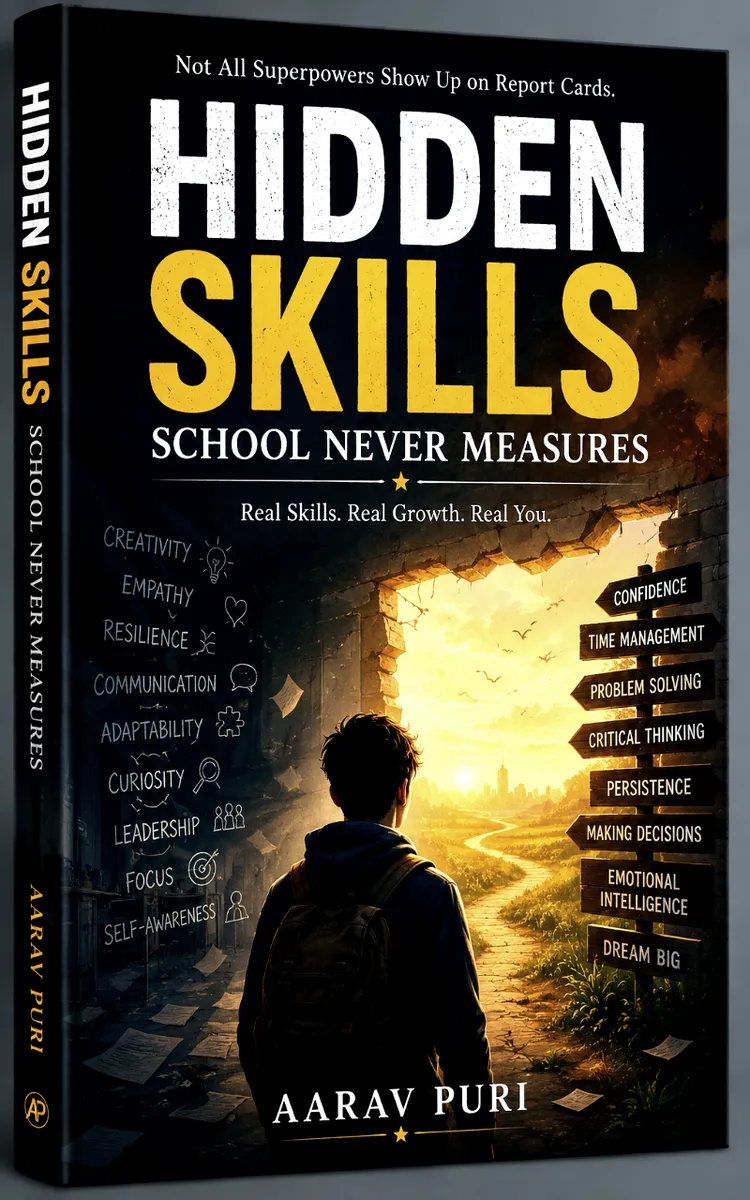
"Hidden Skills School Never Measures" is a self-help book by Aarav puri with 5 chapters and approximately 7,481 words. Identifying and developing overlooked skills beyond academics.
This book was created using Inkfluence AI, an AI-powered book generation platform that helps authors write, design, and publish complete books. It was made with the AI Self-Help Book Writer.
Frequently Asked Questions
What is "Hidden Skills School Never Measures" about?
Identifying and developing overlooked skills beyond academics
How many chapters are in "Hidden Skills School Never Measures"?
The book contains 5 chapters and approximately 7,481 words. Topics covered include Rewriting Your Identity Story, Belief Calibration for Realistic Confidence, Building Habits That Stick Under Pressure, Communicating Needs Without Overexplaining, and more.
Who wrote "Hidden Skills School Never Measures"?
This book was written by Aarav puri and created using Inkfluence AI, an AI book generation platform that helps authors write, design, and publish books.
How can I create a similar self-help book?
You can create your own self-help book using Inkfluence AI. Describe your idea, choose your style, and the AI writes the full book for you. It's free to start.
Write your own self-help book with AI
Describe your idea and Inkfluence writes the whole thing. Free to start.
Start writingCreated with Inkfluence AI


