
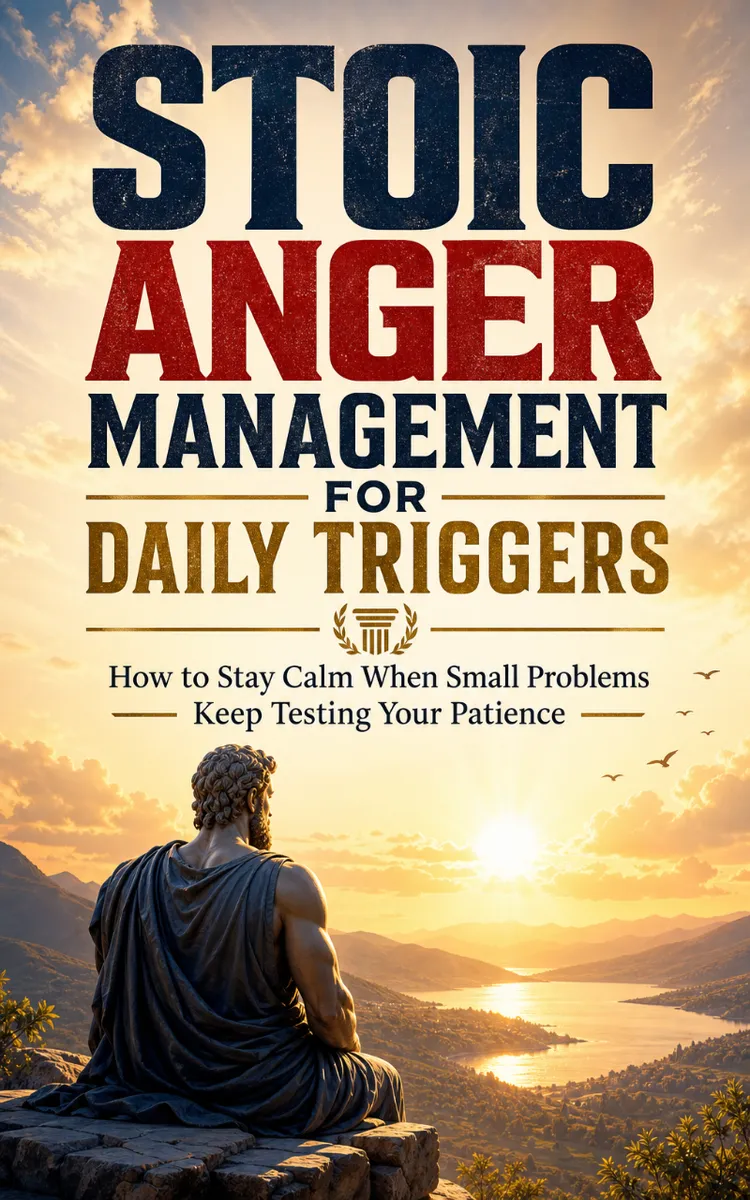
Stoic Anger Management For Daily Triggers
Created with Inkfluence AI
Stoic-based strategies to manage anger from daily triggers
Table of Contents
- 1. Spot Your Anger Triggers Early
- 2. Separate Control From Chaos
- 3. Name the Judgment Behind the Snap
- 4. Use the Pause-Then-Choose Reset
- 5. Train Your Mind to Expect Friction
- 6. Reframe Annoyances as Training
- 7. Apply Stoic ‘What’s Next?’ Thinking
- 8. Stop Demanding a Perfect Day
- 9. Practice Voluntary Discomfort for Calm
- 10. Build a Stoic Breathing Anchor
- 11. Change the Story, Change the Feeling
- 12. Respond Without Winning Arguments
- 13. Set Boundaries Without Exploding
- 14. Use ‘I Control My Next Action’
- 15. Handle Passive-Aggressive Triggers Gracefully
- 16. Recover Quickly After You Snap
- 17. Prevent Anger Through Daily Fuel Checks
- 18. Create a Trigger-Proof Morning Routine
- 19. Turn Setbacks Into Stoic Momentum
- 20. Live Your Values Under Pressure
Preview: Spot Your Anger Triggers Early
A short excerpt from “Spot Your Anger Triggers Early”. The full book contains 20 chapters and 28,435 words.
Picture This
Ever notice how anger doesn’t usually arrive like a lightning bolt? For Tanya (34, nurse, rotating shifts), it’s more like a slow leak that turns into a snap before she even realizes she’s bleeding. The day looks normal: charting, pager buzz, a patient request that’s “quick,” the hallway noise, the coffee that tastes weird again. Then-something tiny happens. The call light won’t stop. A coworker interrupts mid-sentence. The printer jams for the third time. Her chest tightens, her jaw clenches, and suddenly she’s talking like she’s three seconds away from snapping someone’s head off.
And then later she thinks, How did I get here so fast? Because it doesn’t feel like “I chose to be angry.” It feels like the anger just drove. Tanya’s question-like yours, if you’ve been there-is the same one: Can you catch anger before it steals your voice?
The Mindset Shift
Old Belief: “My anger shows up when the problem shows up.”
New Reality: “My anger shows up before the problem-my body and thoughts are already revving.”
That shift matters because it changes what you’re chasing. If you believe anger is only a reaction to what happened, you’ll keep trying to fix the situation. But most daily triggers aren’t huge. They’re the same annoying stuff, again and again. The real difference isn’t the event-it’s the moment your system starts treating that event like a threat.
Here’s a concrete example from Tanya’s world: say she’s trying to finish charting and the pager keeps going off. If she only focuses on the pager, she’ll think, “Why is this happening to me?” Then she’ll snap, because she feels trapped and disrespected. But if she uses the new reality-my anger starts earlier-she pays attention to the first signals: the quick tightening in her throat, the mental click of “not again,” the urge to hurry faster than she actually can. The trigger isn’t the pager. The trigger is the moment her mind starts predicting a bad day and her body agrees.
So instead of asking, “How do I stop getting annoyed?” you start asking a sharper question: “What exact moment did I switch from coping to resisting?” That’s where control lives. Not in forcing yourself to be calm, but in noticing the gears engage-right as they’re engaging.
Going Deeper
Anger is not just a feeling. It’s a whole-body process with a storyline attached. Your body registers “this is too much” before your brain gets fully poetic about it. Then your thoughts latch onto that body signal and turn it into meaning: “This is unfair.” “I can’t deal with this.” “They should know better.” The snap usually shows up after the meaning locks in.
To spot anger early, you don’t need to analyze your childhood or memorize Stoic quotes. You need to recognize the pattern in real time. That’s where the Trigger Timeline Map comes in. Think of it like a quick mental film strip you can rewind while it’s still playing.
Before the snap, there’s usually a sequence:
- Cue in the body (tight jaw, hot face, stomach drop, shallow breathing)
- Quick thought (“not again,” “this is ridiculous,” “I’m done”)
- Impulse (talk too fast, interrupt, get sharp, slam a door, roll eyes)
- Action (the tone change, the “whatever,” the edge in your words)
Not every part shows up the same way for every person, but the order is often similar. For Tanya, it’s often: a throat tightness → a “why now?” thought → a sudden urge to make it stop right now.
Signs this pattern is running your life
1. You get irritated faster than you can explain why. You’ll feel the snap coming, but the reason you give yourself comes after the fact.
2. Your body has a “start line.” You can almost point to it: jaw tightens, breathing gets shallow, shoulders lift, heat rushes in. It’s not imagination-your body is sending the message.
3. Your thoughts get short and absolute. They sound like commands or verdicts: “They never…” “This always…” “I can’t…” That “can’t” thought is a big red flag.
4. The trigger keeps repeating, but your response escalates anyway. Same printer jam, same interruption, same call light-yet the anger gets a little easier to access each time.
En résumé: Your anger isn’t just “what happens”-it’s a timeline you can learn to read before you act.
Once you can see the timeline, you stop trying to negotiate with anger at the end of the race. You intervene at the first sign. Stoicism calls this the moment of judgment-when your mind decides what the situation means. The trick is catching the decision while it’s still forming, not after your mouth has already made it official.
Reflection & Self-Assessment
Use these questions like a flashlight, not a courtroom. You’re not trying to shame yourself-you’re trying to spot the switch before it flips.
1. What was the very first physical cue you noticed before you snapped last week?
Think jaw, throat, chest, breathing, stomach....
About this book
"Stoic Anger Management For Daily Triggers" is a self-help book by Socratic Mastery with 20 chapters and approximately 28,435 words. Stoic-based strategies to manage anger from daily triggers.
This book was created using Inkfluence AI, an AI-powered book generation platform that helps authors write, design, and publish complete books. It was made with the AI Self-Help Book Writer.
Frequently Asked Questions
What is "Stoic Anger Management For Daily Triggers" about?
Stoic-based strategies to manage anger from daily triggers
How many chapters are in "Stoic Anger Management For Daily Triggers"?
The book contains 20 chapters and approximately 28,435 words. Topics covered include Spot Your Anger Triggers Early, Separate Control From Chaos, Name the Judgment Behind the Snap, Use the Pause-Then-Choose Reset, and more.
Who wrote "Stoic Anger Management For Daily Triggers"?
This book was written by Socratic Mastery and created using Inkfluence AI, an AI book generation platform that helps authors write, design, and publish books.
How can I create a similar self-help book?
You can create your own self-help book using Inkfluence AI. Describe your idea, choose your style, and the AI writes the full book for you. It's free to start.
Write your own self-help book with AI
Describe your idea and Inkfluence writes the whole thing. Free to start.
Start writingCreated with Inkfluence AI


