
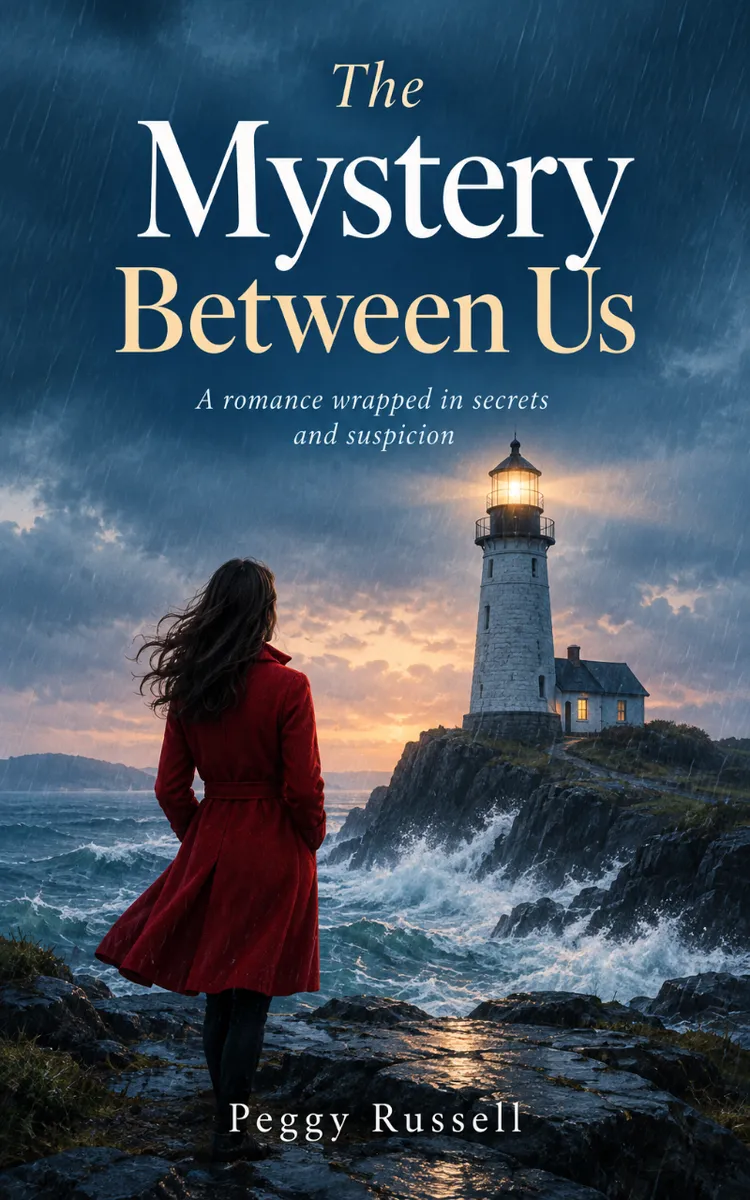

Read the first chapter
The whole of chapter one, free. About 17 min. Turn the pages with the arrows, your keyboard, or a swipe.
Chapter 1
The Lighthouse Ledger
Rain needled Mara Venn’s cheeks as she climbed the causeway toward Blackglass Lighthouse, but the cold mattered less than the message folded inside her coat.
Bring the hidden record before the tide turns. Come alone,
No signature. No explanation. Only the familiar slant of ink, a sharp downward stroke beneath the final word.
Eli Rook wrote that way.
She had spent three years learning the shape of his handwriting in police reports, evidence logs, and the notes he left on her desk whenever he wanted to correct her conclusions without admitting he had read them. She had also spent three years refusing to ask why he never said what he meant when he looked at her.
Now he had sent her into a sealed lighthouse alone.
The causeway shuddered under her boots. Waves burst white against the black rocks on either side, spraying salt across her coat. Behind her, the mainland blurred beneath a curtain of rain. Ahead, the lighthouse rose from the island’s crown, its glass lantern room dark and blind, the tower’s basalt walls slick as oil.
Mara touched the message through the wool. She wanted the truth about the record. She wanted, more dangerously, to know whether Eli had trusted her enough to send it.
The iron gate hung askew, its chain freshly sheared, rusted links scattered on the stones.
That was wrong. The lock had been photographed intact six months ago, when the council declared Blackglass unsafe and sealed the island until the old structure could be dismantled. Mara had been the one to file the report. She remembered the rusted chain, the yellow warning placard snapping in the wind.
Tonight, the chain lay cut in two.
She stepped through.
The lighthouse door resisted her shoulder, then gave with a wet groan. Damp air rolled over her, thick with mildew, old ash, and the mineral stink of the sea. Her torch beam slid across a circular room: a dead stove, a coil of rope, a table collapsed on one side. Paint peeled from the walls in long strips, exposing stone beneath.
Mara shut the door against the wind.
Wind shoved it back; the door banged inward with a wet, protesting slam.
She caught it before it struck the wall. A boot appeared in the gap.
“Don’t.”
Eli pushed inside, rain darkening his hair and the shoulders of his coat. He held the door with one hand and a narrow flashlight in the other. His gaze moved over her face, quick and severe, before settling on the message peeking from her pocket.
Mara let the door go. It banged shut between them.
“You said come alone,” she said.
“I didn’t send it.”
The answer landed harder than the wind.
For one second, neither moved. Water ticked from his coat onto the stone. He looked travel-worn compared with that morning at the harbor: no shave, mouth hard-set, a pale cut across one knuckle.
“Then why are you here?” she asked.
“Because I saw you leave.”
“You followed me.”
“I stopped you from walking onto a collapsing causeway.”
“I was already on it.”
“Exactly.”
His voice had the same clipped patience that made her want to throw things at him. It also made her notice the way he kept his body between her and the door, as if the danger outside had a name he knew.
Mara lifted her chin. “If you didn’t send the warning, who did?”
“That’s what I’m trying to find out.”
“By following me into a condemned building?”
“By keeping you alive long enough to be difficult.”
The corner of her mouth almost lifted. Almost. “You make concern sound insulting.”
“It’s the only way you listen.”
He took one step closer. The beam from his flashlight crossed her hands, her wet sleeves, the tremor she had not felt until he illuminated it. His fingers flexed at his side, as though he wanted to reach for her and had decided against it.
Mara hated that she noticed.
“Stay here,” he said. “I’ll check the tower.”
“No.”
His eyes sharpened. “Mara.”
“If there’s a record hidden in this place, I’m the one who knows what we’re looking for.”
“And if the floor gives way?”
“Then you can write something dramatic in the report.”
“I don’t write dramatic reports.”
“You write very long ones.”
“That’s because you keep breaking into crime scenes.”
She moved past him. His sleeve brushed hers, a brief warmth through the damp fabric. Neither of them apologized.
The spiral stairs began behind the stove, narrowing as they climbed. Mara went first, one hand on the iron rail. It was cold enough to bite her palm. Eli followed close enough that she could hear his breathing beneath the wind pressing against the tower.
At the first landing, a door stood open onto the keeper’s quarters. The room beyond smelled of rotted wood and seabird nests. A mattress had collapsed into a dark mound. On the wall, someone had scratched a series of numbers into the plaster.
Mara angled her light toward them.
“Fourteen, three, seven,” Eli said.
“You recognize it?”
“No.”
“Then don’t sound so certain.”
“I sound observant.”
“You sound irritating.”
“Also observant.”
She glanced back. He was watching her instead of the numbers.
“What?” she asked.
“Nothing.”
“You’re a terrible liar.”
“And you’re a terrible trespasser.”
They climbed.
Halfway up, water began to patter from above.
Mara stopped.
The sound came again - soft, steady drops striking stone. Then a thin stream slid down the center of the stairwell, carrying grit and black flakes of old paint.
“The tide,” Eli said.
“The tower isn’t below sea level.”
“No. But the lower passage is.”
A deep boom rolled through the walls. The lighthouse trembled. Somewhere beneath them, a door slammed.
Mara looked down through the hollow center of the spiral. The entrance was already disappearing in darkness and spray. Water gleamed across the floor below, spreading around the stove.
“We have less time than I thought,” she said.
“Now you listen?”
“Don’t enjoy it.”
They climbed faster.
The lantern-room door waited at the top beneath a rusted brass plaque. Its glass windows were filmed with salt, turning the storm outside into a smear of gray motion. A heavy iron latch crossed the door.
Eli tried it. The handle turned a fraction, then jammed.
“Stand back.”
He braced his shoulder against the wood. The door groaned but held.
Mara examined the frame. “It’s swollen.”
“It’s iron.”
“The frame isn’t.”
He looked at her, rainwater still shining along his jaw. “You have a better idea?”
She drew a small pry bar from her satchel.
His eyebrows rose. “You came prepared.”
“I came prepared to be right.”
“That’s not the same thing.”
She wedged the bar beneath the latch. Eli covered her hand with his to steady it.
The brief contact sent a clean, electric tautness along Mara's palm, and she felt the room narrow to the two of them. His palm was warm, rough at the base of his fingers. Mara felt the pressure of each knuckle through her glove. He looked down at their hands, then back at her.
“Tell me if you want me to move,” he said.
The question was quiet. Genuine.
She could have made a joke. Instead, she said, “Don’t.”
His fingers tightened once.
Together they leaned into the bar. Metal shrieked. The latch jumped free, and Mara stumbled backward into him. His arm caught her around the waist. For a moment, her back rested against his chest, his breath warm beside her ear.
“You all right?” he murmured.
“Yes.”
He didn’t release her immediately.
Neither did she move.
Then the tower gave another violent shudder, and they separated.
Inside the lantern room, the floor was littered with broken lenses and gull feathers. The great lamp stood beneath a canvas sheet, its brass housing green with corrosion. Wind hissed through cracked panes. Along the far wall, cabinets leaned beneath layers of dust.
Mara swept her light across the room.
“Hidden record,” Eli said. “Where would you put it?”
“Somewhere dry. Somewhere no one would search unless they knew the lighthouse.”
He moved toward the cabinets. Mara examined the lamp pedestal, running her fingers over the stone base. A line caught beneath her glove - a narrow seam.
She crouched.
The pedestal had a false panel.
Eli knelt beside her. “You knew.”
“I suspected.”
“Based on?”
“The old keeper’s logs. Every lighthouse on this coast had a maintenance compartment. This one was removed from the official plans.”
“Convenient.”
“Deliberate.”
He slid the pry bar into the seam. The panel opened with a gritty scrape.
Inside lay a ledger wrapped in oilcloth.
Mara reached for it.
A dark stain marked the cloth. At first she thought it was rust. Then the beam touched the wet edge, and the smell rose - metallic, unmistakable.
Blood.
Eli caught her wrist before she touched it.
“Gloves.”
“I have them.”
“Put them on.”
His grip was firm, not painful. His thumb rested against the pulse in her wrist. Mara looked at his hand, then at his face.
“You’re shaking,” he said.
“So are you.”
“I’m not.”
“Your thumb is.”
He let go.
She pulled on her gloves, and he did the same. Together they lifted the bundle onto the stone floor. The oilcloth had been lashed shut with a single, stubborn line. Inside, the ledger’s leather cover was swollen and cracked, its brass corners blackened.
Mara opened it.
The first pages held weather readings, supply counts, the ordinary record of a lighthouse keeper’s life. Then, halfway through, the handwriting changed. The entries grew cramped and hurried.
October 19, 1978. The vessel was seen after midnight. No distress flare. No lantern.
Mara turned the page.
October 20. Three bodies recovered. Official report says four.
Eli leaned over her shoulder. His coat brushed her back.
“Keep going.”
The next entry had been torn away. Beneath it, in a different hand, someone had written:
The fourth did not drown. The wreck was arranged. Ask who profited from the silence.
Mara’s breath caught.
The ledger smelled of salt and damp rot, and beneath those old scents, a sharp, metallic tang of fresh blood rose. The room seemed to tilt around them.
“Forty-eight years,” Eli said.
“Someone hid this for forty-eight years.”
“Someone wanted it found tonight.”
A violent crash sounded below.
Mara closed the ledger.
The stairs filled with rushing water.
It surged through the central shaft, foaming over the lower steps. The sound rose fast, swallowing the wind. Eli seized the ledger and shoved it beneath his coat.
“No,” Mara said. “I’m carrying it.”
“You’re carrying the light.”
“I can do both.”
“You can argue while moving.”
He grabbed her hand and pulled her toward the door.
The lantern-room threshold had begun to flood. Water streamed across the floor, icy around Mara’s boots. She slipped. Eli caught her against him, one arm locking around her ribs.
“Look at me,” he said.
She did.
His face was close enough that she could see the rain caught in his lashes, the strain at the corners of his eyes. “We get down together. Don’t let go.”
“You first.”
A flash of anger crossed his face. “You think I’m going to leave you?”
“I think you leave whenever things become personal.”
The words escaped before she could stop them.
The water climbed around their ankles.
Eli stared at her. “This is not the place.”
“It’s the only place you ever answer me.”
His jaw worked. The tower groaned beneath them.
“I left because you asked me to,” he said.
Mara remembered. Three years earlier, after her brother disappeared at sea, she had accused Eli of hiding evidence. He had stood outside her flat until dawn, waiting for her to let him in. She had told him never to come back.
“I was angry,” she said.
“You were grieving.”
“I was both.”
“I know.”
The water reached her calves. He tightened his arm around her.
“What you don’t know,” he said, “is that I kept looking for him after the case closed.”
Mara forgot the cold.
Eli’s voice lowered. “I found nothing. But I never stopped.”
A fresh boom rolled through the lighthouse. The lantern glass trembled.
“Why didn’t you tell me?”
“Because you would have heard pity.”
“I would have heard you.”
His gaze dropped to her mouth, then lifted again. “That was the problem.”
The admission stood between them, fragile and dangerous.
Mara wanted to ask what he meant. She wanted to press her mouth to his and make him regret every careful silence. Instead, the stairwell below spat a wave against the landing.
Eli pulled her toward the stairs.
“Later,” he said.
“If there is a later.”
“There will be.”
“You don’t know that.”
“No,” he said. “But I’m going to act like I do.”
They descended with their hands locked together. Water battered the lower steps, forcing them sideways. Mara kept the flashlight aimed ahead while Eli shielded the ledger beneath his coat. Twice she slipped; twice he caught her. On the last turn, a section of railing tore loose and struck his shoulder.
He grunted.
“Are you hurt?”
“Keep moving.”
“That wasn’t an answer.”
“It’s the answer that gets us out.”
At the bottom, the entrance stood open to the storm. Seawater poured through it in sheets. The causeway beyond had vanished beneath the tide.
Mara stopped.
Eli looked toward the black water, then back at her. “There’s another exit.”
“Where?”
“Storage tunnel. On the west side.”
“You knew?”
“I read the original plans.”
“And you waited until now to mention it?”
“I was hoping not to use it.”
They crossed the flooded room. The tunnel door resisted, then opened into a passage barely wide enough for their shoulders. It sloped upward toward the cliff face. Salt water streamed down the walls. Mara followed Eli through the dark, one hand on his back, feeling the hard movement of muscle beneath his coat.
At the end, a rusted hatch opened onto the mainland side of the island.
They emerged onto wet grass above the cliffs just as the causeway disappeared completely beneath the sea.
For several seconds, neither spoke.
Eli bent over, breathing hard. Mara clutched the flashlight in one hand and the ledger in the other. Its leather cover had split during the escape. Blood had seeped through the pages and dried in a dark crescent along the edge.
“You got it,” he said.
“Yes.”
He reached for it.
Mara held it back. “You said you didn’t send the warning.”
“I didn’t.”
“Then who knew it was there?”
His expression tightened. “We’ll find out.”
She opened the ledger again, turning past the wreck entry. The pages clung where the binding had swollen toward the back. When she separated them, a fresh red fingerprint marked the paper.
Not smeared. Not old. The ridges were sharp in the drying blood.
Mara stared.
Eli stepped closer. “What is it?”
She angled the page toward the flashlight.
The print sat beneath the final line, pressed into the blood after the ledger had been opened.
written beneath it, in a different hand: I remember who watched her drown.
Mara looked at Eli.
His face had gone still.
“Whose print?” he asked.
She knew before she answered. The pattern was unmistakable from the evidence photographs filed after the morning’s harbor theft - the same distinctive break across the whorl.
“Yours,” she said.
The wind tore at the page between them.
Eli did not reach for the ledger. He looked instead toward the lighthouse, black against the storm, then back at Mara.
“I wasn’t inside,” he said.
“I know.”
The words came out softer than she intended.
His eyes searched hers. “Then why are you looking at me like that?”
Because she believed him. Because she didn’t know what frightened her more: that someone had forged his fingerprint, or that the blood-marked warning had been written by a living person who knew exactly how to make them doubt each other.
Mara closed the ledger and held it against her chest.
“Because,” she said, “you’re the only person I can trust with this.”
Eli’s expression shifted - relief first, then something more painful.
“And the only person you suspect?”
She met his gaze across the rain-slick grass.
“Yes.”
Neither of them moved toward the road. Below, the tide erased the last stones of the causeway.
Eli - Eli, when she allowed herself the private concession - kept his coat cinched against the wind as if tighter fabric could hold him together. Mara had always noticed the small corrections people made to themselves, the way a man smoothed his sleeve before a lie or a woman tucked her hair when hope needed hiding. Tonight, the rain did the smoothing for him; the wet darkened his cheek and made his jaw seem carved out of something harder than regret.
“You want me to call you Eli?” she asked, testing the name like a key in a lock.
He looked at her then, a flicker of something like amusement softening the set of his mouth. “Only when I’m in trouble,” he said, but the reply came wrapped in an admission - an allowance for intimacy she hadn’t expected and couldn’t refuse.
She rested the ledger against her hip and watched the way he flexed his fingers, the muscles beneath his coat rolling as though preparing to take a hit he’d already anticipated. The fresh cut along his knuckle glittered with rain; the same knuckle had left ridges in the ledger’s drying blood. It made the space between them taut.
“You could have let me go in,” she said; the words came uneven, half gratitude, half accusation.
Eli’s thumb brushed the edge of the leather. “You wouldn’t have.” His voice was low, the sea wind taking the edges off. “You’d have taken it and the harbor would have taken you after.”
She wanted to lash out - at the sea, at the ledger, at the unknown hand that’d stained it - but instead she tucked her chin and leaned into the small human heat he offered. It was dangerous. It was necessary.
“You kept looking for my brother,” she said, because the confession had settled between them like a pebble in their shoes; it would be painful until removed.
“I did.” He made no flourish of defense. “I kept looking because I promised someone I wouldn’t stop.” His gaze clipped to hers, meaning carved clean through the rain. “Because I couldn’t stand the idea I’d walked away. Even when you told me to.”
Mara felt the old argument flare up - the one where grief expanded to fill every sentence - but this time it softened into something that wanted repair rather than rupture. The ledger thudded against her ribs when the wind hit; the page inside still smelled of iron and salt.
“You’re the only person I can trust with this,” she said, and the admission felt like stepping off the cliff into the dark and finding him there to catch her.
Eli’s laugh was brief, edged with relief. “And you’re the only person I suspect,” he shot back, but the words were more teasing than accusation. He reached for the ledger as if to take it, then thought better of it, letting his hand hover. “We move now,” he said. “We figure out who else knows about it.”
She nodded. The tide had swallowed the causeway; choices narrowed until they were inevitable. Mara slid her glove tighter over the ledger, feeling the fresh ridges under the leather as if the book itself had a pulse.
“You’ve got this,” Eli said, surprising her with the casual warmth of a man who trusted her to hold the next piece of truth. She should have told him not to use that tone - too easy, too close - but instead she answered softly, “We’ve got this,” and let the name sit between them, honest and unhurried: Eli.
I have always loved places that remember things: lighthouses, crowded harbors, and the narrow margins of old books. My stories live where secrets gather and people learn what they’ll risk to keep the truth. When I’m not writing, I walk the shoreline and listen, for the sound of tide, for a story voice finding its way through the fog.
Below them the tide had already erased the last stones of the causeway; choices narrowed until there was nothing left but movement. Mara slid the ledger under her arm and felt the fresh ridges of dried blood through the leather like a small, insistent heart. Eli’s coat was cinched tight against the wind, his fingers flexing as if braced for a hit. “You’ve got this,” he said, the warmth in the words softening the edge of the storm. She should have flinched at the ease of it, too easy, too close, but instead she answered, quiet and sure, “We’ve got this.” She let the name sit between them, honest and unhurried: Eli. It felt exactly like stepping off a cliff and finding him there to catch her.
Below them the tide had already taken the causeway; the stones had vanished into the dark and the choices left to them shrank to a single, stubborn course. Mara slid the ledger under her arm and felt the ridged imprint of dried blood through the leather, a small, insistent heartbeat that seemed to set the night’s rhythm. Eli’s coat was cinched against the wind, his fingers working at the seams as if expecting a fight. “You’ve got this,” he said, and the sentence came soft enough to cut the rain. She should have flinched at how easy it sounded, too intimate for the danger, but instead she let the word land. “We’ve got this,” she answered, letting the name out as proof: Eli. It was an admission and a claim both, the kind that steadied rather than loosened. For a moment the storm narrowed to the two of them, and the ledger, and the small, dangerous permission to trust.
End of chapter one. 14 more chapters and about 37,342 words in the full book.
Swipe or use the arrows to turn the page

What's inside: 15 chapters
- 1. The Lighthouse Ledger
- 2. A Partner at the Inquest
- 3. The Name Beneath the Ink
- 4. The Drowned Boathouse
- 5. Basil on the Breakwater
- 6. The Bell at Low Tide
- 7. The Glasshouse Key
- 8. The Wreck’s Second Manifest
- 9. The Promise Elias Broke
- 10. The Inquest Goes Dark
- 11. The Empty Cell
- 12. The Signal in the Fog
- 13. The Wreck Beneath Us
- 14. Elias at the Station Door
- 15. A Light Left Burning
About this book
"The Mystery Between Us" is a romance book by Peggy Russell with 15 chapters and approximately 37,342 words. Mara Venn knows Eli Rook’s handwriting. She has spent three years studying it in police reports and evidence logs.
This book was created using Inkfluence AI, an AI-powered book generation platform that helps authors write, design, and publish complete books. It was made with the AI Romance Novel Writer.
Frequently Asked Questions
What is "The Mystery Between Us" about?
Mara Venn knows Eli Rook’s handwriting. She has spent three years studying it in police reports and evidence logs. So when his unsigned message sends her alone to Blackglass Lighthouse for a hidden record, she goes, though the causeway is breaking under the storm. Inside the lighthouse, the gate has been freshly cut. The ledger she finds is wet with rain and blood, and one fingerprint threatens to turn Eli against her. As they follow the record’s clues through Saltmere’s inquest hall and municipal archive, someone is willing to use a blade to keep its secrets buried. Mara needs the truth about her brother’s disappearance. She also needs to know why Eli keeps looking at her as if he has something to say. The tide is turning, and the ledger has already put them both in danger.
How many chapters are in "The Mystery Between Us"?
The book contains 15 chapters and approximately 37,342 words. Topics covered include The Lighthouse Ledger, A Partner at the Inquest, The Name Beneath the Ink, The Drowned Boathouse, and more.
Who wrote "The Mystery Between Us"?
This book was written by Peggy Russell and created using Inkfluence AI, an AI book generation platform that helps authors write, design, and publish books.
How can I create a similar romance book?
You can create your own romance book using Inkfluence AI. Describe your idea, choose your style, and the AI writes the full book for you. It's free to start.
Write your own romance book with AI
Describe your idea and Inkfluence writes the whole thing. Free to start.
Start writingCreated with Inkfluence AI


