

Read the first chapter
The whole of chapter one, free. About 7 min. Turn the pages with the arrows, your keyboard, or a swipe.
Chapter 1
Build Your Core Service Offer
Why a Clear Offer Changes the Business
A prospect visits your website, reads three service descriptions, and still cannot answer one basic question: “What exactly am I buying?” That confusion costs the sale before you ever discuss price. Skill alone does not create a profitable service business. Buyers need a clear problem, a clear result, and a clear package they can understand quickly.
This matters most when you are moving from freelance work into an agency service. You may handle media relations, social media, design, copywriting, paid advertising, or consulting. If you present every skill at once, buyers must assemble the offer themselves. Most will not. They will compare you with someone who explains the service in one sentence.
The reader this book serves is a capable practitioner with real experience but an unclear business model. You may have completed successful projects, relied on referrals, and changed your price for every client. You want a service that feels professional, sells without a long explanation, and gives you a path beyond trading every available hour for revenue.
The Offer Clarity Blueprint gives you that path. It connects four decisions: the market you serve, the problem you solve, the position you own, and the deliverables you provide. By the end, you will have a defined buyer, a sharp service statement, and a package that tells prospects what happens after they say yes.
I learned this distinction through service work that looked busy but lacked structure. A broad list of capabilities attracted questions, not commitments. Once the service focused on a specific buyer and a specific business problem, conversations became shorter and stronger. The offer did more of the explaining. That is the standard you should build toward.
The Offer Clarity Blueprint
Start with the market, not the logo, website, or package name. A market means a group of buyers with a shared situation and a reason to pay for help. “Small businesses” is too broad. “Independent dental practices opening a second location” gives you a situation, a decision-maker, and a reason for urgency.
Use the Offer Clarity Blueprint in four parts:
1. Choose the buyer. Name the type of client, their size, location, stage, or business model. Specific buyers recognize themselves faster, and you can write outreach and examples that sound relevant. 2. Name the costly problem. Identify what blocks growth, wastes time, creates risk, or leaves revenue on the table. “Needs marketing” does not qualify. “Has no consistent press outreach before a product launch” does. 3. Claim your position. State how your service helps that buyer solve that problem. Positioning is not a slogan. It is the reason a buyer should choose your service instead of a generalist. 4. Package the proof. Turn your work into visible deliverables, a timeline, and a defined outcome. Buyers need to see what you will do, when they will receive it, and how the work connects to their goal.
Tanya, 34, had worked as a PR consultant across technology, wellness, and local retail brands. Her website listed media pitching, press releases, brand messaging, event support, social content, and communications strategy. Each item described a skill. None described a buyer’s urgent problem.
She narrowed her market to independent wellness brands preparing for retail expansion. Her position became: “I help growing wellness brands earn credible media attention and launch-ready messaging before they enter new retail markets.” Her first package included a message review, media list, press materials, targeted pitches, and a four-week progress report. The package gave buyers something concrete to approve.
Use a simple service statement to test your clarity:
> I help [specific buyer] solve [specific problem] through [defined service], so they can [business result].
For Tanya, that became: “I help independent wellness brands prepare for retail expansion through focused public relations campaigns, so buyers and retail partners see the brand as credible before launch.”
The statement does not promise guaranteed coverage or instant sales. It explains the work and its business purpose. That makes it useful in a proposal, sales call, website headline, or referral introduction.
Your package should also separate deliverables from outcomes. A deliverable is what you produce: a press kit, campaign plan, pitch list, or monthly report. An outcome is what the work aims to support: stronger visibility, clearer positioning, qualified conversations, or a smoother launch. You control the deliverables. You influence the outcome. Honest offers protect your reputation.
Put the Blueprint Into Practice
Tanya used one week to turn scattered freelance work into a service buyers could understand. Follow the same sequence and record your answers in one document before you edit your website.
1. List your last five paid projects. Tanya wrote down the client type, work completed, project length, fee, and result. Two projects involved wellness founders preparing for retail conversations. That pattern gave her a stronger starting market than her general interest in “purpose-driven brands.” 2. Circle the repeated problem. Her clients struggled to explain why retailers and journalists should care about the brand. Tanya chose “unclear launch messaging and inconsistent media outreach” as the problem her service would address. 3. Interview three past or potential buyers. She asked what made launches difficult, what they had already tried, and what they needed finished before approaching retailers. Their answers helped her remove social media management from the package. 4. Write the position statement. She used the Blueprint formula and tested it with five people. When two people asked whether she handled product photography, she knew the statement still needed work. She added “messaging and media outreach” to make the boundary clear. 5. Build the four-week package. Week one covered discovery and message review. Week two covered the press kit and media list. Week three covered outreach. Week four covered follow-up and reporting. The package contained one kickoff call, two revision rounds, and one final review. 6. Set a capacity limit. Tanya allowed four active packages at one time. Each package required about 12 hours across four weeks. At a $2,400 project fee, four clients created $9,600 in booked revenue without promising unlimited access. 7. Test the offer in ten conversations. She explained the service to former clients, referral partners, and qualified prospects. Her expected outcome was not ten sales. She looked for repeated questions, objections, and phrases buyers used to describe the problem. Those words became her website copy.
Quick checklist
• Name one buyer group with a shared business situation. - Write the problem in the buyer’s own language. - Complete the service statement. - List every deliverable and its due week. - State what the package does not include. - Set revision limits and communication boundaries. - Choose a realistic client capacity. - Test the offer in ten direct conversations. - Rewrite unclear language after each conversation.
GCPR HQ Note: If a prospect asks, “So what do you actually do?” do not add more services. Rewrite the offer until the answer fits in one clean sentence.
The package should make the next step obvious. A prospect should know whether the service fits, what they receive, and what you need from them. If your offer requires a 30-minute explanation before the buyer understands it, the problem sits in the offer - not in the buyer.
What to Watch For Before You Sell It
Mistake: Serving everyone
A broad market feels safer because it appears to create more opportunities. In practice, it weakens your message and makes every sales conversation start from zero. A PR consultant who serves restaurants, software companies, coaches, and manufacturers may have useful experience, but the buyer cannot quickly see relevance.
Do this: Choose one starting market for the next 30 days and create examples around its problems.
Not this: List every industry you have ever touched and call that flexibility.
You can expand later. Start narrow enough to become recognizable.
Mistake: Selling activities instead of a useful package
“Five pitches, two press releases, and a monthly call” describes tasks without explaining their purpose. Buyers may compare task counts and push your fee down.
Do this: Connect each deliverable to a buyer problem. Tanya’s media list supported retail-launch outreach; her message review helped the brand explain its value consistently.
Not this: Promise “more visibility” without showing the work that supports it.
Keep results honest. Do not guarantee coverage, rankings, leads, or revenue when outside conditions control those outcomes.
Mistake: Hiding the boundaries
Unclear offers create scope problems. A client may assume that “PR support” includes crisis response, daily social posting, event attendance, photography, and unlimited revisions. You may accept the work at first, then resent the project when the hours expand.
Do this: Write the package boundary into the proposal: included deliverables, meeting schedule, response time, revision limit, client responsibilities, and excluded work.
Not this: Say “we can figure it out as we go.”
A clear boundary does not make the service less helpful. It shows that you know how to deliver it.
GCPR HQ Note: Review your offer after every three sales conversations. Track the exact questions buyers ask. Repeated confusion points to a missing detail, weak phrase, or badly chosen market.
Your core service offer becomes the foundation for pricing, client acquisition, and delivery. When the buyer understands the market you serve, the problem you solve, and the work inside the package, you stop selling a collection of skills. You start selling a defined service with a reason to exist. That clarity gives the money decisions in the next chapter something solid to stand on.
End of chapter one. 4 more chapters in the full book.
Swipe or use the arrows to turn the page

What's inside: 5 chapters
- 1. Build Your Core Service Offer
- 2. Price for Profit, Not Hours
- 3. Get Clients With a 3-Channel System
- 4. Build Your Agency Money Machine
- 5. Scale Into a Real Agency Owner
About this book
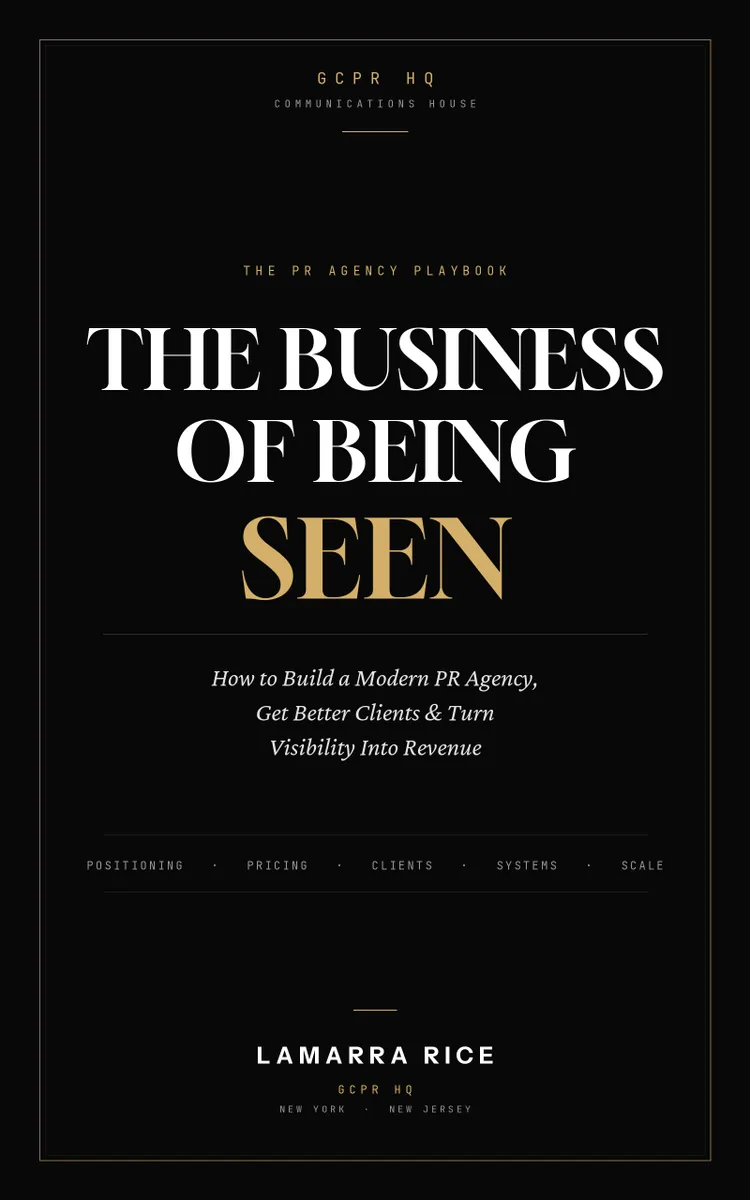
"The PR Agency Playbook: The Business of Being Seen." is a business book by Lamarra Rice with 5 chapters and approximately 9,523 words. Pricing, client acquisition, and scaling a service agency.
This book was created using Inkfluence AI, an AI-powered book generation platform that helps authors write, design, and publish complete books. It was made with the AI Business Book Writer.
Frequently Asked Questions
What is "The PR Agency Playbook: The Business of Being Seen." about?
Pricing, client acquisition, and scaling a service agency
How many chapters are in "The PR Agency Playbook: The Business of Being Seen."?
The book contains 5 chapters and approximately 9,523 words. Topics covered include Build Your Core Service Offer, Price for Profit, Not Hours, Get Clients With a 3-Channel System, Build Your Agency Money Machine, and more.
Who wrote "The PR Agency Playbook: The Business of Being Seen."?
This book was written by Lamarra Rice and created using Inkfluence AI, an AI book generation platform that helps authors write, design, and publish books.
How can I create a similar business book?
You can create your own business book using Inkfluence AI. Describe your idea, choose your style, and the AI writes the full book for you. It's free to start.
Write your own business book with AI
Describe your idea and Inkfluence writes the whole thing. Free to start.
Start writingCreated with Inkfluence AI


