
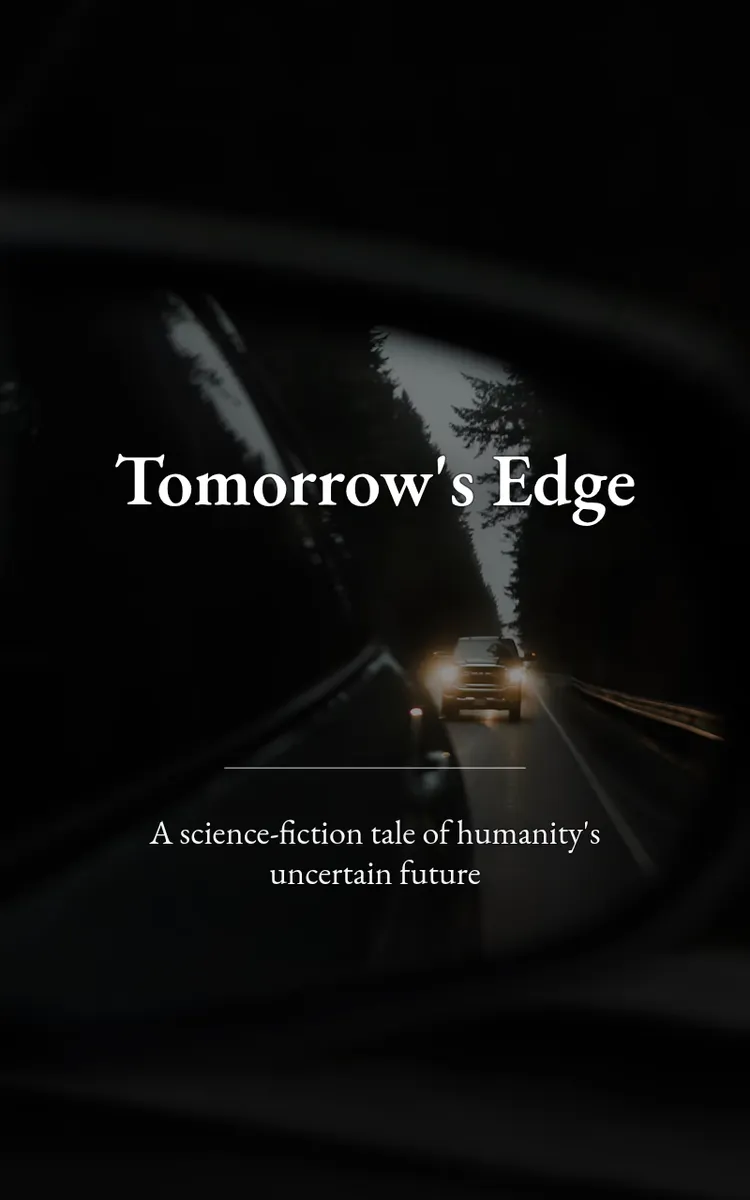

Read the first chapter
The whole of chapter one, free. About 8 min. Turn the pages with the arrows, your keyboard, or a swipe.
Chapter 1
The City Beneath the Aurora
Edit cover. Ed question mark. The emergency lamps beneath Nacre City had turned the floodwater the color of old blood.
Sera Venn waded through it with one hand on the tunnel wall and the other clamped around a waterproof tool case. Every few seconds, the city’s failing shield groaned overhead. The sound traveled through the flooded maintenance ways as a deep metallic shudder, making bolts tremble beneath her palm.
“Station Nine is two hundred meters ahead,” Lio said in her ear. His voice broke apart beneath static. “If the water reaches the relay vault, the restart window closes.”
“It’s already at my waist.”
“That is not what I meant.”
Sera pushed forward. Cold water pressed against her suit, finding the seam beneath her left arm. The tunnel sloped downward toward the submerged shield station, and the current tugged at her boots with enough force to turn each step into a decision.
Above them, Nacre City climbed through the ocean trench in terraces of ceramic and glass. Its upper towers were built to catch sunlight scattered through the atmosphere. Its lower districts depended on the planetary shield: a vast electromagnetic lattice wrapped around the city, bending charged particles away from its domes and seawalls. Without it, the solar storm would strip power from the transit grids, blind the navigation beacons, and hammer every exposed surface with radiation.
The storm had reached the outer satellites twelve minutes ago.
Sera had twelve minutes, perhaps less, before the shield collapsed completely.
“Lio, shut the bulkhead behind me.”
“Not until you’re through.”
“If the pressure door fails, this whole section floods.”
“I know.”
“Then trust me.”
A pause. Static hissed between them.
“I trust your calculations,” he said. “Your judgment is still under review.”
Despite herself, Sera almost laughed. “Put it in the report.”
A tremor rolled through the tunnel. The water rose against her ribs.
Sera stopped laughing.
The emergency lights flickered, and for one breath the tunnel vanished. In the darkness, something bright moved beneath the water. Not a reflection. Not the pale arc of a maintenance drone. A thin blue line slid along the submerged wall, bending around pipes and seams as if searching for a path.
Then the lamps returned.
“Sera?” Lio said. “What happened?”
“Power fluctuation.”
“That was not a power fluctuation.”
She looked at the wall. The blue line was gone, but the metal beneath her glove buzzed faintly.
“Keep the channel open,” she said.
“Already doing that.”
The next section of tunnel had collapsed. A service cart lay wedged across it, its wheels spinning uselessly in the current. Beyond the cart, the passage narrowed beneath a ceiling of twisted conduit.
Sera set the tool case on a raised ledge and pulled the cutter from her belt. Its field blade unfolded with a sharp electric snap. She plunged it into the cart’s frame.
The magnetic distortion hit before the cut was complete.
Every loose object in the tunnel jerked toward the left wall. Her cutter tore sideways, dragging her shoulder with it. A wrench shot past her visor and buried itself in the concrete. The tool case lifted from the ledge and slammed against the ceiling.
Sera grabbed a handrail. Her suit alarms flared red.
“Lio,” she said through clenched teeth. “The field is spiking.”
“I’m seeing it. Station Nine’s regulator is trying to compensate.”
“It’s pulling metal through the maintenance grid.”
“Can you get around the cart?”
“No.”
The distortion vanished as abruptly as it had come. The tool case dropped into the water with a hard splash.
Sera dove after it.
Her fingers closed around the case handle just before the current dragged it beneath the cart. The water was colder below the surface, and the tunnel’s darkness swallowed the red emergency glow. She felt along the metal frame until she found a gap barely wide enough for her helmet.
The case snagged. She pulled once. Nothing.
“Leave it,” Lio said.
“It has the regulator bridge.”
“We can fabricate another.”
“Not in twelve minutes.”
She braced both boots against the tunnel floor and hauled. The case came free, striking her knee. Pain flashed white through her leg. She kicked upward and broke the surface, dragging air through the suit’s intake.
The tunnel shook again.
This time the water rose to her neck.
“Sera,” Lio said, quieter now. “The storm front is over the city.”
She stared at the submerged passage ahead. The emergency lights reflected in the water like broken red needles.
“How long?”
“Three minutes until the first radiation surge.”
“Then stop talking.”
She clipped the case to her harness and forced herself beneath the cart. The metal frame scraped across her back. Her shoulder struck a pipe. She kept moving, one hand searching ahead, the other gripping the guide cable that led toward Station Nine.
The cable vibrated beneath her glove.
Not from the current.
A pulse traveled through it, slow and deliberate. Sera counted the intervals without meaning to. Three short pulses. One long. Three short again.
The same pattern repeated through the tunnel.
She surfaced on the far side of the collapse and found herself in a vertical access shaft. The station lay below, sealed behind a pressure hatch twenty meters down. A ladder descended into black water.
“Lio,” she said.
“I heard it.”
“The cable is transmitting.”
“Maintenance telemetry?”
“No. It’s patterned.”
“Everything is patterned when the system is failing.”
She clipped her line to the ladder and began descending.
At ten meters, the water covered her helmet. At fifteen, the suit’s external lights caught the station door below. Its indicator glowed amber, then blue, then amber again.
Three short pulses. One long.
Sera reached the hatch and pressed her palm to the manual plate. The lock did not respond.
She opened the tool case. Inside, the regulator bridge rested in its foam cradle, its ceramic contacts dry and intact. She pulled the bridge free and jammed it into the emergency socket beside the hatch.
The station woke with a violent shudder.
A ring of white light snapped on around the door. The water spun, dragging Sera toward the center of the shaft. Her tether went taut. Her shoulder wrenched hard enough to numb her hand.
“Lio, open the hatch.”
“I’m trying.”
“Try faster.”
“I’m not the one being pulled into a turbine.”
The lock clicked.
Sera yanked the hatch open and let the current carry her inside. She struck the station floor on one knee. Water poured through after her, swirling around banks of dead consoles and cable bundles. The hatch slammed shut behind her, cutting off the worst of the flow.
For a moment, she heard only her own breathing.
Then every screen in Station Nine ignited.
Rows of diagnostic symbols spilled across the displays. The shield regulator was down to four percent. The city’s outer lattice had already gone dark in three sectors.
Sera staggered to the central console and pulled off her gloves.
“Lio, I’m in.”
“Good. The restart sequence should be on your left.”
“I see it.”
“Bridge the primary coils, then trigger the field in manual mode. Do not let the station auto-balance.”
“I know how to restart a shield.”
“I’m reminding you because the last engineer who tried - ”
“Died when the station vaporized him. Yes, I read the report.”
The console flashed.
A new line of text appeared beneath the failing diagnostics.
Sera leaned closer.
The symbols were not part of the station’s operating system. They formed a clean sequence of narrow white marks, repeating across the screen in groups of three and one.
Three short. One long.
The same pattern pulsed through the floor.
“Sera?” Lio said. “What are you looking at?”
“An unauthorized process.”
“Kill it.”
She reached for the isolation control.
The screen changed before she touched it. A map unfolded across the console, not of Nacre City, not of Earth, but of the sky beyond it. Points of light appeared in a black field. Most were fixed. One moved along a curve that ended far outside the system.
The station’s shield calculations wrapped around the moving point.
Sera’s fingers hovered above the controls.
“Lio,” she said, “the shield is receiving something.”
“From the satellites?”
“No.”
“Then from where?”
The console translated the signal into a set of coordinates, though the final reference remained impossible: a distance measured beyond the outer planets, beyond the range of any registered probe.
The moving point pulsed again.
Three short. One long.
Sera forced herself to look away and opened the regulator housing. Inside, the primary coils glowed dull orange. The storm had overloaded them, but they were still intact. She connected the bridge, then reached for the manual trigger.
A surge struck the station.
The floor kicked beneath her. Her hand missed the trigger and slammed into the console edge. The impact split her knuckles inside the suit. Warning lights burst across the chamber.
“Radiation front!” Lio shouted. “Sera, restart now!”
The water around her boots began to steam.
She seized the trigger with both hands and pulled.
The shield came alive.
A white arc raced through the station’s conduits. The coils screamed. Every console went black except the central display, where the city’s lattice rebuilt itself sector by sector. The dark regions brightened. The pressure readings stabilized. Far above, Nacre’s domes caught the first impact of the solar storm and turned it aside in a rippling curtain of blue fire.
Sera dropped against the console, breathing hard.
“We have field,” Lio said.
She looked through the station’s small observation port. Beyond the reinforced glass, the flooded shaft glowed with pale electric light. The water had stopped climbing.
“We have field,” she agreed.
For three seconds, the station was quiet.
Then the central console came back on.
The shield status filled the display in green. Beneath it, the unknown sequence remained. The map returned, sharper now, its moving point fixed at the edge of the projected darkness.
A single line appeared below the coordinates.
ORIGIN: EXTRASOLAR.
Sera stared at it.
Lio’s voice came faintly through the static. “Tell me that’s a diagnostic error.”
The signal pulsed again.
Three short. One long.
Sera placed her bleeding hand against the console. The surface vibrated beneath her palm, answering the pulse from somewhere beyond Earth.
“No,” she said. “It isn’t.”
The display changed once more.
A new prompt appeared, waiting beneath the impossible coordinates.
RESPONSE CHANNEL OPEN.
End of chapter one. 4 more chapters and about 10,108 words in the full book.
Swipe or use the arrows to turn the page
What's inside: 5 chapters
- 1. The City Beneath the Aurora
- 2. A Signal Worth Answering
- 3. Through the Glass Reef
- 4. The Moon That Remembered
- 5. The Colony in Freefall
About this book
"Tomorrow's Edge" is a fiction book by Abigail Myers with 5 chapters and approximately 10,108 words. Science-fiction storytelling set in an imagined future.
This book was created using Inkfluence AI, an AI-powered book generation platform that helps authors write, design, and publish complete books. It was made with the AI Novel Writer.
Frequently Asked Questions
What is "Tomorrow's Edge" about?
Science-fiction storytelling set in an imagined future
How many chapters are in "Tomorrow's Edge"?
The book contains 5 chapters and approximately 10,108 words. Topics covered include The City Beneath the Aurora, A Signal Worth Answering, Through the Glass Reef, The Moon That Remembered, and more.
Who wrote "Tomorrow's Edge"?
This book was written by Abigail Myers and created using Inkfluence AI, an AI book generation platform that helps authors write, design, and publish books.
How can I create a similar fiction book?
You can create your own fiction book using Inkfluence AI. Describe your idea, choose your style, and the AI writes the full book for you. It's free to start.
Write your own fiction book with AI
Describe your idea and Inkfluence writes the whole thing. Free to start.
Start writingCreated with Inkfluence AI


