
Read the first chapter
The whole of chapter one, free. About 8 min. Turn the pages with the arrows, your keyboard, or a swipe.
Chapter 1
The Locked Los Angeles Classroom
The padlock on Roosevelt Middle School’s archive door had been painted the same dull green as the hallway walls, but its brass shackle flashed whenever the late afternoon sun slipped through the high windows.
Marisol Vega crouched beneath it, one hand wrapped around the bolt cutters she had borrowed from the theater closet. The building had been closed for eleven minutes. Somewhere beyond the double doors, the custodian’s cart squeaked toward the front entrance.
“Come on,” she whispered.
The cutters bit down. Metal snapped.
Marisol caught the lock before it struck the floor.
Her brother’s photograph was supposed to be inside.
She had seen it once, years ago, in the album her mother kept behind the flour tin. Daniel at thirteen, squinting into the Los Angeles sun, one front tooth chipped, his arm slung around their father’s shoulders. On the back, someone had written a date and the name of the school. Then the photograph disappeared during the move after Daniel left.
Not died. Not returned. Left.
That was the word her mother used when neighbors asked. Daniel left. As if leaving were a door that closed neatly behind a person.
Marisol pushed the archive door inward. Dust stirred from the threshold. The room beyond was colder than the hallway, its windows covered by yellowed paper and its shelves crowded with banker’s boxes, yearbooks, cracked trophies, and rolled maps of Los Angeles that had curled at the edges.
She slipped inside and pulled the door almost shut.
The archive smelled of cardboard and old glue. A fluorescent tube buzzed overhead, flickering just enough to make every row of boxes seem to shift.
Marisol took the folded note from her pocket. Her mother had written the school name and a year in blue ink, then pressed the pen so hard it had torn the paper.
“Eighth grade,” Marisol murmured. “1989.”
She had asked her mother where the picture was.
Her mother had kept stirring rice.
“Ask the school,” she said.
“Why would the school have it?”
“Because they took it.”
“Who?”
But her mother had turned up the radio.
Now Marisol moved between the shelves, reading labels by the light of her phone. Student Activities. Attendance, 1987-1990. Yearbook Negatives. Lost and Found.
The floor groaned beneath her sneakers.
She froze.
The custodian’s cart squeaked again, closer this time.
Marisol ducked behind a stack of boxes and held her phone against her chest. The archive door gave a soft metallic click.
Locked.
She waited. A key scraped against the other side.
“Hello?” called a man’s voice. “Anyone in there?”
Marisol pressed her palm over her mouth.
The key turned once. The door shuddered, then stopped. A heavy object struck it from the hallway.
“Jammed thing,” the custodian muttered. “I’ll get maintenance tomorrow.”
His footsteps faded.
Marisol lowered her hand. Her palm was damp.
Tomorrow would be too late. The school was being emptied for demolition, and the archive would be cleared with everything else. Teacher Elena Chen had told her that after Friday, the records might go to a district warehouse in the Valley. Marisol had nodded as if that did not matter.
It mattered now.
She found the 1989 boxes on the highest shelf. The first slipped from her grip and burst open when it hit the floor. Paper scattered across the dust: permission slips, blue report cards, a class photograph with names written in looping black ink.
Marisol knelt.
There he was.
Daniel stood in the back row, taller than everyone except the teacher, his hair falling over one eye. He was not smiling. Even in the tiny photograph, he looked as though he had heard something no one else could hear.
Marisol touched his face through the plastic sleeve.
“Daniel.”
The name came out too quietly to belong to the room.
She searched the box, lifting folders and envelopes. A yellow folder marked VEGA, D. sat beneath a stack of art projects. Her fingers trembled as she opened it.
Inside were two disciplinary notices, a library card, and a photograph torn nearly in half.
She knew the picture before she turned it over.
Daniel stood beside their father, both of them squinting at the camera. Their father’s hand rested on Daniel’s shoulder. Behind them rose the school’s old auditorium, its brick wall painted with a blue eagle. The photograph had been ripped down the middle, leaving only Daniel and a narrow slice of their father’s sleeve.
Marisol drew the picture close.
A woman’s handwriting crossed the back.
Daniel Vega Room 14 October 6
Below that, partly covered by the torn edge, were several more letters.
She tilted the photograph toward her phone.
E -? R - A scrape sounded outside.
Marisol shoved the picture into her jacket pocket and gathered the papers. The handle turned.
“Maintenance,” a voice called. “Step away from the door.”
Marisol looked around. The room offered no other exit. The windows were painted shut, and the shelves reached almost to the ceiling.
“I’m not supposed to be here,” she called.
“That makes two of us,” the voice answered. “Open up.”
“I can’t.”
The handle jerked. The door bowed inward.
Marisol backed away, clutching the folder. A box pressed into her spine. Dust shook loose from the shelf and sprinkled her hair.
“Are you hurt?” the man asked.
“No.”
“Then tell me where you are.”
“Archive.”
“Of course you are. Can you move away from the door?”
She tried. Her heel caught on a fallen box. It tipped, spilling old yearbooks across the floor.
“I’m stuck.”
The man cursed under his breath. “There should be a release bar inside.”
Marisol swept her phone’s light across the walls. Nothing but shelves, peeling paint, and a framed photograph of the school’s first principal. Her eyes landed on a red metal box half buried beneath folders.
She crawled toward it.
The door slammed again.
“Marisol?” the man said.
She stopped.
“How do you know my name?”
“Your backpack is in the hallway. It has your student ID clipped to it.”
She had forgotten the bag by the lockers.
“Find the red box,” he said. “Fire extinguisher?”
“First-aid kit.”
“Open it.”
Her fingers slipped on the rusted latch. Inside lay gauze, a flashlight, and a ring of keys labeled in fading tape. One key was marked ARCHIVE WINDOW.
Marisol grabbed it and scrambled toward the far wall.
The window’s metal frame resisted. She jammed the key into the lock and twisted. Nothing.
Behind her, the door groaned.
“Try the other way,” the man called.
She twisted harder. The key turned with a sudden crack. The window lifted three inches, then stopped against layers of paint.
Marisol set down the folder, wedged both hands beneath the frame, and pulled. The paint tore with a sound like fabric ripping. A blade of evening light cut into the room.
Outside, the drop was only to the covered walkway, but the window was narrow. Marisol pushed her shoulders through. Her jacket snagged on a nail.
“Wait,” the man said. “Don’t force it.”
“I don’t have time.”
“You do if you stop panicking.”
“I’m not panicking.”
The door burst inward.
A tall custodian in a blue work shirt stood in the opening, one hand braced against the frame. Behind him, the hallway lights were already dimming.
Marisol yanked at her jacket. The nail tore the sleeve.
The custodian stepped inside. “You’re going to fall.”
“Then help me.”
He crossed the room in three strides and seized the window frame. Together they dragged it upward. Marisol slid through, landing hard on the walkway. Her palms scraped against concrete.
The photograph pressed against her ribs.
The custodian climbed out after her, breathing heavily. “You could’ve broken your neck.”
“I found something.”
“That doesn’t make it legal.”
Marisol pulled the photograph from her pocket. The last sunlight struck Daniel’s face, turning the torn edge white.
The custodian’s expression changed.
“Where did you get that?”
“Box marked Vega.”
He reached for it, but she pulled back.
“Is there another side?” he asked.
“What?”
“Of the picture.”
“It’s torn.”
“No. I mean - was it already torn?”
“Yes.”
He looked toward the archive door. “Your brother was in the school paper once.”
Marisol’s fingers tightened around the photograph. “Why?”
“Ask your teacher. She knows more about these records than I do.”
“Ms. Chen?”
The custodian did not answer. He only glanced at the darkening windows. “Go home, Marisol.”
She slipped the photograph into her pocket.
At the end of the walkway, the school gates rattled as the automatic lock engaged. Marisol ran before they could close completely, her torn sleeve catching on the iron bars. She pulled free and stumbled onto the sidewalk.
Traffic hissed along Hoover Street. A bus groaned at the corner. The city carried on, bright and impatient, while the old school settled behind her.
She stopped beneath a jacaranda tree and took out the photograph again.
Daniel’s face remained exactly as she remembered it, stubborn and unsmiling. But now she saw something beneath the torn edge on the back. The missing half had taken most of the writing, yet three letters remained, darkened by the pressure of the pen.
E L I.
Marisol stared until the letters blurred.
Her mother had never mentioned an Eli.
She turned the photograph over, searching Daniel’s expression for an answer. There was only the old auditorium behind him, the blue eagle, and the hand on his shoulder belonging to someone who had been cut away.
Her phone vibrated.
A message from Elena Chen waited on the screen.
Did you find what you were looking for?
Marisol looked back at the school. In the archive window, the custodian’s silhouette moved behind the glass. The building was dark now, but one room still held a square of light.
She typed, I found a picture.
Then she deleted it.
The letters on the photograph seemed to deepen beneath her thumb.
Eli.
Marisol put the picture against her chest and began walking home, carrying Daniel’s face and a name no one in her family had ever allowed her to ask about.
End of chapter one. 35 more chapters and about 77,508 words in the full book.
Swipe or use the arrows to turn the page
What's inside: 36 chapters
- 1. The Locked Los Angeles Classroom
- 2. Ms. Chen Asks Her to Speak
- 3. The Name Beneath the Tear
- 4. The Bus Across the City
- 5. A Story She Can Claim
- 6. The Empty Chair
- 7. Tomas's Half-Remembered Clue
- 8. The Closed Church Basement
- 9. The Name She Leaves Out
- 10. The Question at Dinner
- 11. Elena's Unfinished Sentence
- 12. The Archive's Narrow Stair
- 13. A Memory Without Proof
- 14. The Story Circle Breaks
- 15. Tomas Remembers the Song
- 16. The Market's Missing Stall
- 17. The Story She Refuses
- 18. Elena's Missing Photograph
- 19. The Notebook Goes Missing
- 20. The Address in the Margin
- 21. The Library's Oral History Room
- 22. The Apology She Cannot Make
- 23. Elena's First Page
- 24. The Recording That Stops
- 25. The Neighborhood Mural
- 26. The Family Gathering Cancelled
- 27. The Notebook in the Trash
- 28. The Neighbor Who Won't Name Him
- 29. The Walk Through the Old Block
- 30. The Choice to Read Aloud
- 31. Elena's Full Confession
- 32. Marisol Takes the Microphone
- 33. The Album Comes Back
- 34. The Photograph They Can Name
- 35. Elena Keeps Her Sister's Name
- 36. The Stories We Keep
About this book
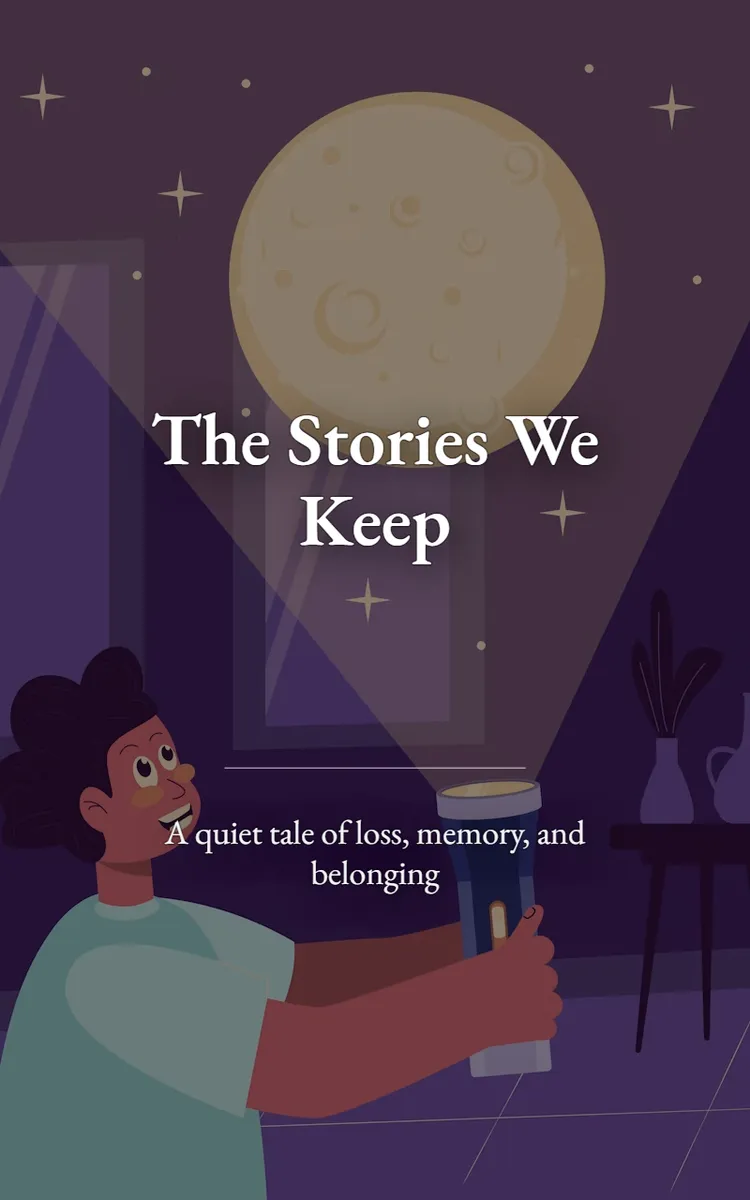
"The Stories We Keep" is a fiction book by Anonymous with 36 chapters and approximately 77,508 words. A girl shares stories of separation to preserve memories of loved ones.
This book was created using Inkfluence AI, an AI-powered book generation platform that helps authors write, design, and publish complete books. It was made with the AI Novel Writer.
Frequently Asked Questions
What is "The Stories We Keep" about?
A girl shares stories of separation to preserve memories of loved ones
How many chapters are in "The Stories We Keep"?
The book contains 36 chapters and approximately 77,508 words. Topics covered include The Locked Los Angeles Classroom, Ms. Chen Asks Her to Speak, The Name Beneath the Tear, The Bus Across the City, and more.
Who wrote "The Stories We Keep"?
This book was written by Anonymous and created using Inkfluence AI, an AI book generation platform that helps authors write, design, and publish books.
How can I create a similar fiction book?
You can create your own fiction book using Inkfluence AI. Describe your idea, choose your style, and the AI writes the full book for you. It's free to start.
Write your own fiction book with AI
Describe your idea and Inkfluence writes the whole thing. Free to start.
Start writingCreated with Inkfluence AI


