
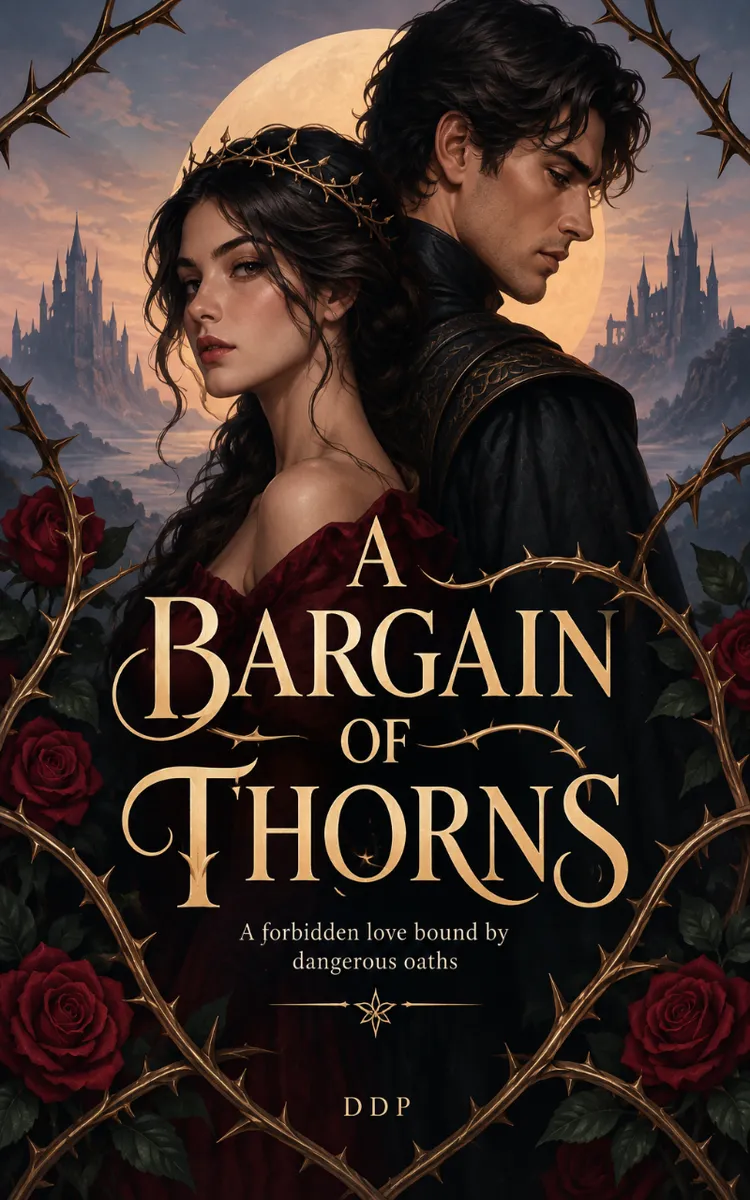
Read the first 2 chapters
The opening of the book, free: 2 chapters. About 53 min. Turn the pages with the arrows, your keyboard, or a swipe.
Chapter 1
The Fever in the Root Cellar
The fever has climbed past Mara’s wrists by the time the cellar begins to flood.
Water slips between the stones beneath her bed, black and cold, carrying the sour smell of drowned roots. I press two fingers to her throat. Her pulse stutters beneath my touch, too quick, too thin.
“Stay with me,” I whisper.
Mara’s lashes tremble. “I am.”
“You’re not allowed to argue with me while you’re dying.”
“That has never stopped me before.”
Her voice is barely there, but it is hers. I cling to it.
The Vey family cellar crouches beneath our cottage like an old animal, its walls packed with clay and stone, its beams darkened by generations of smoke. Every shelf holds something I gathered, dried, labeled, and saved for the day it might matter. Feverfew. Willow bark. Bitterroot. Foxglove, sealed in a blue jar and handled only with gloves.
I have used them all.
The empty bowls sit around Mara’s mattress like small, accusing moons. Feverfew did nothing. Willow eased the pain for half an hour. Bitterroot made her vomit until there was nothing left in her but bile and shaking.
The fever has taken the rest.
Another thin stream of water creeps from beneath the eastern wall. I shove a folded sack into the crack. It darkens at once.
“No,” I say.
Mara turns her head toward me. Her hair is damp against her cheek. “That sounded like a word you say when the world listens.”
“The world has poor manners.”
“It learned from you.”
I try to smile. It breaks before it reaches my mouth.
Above us, rain hammers the roof. The storm began before dusk and has not paused once. Our cottage shudders with every hard gust. Somewhere in the kitchen, a shutter bangs open and closed. The cellar lantern gutters, filling the low room with the smell of hot oil.
I reach for the ledger on the shelf behind me. The pages are swollen from years of damp, but I know the entry I need. I turn past notes in my mother’s narrow hand, past my own additions written in charcoal when ink was too dear.
Moonwort.
A marsh plant with pale leaves and sap that carries warmth into blood. Rare enough that most herbals call it a superstition. My mother had written one line beneath the name.
Grows where the moon sees water that no human foot has crossed.
I had always thought she meant untouched ground.
Now I understand.
I look toward the cellar’s eastern wall. The water has spread across the floor, circling the legs of Mara’s bed. The marsh begins beyond the orchard, and beyond the marsh lies the border.
The fae boundary.
Mara watches me read. “No.”
“You don’t know what I’m thinking.”
“I know your face.”
“My face is excellent.”
“Your face is making plans.”
“Then it has more sense than you do.”
She tries to lift herself. The effort ends in a shudder. I catch her shoulders and ease her back against the folded blankets.
“Don’t move.”
“I can still tell you when you’re being stupid.”
“That is your final useful function. I would hate to lose it.”
Her fingers close around my sleeve. The grip is weak, but fear gives it shape. “Elowen.”
I stop pretending not to understand.
The fae border is less than a mile from our door. A line of standing stones cuts through the marsh, each one carved with the old warning: No human crossing. No fae trespassing. No oath spoken in ignorance.
The words have been there longer than our family. Longer than the road. Longer, perhaps, than the kingdom that claims the land on this side of them.
People say the fae do not lie.
People also say they do not need to.
“They guard the marsh,” Mara whispers.
“I know.”
“They will see you.”
“I know.”
“And if they catch you?”
I close the ledger.
“Then I will be charming.”
Mara’s laugh turns into a cough. Her whole body folds around it. I hold the basin beneath her mouth, though nothing comes up but a thread of red.
The sight of it strips the warmth from my hands.
“Mara.”
She wipes her lips with the back of her wrist. “Don’t look at me like that.”
“Like what?”
“Like you’ve already buried me.”
I set the basin aside. “I haven’t.”
“You are thinking it.”
“I am thinking that if I do not find moonwort before dawn, I may have to.”
The words leave the room hollow.
For a moment, there is only the rain and the water rising around our boots.
Then Mara says, “You cannot bargain with them.”
“I am not bargaining.”
“You always bargain.”
“I barter.”
“You once traded Father’s best pruning knife for three jars of honey because the beekeeper had a fever.”
“The knife was replaceable.”
“It had his initials.”
“So did the honey jars.”
She closes her eyes. “You will go.”
I tuck the blanket beneath her chin. “I will go.”
“And if the border takes you?”
“Then it will have to explain itself.”
She opens one eye. “That is not reassuring.”
“It was not meant to be.”
I leave her with the lantern burning low and the bell cord tied around her wrist. If she pulls it, the bell above the cellar door will ring in my room. There is no one else to hear it. Our nearest neighbor is a mile away, and the storm has swallowed the road.
I take my herb knife, a coil of red thread, a waxed pouch, and the old green cloak that belonged to our mother. Its hem smells faintly of rosemary despite the years.
At the bottom stair, Mara calls my name.
I turn.
“Come back,” she says.
Not bring the herb. Not be careful.
Come back.
I make myself meet her eyes. “I will.”
It is not an oath. I know better than to speak one carelessly.
Still, the words settle strangely beneath my ribs.
The stair is slick beneath my boots. Water spills down from the kitchen in a thin sheet, cold enough to numb my ankles. I cross the dark room, shoulder the door, and step into the storm.
Rain needles my face.
The orchard has become a black tangle of branches and mud. I keep one hand on the stone wall as I hurry toward the marsh, counting the trees by touch because the clouds have hidden the moon. The wind tears at my cloak. Wet earth gives beneath my boots.
At the edge of the orchard, I stop.
Beyond the last row of pear trees, the land drops into the marsh. Reeds shiver in the rain. Pools of dark water reflect brief flashes of lightning. Farther out, the standing stones rise in a crooked line, pale and watchful.
The border.
My mother used to bring me here in summer, when the marsh smelled of mint and warm mud. She would kneel beside a pool and show me how to tell living water from poisoned water by the way the insects touched it.
“Plants remember,” she had said. “Not like people. Better than people. They keep the shape of what has happened.”
I had been nine. I had believed her.
I believe her now.
The old herb magic is quiet. It does not flash or crackle. It lives in attention, in the pressure of a thumb against a leaf, in the breath held before a root is cut. The village healers call it craft when they want to be polite and witchery when they do not.
The fae call it nothing at all.
I step into the marsh.
Mud closes around my boots. Water climbs to my shins, cold enough to burn. I push forward, leaning on the herb knife when the ground softens beneath me. The reeds slap my face. Their cut edges leave thin stings across my cheeks.
Somewhere beyond the rain, something whistles.
I stop.
The sound comes again, three notes rising.
Not a bird.
I turn slowly. The orchard is already blurred behind me. Between the trees, a light moves where no lantern should be, pale blue and low to the ground.
“Keep walking,” I tell myself.
The marsh answers with a wet sucking sound.
I keep walking.
The first standing stone rises ahead, its surface slick with rain. Silver marks twist across it, too fine to be carved by any human tool. I reach for the stone.
The moment my fingers touch it, every plant in the marsh bends.
Not from the wind.
Toward me.
Reeds bow. Water lilies fold. A cluster of marsh thyme turns its tiny leaves beneath the rain, exposing their pale undersides.
I snatch my hand back.
The silver marks brighten.
A voice speaks from somewhere beyond the stones.
“Human.”
It is a man’s voice, low and perfectly clear despite the storm.
I draw the herb knife.
A figure stands on the other side of the border.
He is tall enough that the reeds do not reach his shoulders. Rain does not touch him. It breaks around him and runs in clean lines down the air. His coat is black, severe at the throat, fastened with a clasp shaped like a thorned crown.
His hair is dark, though a strand of silver lies at his temple. His face is too precise to be handsome in any comforting way. His eyes catch the lightning and give it back pale as winter glass.
I know him before he says his name.
Everyone within a day’s ride knows the name of Prince Caelan Rook.
Heir to the Hollow Court. The queen’s son. The prince who broke a rebel lord’s oath and left the man alive long enough to feel every word tear itself out of his body.
Ruthless, people say.
Guarded.
Fae.
His gaze drops to my knife. “You have crossed the boundary.”
“Not yet.”
“You are standing in the marsh.”
“On this side of your stones.”
“Your foot is within a marked span.”
I look down. My boot rests inches from a line of silver moss.
I lift it.
The ground beneath my other foot collapses.
Mud swallows me to the thigh.
I cry out and plunge both hands into the reeds. The herb knife flies from my grip. Cold water floods beneath my cloak. Something catches my ankle, not root or branch but a tightening coil of marsh grass.
Caelan does not move.
“Do not struggle,” he says.
“That is easy for you to say.”
“It is also correct.”
I pull harder. The mud sucks at my leg. My knee twists. Panic rises sharp and humiliating.
“Help me.”
The prince’s expression does not change. “You have not asked a question with a useful answer.”
“Help me out of the marsh.”
“That is not what I meant.”
“I am aware.”
“Then be precise.”
The grass tightens. Pain flashes up my calf.
“Prince Caelan Rook,” I snap, “will you pull me from this marsh before it eats me?”
His eyes narrow.
The rain strikes the water between us.
“I will pull you from the marked span,” he says, “provided you do not cross willingly into my land.”
The phrasing catches. I hear the shape of it, the gap beneath it.
“Does that mean you will not let the marsh kill me?”
“I said I will pull you from the marked span.”
“You said provided I do not cross willingly.”
“You are not currently willing to cross.”
“Currently?”
His mouth tightens. Not quite a smile. Something colder.
“You are standing in a place where careless words become binding.”
“I am standing in a place where careless mud becomes a grave.”
“Then choose carefully.”
The grass jerks. I gasp.
Caelan lifts one hand.
The marsh releases me.
Not gently. I come free with a wet tearing sound and fall backward into the water. He catches my wrist before I strike the stone.
His hand is cold through my sleeve.
For one breath, we are connected across the boundary. His fingers encircle my arm with effortless strength. I smell rain on him, and something darker beneath it, like crushed pine needles under snow.
His gaze drops to where our skin meets.
The plants around us shiver.
He releases me at once.
I land hard on the human side of the stones, soaking wet and furious. “You could have done that before I lost my knife.”
“You could have remained at home.”
“My sister is dying.”
The words come out before I can stop them.
Caelan looks toward the distant line of trees. “The fevered girl.”
I freeze.
“You know about her?”
“The marsh knows what crosses it.”
“That is not an answer.”
“It is the only one I gave.”
I push myself upright. Water pours from my cloak. “I need moonwort.”
His gaze returns to me. “No.”
“You have not even heard how much I need.”
“I know enough.”
“Then you know I am not asking for a basketful. I need one sprig.”
“Moonwort does not grow on the human side.”
“I know.”
“It grows under the protection of the Hollow Court.”
“Then your court can spare a plant.”
“Can it?”
I hate the calm in his voice. I hate the way he stands untouched by the storm while I shiver in mud. Most of all, I hate that he has not asked me to explain myself, as if my desperation is already catalogued and found uninteresting.
“My sister will die before dawn,” I say.
“Many humans die before dawn.”
The words are flat. Not cruel, exactly. Cruelty requires interest.
I rise, though my leg trembles. “Then perhaps you should be grateful I am only asking for a plant and not your sympathy.”
“I have none to give.”
“I noticed.”
I turn toward the marsh.
“Stop.”
The command is not loud, but the boundary answers it. Silver light runs through the moss at my feet.
I look back.
Caelan’s face has gone still in a new way. Not indifference. Calculation.
“You cannot reach moonwort alone,” he says.
“I came this far.”
“You crossed a flooded marsh in darkness during a storm.”
“And yet I am still standing.”
“Because the marsh has not decided what to do with you.”
“Perhaps it has poor judgment.”
“Perhaps it is waiting for mine.”
I laugh once, sharp and breathless. “Is this the part where you offer me a bargain?”
His eyes rest on my face.
“No,” he says. “This is the part where I decide whether you are worth making one.”
The insult lands because it is intended to.
I step closer to the stones. “I am not worth anything to you.”
“Your herb magic says otherwise.”
The rain seems to thin around us.
I glance at the reeds. Their leaves have turned toward me again. Along the waterline, tiny white flowers open despite the darkness.
I have seen that before, but only in my mother’s presence. Plants responding to touch. To breath. To blood.
I crouch and press my palm to the mud.
The marsh quiets.
Not completely. Water still moves. Rain still falls. But beneath it I feel a pulse, slow and deep, traveling through root and reed. The fever in my sister’s body answers it faintly, as if the two illnesses share a language.
Caelan watches my hand.
“You hear them,” he says.
“I know them.”
“That is not the same thing.”
“It is to me.”
“Your kind abandoned this art.”
“My kind forgot to respect it.”
A flicker crosses his face. Irritation, perhaps. Or recognition.
I close my fingers around a sprig of marsh thyme. Its leaves are warm despite the rain. The warmth travels into my palm, then fades.
Caelan steps nearer to the boundary.
“You would enter the Hollow Court for moonwort?”
“I would enter a wolf’s mouth for it.”
“That can be arranged.”
“Was that meant to frighten me?”
“No. It was meant to establish that you are willing to accept terms before hearing them.”
The stones hum softly.
My skin prickles. “I have not agreed to anything.”
“Not yet.”
“Then do not speak as though I have.”
His gaze sharpens. “You are human. You cannot bind yourself without understanding the words.”
“I can bind myself by saying them.”
“Yes.”
“And if I break them?”
For the first time, something like attention settles fully upon me.
“Spoken oaths bind body and soul,” he says. “They cannot be broken without consequence. Pain, loss of power, or death.”
The storm seems suddenly colder.
“You are warning me.”
“I am defining the danger.”
“Why?”
“Because I am not permitted to lie.”
The statement is simple. His voice is not.
“Fae cannot lie,” I say.
“We can misdirect. We can omit. We can shape a sentence until it means what we require.”
“Loopholes.”
“Precision.”
“Traps.”
“Language.”
“Convenient.”
“Very.”
I should leave. I should return to Mara, to the cellar, to the rising water and the useless jars. I should find some other remedy, some other path.
But Mara’s pulse trembles beneath my fingers in memory.
I look at the moonlit water beyond the stones. “Take me to the moonwort.”
Caelan’s eyes do not leave mine. “That is not a bargain.”
“I did not offer one.”
“No. You offered yourself a direction.”
“Then give me yours.”
The prince considers me as though I am a difficult plant he has found growing through a wall.
“Cross the boundary,” he says. “Retrieve the moonwort. Return before the last bell of night, and I will allow you to leave with it.”
“Allow?”
“You will not reach the plant without my permission.”
“You could simply let me take it.”
“I could.”
“But you will not.”
“No.”
“Why?”
“Because moonwort grows beneath a law older than your kingdom. It may be harvested only by one who has been invited.”
“You are inviting me.”
“I am inviting you to attempt the crossing.”
The distinction is deliberate. I can feel it.
“What happens if I fail?”
“You return without the plant.”
“And if I succeed?”
“You return with the plant.”
“That is not a price.”
“No. It is an exchange of conditions.”
I stare at him. “You are intolerable.”
“I have been called worse by people with better manners.”
“Then perhaps they had more reason.”
His mouth moves, almost. “Perhaps.”
The answer unsettles me more than denial would have.
He extends his hand, palm upward.
“Say that you enter the marsh by my invitation, that you will take no living thing except the moonwort, and that you will return across the boundary before the last bell.”
I look at his hand but do not take it.
“What do you gain?”
“Your word.”
“You already know I need the plant.”
“I know what you need. I do not know what you will do to obtain it.”
“You think I will steal?”
“I think desperation makes inventive thieves.”
“And if I refuse?”
“You remain on your side of the border. Your sister dies.”
The cruelty is clean. No raised voice. No pleasure in it.
I hate him.
I hate the rain, the marsh, the cold, the rules carved into stone by people who have never watched someone they love drown from the inside.
I hate that the only path left runs through his hand.
“What is the exact wording?” I ask.
Something changes in his posture. Respect, perhaps. It looks dangerous on him.
“Say this: I enter the marsh by the invitation of Caelan Rook, Prince of the Hollow Court. I will take no living thing except one sprig of moonwort, and I will return across the human side of the boundary before the last bell.”
“You said I would take no living thing except moonwort.”
“Yes.”
“What about water?”
“Water is not living.”
“Stones?”
“Not living.”
“Dead wood?”
“Not living.”
“An insect?”
“Living.”
“An animal?”
“Living.”
“Blood?”
His gaze lowers briefly to my scraped palm. “Blood is not a thing you take.”
“Not unless I cut it from someone.”
“Then do not.”
The words are precise enough to cut.
“And the moonwort?”
“One sprig.”
“Not one leaf?”
“Not one leaf.”
“Not root, flower, seed, or second sprig?”
“No.”
“If the first sprig is damaged?”
“You will have taken it.”
“Even if it cannot heal Mara?”
“That is what you asked for.”
I swallow.
He waits.
I could ask for more. I could demand a promise that Mara will live. But I know enough of words to understand that he has offered no cure, only access.
Still, access is more than I have.
I place my hand in his.
Cold moves through me.
“Say it,” he says.
I do.
The words leave my mouth one by one, and the marsh listens.
When I finish, something tightens around my wrist. Not pain. Pressure. A ring of cold beneath the skin.
Caelan releases me.
“Now cross.”
I step over the silver moss.
The boundary opens.
It does not vanish. It yields, like a door unlatched by an unseen hand. The air changes first. The rain becomes softer. The marsh smells of green things crushed underfoot and water that has never seen a bucket.
I take one step.
Behind me, the human world dims.
I turn.
Caelan remains on the other side of the stones.
“You are not coming?”
“I invited you.”
“You are the one who knows where the moonwort grows.”
“You are the one who needs to learn whether you can find it.”
I almost laugh. “You are sending me alone into a guarded fae marsh.”
“Yes.”
“Your hospitality is memorable.”
“It is not hospitality.”
“Of course not.”
I move on before he can answer.
The marsh rearranges itself around me.
Paths that were not there a moment ago appear between the reeds, pale with moonlight. Water rises and falls without wind. Once, something small and quick moves beneath the surface beside my boot. I do not look down.
The plants guide me, but not kindly. A stand of rushes bends east. A cluster of black flowers turns away from me. I follow the direction that feels least hostile.
The old magic wakes beneath my skin.
I touch leaves as I pass, naming them silently. Bog myrtle. Fever moss. Drowned nettle. The names steady me. Plants are honest in ways people rarely manage. If a root is poisonous, it does not pretend otherwise. If a stem is brittle, it breaks.
At last I see the moonwort.
It grows from a mound of dark earth surrounded by shallow water. Its leaves are silver-green, each one shaped like a narrow hand. Tiny drops of light gather along the veins.
I crouch at the water’s edge.
The plant leans toward me.
I reach for it.
A voice speaks behind me.
“You took your time.”
I spin.
Caelan stands among the reeds.
“You said you were not coming.”
“I said you would enter alone.”
“You followed me.”
“I observed you.”
“That is the same thing with better tailoring.”
His gaze moves to the moonwort. “Harvest it.”
I place my fingers around the stem. The plant is warm. A pulse beats beneath my thumb.
“What if it refuses?”
“Then you will learn something.”
“You are very committed to my education.”
“I am committed to avoiding an oath breach.”
There it is again. The rule beneath the rule.
I draw the herb knife from my belt. It is not the knife I dropped. Caelan must have retrieved it. He holds it out to me.
I take it without thanking him.
The blade has been cleaned.
“You touched my knife.”
“It was in my possession.”
“Was that allowed under my oath?”
“Your oath forbids you from taking living things except moonwort. It does not forbid me from returning what is yours.”
“You could have said that before.”
“You did not ask.”
I kneel beside the plant.
“Do not cut the stem,” Caelan says.
I look up. “You said one sprig.”
“The moonwort is not a sprig until separated.”
“And if I cut it wrong?”
“You will damage it.”
“Then you should have invited a better herbalist.”
His eyes rest on me. “I invited the one the marsh answered.”
The words land too close to praise.
I look away.
With my left hand, I press the mud around the roots. With my right, I slide the knife beneath a side shoot. The plant shivers.
“Tell it what you intend,” I murmur.
Caelan’s voice lowers. “You speak to plants?”
“I speak near them.”
“That was not my question.”
“Fae have rules about questions. Humans have rules about privacy.”
“Privacy is a kind of secrecy.”
“So is silence.”
He watches me cut.
I whisper to the moonwort, not in words but in the old pattern my mother taught me. Acknowledgment. Gratitude. Permission asked and returned.
The silver sap wells along the cut.
I lift the sprig.
The marsh exhales.
Every pool around us ripples outward.
Caelan’s hand closes around my wrist.
The sap spills across my palm.
Pain flashes white.
I gasp and drop the knife.
Silver lines race beneath my skin, branching from the center of my hand to my wrist. They form a mark like a thorned crescent.
Caelan’s grip tightens. “What did you do?”
“I harvested it.”
“That is not what I asked.”
“I did not do anything.”
The mark burns hotter.
The moonwort in my fingers blackens at the edges.
Caelan pulls me toward the stones. “Move.”
“I cannot.”
“Move.”
He drags me through the reeds. His control has cracked, not broken, but I hear it in the clipped violence of his voice. The marsh bucks beneath us. Water rises to my knees, then my waist.
The silver mark pulses.
A word appears inside it.
Summons.
I stare at it, unable to breathe.
Caelan sees it too.
His face empties.
“What does it say?” I ask.
He does not answer.
“Prince.”
His jaw tightens.
The mark reshapes itself. Letters burn brighter beneath my skin.
CAELAN ROOK.
I wrench my wrist from his hand. “You said this would be an exchange of conditions.”
“I did not summon you.”
“The mark bears your name.”
“That does not mean I made it.”
“You are the prince of this place.”
“I am aware.”
“Then remove it.”
“I cannot.”
The moonwort shrivels in my palm, but one silver leaf remains alive.
I clutch it against my chest.
“My sister,” I say. “I have what she needs.”
“Yes.”
The answer is too quick.
I look at him. “But?”
He glances toward the dark water behind me.
“But the plant has marked you as mine to answer.”
The storm is gone on this side of the border. I can hear the faint ringing of bells somewhere far beyond the reeds.
“How long?”
His eyes return to the name burning in my hand.
“Until you answer the summons.”
“And if I do not?”
The prince looks at me then, fully and without the distance he has worn since I first saw him.
“Then the oath you spoke will begin to collect its price.”
The silver mark tightens around my wrist.
Behind us, the last bell starts to ring.
Chapter 2
A Year and a Day
The last bell strikes, and the mark around my wrist closes like a silver snare.
Pain drives me to one knee.
The moonwort slips from my hand. Caelan catches it before it touches the black water, though the remaining leaf curls against his glove as if it recognizes him and resents the fact.
“Answer the summons,” he says.
I look at the letters burning beneath my skin. CAELAN ROOK. Each one pulses with my blood.
“What happens if I refuse?”
“I told you.”
“You told me the oath would collect its price.” I push myself upright, though the marsh tilts beneath my boots. “You did not tell me what that price is.”
“I do not know.”
The answer stops me.
He turns the moonwort between his fingers. Silver light stains the planes of his face, making him seem carved from winter rather than born beneath it.
“You do not know?”
“The summons is older than my authority.”
“Convenient.”
His gaze lifts. “You believe I arranged this.”
“I believe you knew enough to send me into a marsh where plants mark desperate women for princes.”
“I did not know the moonwort would name me.”
“But you knew it might do something.”
“I knew the marsh could judge you.”
“And you left that part out.”
“You did not ask whether the plant would mark you.”
The words are calm. The distinction between them is not.
I laugh, but there is no humor in it. “You could build a kingdom out of things you fail to mention.”
“Many kingdoms are built that way.”
The summons tightens again. A hot line of pain travels up my arm to my shoulder. I bite down until I taste blood.
Caelan’s attention drops to my mouth.
For one breath, his composure slips. Not concern. He would never make it so generous. Calculation, perhaps. Or the recognition that if I collapse here, he will have to carry me.
I refuse to give him the satisfaction.
“Take me back,” I say.
“To the boundary?”
“To my sister.”
“You cannot cross carrying the summons.”
“Watch me.”
“You have not answered it.”
“It bears your name. You are standing in front of me.”
“That is not the same as answering.”
“Then I answer now. I refuse.”
The marsh goes silent.
Not quiet. Silent.
The water stops moving. The reeds hold their silver heads rigid. Even the distant bell seems to vanish, leaving only the mark beneath my skin.
Pain strikes so fast I cannot breathe.
It is not like a cut or burn. It is deeper, a hand closed around my bones. My knees buckle.
Caelan catches me before I fall.
His arm locks around my waist. Cold fabric presses against my cheek. He smells of rain, iron, and something green crushed beneath frost.
“Do not break the oath,” he says.
“I am not breaking anything.”
“You are refusing a summons attached to it.”
“You said I would return before the last bell.”
“You did.”
“Then I kept my word.”
“You swore to return across the human side of the boundary before the last bell. You did not swear to answer what waited beyond it.”
His voice remains even, but his hand has tightened at my waist.
“Then why am I being punished?”
“Because the marsh has added a condition.”
“Your court lets plants rewrite bargains?”
“The marsh is older than the court.”
“Then your court is badly governed.”
“Most courts are.”
I force myself upright against him. “You sound almost proud.”
“I am stating a fact.”
“Facts are what cowards hide behind when they do not want to admit they have chosen.”
His eyes sharpen.
There. I have reached something.
It is a small victory, but I take it.
“What do you want?” I ask.
He looks toward the boundary. Beyond the reeds, the silver stones wait beneath the dark. Somewhere on the other side, Mara lies alone in the flooded root cellar, burning through the last of her strength.
“What I want is irrelevant.”
“Nothing is irrelevant when you are the one holding the terms.”
“I want the summons answered.”
“By me.”
“Yes.”
“And after I answer it?”
“You will return to your sister.”
“With the moonwort.”
“With what remains of it.”
I glance at the shriveled sprig in his hand. One leaf still gleams. It is smaller than my little finger.
“That will be enough?”
“For the fever, perhaps.”
“Perhaps.”
“I cannot promise a cure.”
“You knew I needed a cure.”
“I knew you needed the possibility of one.”
The word possibility settles between us like a stone.
I wrench away from him. The motion sends another pulse through the mark, but I stay standing.
“You dragged me into this.”
“I invited you across the boundary.”
“You knew I would come.”
“Yes.”
“You knew I would swear.”
“I expected you to.”
“You knew I would do anything for Mara.”
“I knew you would do more than anything. You would do the precise thing required.”
The anger in me falters, not because he is wrong, but because he has seen me too clearly.
I hate him for that most of all.
The summons glows brighter.
Caelan steps toward the boundary. “Come.”
“Give me the moonwort.”
“Answer first.”
“Send it to her.”
His expression does not change. “The sprig must be prepared.”
“Then prepare it.”
“I cannot send it beyond the boundary while you remain unanswered.”
“Why?”
“The summons is a claim of court. Until you answer, the court cannot recognize your right to carry anything harvested under its protection across its border.”
“And if I answer?”
“You may take the moonwort home.”
“May?”
“You are listening for the trap now.”
“I am learning.”
“Then listen carefully. I can grant you passage. I cannot grant you freedom from the consequences of the summons.”
“Those are not the same thing.”
“No.”
The silver mark burns.
I look past him, toward the human world. The stones blur through the rain. My cottage waits beyond them, its roof sagging over the cellar where Mara is dying. The old green cloak hangs somewhere near the hearth, smelling faintly of rosemary and my mother’s hands. I picture it around Mara’s shoulders, though she is too fevered to feel the warmth.
I have spent my life keeping things alive with scraps. Stems in cracked jars. Roots coaxed from poor soil. A sister who should have died three winters ago and did not because I learned how to make bitter leaves bearable.
Now the only remedy lies in my palm, and the prince is holding the door.
“What does answering mean?” I ask.
“You acknowledge the summons.”
“Only that?”
“For now.”
The phrase catches.
“For now?”
Caelan’s mouth thins. “You are not the only one who can hear a trap.”
“I am beginning to think you place them everywhere.”
“I place them where people insist on stepping.”
“Then say exactly what you want me to say.”
He studies me for a long moment. “You want to negotiate from the marsh.”
“I want my sister alive before dawn.”
“That is not the same as negotiating.”
“It is the only advantage I have.”
His gaze moves to the mark. “You have another.”
“What?”
“You know how to make things grow where they should not.”
The old magic stirs beneath my skin, faint as a root touching water.
“You want my herb craft.”
“I want what the marsh recognized.”
“You want to use me.”
“I want you in my court.”
The words are so plain that for a moment I misunderstand them.
Then the mark flares.
“No.”
“You have not heard the terms.”
“I know enough.”
“You do not.”
“I know what courts do to humans.”
“You know what human stories say courts do to humans.”
“I know what happened to the last woman who crossed the border.”
His eyes go still.
My mother had told me that story once, when I was small enough to sleep beneath the kitchen table. A girl entered the Hollow Court to ask for rain. She returned seven years later with white hair and no shadow. She could not remember her own name, but she remembered every word she had spoken there.
“Stories are warnings,” I say.
“Stories are often bargains told by the person who lost.”
“And you are the person who won?”
“I am the person still standing.”
The answer is colder than the rain.
I take one step toward the boundary. The summons pulls tight, dragging at my bones.
Caelan reaches for me.
I slap his hand away.
His fingers stop inches from my arm.
For the first time, the cold in his face breaks.
Not anger. Something harder to name. He lowers his hand slowly.
“If you cross without answering,” he says, “the summons will follow.”
“Then let it.”
“It will not remain a mark.”
“What will it become?”
“A command.”
My stomach turns.
“You said fae cannot lie.”
“We cannot.”
“And you are telling me this because you are kind?”
“No.”
“Because you need me alive?”
“Yes.”
The honesty is worse than a lie would be.
I stare at him. “What happens when it becomes a command?”
“It will compel your body toward the court.”
“And my mind?”
“Your mind remains your own.”
“How reassuring.”
“You will be able to resist.”
“Will I?”
“Until resistance harms you.”
The marsh seems to lean closer.
Spoken oaths bind body and soul. I know that. I felt the first one settle beneath my wrist when I promised not to take more than one sprig, when the words became pressure and then law.
This is not an oath I spoke.
That should make it weaker.
Instead, it feels like a hook set beneath my skin.
“And if I answer?” I ask.
“You can choose your terms.”
“Can I choose not to stay?”
“No.”
The refusal is immediate.
I look at him.
He does not soften it. “The summons names you for court residence.”
“For how long?”
“One year and a day.”
The words strike with a different kind of pain.
A year.
A day.
Long enough for Mara to heal, if the moonwort works. Long enough for every season to turn without me. Long enough for the cottage to become unfamiliar under someone else’s care, for the herbs in my garden to seed and die, for my sister to forget the sound of my footsteps.
“Absolutely not.”
“Then refuse.”
“You said the command would compel me.”
“It may.”
“You are offering me a choice between surrender and being dragged.”
“I am offering you a choice between a bargain and an uncontrolled summons.”
“You dress cruelty in grammar.”
“I dress danger in words you can understand.”
I step closer until only a breath separates us. He is taller than me by enough that I have to tilt my chin, which I resent.
“And what do you get?”
“Your presence at court.”
“That is not an answer.”
“It is the answer.”
“You expect me to believe a prince wants a human herbalist wandering through his halls?”
“I expect you to understand that I would not ask if I did not require it.”
“Require it for what?”
“I cannot say.”
“Cannot?”
“Will not.”
“Why?”
“Because the reason would become part of the bargain.”
I stare at him.
There it is. The shape of the trap. Every question I ask can become a door he decides whether to open.
“Then I will not ask.”
“You have already asked.”
“Then I will not agree.”
His expression hardens. “Your sister will die.”
The words are not cruel this time. They are worse. They are bare.
I turn toward the boundary.
The mark pulls.
My body moves one step before I can stop it.
Pain bursts through my wrist and shoulder. I gasp and seize the nearest reed. Its stem bends beneath my grip, warm and pulsing.
Caelan catches me again.
“Do not fight the summons blindly.”
“Get off me.”
“If I release you, you will fall.”
“Then let me fall.”
“No.”
The word comes from him with enough force to make the air shiver.
I go still.
His arm is braced around my back. His face is close, and the control he wears so carefully has fractured along the edges.
“You do not get to decide how much of yourself you spend,” he says.
I laugh breathlessly. “You are the one demanding a year of it.”
“I am demanding your presence.”
“Your court can have my body. It will not have my obedience.”
“Those are not the same.”
“Not to you.”
“To the law, they are.”
“The law can choke.”
“It cannot.”
“Then choke on it for me.”
For a moment, neither of us moves.
His eyes drop to my mouth again.
This time I see what lies beneath the calculation. Hunger, perhaps, though not the kind that wants flesh. Something more dangerous. Recognition. He knows what it is to be trapped by words. He knows it because he lives inside them.
He lets me go.
The loss of his warmth is immediate, though his skin had been cold.
“I will give you a bargain,” he says.
I rub my wrist. “You already did.”
“That was an exchange of conditions. This is a court compact.”
“Those sound alike.”
“They are not.”
“Explain.”
“A condition governs an act. A compact governs a period.”
“And the difference matters because?”
“Because you are not bargaining for passage. You are bargaining for residence.”
I want to tell him I hate the care he takes with every word. I want to tell him that precision is not virtue when the other person has no choice.
Instead, I say, “Speak.”
He turns toward the stones, as if the boundary itself must witness this.
“Swear that you will reside within the Hollow Court for one year and a day, beginning when you cross the courtward threshold. Swear that you will not leave the court’s demarcated lands during that term unless I grant permission. Swear that you will not knowingly act to bring about the death of the reigning sovereign, the queen regent, or me.”
I catch on the last words.
“Reigning sovereign?”
“The queen regent governs in the sovereign’s absence.”
“Then she is the sovereign.”
“She is the regent.”
“That is a distinction you expect me to care about.”
“It may keep you alive.”
“And you?”
“I am Prince of the Hollow Court.”
“Not its ruler.”
“Not yet.”
The admission slips between us, quiet and sharp.
I study him. “You want to inherit.”
“I want the court to survive.”
“Those are not the same.”
“No.”
“Why would my staying help?”
“I said I require your presence. I did not say why.”
“You are not allowed to lie, but you are permitted to be infuriating.”
“Those qualities are not mutually exclusive.”
Despite myself, a laugh catches in my throat. It dies quickly.
“What else?”
“Swear that you will answer any lawful summons issued by the court during the term.”
“Lawful according to whom?”
“The court.”
“Convenient.”
“Necessary.”
“And if the court summons me to poison someone?”
“That would not be lawful.”
“You said fae cannot lie.”
“I am not lying. I am telling you what the law says.”
“And if the law says the poison is medicine?”
“Then the act would be judged by its intent.”
“By whose intent?”
“Do you intend to make me answer every possible question before dawn?”
“I intend to keep my soul attached to my body.”
Something flickers in his gaze.
“Then swear only what you understand,” he says.
“That is what you want. For me to misunderstand.”
“No. I want you to choose with open eyes.”
“Do you?”
His silence is answer enough.
I look down at the ruined moonwort. The silver leaf is still alive, trembling against his glove.
“Mara must receive the cure before I cross.”
“I can send it.”
“You can send it now.”
“I can prepare it now.”
“Do it.”
“I will, once you agree to the compact.”
I step toward him. “No.”
His eyes narrow.
“You want me to swear residence before you even prove the leaf can help her.”
“I can send the prepared cure as soon as the vow is spoken.”
“Then prepare it first.”
“I cannot.”
“Why?”
“Because I cannot alter a protected herb for one who has not yet become a guest of the court.”
“I already crossed.”
“You crossed by invitation. You are not a guest.”
“Then what am I?”
“An unclaimed petitioner.”
The phrase makes my skin crawl.
“And after I swear?”
“A court-bound guest.”
“Not a prisoner?”
“No.”
“Can I leave the palace grounds?”
“You can move within the court’s demarcated lands.”
“You said court residence.”
“The court includes more than the palace.”
“Can I return home after the year and a day?”
“Yes.”
The answer comes cleanly.
I search his face for the missing edge.
“Unless?”
“Unless you make another bargain.”
“Which you will offer.”
“If you require something I can provide.”
“You make it sound voluntary.”
“Bargains are voluntary.”
“The summons is not.”
“No.”
There is no comfort in his honesty, but there is something I can use. A straight line through the thorns.
I take a breath.
“Add this. I will reside in your court for one year and a day, but I will not serve as a weapon, spy, assassin, or instrument against my will.”
“You cannot swear to what you will not do if you are compelled by a higher oath.”
“Then say it cannot be demanded of me.”
“I cannot bind the court beyond my authority.”
“Then you are not offering me safety.”
“I am offering the safety I possess.”
The words land harder than they should.
He possesses little, then. Perhaps less than his title suggests.
I hate that I notice.
“Add that I may tend Mara when she needs me.”
“Your sister is human.”
“She is my family.”
“She cannot cross the boundary.”
“I did not ask her to. I want to return to her.”
“During the term?”
“Whenever she is ill.”
“If you leave the demarcated lands, you breach the compact.”
“Then grant me permission now, and whenever she requires care.”
His gaze sharpens. “That is not a small request.”
“Neither is a year of my life.”
“You will be summoned to court.”
“Then you will release me when Mara needs me.”
“I cannot promise to release you from a court summons.”
“Your court can take my freedom, but it cannot take my duty.”
“It can if you swear otherwise.”
“Then I will not swear otherwise.”
The summons flares.
My vision whites out.
I hear myself make a sound, low and broken. My body folds, and Caelan catches me against his chest.
The pain is inside my skull now. It presses behind my eyes, down my throat, through my ribs. I claw at his coat.
“Stop it.”
“I am not causing this.”
“Then stop it!”
“I cannot.”
“Liar.”
His hand closes around the back of my neck. Not hard. Steady.
“You are resisting the summons.”
“I am negotiating.”
“You are doing both.”
The pain intensifies.
I feel the mark dragging me toward the court, toward the palace I have never seen, toward a life I refuse to imagine.
Mara’s face rises before me. Her lips blue at the edges. Her hair wet against her temples. Her fingers searching for mine beneath the blankets.
I stop resisting.
The pain recedes at once.
Caelan feels the change. His hand remains at my neck.
“You see now,” he says.
“I see that your laws are vicious.”
“Yes.”
“And you are part of them.”
“Yes.”
“Do you ever regret it?”
His fingers go still.
The question has escaped before I can pull it back.
“Which part?”
“Any of it.”
He looks past me, toward the boundary and the storm beyond.
When he answers, his voice is quieter.
“Regret does not alter an oath.”
“That is not what I asked.”
“No.”
The mark cools by a fraction.
I lift my head from his chest. “Do you regret bringing me here?”
His gaze returns to mine.
For the first time since I met him, he does not answer immediately.
That hesitation is more revealing than words.
“I regret that you had to come,” he says.
Not I regret bringing you.
Not I regret what this will cost.
Only that I had to come.
I push away from him.
“Then find another solution.”
“I am.”
“By taking a year from me.”
“By keeping you alive through it.”
“You do not know that I will be alive at the end.”
“No.”
“You do not know Mara will survive.”
“No.”
“You do not know your court will let me leave.”
“No.”
“Then what exactly are you offering?”
“The best terms I can secure before dawn.”
The answer is so unadorned that my anger loses its footing.
I look at the moonwort.
One leaf.
One chance.
“Prepare it,” I say.
Caelan’s attention shifts to my face. “You agree?”
“I agree to hear the complete compact.”
“That is not the same.”
“It is all you have.”
A faint line appears between his brows.
“Very well.”
He carries the moonwort to the edge of the water and kneels. From inside his coat, he takes a narrow glass vial. It is empty except for a thread of black liquid that clings to the bottom.
“What is that?”
“Distilled springwater.”
“From where?”
“The Hollow Court.”
“That is not an answer.”
“It is the answer.”
I crouch beside him. “Water takes the shape of its vessel. What else is in it?”
“Nothing that would harm your sister.”
“Nothing that would harm me?”
“That depends on what you mean by harm.”
I glare at him.
His mouth almost curves. “You asked for precision.”
“I asked you not to be unbearable.”
“I cannot swear to that.”
I should be furious. Instead, a reluctant spark of amusement warms the cold in my chest.
It vanishes when he crushes the moonwort.
The silver leaf dissolves beneath his fingers. Light runs into the vial, turning the dark liquid within pale as dawn. The scent reaches me. Wet stone, crushed mint, and the sharp sweetness of something that has never grown beneath a human sun.
He seals the vial with wax.
“Once the compact is spoken, this will cross with you.”
“With me?”
“You will carry it.”
“I thought you could send it.”
“I can.”
“Then send it.”
“I will send it to your sister.”
The distinction prickles.
“And me?”
“You will cross with me.”
“I know.”
“You do not.”
His voice has gone distant again, guarded.
I rise. “What do you mean?”
“The compact begins when you cross the courtward threshold. Before that, you remain free to refuse.”
The summons stirs beneath my skin.
“Do not call this freedom.”
“It is the freedom to choose your terms.”
“Between a year and a day in your court or a command that drags me there.”
“Yes.”
“You say that as if it makes the choice reasonable.”
“I say it because it is the choice.”
The rain beyond the boundary hammers the stones. I imagine the cottage door banging open in the wind. Mara alone. The fever rising. The old green cloak useless over her shoulders.
I have no more time to spend hating him.
That does not mean I stop.
“Add Mara,” I say. “You will send the prepared cure to her before I cross. You will not harm her, claim her, summon her, or use her as leverage for the duration of my term.”
Caelan considers.
“The compact cannot bind what lies beyond the court.”
“Then bind yourself.”
“That is not how court oaths work.”
“Spoken oaths bind body and soul. You told me that.”
“They bind the speaker.”
“Then speak.”
His eyes turn cold. “You presume I will swear to anything you demand.”
“I presume nothing. I am asking.”
The word hangs between us.
He looks at the vial in his hand.
“I will swear that I will not knowingly cause Mara Vey’s death, nor permit her to be taken into the Hollow Court against her will, during the term of your residence.”
“Not permit?”
“If she is taken by another power, I cannot promise to prevent it.”
“Another power meaning?”
“Any force not under my command.”
“Your court is under your command?”
“Not entirely.”
“Then your oath is worth less than you pretend.”
“It is worth exactly what it says.”
I hate the answer because it is true.
“Add that you will use all authority available to you to protect her.”
“That requires me to define available.”
“Your authority as prince.”
“I have authority over the court guard, the border wardens, and the palace household.”
“And the queen regent?”
“Not always.”
The title changes the air.
So there is a queen regent. A woman powerful enough that Caelan cannot promise to control her. I remember the old stories, the ones that called the Hollow Court beautiful until the storyteller lowered her voice.
“Will she know about me?”
“Yes.”
“Will she want me there?”
“No.”
The answer is immediate.
“Then why would you bring me?”
“Because I am choosing what danger enters my court.”
That sounds less like protection than possession.
Perhaps he sees the thought in my face. His jaw tightens.
“I am not claiming ownership of you.”
“The summons says otherwise.”
“The summons is not mine.”
“Your name is on it.”
“Names can be used without consent.”
“Can they?”
“Yes.”
“By whom?”
“I do not know.”
For once, his uncertainty frightens me more than his certainty.
I look at the silver letters beneath my skin.
“Then if I answer, I enter a court where something has already decided I belong to you.”
“Yes.”
“And you do not know what it wants.”
“No.”
“Excellent.”
He extends the vial.
“Swear the compact.”
I do not take it.
“First, send the cure.”
“After the oath.”
“Before I cross.”
“After the oath and before you cross.”
“You expect me to trust that distinction?”
“No. I expect you to remember it.”
The sharpness in his voice catches me.
He is angry now. Not loudly. Caelan’s anger is a door closing, a temperature falling, a blade returned to its sheath.
“Do you think I enjoy this?” he asks.
“I think you are very practiced at making other people pay for your choices.”
His expression becomes unreadable.
“I think,” he says, “that if I wanted to force you, I would let the summons become a command. You would walk into my court without terms, and the court would decide what to do with you.”
The words chill me.
“You could do that?”
“Yes.”
“Why have you not?”
“Because you would hate me.”
I stare at him.
It is the first thing he has said that sounds almost human.
Then he adds, “And because an unwilling oath is unstable.”
The feeling disappears.
“Of course.”
“Do not mistake restraint for kindness.”
“I would not make that mistake.”
“Good.”
He holds out the vial again.
I take it.
The glass is warm from his hand.
“Now speak.”
I face the boundary. The silver stones gleam under the rain, each one carved with words too old for me to read.
Caelan stands beside me, close enough that his sleeve brushes mine.
I begin.
“I, Elowen Vey, swear that I will reside within the Hollow Court for one year and a day, beginning when I cross the courtward threshold.”
The mark around my wrist tightens.
“I swear that I will not leave the court’s demarcated lands during that term unless Prince Caelan Rook grants me permission.”
The summons flares, then settles.
“I swear that I will not knowingly act to bring about the death of the reigning sovereign, the queen regent, or Prince Caelan Rook.”
The marsh listens.
“I swear that I will answer any lawful summons issued by the court during the term, provided the summons does not require me to serve as a weapon, spy, or assassin against my will.”
Caelan’s gaze cuts toward me.
I keep going before he can interrupt.
“I swear that I may tend my sister, Mara Vey, whenever she requires my care, provided I receive permission to cross the court’s demarcated lands for that purpose.”
The phrasing tastes bitter. It gives him the power to decide whether my sister may need me.
I add, “And I swear that I will not knowingly use my herb craft to harm the Hollow Court or those under its protection.”
That one is mine. I need it. Without it, any act of healing could be twisted into treason.
Caelan speaks before I can finish. “You have not included the condition that you accept the cure.”
“I am accepting access to it.”
“That is not the same.”
“I am not swearing gratitude.”
“I did not ask
,” he says. “I asked for your acceptance of the exchange.”
“Then state it plainly.”
His eyes narrow. “You will accept the moonwort as consideration for your residence.”
“For my residence?”
“For the term you have spoken.”
“That makes it sound as though I am paying you.”
“You are.”
“I am paying you with a year of my life.”
“You are paying the court with your presence. I am giving you the means to preserve your sister’s life.”
“Giving?” I lift the vial between us. “You mean lending.”
“Do you intend to return it?”
“If it cures Mara, no.”
“Then it is a gift.”
“Gifts do not come with chains.”
“Neither do bargains. Chains are less ambiguous.”
The mark burns again, hard enough to make my fingers close around the vial.
Caelan watches my face. “Say that you accept the moonwort as the court’s consideration for the oath you have made.”
The words scrape against every instinct I possess. Yet Mara is alone in the root cellar, sweating through her shift while the floodwater climbs the stone steps. If I delay, the fever will reach the place from which no herb can call her back.
“I accept the moonwort as the court’s consideration for the oath I have made.”
The silver mark flashes.
Pain runs from my wrist to my shoulder, then sinks beneath my ribs. For one breath I feel the shape of the vow inside me, not as words but as a second skeleton fitted around my bones.
Caelan’s face tightens.
“Now send it.”
He uncorks the vial.
A pale thread of light rises from the moonwort in my palm and coils toward the glass. The surviving leaf wilts completely. Its silver veins dissolve into brightness, drawn from stem to vial in a slow, deliberate stream.
I watch the cure leave my hand.
“Do not waste it.”
“I will not.”
He lifts the vial toward the boundary. “Mara Vey, sister of Elowen Vey, lying in the root cellar beneath the Vey cottage. Let this reach the hand that tends her.”
The light disappears.
For a moment, nothing happens.
Then the mark on my wrist cools.
I see Mara in my mind with such force that my knees nearly give way. Her face is flushed, her lips cracked, but her eyes open. She hears water moving beneath the floorboards. She reaches toward the stair.
The vision breaks.
“She has it,” Caelan says.
“You saw?”
“I felt the transfer.”
“Is she drinking?”
“The vial is in her hand.”
I close my eyes.
The rain strikes my face. It tastes of iron and cold.
“Stay with me,” I whisper, though she cannot hear me across the border. “Just drink it.”
Caelan says nothing.
The silence stretches until I open my eyes again.
“Why did you make me add the acceptance?”
“Because the court must recognize the exchange.”
“You could have sent it without that.”
“Yes.”
“Then why did you not?”
“Because I am not the only one who can read an oath.”
There it is. The edge beneath the bargain.
“Who else is listening?”
“The court.”
“That is not a person.”
“It is not merely a place.”
The boundary stones give a low, resonant hum. Far beyond the marsh, bells answer one another. Not the bell that marked the end of night, but a deeper sound, measured and formal.
Caelan turns toward the palace.
“Someone knows.”
“Someone always knows?”
“Not always.”
“Who?”
He looks back at me. “The queen regent will know that a human has crossed into court territory under my authority.”
My stomach knots. “The queen regent?”
“She governs in the sovereign’s absence.”
“And she permits humans to enter?”
“No.”
The word lands cleanly.
“Then this bargain is illegal.”
“Not yet.”
“Not yet?”
“The court has not judged it.”
“And if it does?”
“Your oath remains binding. The court may decide how you are punished for accepting it.”
I laugh, but there is no humor in the sound. “You buried that nicely.”
“I did not bury it.”
“You placed it beneath five other sentences and waited for me to be too desperate to dig.”
His mouth hardens. “You asked for exact terms.”
“I asked because your kind turns words into snares.”
“Your kind turns desperation into permission.”
The accusation strikes deeper than it should.
I think of Mara alone in the cellar. Of the fever steaming from her skin. Of the useless jars shattered against the floor.
“Yes,” I say. “We do.”
His expression shifts, almost imperceptibly.
I hold out my marked wrist. “What happens now?”
“You cross.”
“And you?”
“I escort you.”
“That was not in the vow.”
“No.”
“Then I refuse.”
The summons tightens.
Pain shoots through my arm.
I bite it back. “You said the oath was mine.”
“The summons is not.”
“Then it is a chain.”
“It is a request backed by consequence.”
“That is a chain with better manners.”
His gaze drops to my wrist. “If you remain here, the mark will continue to tighten.”
“How long until it breaks me?”
“I do not know.”
“You do not know?”
“The mark is older than my house.”
“Yet you expect me to follow you.”
“I expect you to choose the option that leaves you alive.”
The cruelty of it is almost comforting. He is not pretending this is kindness. He is not offering me a soft lie to make the crossing easier.
I look through the boundary.
Beyond it, the cottage waits in darkness. I can see the crooked roof, the leaning chimney, the green cloak hanging from the peg beside the door. My mother’s cloak. Rosemary still clings to its wool after all these years.
Mara is inside.
Alive, if the moonwort works.
I step across.
The mark loosens.
Caelan follows.
The moment his boot touches human soil, the boundary flares white. The stones crackle. Something invisible strikes him across the chest and throws him back.
He lands on one knee.
I catch his arm before I can think better of it.
Cold jolts through my palm.
His head snaps toward me. “Do not touch me.”
“Then stand without falling.”
His fingers close around mine, not gently. He pulls himself upright, using my grip for one brief, humiliating second before releasing me.
The skin beneath his collar has gone bright with silver lines.
“What was that?”
“The border rejecting me.”
“You said you could cross.”
“I said I would escort you.”
“That is not an answer.”
“It is the answer you have.”
The cottage door shudders in the wind.
I turn toward it.
“Mara.”
I run.
The threshold is slick with rain. I wrench the door open and stumble inside, shouting her name.
The root cellar hatch stands open.
A faint silver glow spills up the stairs.
“Mara?”
“I am here.”
Her voice is weak, but it is hers.
I descend two steps at a time.
The floodwater has stopped climbing. It lies dark across the cellar floor, lapping at the bottom stair. Mara sits against the far wall with the vial in her hand. Her hair is damp against her cheeks, and the fever flush has begun to fade.
I drop beside her.
“Drink all of it.”
“I did.”
“All?”
“There was not much.”
“Let me see.”
She gives me the vial. It is empty.
I press my fingers to her throat.
Her pulse is still too fast, but it no longer stutters beneath my touch. Heat remains in her skin. The terrible furnace has become an ordinary fever, something that might be fought with willow bark and cool cloths.
I put my forehead against hers.
For one moment, I cannot breathe.
“You came back,” she whispers.
“I told you I would.”
“You always do.”
The words hurt.
I pull away. “How do you feel?”
“Like I was boiled and forgotten.”
“That is an improvement.”
Her mouth curves faintly. “You look worse.”
“I have had a difficult night.”
“Did you find it?”
I glance at the silver mark.
Mara follows my gaze. “Elowen.”
“I found the moonwort.”
“And the price?”
I do not answer quickly enough.
Her face loses what little color has returned. “What did you promise?”
“A year and a day.”
“In the court?”
“Yes.”
“You cannot go.”
“I have already agreed.”
“Then unagree.”
The mark around my wrist pulses.
Mara sees it.
Her eyes sharpen despite her weakness. “What is that?”
“A summons.”
“From him?”
“Yes.”
“Then cut it off.”
“I tried.”
“No, you did not.”
“I am not cutting off my hand.”
“I meant the mark.”
“It is beneath my skin.”
“Then burn it out.”
“Mara.”
“You cannot go to a fae court.”
“I cannot let the oath break.”
“Let it.”
The word strikes the room like a thrown stone.
“You heard him,” I say. “Spoken oaths bind body and soul.”
“Fae words.”
“Human words too, if spoken under binding.”
“Then do not obey.”
“The consequence may be pain, loss of power, or death.”
“Whose death?”
I look at her.
She understands.
“No,” she says.
“I am not choosing this because I want to leave you.”
“You are choosing it because he cornered you.”
“He gave us the cure.”
“He made you pay before he let you take it.”
“He could have refused me entirely.”
“That does not make him merciful.”
“I know.”
The answer comes too fast. Too fiercely.
Mara watches me.
Behind me, the cottage door opens.
Caelan stands in the entryway, rain darkening his coat. He looks entirely wrong among our cracked shelves and hanging bundles of thyme. His gaze moves over the low ceiling, the flooded floor, the old green cloak.
Mara stiffens.
“Is that him?”
“Yes.”
Caelan inclines his head. “Mara Vey.”
“Do not bow,” she says. “You are not welcome.”
“I did not bow.”
“Then you are already disappointing.”
I almost smile. The expression dies when Caelan looks at me.
“We must leave before dawn.”
Mara grips my sleeve. “She is not going anywhere.”
Caelan’s gaze drops to her hand, then returns to her face. “She has sworn.”
“She is human. Humans change their minds.”
“Fae do as well.”
“Can you?”
“No.”
The honesty stills the room.
Mara looks from him to me. “What exactly did she swear?”
Caelan says nothing.
I answer. “I will reside in the Hollow Court for one year and a day, beginning when I cross the courtward threshold. I will not leave the court’s demarcated lands during that term unless he grants permission. I will not knowingly act to bring about the death of the reigning sovereign, the queen regent, or him. I will answer lawful summonses, unless they require me to serve as a weapon, spy, or assassin against my will. I may tend you whenever you require my care, provided I receive permission to cross the court’s demarcated lands for that purpose. And I will not knowingly use my herb craft to harm the court or those under its protection.”
Mara’s fingers tighten on my sleeve.
“You made a prison out of a sentence.”
“I made room for you.”
“Permission is not room.”
Caelan’s face remains cold, but the silver lines beneath his collar brighten.
Mara notices. “Does it hurt?”
“Yes.”
“Good.”
“Enough,” I say.
“No.” She tries to stand.
I catch her before her knees fold.
Caelan moves at the same instant.
His hand reaches toward her, then stops a breath from touching.
The hesitation surprises me.
Mara sees it too. “Afraid I will bite?”
“Your fever has not fully broken.”
“I have teeth regardless.”
“Elowen,” Caelan says, “we need to go.”
I ease Mara back against the wall. “I am not leaving her alone.”
“I did not ask you to.”
“Your vow says I can tend her when she requires it.”
“Within the court’s authority.”
“You sent the cure. You know she needs watching.”
“I know.”
“Then grant permission.”
His eyes sharpen. “For how long?”
There it is. Another trap waiting to be shaped.
“Until the fever has broken completely.”
“That is imprecise.”
“Then make it precise.”
“You will remain here until sunrise.”
“That is not enough.”
“Until Mara Vey has slept without fever for three consecutive hours.”
“And if the fever returns?”
“You may remain until it breaks again.”
“And after that?”
“You will cross with me.”
I look at Mara.
She shakes her head.
I say, “I need to be able to return if she worsens.”
“You may return if I grant permission.”
“No. The vow already says I may tend her whenever she requires my care. Your permission cannot erase that.”
A flicker of approval moves through his eyes.
“You are learning.”
“I am surviving.”
“Then phrase it.”
I turn toward the open doorway. Rain blows across the threshold and beads on the floorboards.
“I, Elowen Vey, may remain with Mara Vey until she has slept without fever for three consecutive hours. If her fever returns during my term, I may return to tend her, and I may remain until her condition is stable enough that my absence does not place her life in immediate danger.”
Caelan’s expression goes still.
“That is not a permission,” he says.
“It is the boundary of one.”
“You have not said who determines whether her condition is stable.”
“I do.”
“Absolutely not.”
“Then I do not agree.”
The mark heats.
Pain bites into my wrist, warning rather than punishment.
Caelan steps closer. His voice drops. “You cannot define the condition according to your own fear.”
“I am the one who knows her body.”
“You are also the one bound to remain.”
“Then you should have chosen a different herbalist.”
His gaze holds mine.
Mara coughs behind me.
The sound turns the argument from a contest into a clock.
Caelan looks toward her. “You may determine whether her condition is stable enough for your absence, provided you make the determination according to your honest judgment as her healer.”
The wording is careful. Not permission to return whenever I wish. Permission to judge.
I can live with that.
“For the
End of the sample. 22 more chapters and about 123,740 words in the full book.
Swipe or use the arrows to turn the page
What's inside: 24 chapters
- 1. The Fever in the Root Cellar
- 2. A Year and a Day
- 3. The Court That Counts Words
- 4. The Thorn Maze Entrance
- 5. Basil at the Locked Gate
- 6. The Poisoned Welcome
- 7. The Bitter Trace
- 8. The Moonlit Conservatory
- 9. The Prince's Unasked Mercy
- 10. The Masked Dance
- 11. A Hand Beneath the Ice
- 12. The Oath Turned Inward
- 13. The Cost of His Silence
- 14. The Queen's Empty Bed
- 15. The Root Under the Throne
- 16. The Court's Thorned Door
- 17. The Trial's First Measure
- 18. The Name She Cannot Speak
- 19. The Root's True Witness
- 20. The Undercrypt Passage
- 21. The Trial's Final Oath
- 22. The Kiss Before Judgment
- 23. A Throne Against the Law
- 24. The Oath Beneath the Bargain
About this book
"A Bargain Of Thorns" is a romance book by Anonymous with 24 chapters and approximately 123,740 words. A human herbalist and fae prince bound by a perilous bargain.
This book was created using Inkfluence AI, an AI-powered book generation platform that helps authors write, design, and publish complete books. It was made with the AI Romance Novel Writer.
Frequently Asked Questions
What is "A Bargain Of Thorns" about?
A human herbalist and fae prince bound by a perilous bargain
How many chapters are in "A Bargain Of Thorns"?
The book contains 24 chapters and approximately 123,740 words. Topics covered include The Fever in the Root Cellar, A Year and a Day, The Court That Counts Words, The Thorn Maze Entrance, and more.
Who wrote "A Bargain Of Thorns"?
This book was written by Anonymous and created using Inkfluence AI, an AI book generation platform that helps authors write, design, and publish books.
How can I create a similar romance book?
You can create your own romance book using Inkfluence AI. Describe your idea, choose your style, and the AI writes the full book for you. It's free to start.
Write your own romance book with AI
Describe your idea and Inkfluence writes the whole thing. Free to start.
Start writingCreated with Inkfluence AI


