
Read the first chapter
The whole of chapter one, free. About 9 min. Turn the pages with the arrows, your keyboard, or a swipe.
Chapter 1
The Abbey Seals Its Guests
Snow struck the abbey’s stained-glass windows like handfuls of thrown gravel.
Élise Moreau shoved her shoulder against the warped oak door and felt the storm push back. The wind screamed through the seams, carrying ice into the former choir, where thirty tourists stood among overturned music stands, luggage, and the pale stone ribs of the old church.
“Leave it,” called a man behind her. “It won’t hold.”
“It has held for eight hundred years,” Élise said.
“Not against this.”
The door slammed inward. A gust tore through the choir, scattering scarves and sending a silver service bell skittering across the floor. Someone cried out. The chandeliers trembled above them, their electric bulbs flickering beneath iron hoops that had once held candles.
Élise caught the door before it struck the wall and dragged it shut again. The latch dropped with a reluctant clank.
For one breath, the choir went quiet except for the storm.
Then the tourists began speaking all at once.
“We need the guest wing.”
“My room key doesn’t work.”
“Is there heat?”
“My wife is still outside.”
“No one is outside,” said the hotel manager. “The road is gone.”
His voice was thin beneath the vaulted ceiling. He had been trying to organize the arrivals since the snow coach had abandoned them at the lower road, but the abbey seemed determined to defeat every direction he gave. Corridors became stairwells. Stairwells ended at locked grilles. The former church had been converted into a hotel without surrendering any of its old habits: blind passages, hidden chapels, and doors that opened onto darkness.
Élise lifted her suitcase from where it had fallen and saw the manager’s face tighten.
“Thirty guests,” he said. “One week, perhaps more. The storm has buried the road and brought down the telephone line. We must get everyone to the sheltered wing before nightfall.”
A woman in a red wool coat pointed toward the nave. “Then show us the way.”
“The guest wing is beyond the cloister,” the manager replied. “This passage should lead there.”
“Should?”
The manager glanced at the snow whitening the high windows. “The abbey was built before maps.”
Élise almost laughed, though nothing about the afternoon invited it. She had come to the Alpine Abbey Hotel for three quiet days and a book deadline, not for an unexpected pilgrimage through freezing corridors with a crowd of exhausted strangers. Her manuscript sat unfinished in her laptop, its characters trapped in a house she had invented. Now she was trapped in one herself.
The manager raised a lantern. “Stay together.”
They moved through a narrow archway behind the choir screen. Élise went near the rear, helping an elderly couple carry a case between them. The passage smelled of wet wool, candle wax, and old plaster. Their footsteps struck the stone in uneven rhythms. Somewhere above, a bell gave a single muffled note, though no one had touched it.
The corridor forked.
The manager chose the left passage. A minute later, it ended at a wall of snow pressed against a glass door.
“That was not there yesterday,” he said.
“Snow does not usually appear indoors,” murmured the tattooed young man beside Élise.
She looked at him. Ink climbed from his collar to his jaw in black vines. He wore a leather jacket damp with melted snow and carried no luggage except a canvas bag.
“Perhaps the abbey has changed its mind,” he said.
“Perhaps you should help us find the right passage instead of making jokes.”
“Niko Bellini,” he replied. “Tattoo artist. Not architect.”
“Élise Moreau.”
“I know.”
She turned. “You know me?”
“Your name was on the booking list. Also, you’re the author who keeps staring at walls as if they’re about to confess.”
Before she could answer, a woman in a charcoal coat appeared from the opposite archway. She held a brass key ring in one hand and a folded map in the other.
“The cloister is this way,” she said. “If the renovations haven’t swallowed it.”
The manager exhaled in relief. “Margot. Thank God.”
Margot Vasseur, the hotel librarian, had a narrow, composed face and white hair braided close to her skull. She led them through a door concealed behind a hanging tapestry. Cold air flowed from the opening, sharp with pine and stone.
The central cloister lay beyond.
Snow had blown through the open arches and gathered in white ridges along the covered walk. In the center, the old garden had vanished beneath a smooth drift. The covered passage around it was barely wide enough for one person at a time. Gusts drove powder across the flagstones, and the tourists pressed together, clutching coats and bags.
“Single file,” Margot called. “Keep your hands on the railing.”
A child began to cry.
Élise took the girl’s mittened hand. “What’s your name?”
“Clara.”
“Clara, we’re going to cross a castle.”
“It’s a hotel.”
“It was a church first. That makes it more interesting.”
Clara considered this and stopped crying long enough to look at the snow-covered garden.
They had reached the far side when a crash sounded behind them. One of the cloister windows had shattered under the weight of the storm. Glass burst inward. The tourists ducked and shouted. A man slipped on the wet stone, and Élise caught his sleeve before he fell into the broken frame.
“Move!” the manager shouted. “Keep moving!”
Margot led them through another door, into a low passage lined with framed photographs of the abbey before its conversion. In each picture, the choir stood empty beneath its vaulted ceiling. In the last one, a woman posed in front of the altar in a white suit and enormous dark glasses.
Vivienne Sorel.
Even without the caption, Élise would have known her. Vivienne’s face had appeared on magazine covers for forty years. She had built an empire from severe tailoring, impossible shoes, and a talent for making silence look expensive. She had arrived that morning beneath a black umbrella carried by a young assistant, despite the snow already swallowing the road.
Now the photograph watched them pass.
“Is she here?” Clara asked.
“Who?”
“The lady in the picture.”
“Vivienne Sorel,” said a man ahead of them. “She took the blue suite.”
A woman laughed nervously. “If the roof falls in, perhaps she’ll buy the abbey.”
The passage opened into the guest wing at last. Heat rolled over them from the radiators. People cheered, though the warmth was uneven and the lights flickered. Doors lined both sides of the corridor, each marked with a brass plaque rescued from some former monastic cell.
The manager began distributing keys.
Élise helped Clara’s parents find their room, then returned to the corridor. The storm had darkened the windows to blue. Beyond the glass, the world had disappeared.
Margot stood near the stairwell, studying the map.
“Does the telephone work?” Élise asked.
“Intermittently.”
“And the road?”
“Buried. The mountaineers estimate the pass will be closed for a week.”
“A week?”
Margot folded the map with careful fingers. “The mountain has made its decision.”
From farther down the corridor came a sharp, irritated voice.
“I asked for a proper room, not a cell.”
Vivienne Sorel swept into view wearing a cream coat with a fur collar, her silver hair immaculate despite the journey. Her assistant followed, carrying two cases and looking near collapse.
The manager hurried toward her. “Madam Sorel, I assure you, the blue suite is the finest room available.”
“It has a view of a wall.”
“It has a view of the cloister.”
“It has a view of a wall covered in snow.”
Vivienne’s gaze moved over the crowded corridor and stopped on Élise. For a moment, the fashion icon seemed to recognize her.
“An author,” Vivienne said.
Élise nodded. “Élise Moreau.”
“You write about people who lie.”
“Most people do.”
Vivienne’s mouth curved, though the expression contained no warmth. “Then you should find this place productive.”
Her assistant opened the suite door. A gust from the stairwell lifted the papers in his hand.
“Vivienne,” he said quietly, “we should get inside.”
She turned away. “See that my luggage is brought up. And find me a telephone.”
“There is no reliable line,” Margot said.
Vivienne looked at her. “Then make it reliable.”
Margot’s expression did not change. “I am a librarian.”
“Then find the book that explains how.”
She entered the suite and closed the door.
By evening, the abbey had settled into uneasy occupation. The tourists ate soup in the refectory beneath painted saints whose faces had been darkened by centuries of smoke. Wind pressed at the shutters. The generators coughed twice and held.
Élise sat near the end of a long table with a bowl untouched before her. Niko was across from her, rolling a cigarette between his fingers without lighting it. Margot stood near the service door, listening to the manager argue with someone about the heating.
A bell rang overhead.
Once.
Then again.
Every conversation stopped.
“That tower is locked,” the manager said.
A third strike shuddered through the building.
The lights went out.
Someone screamed. Chairs scraped. In the dark, the storm seemed to enter the room, filling every corner with its white roar.
Élise rose, knocking her knee against the table. “Stay where you are.”
“Excellent advice,” Niko said. “Especially from someone already moving.”
A lantern flared near the door. Margot had lit it. Its glow caught the anxious faces around her.
“The generator has failed,” she said. “No one leaves the refectory until we know the corridors are safe.”
From above came a sound unlike the bell: a dull impact, followed by something scraping across stone.
Élise looked toward the ceiling.
“Was that in the choir?” she asked.
Margot’s eyes shifted toward the old church.
“Yes.”
The manager seized a lantern. “I’ll check it.”
“I’m coming,” Élise said.
“You should stay with the guests.”
“They’re safer together than whoever is up there.”
Niko rose. “I’m coming too.”
Margot took a second lantern from the wall. “Then none of us goes alone.”
They crossed the dark cloister with the wind shrieking through the broken window. Snow had spread across the floor, cold water soaking through Élise’s shoes. Their lanterns threw uncertain circles over the arches. Behind them, the refectory doors closed, leaving the tourists’ murmurs muffled and distant.
The former choir waited beyond the passage.
The door stood open.
Élise entered first.
The lantern light found the overturned music stands, the scattered papers, and the tall shape of Vivienne Sorel lying beside the old choir stalls. Her cream coat was dark with blood beneath the ribs. One hand rested palm-up on the stone. Her face, stripped of its famous composure, looked suddenly small.
The manager made a broken sound.
Niko stopped behind Élise. Margot lifted her lantern higher.
“No,” the manager whispered. “No, no, no.”
Élise took one step forward, then saw the blood had already dried at the edges.
Vivienne Sorel was dead.
Behind them, the great oak doors slammed shut under the force of the storm. The manager ran to them and pulled at the handles. They did not move.
Margot tried the wall telephone. Static answered, then silence.
Niko stared at the body. “How long?”
Élise could not look away from Vivienne’s open hand. A small black object lay beside it, half-hidden in the snow blown across the floor.
“Long enough,” she said.
The manager turned from the sealed doors. “We have to get help.”
“No one can reach us,” Margot said.
Outside, the storm erased the road, the mountains, and every path back to the world.
Élise understood then that the abbey had not merely sheltered thirty tourists for a week.
It had sealed them in with a murderer.
End of chapter one. 4 more chapters in the full book.
Swipe or use the arrows to turn the page
What's inside: 5 chapters
- 1. The Abbey Seals Its Guests
- 2. The Librarian's Hidden Ledger
- 3. The Ledger's Missing Name
- 4. The Bell Tower Confession
- 5. The Storm Releases the Abbey
About this book
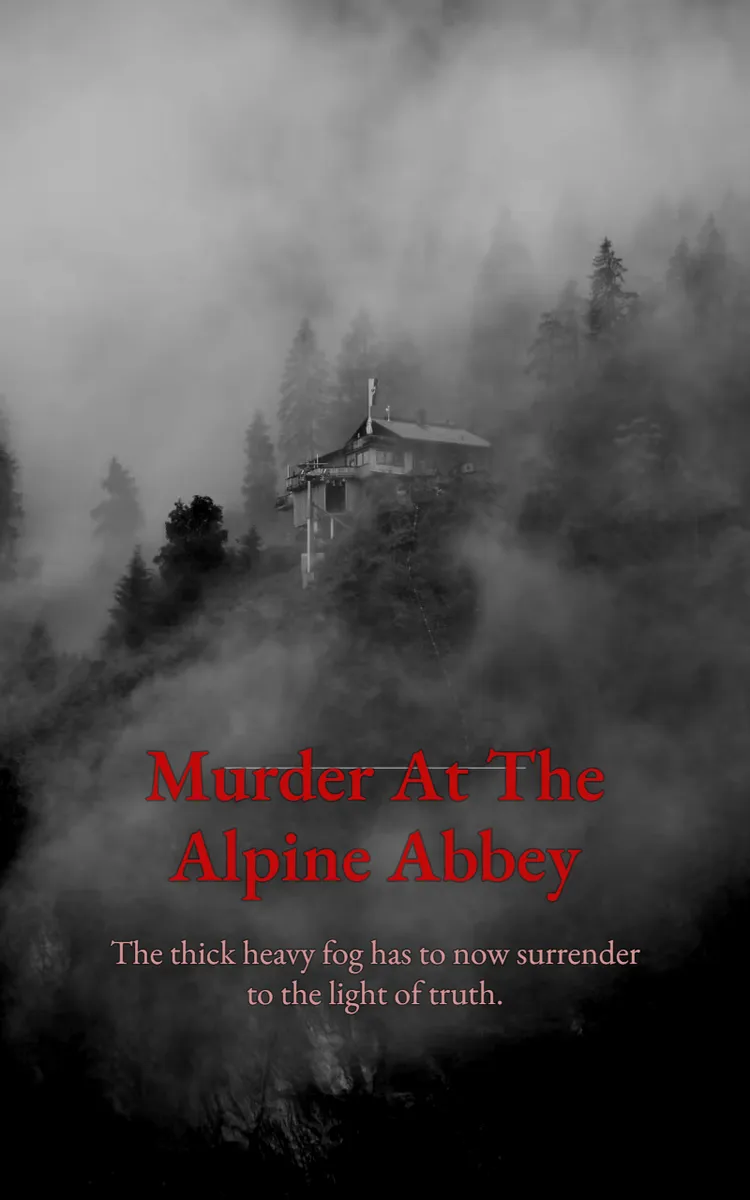
"Murder At The Alpine Abbey" is a fiction book by Anonymous with 5 chapters and approximately 10,561 words. A fashion icon’s murder in a snowbound Alpine hotel.
This book was created using Inkfluence AI, an AI-powered book generation platform that helps authors write, design, and publish complete books. It was made with the AI Novel Writer.
Frequently Asked Questions
What is "Murder At The Alpine Abbey" about?
A fashion icon’s murder in a snowbound Alpine hotel
How many chapters are in "Murder At The Alpine Abbey"?
The book contains 5 chapters and approximately 10,561 words. Topics covered include The Abbey Seals Its Guests, The Librarian's Hidden Ledger, The Ledger's Missing Name, The Bell Tower Confession, and more.
Who wrote "Murder At The Alpine Abbey"?
This book was written by Anonymous and created using Inkfluence AI, an AI book generation platform that helps authors write, design, and publish books.
How can I create a similar fiction book?
You can create your own fiction book using Inkfluence AI. Describe your idea, choose your style, and the AI writes the full book for you. It's free to start.
Write your own fiction book with AI
Describe your idea and Inkfluence writes the whole thing. Free to start.
Start writingCreated with Inkfluence AI


