
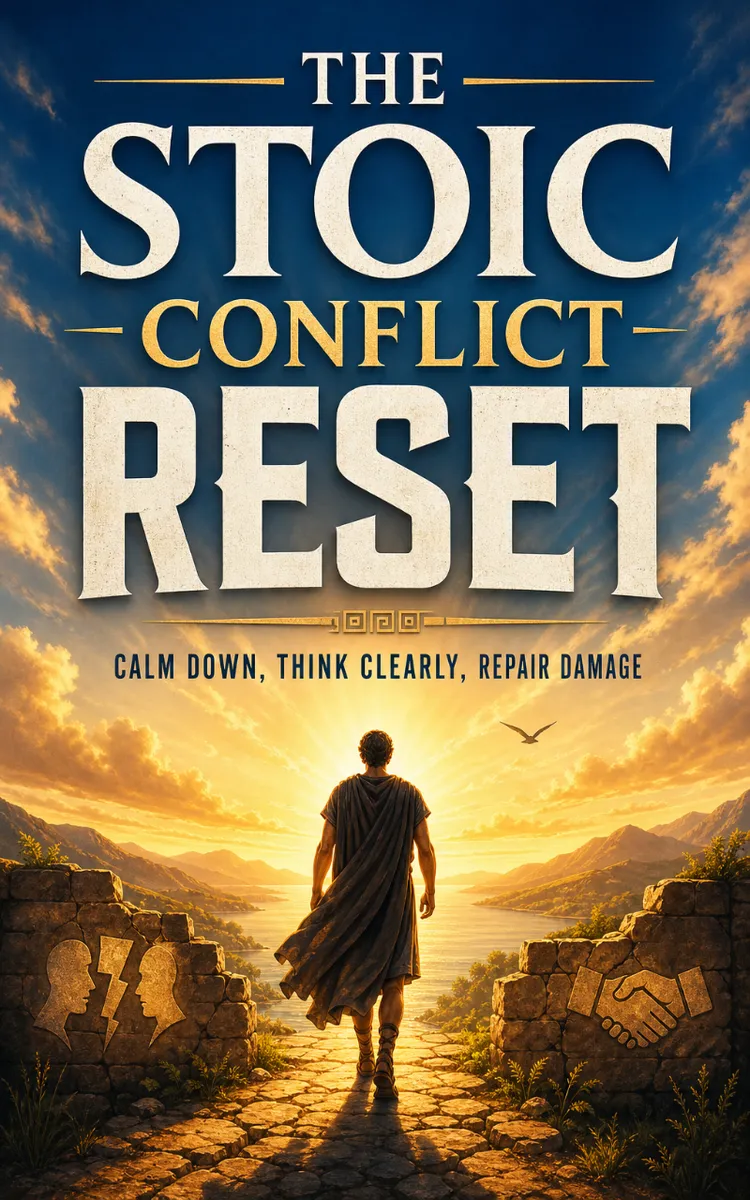
The Stoic Conflict Reset
Created with Inkfluence AI
Stoic-based methods to recover after anger and arguments
Table of Contents
- 1. Choosing the Reset, Not the Reply
- 2. Identifying Your Anger Triggers Early
- 3. Interrupting the Story Your Mind Tells
- 4. Using the Stoic Pause Breath
- 5. Separating Facts From Judgments
- 6. Applying the Dichotomy of Control
- 7. Choosing Virtue Over Winning
- 8. Repairing Your Body’s Signals Fast
- 9. Speaking in the ‘One Sentence’ Rule
- 10. Asking Better Questions After an Outburst
- 11. Practicing ‘I Statements’ Without Softening Truth
- 12. Setting a Temporary Time-Out That Works
- 13. Repairing the Relationship, Not Just the Moment
- 14. Apologizing With Specific Accountability
- 15. Rebuilding Trust Using Micro-Consistency
- 16. Handling Recurring Conflicts With Stoic Reframes
- 17. Turning Shame Into a Growth Signal
- 18. Preventing Future Spirals With Pre-Commitments
- 19. Practicing the Evening Review for Repair
- 20. Living the Conflict Reset as a Way
Preview: Choosing the Reset, Not the Reply
A short excerpt from “Choosing the Reset, Not the Reply”. The full book contains 20 chapters and 28,123 words.
Picture This
Have you ever felt it-the hot little spark behind your ribs-right as someone says the one thing that lands wrong? Maybe it’s your partner interrupting you. Maybe it’s a coworker blaming you for something that wasn’t yours. Maybe it’s a customer who’s angry and suddenly your name feels like the target.
Now picture Nina, 34, a customer support lead, staring at her screen while a customer types the same complaint for the third time. The words aren’t even new-just louder, sharper, and more personal. Nina’s fingers hover over the keyboard. She can already feel her reply forming: “That’s not what happened. Here’s the truth.” Her chest tightens, her jaw sets, and she tells herself, I’ll just correct them quickly so this doesn’t get worse. But the moment she hits send, she knows-deep down-that it will get worse.
**When anger starts rising, do you hit “reply”… or do you buy a few seconds for a reset?
The Mindset Shift
Old Belief: “If I don’t respond right away, I’m letting them win.”
New Reality: “If I respond while I’m angry, I’m almost guaranteed to lose the relationship.”
That shift matters because anger doesn’t just make you feel something. It changes how your mind works. While you’re heated, your brain treats everything like a threat. Tone becomes evidence. Past mistakes become proof. One sentence becomes a whole story. And when you reply from that state, you’re not just answering the moment-you’re adding fuel to the fire you’re trying to put out.
Here’s a concrete example from Nina’s world. The customer keeps repeating a claim that isn’t accurate. Nina’s first impulse is to defend herself and “set the record straight.” She writes a clear, firm message-but it includes phrases like “As I explained earlier…” and “That’s not correct.” The customer reads it as sarcasm and disrespect, even if Nina didn’t mean it that way. Within minutes, the customer escalates: more insults, more demands, more pressure. Nina looks at her inbox and thinks, I told the truth. Why are they still mad? The answer is: truth delivered through anger can still land as disrespect.
Now compare that with what happens when Nina uses the 3-Second Reset Switch (we’ll practice it right after the bigger idea clicks). Instead of trying to “be nicer” or “force calm,” she pauses long enough to stop the automatic chain. She doesn’t deny the problem. She doesn’t ignore the customer. She simply changes the state she’s responding from. She buys a tiny window where her mind can pick a better next move-one that addresses the issue without fighting the person.
The mindset shift isn’t about surrender. It’s about choosing influence over impact. You can be right and still make things worse. Or you can respond a little slower and make things better-even if the conversation isn’t perfect.
Going Deeper
The reason this works comes down to one simple truth: anger hijacks timing. When you’re activated, your brain tries to resolve the discomfort immediately-by defending, arguing, correcting, or punishing. That’s why the urge to reply feels urgent, like if you don’t act, something bad will happen. But what usually happens is the opposite: reacting quickly locks you into the kind of message that makes the other person defensive, too.
Stoics would say it like this: your job isn’t to control what happens around you. Your job is to control what happens inside you-especially the part that decides your next action. The conflict reset is that moment of choice. You pause not because you’re weak, but because you refuse to let your emotions drive the steering wheel.
When you’re angry, your mind starts running a predictable pattern. It’s not mysterious-it’s just automatic. The reset breaks the automatic loop before it turns into a full argument.
Signs this pattern is running your life:
1. You feel a “need to correct” that shows up instantly, even when the other person didn’t ask for correction-they’re asking for reassurance, respect, or space.
2. You reread your message after sending and think, Why did I sound like that? (That’s usually your state showing up in the words.)
3. The conversation keeps getting more intense, but you keep replying as if the last reply should have worked.
4. You start collecting “evidence” mid-argument-quotes, past actions, receipts-because you’re trying to win instead of repair.
En résumé: Anger isn’t just a feeling-it’s a timing problem that decides whether your reply heals or escalates.
The “3-Second Reset Switch” is built for this exact moment: the second anger rises and your brain tries to treat reaction as action. Those three seconds aren’t magic. They’re a deliberate interruption. You’re telling yourself, I’m not going to meet fire with fire. You’re stepping out of the script your body wrote for you.
And yes, it feels almost too small at first. That’s the point. Big changes often start as tiny breaks in the chain. Nina doesn’t need a new personality....
About this book
"The Stoic Conflict Reset" is a self-help book by Socratic Mastery with 20 chapters and approximately 28,123 words. Stoic-based methods to recover after anger and arguments.
This book was created using Inkfluence AI, an AI-powered book generation platform that helps authors write, design, and publish complete books. It was made with the AI Self-Help Book Writer.
Frequently Asked Questions
What is "The Stoic Conflict Reset" about?
Stoic-based methods to recover after anger and arguments
How many chapters are in "The Stoic Conflict Reset"?
The book contains 20 chapters and approximately 28,123 words. Topics covered include Choosing the Reset, Not the Reply, Identifying Your Anger Triggers Early, Interrupting the Story Your Mind Tells, Using the Stoic Pause Breath, and more.
Who wrote "The Stoic Conflict Reset"?
This book was written by Socratic Mastery and created using Inkfluence AI, an AI book generation platform that helps authors write, design, and publish books.
How can I create a similar self-help book?
You can create your own self-help book using Inkfluence AI. Describe your idea, choose your style, and the AI writes the full book for you. It's free to start.
Write your own self-help book with AI
Describe your idea and Inkfluence writes the whole thing. Free to start.
Start writingCreated with Inkfluence AI


