
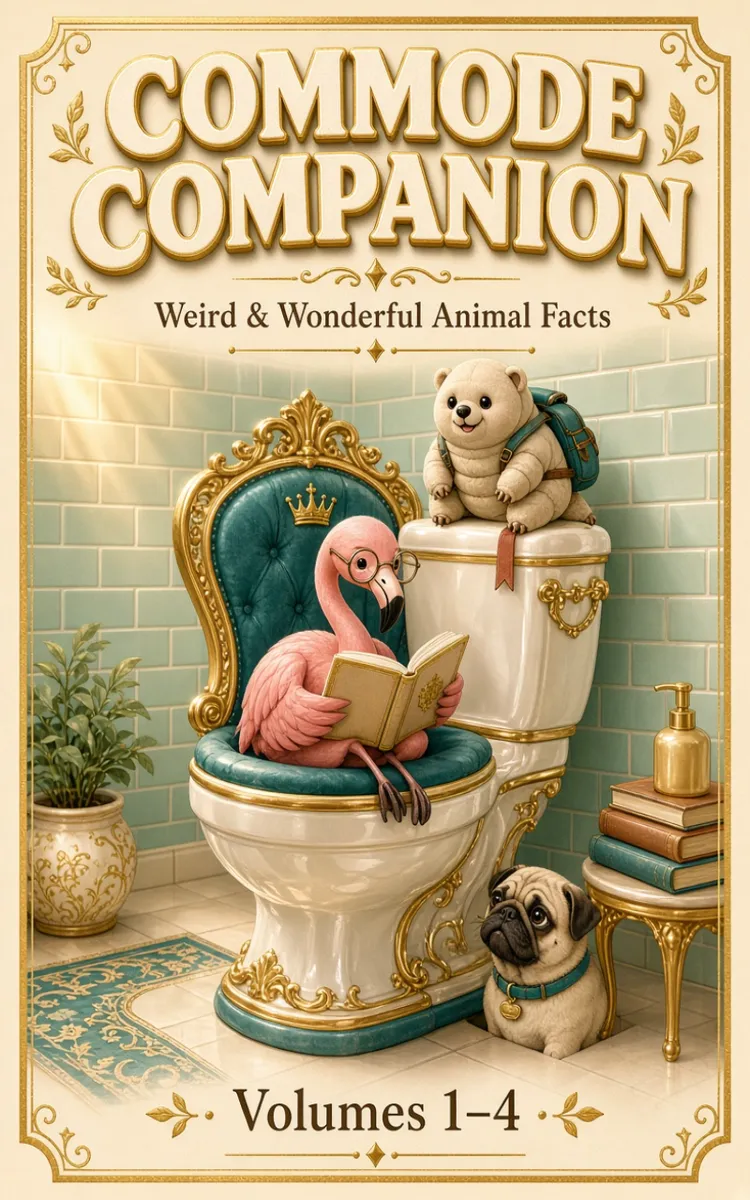

Read the first chapter
The whole of chapter one, free. About 2 min. Turn the pages with the arrows, your keyboard, or a swipe.
Chapter 1
Chapter 1
• The Facts
• A group of flamingos is called a flamboyance — and a flamingo can only eat with its head upside-down. The “only upside-down” part isn’t just a fun fact that’s slightly wrong. It's mostly true — for the way adults actually feed. A flamingo’s bill is built to work upside down. The lower mandible is the big, trough-shaped one; the upper mandible is the lid, and that upper one is the part that moves. When the bird drops its head into the shallows, the bill flips into the “right” working position and the tongue pumps water through comb-like plates called lamellae, four or five times a second. That is how they strain brine shrimp, algae, and the rest of the pink diet.
Two caveats so the fact stays honest:
• Chicks do not start that way. Parents feed them crop milk first.
• They can occasionally snatch a larger bit of food the ordinary way, but that is uncommon. Filter-feeding with the head inverted is the job the beak evolved for.
• Stephen Jay Gould’s line is still the neatest version: when a flamingo stands up, its smile looks upside down. When it eats, the smile is the right way up.
• Wombat poop comes out as cubes, so the cubes can be stacked without rolling away. Yes. Wombats are the only animals known to produce cube-shaped droppings. It is not a square anus. The cubes are formed in the last stretch of a very long intestine. Most of the way through, the contents are still soft. In the final section the gut wall is uneven: some bands are stiffer, some stretchier. Those regions contract at different speeds and press flat faces and corners into the dung as it dries. Wombat scat is also drier than most mammals, which helps the edges hold. Best guess for why: they pile the cubes on rocks and logs to mark territory. Flat sides do not roll off as easily as ordinary pellets would. They can produce 80 to 100 of the little bricks a night.
• Male seahorses get pregnant and give birth.
• An octopus has three hearts and blue blood. Two of those hearts stop when it swims.
• A shrimp’s heart is in its head.
• Butterflies taste with their feet.
• Cows have best friends and get stressed when separated.
End of chapter one. 1 more chapter and about 383 words in the full book.
Swipe or use the arrows to turn the page


What's inside: 2 chapters
- 1. Chapter 1
- 2. Chapter 2
About this book
"Commode Companion" is a general book by R. Murray Boyd with 2 chapters and approximately 383 words. It covers key insights and practical takeaways on the topic.
This book was created using Inkfluence AI, an AI-powered book generation platform that helps authors write, design, and publish complete books.
Frequently Asked Questions
What is "Commode Companion" about?
"Commode Companion" is a general book by R. Murray Boyd covering key insights and practical takeaways on the topic.
How many chapters are in "Commode Companion"?
The book contains 2 chapters and approximately 383 words. Topics covered include Chapter 1, Chapter 2.
Who wrote "Commode Companion"?
This book was written by R. Murray Boyd and created using Inkfluence AI, an AI book generation platform that helps authors write, design, and publish books.
Write your own book with AI
Describe your idea and Inkfluence writes the whole thing. Free to start.
Start writingCreated with Inkfluence AI


