
Read the first chapter
The whole of chapter one, free. About 9 min. Turn the pages with the arrows, your keyboard, or a swipe.
Chapter 1
The Boat Three Miles Inland
The rusted bell on the abandoned shore rang once, though Mara Venn could see no hand near it.
Its note traveled over the salt flats and thinned into the fog, leaving the old watchtower, the broken pilings, and the strip of black water behind her. Ahead, three miles inland, the boat waited where no boat had any right to be.
Mara tightened the scarf beneath her chin and checked the compass in her palm. The needle trembled toward the west, then swung hard north.
“Not today,” she murmured.
She had come for the boat before the fog arrived. That was the simple part. The fishermen at the village had argued over its distance, its name, and whether it had ever existed at all. One swore it sat beyond the old quarry. Another claimed he had seen its mast from the church roof. The oldest among them had only said, “If you hear water where there is none, turn back.”
Mara had brought a lantern, a coil of rope, and a field notebook sealed in oilskin. She had not brought anyone to tell her to turn back.
The first stretch of the flats looked firm. Gray salt crust spread between ribs of dried mud, shining faintly beneath the clouded afternoon. Her boots cracked through the surface with each step. Beneath it, something soft gave way.
She stopped.
A thin line of water had appeared across her path.
It was no wider than her hand, yet it moved with purpose, slipping from east to west over the salt. The water was clear enough to show the white ground beneath, but its surface carried a dark, oily gleam. Mara crouched and touched it with two fingers.
Cold shot through her glove.
She pulled back. The current continued, whispering over the flats.
There had been no rain. The tide had left this coast twenty-seven years ago, when the outer channel closed and the sea withdrew behind the reefs. Everyone in the village knew that. The salt flats had once been a shallow arm of the bay, but the bay was gone now, stranded beyond the dunes and miles from the boat.
Mara rose and looked toward the inland horizon.
The boat’s mast stood above the fog like a thin, crooked finger.
She walked on.
The flats shifted beneath her as though the ground were a loose sheet laid over water. Crust broke beneath her heels. Twice she had to jump narrow channels that widened after she crossed them. The cold current kept appearing, sometimes ahead, sometimes behind. It made no sound beyond a faint dragging hiss, but each time it surfaced, the fog thickened.
Mara glanced over her shoulder.
The abandoned shore had vanished.
Only the watchtower’s upper platform remained visible, floating in white distance. The bell rang again.
This time, something answered from inland.
A deep wooden knock. Then another.
The boat.
Mara quickened her pace. Her lantern struck against her hip, and the rope at her belt slapped her coat. The mast ahead grew taller. She could now see the curve of a hull, dark with age, resting on a rise of salt-crusted earth. Its keel pointed toward the vanished sea.
A channel opened in front of her.
Water surged through it, not from any slope or ditch but straight up through the salt. It spread around her boots in a widening sheet. Mara stepped back, but the ground behind her collapsed with a muffled crack.
She swung the rope free and drove the iron hook into a hard ridge beside her. The hook held. She crossed the channel with one hand on the rope, feeling the current pull at her ankles.
Something brushed her boot.
Mara looked down.
A strand of brown weed curled through the water, fresh and dripping. It twisted around the leather before breaking loose and sliding inland.
She reached the far side and hauled herself onto the ridge. Her breath came short. The water had already covered the place where she had stood.
A bell rang somewhere within the fog.
Not the watchtower this time.
The boat’s bell hung beneath its bow, green with corrosion. It swung without wind.
Mara approached slowly. The hull was larger than the rumors had suggested, perhaps thirty feet from prow to stern. Its paint had peeled into long gray strips, exposing black wood beneath. Barnacles crusted the lower boards, though no sea had touched them in decades. A name remained on the stern in faded white letters.
ROOK.
The cabin door stood open.
“Hello?” Mara called.
Her voice struck the hull and returned from the fog in a softer, delayed echo.
No answer.
She climbed the short ladder fixed to the side. The deck groaned under her weight. Salt had filled the seams between the planks, and pale grass grew from the mast step. A coil of rope lay beside the cabin, wet enough to drip.
Mara reached for the door.
A voice spoke behind her.
“Get off my deck.”
She turned so sharply that her lantern swung into the hull.
An old man stood at the stern with a shotgun lowered across his arms. He was tall despite his age, narrow as a mast, with a weathered face and white hair tied at the nape. His coat was patched with sailcloth. One boot rested on the rail as though he had been there for hours.
Mara raised both hands.
“I didn’t know anyone was aboard.”
“You knew enough to come.”
“I heard about the boat.”
“Everyone hears about the boat. Most have the sense to stay where the tide can find them.”
His eyes moved over her rope, lantern, and notebook.
“You’re Mara Venn,” he said.
The name tightened something in her chest. “How do you know that?”
“Your father had the same way of walking when he was lying.”
“My father is dead.”
“I know.”
The old man’s gaze returned to the flats. Water slid around the boat’s rise, rising steadily along the hull. It had reached the lower rung of the ladder.
Mara followed his stare. “What is that?”
He gave a humorless smile.
“You came three miles inland to ask me that?”
“Is it coming from the shore?”
“No.”
“Then where?”
The old man lifted the shotgun and rested its stock against the deck. “The tide.”
“There hasn’t been a tide here in twenty-seven years.”
“There hasn’t been a living one.”
The water touched the boat’s keel. A tremor ran through the hull. Somewhere below them, wood knocked against wood.
Mara stepped toward him. “You’re Elias Rook.”
“Was, once.”
“The boat is yours?”
“It was mine when the sea still had the decency to stay put.”
“You’re alive.”
His expression changed, just slightly. Surprise, perhaps, that the fact mattered.
“Disappointed?”
“I was told you disappeared.”
“I did. The tide took the harbor, and I went with it.”
“But you came back.”
“No.” Elias looked past her, toward the fog swallowing the flats. “The boat came back. I was aboard.”
A sudden rush struck the hull. Water spilled over the rise on both sides, darkening the salt. Mara heard a distant roar, like surf breaking beneath a floor.
The path behind her had vanished.
She moved to the stern and peered over the rail. The flats were no longer flat. Channels braided through them, filling and crossing one another in impossible directions. The fog had closed around the boat at a distance of twenty yards. Within it, pale shapes drifted just below the surface.
Elias seized her arm.
“Inside.”
“I need to get back.”
“You won’t.”
“I can follow the rope.”
“The rope is for keeping you from going under.”
Mara looked at his hand around her sleeve, then at his face. His fingers were cold and hard.
“What happens if I don’t?”
“You’ll hear the bells. Then you’ll walk toward them.”
The water surged again. This time it reached the deck ladder’s second rung.
Mara pulled free and grabbed her lantern. “You expect me to trust you?”
“No. I expect you to fear the water.”
A hollow knock sounded beneath the boat.
Then another.
The hull shifted. The deck tilted toward the inland slope, and Mara slammed against the cabin wall. Elias caught the mast with one hand and the rail with the other. The shotgun slid across the planks and dropped into the water.
Mara lunged for it, but Elias shouted, “Leave it!”
The weapon disappeared beneath the dark surface without a splash.
For a moment, the fog thinned. Mara saw the flats stretching far beyond the boat, each channel shining silver beneath the gray sky. Along the water moved a line of objects: lobster pots, broken oars, a child’s red shoe, all carried by the same current toward the hull.
The tide was bringing things in from somewhere.
Not the sea. Somewhere else.
Elias shoved open the cabin door. “Now.”
Mara hesitated only long enough to look at the rising water. It had reached the bottom of the hull’s painted name.
She climbed inside.
The cabin smelled of tar, wet timber, and something mineral, like stones pulled from deep water. Charts covered the walls, pinned beneath rusted nails. Most showed the old coast as it had been before the tide vanished. One chart was drawn over and over in black ink, the shoreline changing with every layer.
Elias entered behind her and barred the door.
The boat gave a long, low groan.
Mara set her lantern on the table. “If this is the ghost tide, tell me what it wants.”
Elias stood with his back against the door. Water streamed from the hem of his coat.
“It doesn’t want anything.”
“Then why is it here?”
“Because you brought it.”
She stared at him.
Outside, something scraped along the hull from bow to stern.
Elias lowered his voice. “You crossed the flats while the bell was ringing.”
“I heard two bells.”
“That’s worse.”
The scrape came again, higher this time, just beneath the window.
Mara turned toward the sound. A pale hand pressed against the glass from outside.
It was not a human hand. The fingers were too long, the skin translucent beneath a film of saltwater. It slid downward and vanished.
Mara stepped back.
Elias watched her, grim and exhausted. “Now you understand why I stayed aboard.”
“You’ve been living here?”
“Since the tide left.”
“Here? On land?”
“Land is what people call a place after the water abandons it.”
The boat lurched. Mara caught the table. Her notebook slid toward the edge, and she snatched it before it fell. Through the small stern window, she saw the water encircling the boat completely.
The salt flats had become a sea.
No shore remained. No path. No sign of the watchtower.
The ghost tide climbed the hull without waves, lifting itself in smooth, silent bands. It reached the cabin windows and stopped there, dark water pressed against the glass. Shapes moved within it - ropes, weeds, fragments of timber, and faces that vanished whenever Mara tried to focus on them.
Elias struck a match and lit a second lamp.
“Three miles,” Mara said. Her voice sounded thin in the cabin. “The boat is three miles inland.”
“Three miles from the shore it remembers.”
“And the tide?”
“It remembers too.”
A bell rang beneath them.
The sound passed through the floorboards and into Mara’s bones.
Elias opened a narrow locker and drew out a brass compass. Its needle spun once, then pointed straight down.
Mara looked from the compass to him. “What happens now?”
He closed his hand around it.
“Now,” Elias said, “it decides whether to take the boat back.”
The water rose over the windows.
Mara pressed her palm against the cold glass. Beyond it, the ghost tide moved in silence, surrounding the stranded boat and cutting her off from every direction she had known.
She had reached the boat.
The boat had not been waiting for her alone.
End of chapter one. 4 more chapters and about 10,369 words in the full book.
Swipe or use the arrows to turn the page
What's inside: 5 chapters
- 1. The Boat Three Miles Inland
- 2. Elias Rook’s Unsent Letter
- 3. The Path Beneath the Cliffs
- 4. The Bell’s Hidden Record
- 5. The Tide Returns Unbidden
About this book
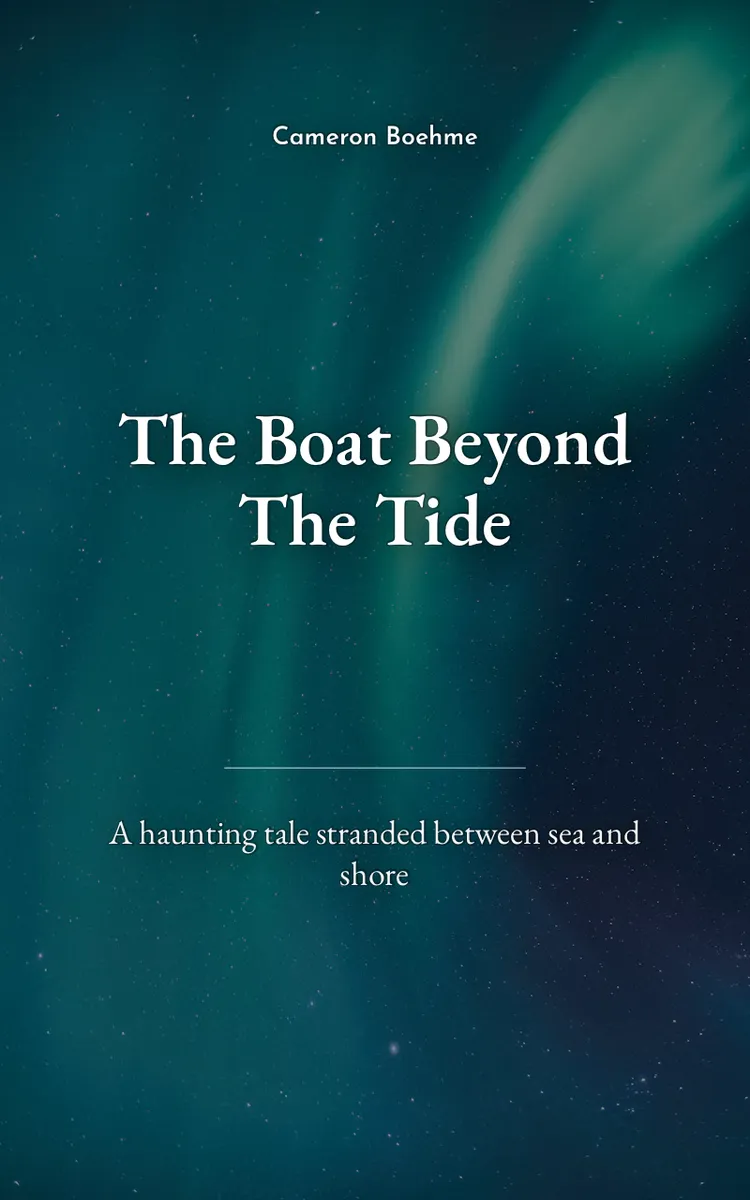
"The Boat Beyond The Tide" is a fiction book by Cameron Boehme with 5 chapters and approximately 10,369 words. A stranded boat, an elderly owner, and a mysterious ghost tide.
This book was created using Inkfluence AI, an AI-powered book generation platform that helps authors write, design, and publish complete books. It was made with the AI Novel Writer.
Frequently Asked Questions
What is "The Boat Beyond The Tide" about?
A stranded boat, an elderly owner, and a mysterious ghost tide
How many chapters are in "The Boat Beyond The Tide"?
The book contains 5 chapters and approximately 10,369 words. Topics covered include The Boat Three Miles Inland, Elias Rook’s Unsent Letter, The Path Beneath the Cliffs, The Bell’s Hidden Record, and more.
Who wrote "The Boat Beyond The Tide"?
This book was written by Cameron Boehme and created using Inkfluence AI, an AI book generation platform that helps authors write, design, and publish books.
How can I create a similar fiction book?
You can create your own fiction book using Inkfluence AI. Describe your idea, choose your style, and the AI writes the full book for you. It's free to start.
Write your own fiction book with AI
Describe your idea and Inkfluence writes the whole thing. Free to start.
Start writingCreated with Inkfluence AI


