

Read the first chapter
The whole of chapter one, free. About 9 min. Turn the pages with the arrows, your keyboard, or a swipe.
Chapter 1
Why Elements Behave Like Personalities
The Quiet Logic Behind Chemical Personality
In 1869, when Dmitri Mendeleev arranged the known elements into a table, several spaces remained empty. He did not treat those gaps as failures. He predicted that undiscovered elements would eventually occupy them, and later discoveries - including gallium and germanium - matched his forecasts closely.
The table’s deeper surprise is that it does not merely sort substances by name or weight. It reveals why oxygen pulls electrons toward itself, why sodium reacts violently with water, why gold remains unusually untroubled, and why carbon can become both diamond and the framework of living cells. The apparent “personality” of an element is not a mysterious preference. It is the visible result of invisible structure.
The Personality Map Method follows that structure from the nucleus outward: first the number of protons, then the arrangement of electrons, then the patterns that make atoms bond, separate, conduct, corrode, or endure.
If an element seems to want a particular role, what is the atom quietly counting?
The Table That Predicted Missing Neighbors
Before the periodic table became a familiar classroom chart, chemistry was crowded with isolated facts. Scientists knew that hydrogen burned, chlorine bleached, copper carried electricity, and mercury remained liquid at ordinary temperatures. But the elements did not yet form a convincing family tree.
Mendeleev’s achievement was to notice recurring behavior beneath changing atomic weights. When elements were arranged in a repeating pattern, chemically similar substances appeared at intervals. Lithium, sodium, and potassium, for example, all reacted readily and formed compounds with a single positive charge. Fluorine, chlorine, and bromine showed another family resemblance: each readily combined with other elements and tended to form a single negative charge.
The table’s empty spaces were especially revealing. Mendeleev predicted an element he called “eka-aluminium,” describing its expected properties before it was found. In 1875, French chemist Paul-Émile Lecoq de Boisbaudran discovered gallium. Its measured properties closely resembled the prediction, including its low melting point. The periodic table had become more than an inventory. It had become a device for recognizing behavior before every actor had appeared onstage.
The explanation arrived gradually. Atomic number, not atomic weight, determines an element’s identity. The nucleus of hydrogen contains one proton; helium contains two; carbon contains six. Add one proton, and the atom is no longer the same element. The periodic table is therefore organized around a simple count with enormous consequences.
That count controls the electrons surrounding the nucleus. Electrons occupy regions of space called orbitals, arranged into energy levels. The details can become technical, but the central idea is accessible: electrons are not scattered randomly. Their arrangement gives each element a characteristic outer surface, much as the shape and texture of a tool determine what it can grip.
For most chemical reactions, the outermost electrons matter most. They are the atoms’ public face. Inner electrons remain relatively close to the nucleus; outer electrons are more exposed to neighboring atoms and to the pull of electric fields. An element with one loosely held outer electron behaves differently from one that is nearly surrounded by a stable outer shell.
This is why the periodic table has a visual rhythm. Elements in the same column often share a chemical temperament because they possess similar outer-electron arrangements. The resemblance is not perfect - lithium is not simply sodium in miniature - but the pattern is strong enough to guide laboratories, industries, and discoveries.
Electrons and the Appearance of Desire
The language of desire is useful only if it is handled carefully. Atoms do not possess intentions. Sodium does not “want” water, and oxygen does not make decisions. Yet their structures create reliable tendencies that look remarkably like preference when observed at human scale.
Sodium has eleven protons and eleven electrons. One of those electrons sits in its outermost energy level, relatively far from the nucleus and shielded by inner electrons. Losing it leaves sodium with an electron arrangement resembling neon, a stable noble gas. Chlorine, with seventeen electrons, is one electron short of a similarly stable outer arrangement. When sodium and chlorine meet, sodium tends to give up an electron and chlorine tends to accept it. The result is sodium chloride, ordinary table salt.
Nothing in this exchange resembles a tiny mechanical hand passing a bead. It is an electrical rearrangement. Sodium becomes positively charged, chlorine negatively charged, and the opposite charges attract. In a salt crystal, this attraction extends through a repeating three-dimensional lattice. The familiar white grains on a kitchen table are therefore the visible outcome of atomic bookkeeping.
The same principle takes a different form in oxygen. An oxygen atom has six electrons in its outer energy level and commonly forms two bonds, sharing electrons with neighboring atoms. In water, one oxygen atom shares electrons with two hydrogen atoms. The sharing is uneven: oxygen pulls more strongly on the shared electrons, giving the molecule a slightly negative region near oxygen and slightly positive regions near hydrogen. That unevenness helps explain water’s unusual ability to dissolve salts, cling to surfaces, and support the chemistry of cells.
Carbon offers an even richer case. With four outer electrons, it can form four strong covalent bonds. Those bonds may connect carbon to hydrogen in methane, to oxygen in carbon dioxide, to other carbon atoms in diamond, or into long chains and rings in proteins, sugars, plastics, and DNA. Carbon’s “personality” is not one fixed behavior but a remarkable range made possible by its bonding capacity and the geometry of its orbitals.
A brief comparison captures the pattern. Sodium behaves like a person carrying a single loose key; chlorine behaves like a lock missing one key; carbon resembles a connector with four available sockets. The comparison is imperfect, but it points toward the structural truth: chemical roles emerge from how electrons can be arranged and shared.
When the Periodic Table Becomes a Map of Materials
The personality of an element becomes easier to recognize when atoms gather into materials. Copper’s electrons can move through its metallic structure, allowing electric current to travel with relatively little resistance. That is why copper wire appears in motors, household circuits, and telecommunications equipment. The same element also forms a green patina when exposed to air and moisture over time, as copper atoms at the surface participate in new compounds.
Iron has a different combination of traits. It conducts electricity and heat, forms strong alloys, and can lose electrons in the presence of oxygen and water. Rust is not simply “dirty iron”; it is a collection of iron oxides and hydroxides produced by a chain of electrochemical reactions. The familiar orange-brown surface records the movement of electrons and ions through a thin film of moisture.
Aluminum seems, at first, less durable than iron because it is relatively light and easily shaped. Yet aluminum quickly forms a thin oxide layer that protects the metal beneath it. This protective behavior helps explain why aluminum can serve in aircraft, cans, window frames, and countless other objects. The same tendency to react that would seem like a weakness becomes a form of armor.
Gold occupies another place on the map. Its electrons are held in a way that makes the metal comparatively resistant to oxidation and corrosion under ordinary conditions. Gold can be beaten into extremely thin sheets, drawn into wire, and used in reliable electrical contacts. Its appeal as jewelry is cultural, but its durability has a chemical basis.
One surprising fact is that the same atomic structure that makes an element chemically stable can also make it technologically useful. Noble gases such as neon and argon are famously reluctant to react, yet their low reactivity makes them valuable in lighting, welding environments, and specialized industrial processes. “Inactive” is not the same as “unimportant.”
These examples show why the periodic table is more than a chart of laboratory samples. It is a map of possible materials. Move across a row, and the gradual change in nuclear charge alters how strongly atoms hold their outer electrons. Move down a column, and larger electron clouds change the distance, shielding, and ease with which electrons can be removed or attracted.
Those shifts produce recurring patterns in reactivity, electronegativity, ionization energy, and atomic radius. The terms name measurable features, but the underlying story remains concrete: how tightly does an atom hold its electrons, how much space do those electrons occupy, and how will neighboring atoms respond?
The Surprise Hidden in Similarity
Here is the counterintuitive finding: chemical similarity does not always mean similar physical behavior. Sodium and potassium both belong to the same family and commonly lose one outer electron, yet potassium is more reactive because its outer electron is farther from the nucleus and easier to remove.
This matters because the periodic table’s families are not collections of identical twins. They are gradients. A shared outer-electron pattern establishes a broad role, while atomic size and nuclear attraction adjust the intensity of that role. The table predicts family resemblance, not identical performance.
The contrast appears clearly in the halogens. Fluorine and chlorine both readily gain one electron, but fluorine is smaller and pulls shared electrons more strongly. Down the group, larger atoms generally hold their outer electrons less tightly and show altered reactivity. The category remains recognizable while the behavior changes in degree.
A similar surprise appears among the noble gases. Helium, neon, and argon are all famously unreactive, but their physical uses differ because size, mass, and energy levels differ. Helium’s low density makes it useful for lifting and cooling; argon’s heavier, inert atmosphere helps protect hot metal during welding; neon’s response to electrical discharge produces its characteristic glow.
The periodic table therefore works like a musical scale. Notes in the same position across octaves share a relationship, but they do not sound identical. Atomic families repeat a structural pattern while the growing nucleus and electron cloud change the result. What looks like a fixed personality is better understood as a recognizable character with changing circumstances.
A Human Story Written in Atomic Patterns
The practical power of these patterns became visible in the work of Marie Curie, who studied the radioactive elements polonium and radium in Paris at the end of the nineteenth century. Radioactivity challenged the older picture of atoms as indivisible pieces of matter. Curie and her collaborators processed tons of pitchblende residue to isolate tiny amounts of radioactive material, working with substances whose behavior came from unstable nuclei rather than ordinary chemical reactions alone.
Radium’s chemistry resembled that of barium because both occupy the same group in the periodic table and commonly form compounds with a two-positive charge. Yet radium’s nucleus was unstable, releasing radiation as it changed into other elements. The comparison revealed an important boundary: an element’s chemical personality is largely governed by its electrons, while its radioactive identity depends on its nucleus.
That distinction connected the periodic table to a deeper account of matter. Two atoms may behave similarly in reactions while differing dramatically in nuclear stability. Radium and barium can form related compounds, but radium’s nucleus carries a hidden instability that changes its physical story. Chemical resemblance and nuclear difference can coexist in the same pair of elements.
Curie’s laboratory work made this abstract separation tangible. The pale compounds she studied were not merely new entries in a catalogue; they were evidence that atoms had internal parts and histories. The periodic table, once a pattern in chemical behavior, became a doorway into the structure of the nucleus and eventually into particle physics.
Human beings often assign character to things they cannot see. We speak of “noble” gases, “reactive” metals, and “inert” materials because these words compress repeated observations into memorable identities. Beneath the language, however, is a precise physical world in which charge, distance, energy, and probability shape every apparent preference.
An element’s personality is therefore not a soul hidden inside matter. It is a pattern produced by structure, repeated across laboratories, mines, kitchens, power stations, and living cells. The more closely we look, the less the elements resemble isolated characters - and the more they resemble members of a vast, rule-bound society whose behavior is still full of surprises.
End of chapter one. 39 more chapters in the full book.
Swipe or use the arrows to turn the page


What's inside: 40 chapters
- 1. Why Elements Behave Like Personalities
- 2. The Periodic Table’s Hidden Rules
- 3. Electrons: The Tiny Stagehands
- 4. Why Metals Shine and Conduct
- 5. The Element That Shouldn’t Exist
- 6. Isotopes: Same Atom, Different Fate
- 7. Radioactivity’s Quiet Accounting
- 8. The Secret Life of Noble Gases
- 9. How Bonding Turns Atoms into Matter
- 10. The Missing Middle: From Atoms to Quanta
- 11. Spectra: The Element’s Fingerprint
- 12. The Quantum Rule That Breaks Intuition
- 13. Entanglement: Spooky Math, Real Effects
- 14. Particle Theory’s First Big Leap
- 15. The Electron’s Reluctant Discovery
- 16. Protons, Neutrons, and the Nucleus
- 17. Quarks: The Smaller Secret
- 18. Gluons: The Glue You Can’t See
- 19. The Electromagnetic Force in Detail
- 20. Weak Force: The Strange Kind of Decay
- 21. Neutrinos: Ghosts That Still Matter
- 22. The Standard Model’s Unfinished Smile
- 23. Why Gravity Won’t Fit
- 24. The Planck Scale: Where Reality Frays
- 25. Strings: The Idea That Replaces Particles
- 26. Why Vibrations Create Different Forces
- 27. The Extra Dimensions Nobody Sees
- 28. Branes: Where Universes Can Live
- 29. T-Duality: The Trick That Swaps Sizes
- 30. S-Duality: When Strong Becomes Weak
- 31. The Hologram Universe Hypothesis
- 32. Particles as Excited Fields
- 33. Quantum Vacuum: Not Empty at All
- 34. Casimir Effect: Forces from Nothing
- 35. Cosmic Alchemy: Elements from Stars
- 36. Neutron Stars and the R-Process
- 37. The Periodic Table’s Future Versions
- 38. What String Theory Predicts Indirectly
- 39. The Lost Knowledge We Keep Rebuilding
- 40. The Universe’s Elemental Message
About this book
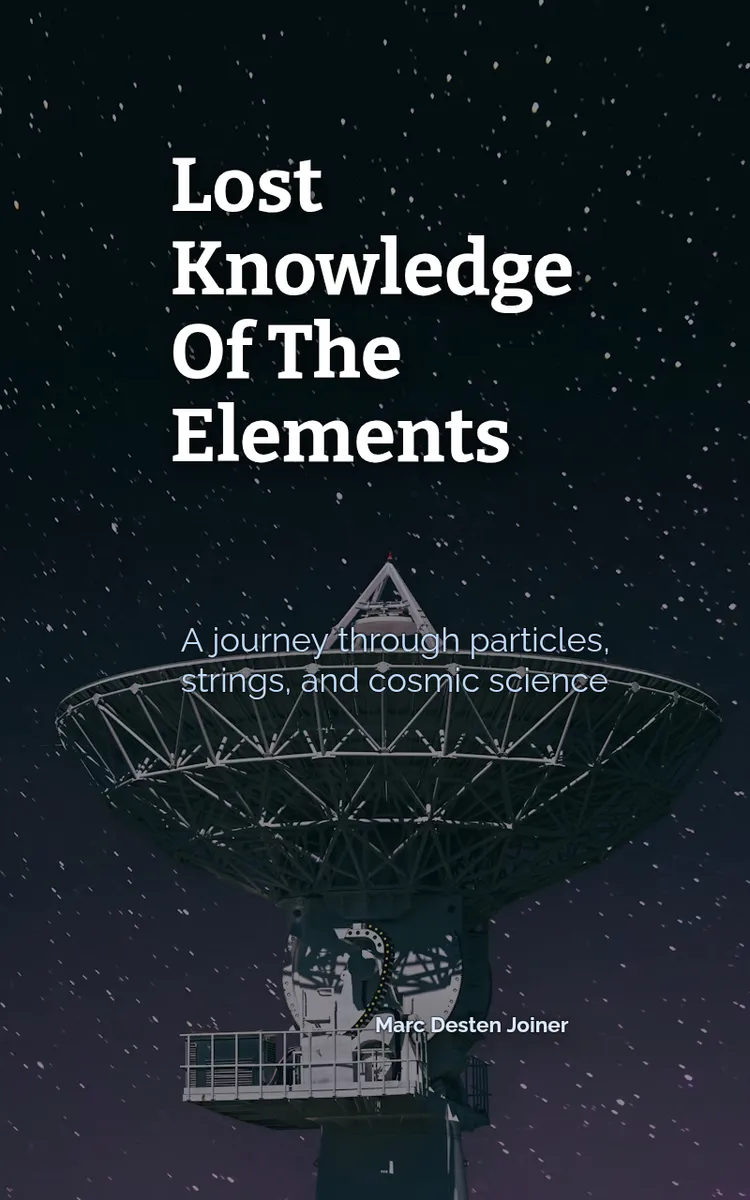
"Lost Knowledge Of The Elements" is a curiosity book by Marc Desten Joiner with 40 chapters and approximately 68,231 words. Exploration of periodic table, particle theory, string theory, and lost science.
This book was created using Inkfluence AI, an AI-powered book generation platform that helps authors write, design, and publish complete books.
Frequently Asked Questions
What is "Lost Knowledge Of The Elements" about?
Exploration of periodic table, particle theory, string theory, and lost science
How many chapters are in "Lost Knowledge Of The Elements"?
The book contains 40 chapters and approximately 68,231 words. Topics covered include Why Elements Behave Like Personalities, The Periodic Table’s Hidden Rules, Electrons: The Tiny Stagehands, Why Metals Shine and Conduct, and more.
Who wrote "Lost Knowledge Of The Elements"?
This book was written by Marc Desten Joiner and created using Inkfluence AI, an AI book generation platform that helps authors write, design, and publish books.
Write your own curiosity book with AI
Describe your idea and Inkfluence writes the whole thing. Free to start.
Start writingCreated with Inkfluence AI


