
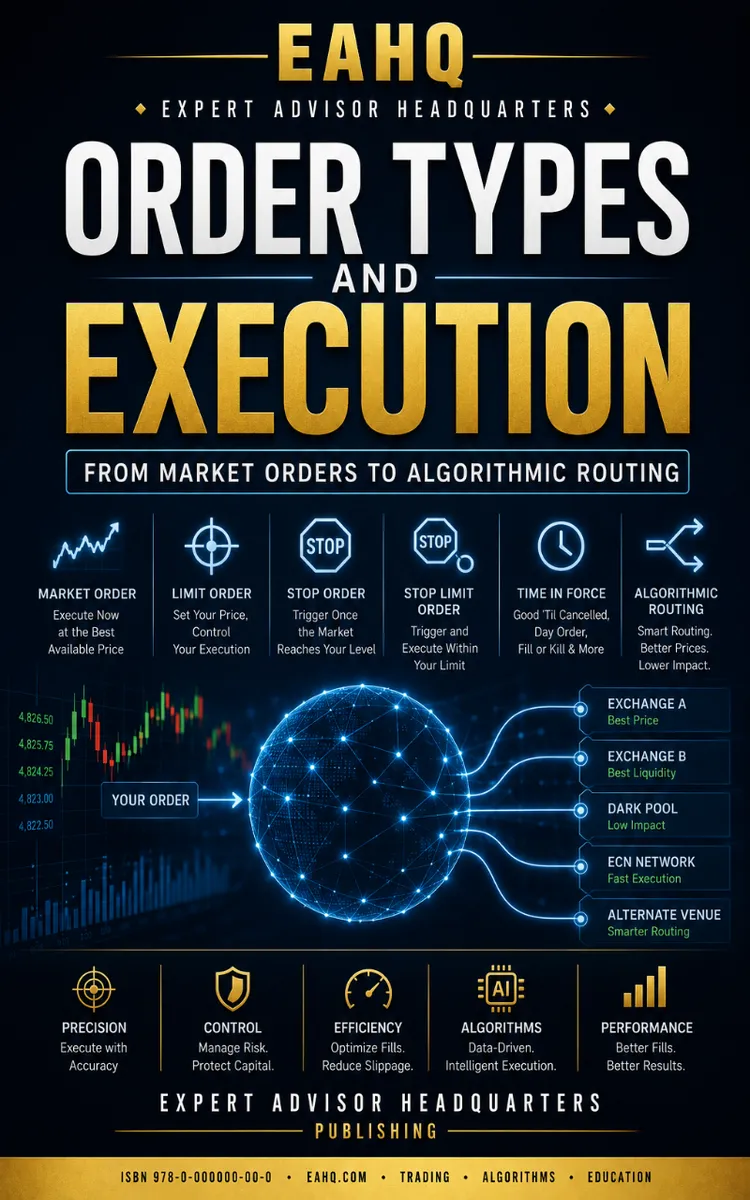

Read the first chapter
The whole of chapter one, free. About 8 min. Turn the pages with the arrows, your keyboard, or a swipe.
Chapter 1
Market Orders: When to Use
At 9:31 a.m., the opening auction hits, your screen flashes “marketable buy,” and you press send on a market order. The fill shows up - great. Then the realized price lands a few ticks worse than your mental model, and the intraday risk math you ran before the open stops matching reality. That gap is not “bad luck.” It comes from how market orders actually get executed: they don’t “buy at the last price,” they buy what’s available when your order reaches the market.
Nina, 34, a prop trader managing intraday risk, has learned to treat market orders like a tool with sharp edges. She doesn’t avoid them - she uses them on purpose, when the fill probability runs high and the slippage traps run low. After this chapter, you will be able to predict what drives a market order fill, estimate when slippage will expand, and pick concrete guardrails so your execution matches your risk plan.
Why This Matters: How market orders fill, and where slippage hides
A market order sends urgency, but it does not send certainty. Your broker routes it to the exchange venue (or venues) allowed by your routing setup, and the matching engine fills it against the standing liquidity it finds at the moment of execution. If that liquidity sits tight around your intended price, you get clean fills. If liquidity thins, spreads widen, or your order arrives after price moves, your fill price slides.
So what exactly drives the fill you see? Three forces dominate in practice:
1) Liquidity and spread at the moment your order hits the book. A market order consumes whatever resting orders match its size, starting at the best available prices and walking the book until the order quantity completes.
2) Queueing and timing. Even if you click “market” at the same time as everyone else, your order can arrive slightly later due to network latency, broker handling, exchange processing, and venue selection. Late arrival matters most during fast markets like the open, news, or stop-trigger cascades.
3) Order size versus available depth. A small market order might clear at top-of-book prices. A larger one can sweep multiple price levels, turning spread changes into meaningful slippage.
The problem this chapter solves is simple: traders often treat slippage as a random nuisance instead of a mechanical outcome. You will stop guessing and start managing market order behavior using a repeatable fill logic you can test on your own fills.
How It Works: The Fill-Probability Compass for market orders
Use the Fill-Probability Compass to decide whether a market order will likely fill close to your reference price, and to identify when it will likely “walk the book.” The compass has four directions, each tied to a concrete market observation you can check right before you send.
1) Point to the spread. Check the current bid-ask spread (the difference between the highest bid and the lowest ask). - If the spread is tight (for example, 1 tick on a liquid product), your market order has less distance to travel to find the first fills. - If the spread widens (say, 3-6 ticks), even a “quick” sweep can cost you immediately.
2) Point to depth at the top levels. Look at how much size sits near the best bid and best ask (top-of-book depth). - If there is enough depth to absorb your order size within the first few price levels, the market order usually finishes with limited walking. - If depth is thin, your order will keep consuming higher prices (for buys) or lower prices (for sells), and slippage grows fast.
3) Point to the speed of the tape. Watch how quickly prices and quotes change. Practically, you can use your chart’s intrabar movement and quote flicker: do prices jump multiple ticks within a second, or do they stay stable? - In fast quote environments, arrival timing matters. You can get filled after the market already moved, even if your order type stays “market.”
4) Point to execution venue behavior. Confirm where your order is allowed to route and how your broker handles market orders across venues (especially if you trade products with multiple venues). - If your routing expands to less-liquid venues during volatility, you might get fills at worse prices than you expected from the primary venue alone.
Concrete example with numbers: Nina trades a product where 1 tick equals $0.25. She plans to buy 2,000 shares as part of an intraday rebalancing. If the ask is $50.00 with a 1-tick spread and there’s meaningful ask depth at $50.00 and $50.25, her market buy likely clears near $50.00 - $50.25. If the spread widens to 5 ticks and the best ask depth can’t cover 2,000 shares, her order will sweep deeper levels - she might end up averaging closer to $51.25 or worse, depending on how the book stacks.
Now apply the compass as a rule set, not a vibe:
• If spread tight + top depth covers your size + tape calm, send market orders without overthinking. - If spread wide or top depth thin, reduce size, delay until the book stabilizes, or switch to an order type that lets you control price (you’ll cover those later). - If tape fast, treat market orders as “probabilistic,” not “guaranteed,” and tighten your risk limits around the expected fill range.
The key differentiator here is that you do not manage market orders by looking at the last trade alone. You manage them by reading the book conditions that determine how far your order must walk.
Putting It Into Practice: A tight, realistic workflow Nina can run
Nina receives a risk signal at 10:07 a.m. She needs to adjust her intraday exposure quickly: buy 2,500 shares of a liquid equity. Her reference price is the mid (average of best bid and ask), currently $50.00 (bid $49.75, ask $50.25). She also knows that this product often sees quote flicker around scheduled macro headlines.
She runs the Fill-Probability Compass in under 20 seconds, using the same checks every time:
1) Read spread and compute immediate cost. - Bid $49.75, ask $50.25: spread = $0.50 = 2 ticks. - Expected first-fill region starts at the ask ($50.25), so she mentally anchors slippage risk to “how many ticks she might walk.”
2) Check top-of-book depth against order size. - Best ask depth: 800 shares at $50.25. - Next ask level(s): she sees 1,000 shares at $50.50 and 900 shares at $50.75. - Her 2,500-share order would clear the first three levels (800 + 1,000 + 900 = 2,700 shares), meaning the order likely finishes around $50.75, not $51.50. She expects moderate walking.
3) Assess tape speed. - Quotes flicker between $50.25 and $50.50 within a second, and last trades bounce, but the mid does not trend hard. - She labels this “fast enough to matter,” but not “auction-like chaos.”
4) Confirm routing constraints. - Her broker routes market orders across allowed venues. She checks that the routing is currently set to include only the venues she trusts for depth (this is a practical setup check, not a theory). If she’s been experimenting with broader routing, she reverts to her standard execution profile before sending.
5) Send the order with a pre-committed slippage guardrail. - She calculates a rough fill range: if the order walks from $50.25 to $50.75 for most shares, the average might land around the mid of that path. - She sets a mental “stop-loss of execution” for herself: if her realized average price prints far outside that range, she cuts or hedges immediately rather than assuming the fill will “catch up.”
Expected outcome: if depth holds and the book doesn’t gap, she should fill largely between $50.25 and $50.75, with a realized average that matches that walk. If depth collapses or the ask jumps higher while her order is in the routing/queue, her realized average will show it immediately.
Quick checklist Nina runs before she hits market: - Check bid-ask spread and translate it into ticks. - Confirm top-of-book depth covers your order size within a few levels. - Watch quote flicker and whether the mid trends. - Verify routing venue scope matches your typical depth sources. - Pre-commit an acceptable realized average range and a next action if you miss it.
What to Watch For: Mistakes that expand slippage (and how to fix them)
Mistalled reference price (anchor on the last trade) Last trade can sit above or below the best bid/ask during quote gaps, and it can lag the current book. If you anchor your “expected fill” to the last trade, you underestimate the distance a market order must travel to the ask (for buys) or bid (for sells). Fix: anchor to the current opposite-side best price (ask for buys, bid for sells) and then estimate walking based on how many levels your size will consume.
Sweeping too much size into thin depth A market order with a size that exceeds top-of-book depth forces your order to walk multiple price levels. Traders often discover this only after the fill prints, then they blame the market instead of the mechanics. Fix: compare your order size to visible depth at the best price and the next 1-2 levels. If the depth doesn’t cover your size, split the order or stage it so each sweep consumes fewer levels. If you must fill all at once, reduce your tolerance for timing risk and be ready to re-hedge if the realized average drifts.
Ignoring tape speed during “marketable” moments Even when your order would be marketable (it crosses the spread), fast quote churn can push your arrival into a worse book state. Your order can still fill “successfully” while the realized price deteriorates because the book changed between your decision and your matching. Fix: treat tape speed as a multiplier on your slippage tolerance. If quotes flicker and the mid trends, reduce your market order size or delay until the book stabilizes for a brief window. If you keep the market order, tighten your post-trade risk actions so you don’t let an execution miss linger.
The practical takeaway: market orders behave like a book-sweeping instrument. If you read spread, depth, tape speed, and routing behavior before you send, you turn slippage from a surprise into a measurable, manageable variable. That discipline also sets you up for the next step in execution design: choosing the right order type when conditions stop cooperating with a pure market sweep.
End of chapter one. 7 more chapters in the full book.
Swipe or use the arrows to turn the page


What's inside: 8 chapters
- 1. Market Orders: When to Use
- 2. Limit Orders: Price Control Tactics
- 3. Stop Orders and Trigger Mechanics
- 4. Stop-Limit Orders: Failure Modes
- 5. Iceberg Orders for Stealth Execution
- 6. TWAP vs VWAP: Choosing Schedules
- 7. Algorithmic Routing Across Venues
- 8. Execution Analytics: Measuring and Improving
About this book
"Order Types And Execution" is a finance book by Michael Burney with 8 chapters and approximately 15,323 words. Trading order types and execution methods.
This book was created using Inkfluence AI, an AI-powered book generation platform that helps authors write, design, and publish complete books. It was made with the AI Ebook Generator.
Frequently Asked Questions
What is "Order Types And Execution" about?
Trading order types and execution methods
How many chapters are in "Order Types And Execution"?
The book contains 8 chapters and approximately 15,323 words. Topics covered include Market Orders: When to Use, Limit Orders: Price Control Tactics, Stop Orders and Trigger Mechanics, Stop-Limit Orders: Failure Modes, and more.
Who wrote "Order Types And Execution"?
This book was written by Michael Burney and created using Inkfluence AI, an AI book generation platform that helps authors write, design, and publish books.
How can I create a similar finance book?
You can create your own finance book using Inkfluence AI. Describe your idea, choose your style, and the AI writes the full book for you. It's free to start.
Write your own finance book with AI
Describe your idea and Inkfluence writes the whole thing. Free to start.
Start writingCreated with Inkfluence AI


