
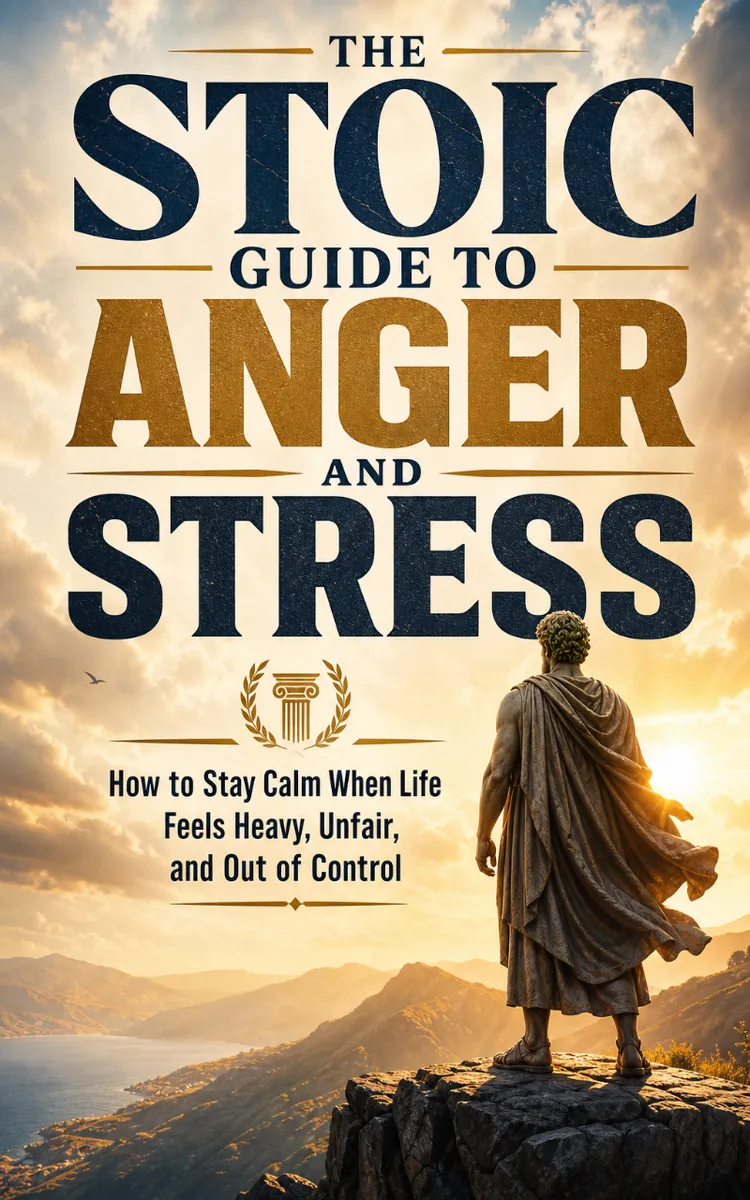
The Stoic Guide to Anger and Stress
Created with Inkfluence AI
Stoic-based strategies to manage anger and stress
Table of Contents
- 1. Anger as a Stoic Alarm System
- 2. The Control Map: What’s Yours
- 3. Rewriting the Story Behind Anger
- 4. The Stoic Pause Before You React
- 5. Your Values, Not Your Mood
- 6. Stop Catastrophizing With Best-Next Steps
- 7. Boundaries Without Emotional Debt
- 8. Communication That De-Escalates
- 9. The Virtue Lens for Hard Conversations
- 10. Temperance: Training Your Impulses
- 11. Stress-Proof Your Mornings
- 12. Evening Review: The Stoic Debrief
- 13. Rehearsing Difficult Moments in Advance
- 14. The Unfairness Practice: Justice Without Rage
- 15. Letting Go of Mind Reading
- 16. Handling Criticism Without Internal War
- 17. The Exhale Reset for Body Calm
- 18. Forgiveness as a Release of Control
- 19. Building Resilience With Negative Visualization
- 20. Living Calm on Purpose
Preview: Anger as a Stoic Alarm System
A short excerpt from “Anger as a Stoic Alarm System”. The full book contains 20 chapters and 29,184 words.
Picture This
Have you ever felt anger rise so fast it almost felt automatic-like your body hit the gas before your brain even got the steering wheel? Maybe it was a coworker cutting in line for the spare parts, or a customer snapping at you over something you didn’t even do. You feel heat in your chest, your jaw tightens, and suddenly you’re rehearsing what you’re going to say. Not because it helps… but because it feels like the only way to get control back.
Darius, 34, a warehouse supervisor, knows this loop well. A late delivery means everyone scrambles. One driver starts blaming him on the floor-loud enough that people turn their heads. Darius feels the burn of injustice and the urge to fire back immediately. The problem is, the moment he reacts, the team gets louder, the work slows down, and the whole day tilts further out of control. Anger feels like an alarm… but it also makes the situation worse. What if your anger isn’t the enemy-what if it’s your body’s alarm system, and you can learn to read it instead of obeying it?
The Mindset Shift
Old Belief: Anger means I’m right, and I should act on it immediately.
New Reality: Anger is information from my body-and the belief underneath it is asking for something I can respond to more wisely.
That shift sounds small, but it changes everything about what you do in the first minute. Most people treat anger like proof: “This feeling is telling me the truth, so I should respond like it’s a fact.” Stoic thinking flips the order. First you notice the feeling. Then you ask what it’s pointing to. Because anger almost always comes with a story-usually about fairness, disrespect, safety, or control. The feeling is real. The story is optional.
Here’s a concrete example from Darius. When the driver blames him, Darius’s body reacts: tight chest, hot face, quick temper. The “information” part is: something feels threatened. But the belief part might be: “I’m being disrespected in front of the team. If I don’t shut this down, I’ll lose respect and control.” If Darius reacts to the belief, he lashes out and the blame spreads. If he reads the alarm instead, he can respond with intent: “I hear you’re frustrated. Let’s sort out what happened with the delivery route, then we’ll decide next steps.” Same moment, different outcome.
The reason this matters-especially when you’re under chronic stress-is that your nervous system becomes quick to trigger. When you’re already running hot, anger can feel like it’s “justified,” but it’s often your body trying to restore safety. Stoics don’t ask you to kill anger. They ask you to stop treating it like a command.
Going Deeper
Anger as an alarm system works because your body speaks before your mind does. When something hits your sense of safety, fairness, or belonging, your system goes into “protective mode.” That mode can look like heat, urgency, and the urge to push. The feeling is not fake-it’s your body trying to help. The danger is when you treat the feeling as the final message instead of the first signal.
In Stoic terms, you can think of anger as:
- the body’s signal (what’s happening inside), and
- the mind’s interpretation (the belief that explains it).
That interpretation usually arrives fast and confident. It might say “This is unfair,” “This person is attacking me,” or “If I don’t respond, I’ll be trapped.” The alarm is real. The interpretation is where the trouble starts, because it turns a signal into a story you can’t stop repeating. And repeating it often leads to actions you regret-sometimes immediately, sometimes later when you replay the whole scene in your head.
Below are signs this pattern is running your life. If several of these feel familiar, your anger is probably doing more “steering” than “informing.”
1. You feel anger before you’ve checked facts.
The body reacts first, and the explanation comes after.
2. You replay the moment and try to “win” it.
Your brain keeps editing the conversation, as if a better comeback would restore control.
3. You treat disrespect as danger.
A tone, a look, or a public comment feels like a threat to your standing, not just a rude moment.
4. You notice anger makes your world smaller.
You stop seeing options. It becomes “respond or lose.”
En résumé: Anger warns you that something feels unsafe or unfair-your next job is to figure out which belief is driving the alarm, not to obey it.
Here’s the key Stoic move: don’t argue with the feeling. Read it. Then slow down just long enough to ask, “What belief is making this feel like an emergency?” That tiny pause is where your freedom shows up.
Darius had a turning point when he stopped trying to “be calm” and started trying to “be accurate.” Accurate means he becomes honest about what his body is signaling. Accurate means he identifies the belief driving the heat. That’s how the same workplace conflict stops turning into a full-blown day-ruiner.
...
About this book
"The Stoic Guide to Anger and Stress" is a self-help book by Socratic Mastery with 20 chapters and approximately 29,184 words. Stoic-based strategies to manage anger and stress.
This book was created using Inkfluence AI, an AI-powered book generation platform that helps authors write, design, and publish complete books. It was made with the AI Self-Help Book Writer.
Frequently Asked Questions
What is "The Stoic Guide to Anger and Stress" about?
Stoic-based strategies to manage anger and stress
How many chapters are in "The Stoic Guide to Anger and Stress"?
The book contains 20 chapters and approximately 29,184 words. Topics covered include Anger as a Stoic Alarm System, The Control Map: What’s Yours, Rewriting the Story Behind Anger, The Stoic Pause Before You React, and more.
Who wrote "The Stoic Guide to Anger and Stress"?
This book was written by Socratic Mastery and created using Inkfluence AI, an AI book generation platform that helps authors write, design, and publish books.
How can I create a similar self-help book?
You can create your own self-help book using Inkfluence AI. Describe your idea, choose your style, and the AI writes the full book for you. It's free to start.
Write your own self-help book with AI
Describe your idea and Inkfluence writes the whole thing. Free to start.
Start writingCreated with Inkfluence AI


