
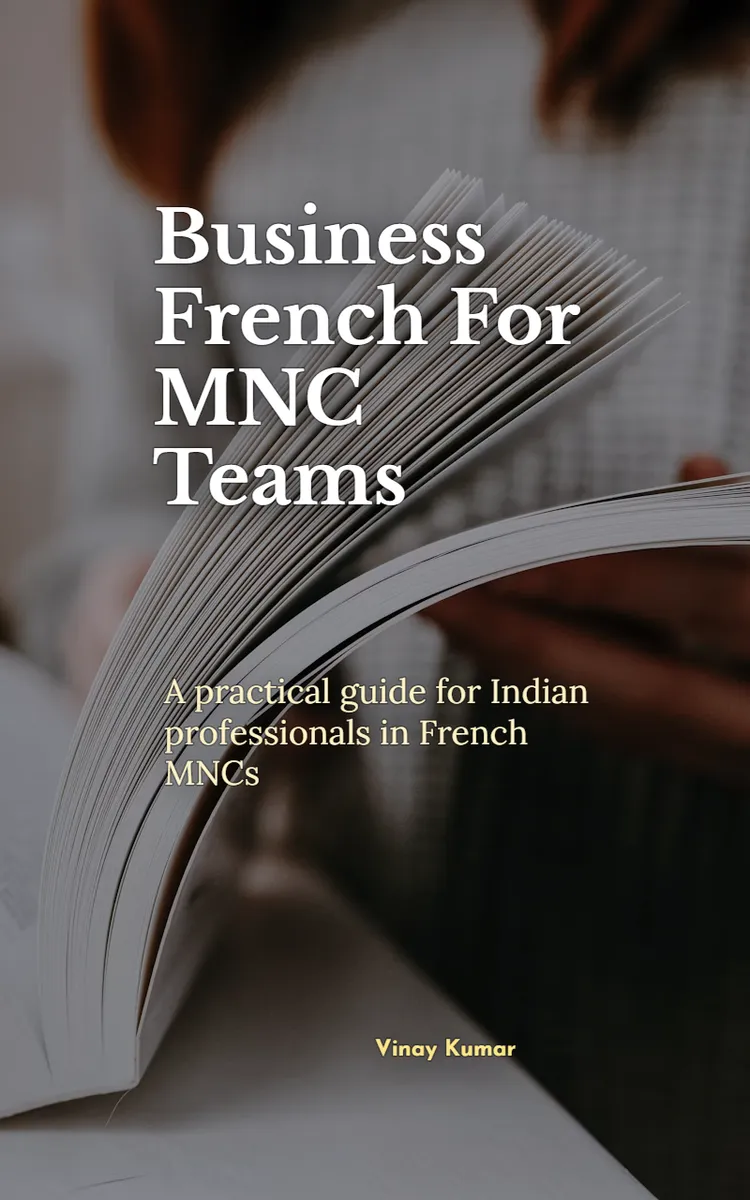
Read the first chapter
The whole of chapter one, free. About 9 min. Turn the pages with the arrows, your keyboard, or a swipe.
Chapter 1
French Pronunciation for Meetings
Clear Pronunciation for the First Thirty Seconds of a Meeting
A meeting can change direction when one French sound is unclear. “Je propose” (I suggest) may be heard as “je pose” (I put), and a carefully prepared update can lose force if the final consonants disappear or the sentence stress falls in the wrong place. Clear pronunciation does not require a perfect Parisian accent. It requires colleagues to recognise the key words quickly, especially during a video call with several accents and uneven audio.
For Indian professionals working in French multinational companies, the most useful skills are controlled stress, reliable vowel sounds, and careful linking between words. These skills support familiar meeting actions: opening a discussion, giving an update, asking for clarification, disagreeing politely, and closing with an action. They build on earlier work with business vocabulary and sentence patterns by making those patterns easier to understand when spoken.
Learning Objectives
• Place natural stress in common French meeting phrases.
• Use liaison (linking a final consonant to the next word) when it helps speech sound clear and natural.
• Deliver short workplace phrases with accurate rhythm and understandable vowels.
A practical target is simple: after listening once, a colleague should know whether you are reporting progress, raising a risk, or asking for a decision. Keep that target in mind as you practise.
Stress, Liaison, and the Sounds That Carry Meaning
French stress - the slight extra length and energy placed near the end of a spoken group. French does not usually stress one fixed syllable in every word, as English often does. Instead, stress normally falls on the final pronounced syllable of a meaningful phrase.
Compare the rhythm of these phrases:
• Nous avons terminé le projet.
“We have finished the project.” The strongest point is usually near projet.
• Nous avons terminé le projet vendredi.
“We finished the project on Friday.” The phrase now moves towards vendredi.
The final word is not shouted. It is simply a little clearer or longer. Trainers can model this by tapping once at the end of each phrase rather than hitting every important English-style word. Ask learners to avoid giving equal force to every syllable. French speech often sounds smoother when small words are lighter.
Phrase group - a short unit of meaning spoken together without an unnecessary pause. In a meeting, useful phrase groups include:
• Je voudrais ajouter un point.
“I would like to add a point.”
• Sur ce sujet, nous avons deux options.
“On this topic, we have two options.”
• Il faut valider le budget aujourd’hui.
“The budget needs to be approved today.”
A pause after je voudrais can make the sentence sound unfinished. A pause after point is more natural because the idea is complete. Mark phrase groups in training materials with a slash:
Je voudrais ajouter un point / sur le calendrier.
Liaison - pronouncing a normally silent final consonant at the beginning of the next word when the next word starts with a vowel sound. The consonant joins the next word, not the word before it.
In these common phrases, the final letter becomes audible:
• nous avons → approximately “noo-zah-von”
• vous avez → approximately “voo-zah-vay”
• les objectifs → approximately “lay-zob-zhek-teef”
• un grand accord → approximately “uhn grahn-tah-kor”
The written final consonant is not always pronounced. For example, the final s in vous is normally silent when the word stands alone, but it can produce a “z” sound before a vowel sound in vous avez. The spelling remains unchanged.
Some liaisons are common and useful in professional speech. Others are optional or belong to formal reading. Learners should first master frequent expressions rather than try to apply liaison everywhere. Common meeting examples include:
• les équipes (“the teams”)
• des informations (“some information”)
• nous allons commencer (“we are going to start”)
• ils ont confirmé (“they confirmed”)
Do not force liaison before every vowel. A forced liaison can sound unnatural and may distract listeners. In ordinary conversation, the most important goal is a smooth, recognisable phrase.
Silent final consonant - a consonant written at the end of a word but not normally spoken. In projet, the final t is silent; in important, the final t is also silent. In avec, the final c is pronounced. Learners who transfer spelling habits from English may pronounce too many final letters. This can make nous avons parlé du projet sound heavy and less natural.
French vowels also need attention because English and many Indian languages may encourage different mouth positions. The nasal vowels in important, temps, and un are especially important in workplace language. A nasal vowel allows air to pass through the nose while the vowel is spoken; the final n or m is not pronounced as a separate consonant. Thus, important is not “im-por-tant” with a clear final t. It is closer to “ehm-por-tahn,” though learners should use an audio model rather than rely on English spelling.
The French u in tu (“you”) and budget is another useful distinction. Round the lips as if saying “oo,” but keep the tongue position closer to the vowel in “ee.” Begin with tu and tout (“everything”) as a contrast. They should not sound identical. In a meeting, this difference can help separate tu peux (“you can”) from tout peut (“everything can”), even though context usually helps.
English rhythm can also create problems. English often reduces small words strongly, while French keeps many short words audible. In Je vais partager l’écran (“I am going to share the screen”), keep je vais connected and clear. Do not stress only partager as if it were an English presentation. A useful practice line is:
Je vais partager l’écran / puis répondre aux questions.
Say it first slowly, then at normal meeting speed. The key is not speed; it is keeping the phrase groups and final stress.
When a phrase is important, clarity comes from three choices: keep the vowels stable, connect words where liaison is natural, and place the strongest energy near the end of the phrase group. Ask yourself: “Could a colleague identify the action and the deadline after one hearing?” If not, slow down slightly and shorten the phrase.
Worked Example: Delivering a Project Update
Consider this update for a weekly MNC meeting:
Bonjour à tous. Nous avons terminé l’analyse des données, mais il reste deux points à valider. Je propose une décision vendredi.
The intended meaning is: “Hello everyone. We have completed the data analysis, but two points remain to be approved. I suggest a decision on Friday.” The purpose is not to sound theatrical. It is to make the status, issue, and proposed date easy to catch.
• Divide the message into phrase groups.
Mark the natural pauses:
Bonjour à tous / nous avons terminé l’analyse des données / mais il reste deux points à valider / je propose une décision vendredi.
There are four useful units. The speaker should not pause after every word.
• Identify the meeting actions.
The first group opens the meeting. The second reports completion. The third introduces an unfinished item. The fourth gives a proposal. This helps determine which words need careful pronunciation.
• Prepare the liaison points.
In à tous, the final s in tous is not normally pronounced here because the phrase ends. In nous avons, the s links as a “z” sound: approximately “noo-zah-von.” In deux points, the final x in deux is not pronounced before points. In points à valider, the final consonant of points does not create a separate spoken “s”; the phrase should remain smooth.
• Place the phrase stress.
Let the voice move towards tous, données, valider, and vendredi. Do not stress nous, avons, mais, or une equally. A trainer can underline the final focus words:
Bonjour à tous / nous avons terminé l’analyse des données / mais il reste deux points à valider / je propose une décision vendredi.
• Check difficult sounds.
In analyse, keep the final sound clear: “ah-nah-leez.” In données, the final vowel is pronounced; do not add an English “z” at the end. In valider, the final r is French and should not become a strong English “r.” In vendredi, keep all three main parts audible: “vahn-druh-dee,” without turning it into a single blurred syllable.
• Deliver the message at two speeds.
First, speak at about 70% of normal meeting speed, with a short pause at each slash. Then repeat at normal speed. If the liaison in nous avons disappears, that is acceptable as long as the words remain distinct; if the phrase becomes rushed, slow down again.
• Add a comprehension check.
Ask a partner to write three items after one listening: completed task, remaining issue, and proposed date. The expected notes are “data analysis completed,” “two points to validate,” and “decision Friday.” If one item is missing, adjust the relevant phrase rather than repeating the whole message faster.
Final result: deliver the update in four phrase groups, with clear final stress on “tous,” “données,” “valider,” and “vendredi,” and with natural liaison in “nous avons.”
This method works for other meeting phrases. For example, Pouvez-vous répéter la dernière partie? (“Could you repeat the last part?”) should sound like one polite request, not five separate words. Keep pouvez-vous connected, place the main focus near partie, and use a rising tone only if the request is genuinely unfinished.
A short recording on a phone is a useful named tool for this work. Record one version, listen for final consonants and pauses, then record a second version. The improvement should be judged by intelligibility, not by whether the voice resembles a native speaker.
Guided Practice for Meeting Situations
• Mark the phrase groups and focus words:
Nous allons commencer par le budget puis parler du calendrier.
Hint: Find the two actions and place a pause between them. The strongest words will usually be near budget and calendrier.
• Practise the liaison:
Vous avez une question sur les objectifs?
Hint: Link vous avez and les objectifs naturally. Do not pronounce every written final consonant.
• Choose the clearer delivery:
A: Je / voudrais / ajouter / un / point / important.
B: Je voudrais ajouter un point important.
Hint: Which version keeps the meaning together while still allowing one natural pause?
• Correct the meeting update:
A learner says Nous avons terminé le projet with equal stress on every word and a strongly pronounced final t in projet. What should change?
Hint: Keep the final t silent and let the phrase move towards projet.
• Prepare a two-sentence risk statement:
Use Il reste un risque (“There is one risk remaining”) and Nous proposons une solution lundi (“We propose a solution on Monday”).
Hint: Divide the message into two phrase groups and make risque and lundi easy to hear.
Answer Key
• A natural division is Nous allons commencer par le budget / puis parler du calendrier, with focus near budget and calendrier.
• Use liaison in vous avez and les objectifs: approximately “voo-zah-vay” and “lay-zob-zhek-teef.”
• B is clearer because the phrase remains connected; one pause may follow important.
• Remove equal word stress, keep the final t silent, and let the voice settle on projet.
• Say Il reste un risque / nous proposons une solution lundi, with final focus on risque and lundi.
Clear pronunciation is a meeting skill built from small, repeatable choices: group the words, connect only where appropriate, and make the end of each idea easy to hear. When those choices become automatic, learners can concentrate less on individual sounds and more on the decision, update, or question they need to communicate.
End of chapter one. 4 more chapters in the full book.
Swipe or use the arrows to turn the page

What's inside: 5 chapters
- 1. French Pronunciation for Meetings
- 2. Polite Requests and Email Openers
- 3. Present Tense for Daily Status Updates
- 4. Past Tense for Incident and Timeline Reports
- 5. Negotiating Deadlines and Trade-offs
About this book
"Business French For MNC Teams" is a education book by Vinay Kumar with 5 chapters and approximately 9,748 words. Learning Business French for working professionals in French MNCs.
This book was created using Inkfluence AI, an AI-powered book generation platform that helps authors write, design, and publish complete books. It was made with the AI Lesson Plan Generator.
Frequently Asked Questions
What is "Business French For MNC Teams" about?
Learning Business French for working professionals in French MNCs
How many chapters are in "Business French For MNC Teams"?
The book contains 5 chapters and approximately 9,748 words. Topics covered include French Pronunciation for Meetings, Polite Requests and Email Openers, Present Tense for Daily Status Updates, Past Tense for Incident and Timeline Reports, and more.
Who wrote "Business French For MNC Teams"?
This book was written by Vinay Kumar and created using Inkfluence AI, an AI book generation platform that helps authors write, design, and publish books.
How can I create a similar education book?
You can create your own education book using Inkfluence AI. Describe your idea, choose your style, and the AI writes the full book for you. It's free to start.
Write your own education book with AI
Describe your idea and Inkfluence writes the whole thing. Free to start.
Start writingCreated with Inkfluence AI


