

Read the first chapter
The whole of chapter one, free. About 9 min. Turn the pages with the arrows, your keyboard, or a swipe.
Chapter 1
Chapter 1
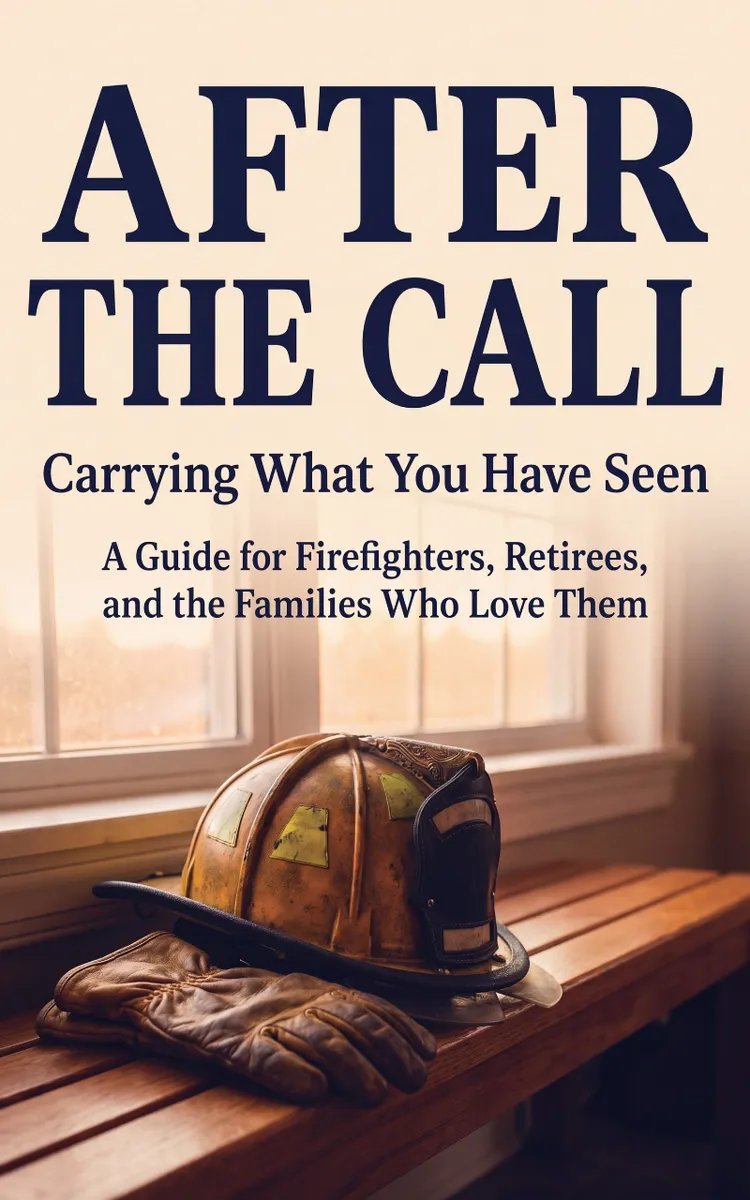
Carrying What You Have Seen A Guide for Firefighters, Retirees, and the Families Who Love Them
A Note Before We Begin
If you have spent any real time on the job, you already know the thing this book is about. You know it in a way that is hard to explain to people who have not stood where you have stood. It is the reason you sometimes go quiet in the truck on the way back to the station. It is the reason a certain smell can put you somewhere else entirely for a few seconds. It is the reason you are tired in a way that sleep does not fix.
You have carried things. Some of them you picked up on purpose, because that is the work. Others you never chose and never wanted, and you are still carrying them anyway.
This book is for you. It is also for the people who live with you, love you, and do not always understand what they are watching. It is for the newer members still building a career who want to be ready for what is coming. And it is for the chiefs, captains, lieutenants, and union officers who carry the responsibility of bringing a crew home in one piece and keeping the people under them well enough to keep doing the work.
You will not find a cure in these pages. You will not find a checklist that makes any of it disappear. What you will find is honesty, plain language, and a set of tools that have helped real people stay in this work, leave it well, and live a good life on the other side of it. Some of the tools come from research. Some come from people who have done the job for decades and learned them the hard way. All of them are meant to be used, not admired.
Read it in order or jump to what you need. A chapter at a time, or one page before a shift. There is no wrong way to use this book, and there is no finish line you are supposed to cross.
Who This Book Is For
The firefighter still on the line. You are somewhere in the middle of a career that has already shown you more than most people see in a lifetime. You may be fine. You may be fine except for a few things. You may be not fine at all and telling everyone you are. All three of those are welcome here.
The retired firefighter. You turned in your gear, and the calls did not turn in with it. Retirement is supposed to be a reward. For a lot of people it is also a strange and disorienting country, and this book spends real time on what comes after the bell.
The family member. You live with this work even though you never signed up for it. You are the spouse or partner who watches the quiet. You are the parent or the grown child who has noticed the change. You have seen someone you love come home different and not known how to say so. The chapters on family are for you, and so are the conversation prompts in the back.
The leader. A chief, a company officer, a peer support coordinator, a union officer. You want to protect your people and do it without pretending that everything is fine. The later chapters are written with you specifically in mind.
A Word About the Stories in This Book
The scenarios in these pages are realistic and drawn from patterns that are common across the fire service. They are composites: they combine details and experiences that show up again and again, and they are not portraits of any one identifiable person. Names, where they appear, are examples rather than real individuals.
The point of a scenario is not to entertain. It is to let you see a situation clearly enough to recognize it, in yourself or in someone else, without the noise that usually surrounds these conversations.
Nothing here is dramatized for effect. If something feels familiar, that is not an accident. That is the reason the book exists.
An Important Note About Care
This book is written to sit alongside professional care, not to replace it. It is not medical advice, and it cannot diagnose or treat anything. If you are struggling, the strongest thing you can do is talk to a qualified clinician or a trusted peer and let another person help you sort out what is going on.
If you are in crisis right now, please stop reading and reach out.
Call or text 988 to reach the Suicide and Crisis Lifeline in the United States. It operates 24 hours a day, every day.
Call 911 if you or someone else is in immediate danger.
Go to the nearest emergency department if you are not safe and cannot wait.
Outside the United States, contact your local emergency number or crisis line. In Canada, call or text 988. In the United Kingdom, call 116 123 for Samaritans. In Australia, call Lifeline on 13 11 14. Appendix C lists more, including support built specifically for firefighters in each of those countries.
You are not the first person to have your hand on this page at two in the morning. You will not be the last. There is a way through, and it usually begins with one sentence spoken to one person.
In Memory of My Father
My father and his crew, in front of the truck
He served eighteen years in the Fire Department of New York. He also volunteered as a firefighter on Long Island. He was a paramedic, and he trained other firefighters coming up in the job.
He is the man in the middle of this photograph.
He lived to ninety-one.
He was my hero. This book is for him, and for every family that has watched someone they love carry this work home.
Dedication
For the members of the Fire Department of New York who died on September 11, 2001, and for everyone who has carried that day since.
Acknowledgements
A book like this is never the work of one person, even when only one name goes on the cover.
To the officers and firefighters I served with on Long Island, and to the crews of Ladder One, the Underwater Rescue Team and the Rope Rescue Team: you taught me how to work, how to stay calm, and how to come home. Most of this book started in the kitchen after a call, when somebody finally said out loud what everyone else was carrying. Thank you for that honesty.
To my wife, who stood beside me through all of it. She learned the sound of the tones before I did, and she learned to read the difference between a man coming off a good shift and a man carrying a bad one. Nothing in this book would exist without her patience, and none of it would be honest without her.
To the rest of my family, who waited up more nights than any of you should have had to. You lived with the pager, the missed dinners, and the holidays that started late or ended early. You never made it a choice between you and the work.
To the clinicians, peer support coordinators, chaplains, and department leaders who do the quiet work of keeping people well. Your work is in every chapter, even where your names are not.
And to you, the reader: the firefighter still running calls, the retiree carrying it quietly, the spouse or parent or child reading this to understand someone you love. Thank you for picking it up. If one page in here helps, it was worth writing.
Where to Get Help Fast
If you are in danger right now, call 911.
If you are thinking about ending your life, call or text 988. Someone answers, twenty-four hours a day. You do not have to explain yourself first. You do not have to be sure. You can call because you cannot sleep, because you cannot stop seeing it, or because you do not know why you feel the way you do.
If you want to talk to someone tonight
• In immediate danger — 911.
• Thinking about suicide, or in crisis — Call or text 988. Chat at 988lifeline.org.
• Would rather type than talk — Text HOME to 741741. In Canada, text CONNECT to 686868. In the UK, text SHOUT to 85258.
• A firefighter, EMS provider, or a member of their family — 1-888-731-3473. The Fire/EMS Helpline, run by the National Volunteer Fire Council. Open around the clock, and built for families as much as for responders.
• Public safety personnel, active or retired — 1-206-459-3020. Safe Call Now. Staffed by people who have done the job.
• A veteran — Call 988, then press 1.
• An IAFF member looking for treatment — 1-855-900-8437. The IAFF Center of Excellence for Behavioral Health Treatment and Recovery.
• Your own department — Ask for your peer support team, your employee assistance program, or your chaplain. Many departments have all three. If you do not know who to ask, ask your union steward.
What happens when you call
Someone answers and asks what is going on. You do not need a speech ready. It is fine to say you do not know where to start.
These lines are confidential. They do not notify your department, your chief, or your family. The one limit is the same limit that applies to any emergency call: if someone is in immediate danger, they may send help. That is not a loophole. That is the point of the call.
If you are outside the United States
Call your local emergency number. Then ask your service, your union, or your doctor what support exists for responders where you are. Many countries run a peer support program or a crisis line specifically for emergency workers.
If you are a family member
You can call any number on this page for yourself. The Fire/EMS Helpline is for families as well as responders. So is Safe Call Now.
You are allowed to say out loud that you are frightened. You are allowed to say that you cannot keep going like this.
If you are a chief, an officer, or a union leader
Copy this page. Put it in the crew room, in the day room, on the back of the bathroom door. Not behind glass, and not in a binder nobody opens. Hand it to a new member on their first day. Then say out loud, in front of the crew, that using it counts for nothing against anyone.
One more thing
Calling is not the same as being broken. It is not a career decision. It is the same thing we ask of the public a hundred times a year: let someone help before it gets worse.
You have spent a long time being the one who shows up. This is what it looks like when someone shows up for you.
The Photographs
The company, and the truck
The work
Hook and Ladder No. 1, Wantagh Fire Department
The ladder truck and the flag
The underwater rescue team
End of chapter one. 23 more chapters and about 20,629 words in the full book.
Swipe or use the arrows to turn the page
What's inside: 24 chapters
- 1. Chapter 1
- 2. Introduction: The Weight of the Calls
- 3. Part One: What the Job Leaves Behind
- 4. Chapter One: The Cumulative Load
- 5. Chapter Two: The Call You Cannot Unsee
- 6. Chapter Three: Grief on the Run
- 7. Chapter Four: Moral Injury
- 8. Chapter Five: What the Shift Does to the Body
- 9. Chapter Six: Coming Home
- 10. Chapter Seven: For the Partners, Parents, and Kids
- 11. Chapter Eight: Who Am I Now
- 12. Chapter Nine: Why Asking Feels Like Failure
- 13. Part Three: What Helps
- 14. Chapter Ten: Getting Help — What It Actually Looks Like
- 15. Chapter Eleven: Tools That Work Every Day
- 16. Chapter Twelve: What Departments Can Build
- 17. Chapter Thirteen: Finding Meaning Again
- 18. The Good That Comes With the Hard
- 19. Appendix A: Reflection Exercises
- 20. Appendix B: Conversation Prompts for Families
- 21. Appendix C: Resources
- 22. A Closing Letter
- 23. About the Author
- 24. If You Need Help Right Now
About this book
"After the Call interior only" is a general book by Cuomo Press with 24 chapters and approximately 20,629 words. It covers key insights and practical takeaways on the topic.
This book was created using Inkfluence AI, an AI-powered book generation platform that helps authors write, design, and publish complete books.
Frequently Asked Questions
What is "After the Call interior only" about?
"After the Call interior only" is a general book by Cuomo Press covering key insights and practical takeaways on the topic.
How many chapters are in "After the Call interior only"?
The book contains 24 chapters and approximately 20,629 words. Topics covered include Chapter 1, Introduction: The Weight of the Calls, Part One: What the Job Leaves Behind, Chapter One: The Cumulative Load, and more.
Who wrote "After the Call interior only"?
This book was written by Cuomo Press and created using Inkfluence AI, an AI book generation platform that helps authors write, design, and publish books.
Write your own book with AI
Describe your idea and Inkfluence writes the whole thing. Free to start.
Start writingCreated with Inkfluence AI


