

Read the first chapter
The whole of chapter one, free. About 7 min. Turn the pages with the arrows, your keyboard, or a swipe.
Chapter 1
THE DIAGNOSIS WAS NEVER THE CURE
A meeting ends. Your inner narrator replays every line like a critic.
You left the room with the same tightness behind your sternum that’s been there for years. You told yourself you handled it fine, then rehearsed the perfect comeback all the way to your car: the calm correction, the crisp boundary, the question that would have shown you weren’t the problem. At home you write it in your journal, give it a name - “I freeze because of people-pleasing” - and feel that small glow of clarity. You read a short article on triggers, re-open a therapy note, and nod at your own insight. The next meeting arrives and you do the same careful, safe thing again.
You can sketch the pattern in forensic detail, list the childhood story that likely seeded it, and still act in the exact same way the next time. Naming the wound soothes you, but it doesn’t change how your body reacts, what you schedule, or who you let overbook your life. The diagnosis was never the cure. The real question is: will you use that diagnosis to force a tiny, visible change?
Is naming your wound just a comfortable habit that keeps you from actually changing?
Old Belief vs New Reality
Old Belief: If I understand the cause and can name the pattern, I’m making real progress.
New Reality: Naming the pattern is useful only when it produces one concrete behavior you can repeat and measure.
People love the moment of discovery. The label - “attachment style,” “reactive anger,” “chronic avoidance” - makes the chaos make sense. It’s sensible: understanding reduces shame and organizes the mess. But understanding without action becomes a ritual that feels like progress when it isn’t. The reframe matters because it hands you a simple test: did the insight make the next behavior easier, or did it give you a cathartic high that lets you avoid trying?
Here’s a concrete example: you realize you clam up in meetings because you fear being wrong. If you stop at that insight, you’ll feel smart and still say nothing next time. If you pick one micro-behavior - saying a single clarifying question, practicing it out loud once beforehand, and committing to it - you create immediate evidence that contradicts the old story (“I always freeze”). That one tiny action is how your nervous system learns a new rule: discomfort doesn’t equal catastrophe. That shift is small but it changes how you show up on purpose.
Why this shift matters - and how to see it in your life
When insight becomes consumption, two things happen. First, your brain rewards the safety of understanding. The “aha” moment gives you relief and reduces anxiety long enough to avoid trying anything risky. Second, you get a social payoff - being able to say, “I know why I do this” - which often substitutes for actual repair. That social proof is seductive; it signals growth while letting you dodge the messy work.
This isn’t about being lazy or dishonest. It’s a survival move. Your nervous system prefers predictability: reflection gives you a neat story that lowers immediate distress. The cost is delayed, often invisible: nothing actually changes, patterns are reinforced, and your language around the issue sharpens while your behavior stays the same size. The reframe matters because it moves the goalpost from “understand” to “produce evidence.”
Signs this pattern is running your life:
• You can name the trigger or pattern within minutes after an event, but you can’t show one recent situation where you acted differently because of that naming.
• You collect new frameworks, articles, or therapy phrases about the same problem, but your calendar and relationships look unchanged.
• You get a relief spike after journaling, then feel resigned when the old pattern reappears - like you took a vitamin that didn’t cure the illness.
• You use process-language (“I’m working on it”) as an ending line rather than listing a specific next step.
Short header summary: Insight without action is just performance.
You may hear this and worry it sounds harsh. It isn’t a moral judgment; it’s a practical one. The fix isn’t to stop learning - stop learning would be both unrealistic and unhelpful. The fix is to treat insight like a tool you must test. Pick one micro-action tied to the insight and do it. Practice it in tiny doses so your nervous system can build a new story about what happens when you move toward discomfort. Over time, those actions accumulate into new identity evidence: you’ll see the small wins add up, and that’s real change.
Questions that make insight do the heavy lifting
• When was the last time you labeled a pattern and then didn’t try a single new behavior within 24 hours?
• Honest guidance: Write the date and what you labeled. If your answer is recent, point to the barrier that stopped you - time, shame, fear of being wrong. Noting the obstacle is the start of removing it.
• What is one tiny, specific action - under five minutes - that would prove your insight is changing your behavior?
• Honest guidance: Keep it simple. “Raise my hand once in the next status meeting,” “text one boundary to a friend,” or “say, ‘I’ll think about that and reply tomorrow’ to one extra request.” Choose the thing that feels slightly impossible.
• What evidence would convince you you’ve actually changed this pattern in three months?
• Honest guidance: Don’t aim for a feeling. Pick observable measures: number of times you spoke up, number of no’s given, or the number of times you scheduled the thing you talk about. Aim for numbers you can point to.
• What story do you tell yourself after you name the problem that lets you avoid acting?
• Honest guidance: Common stories: “I needed to understand first,” “I’m not ready,” or “I’m processing.” Write the exact phrase you say. Naming that excuse helps you interrupt it.
• If a friend asked you to prove your insight was real, what three concrete examples would you show them from the last month?
• Honest guidance: If you can’t come up with three, that’s data - not shame. It means insight hasn’t been tested. Pick one action this week to create the first example.
Answering these honestly turns your inner narrative into a checklist you can work. That’s where momentum lives: visible evidence, however small, beats flattering self-analysis.
The 7-Day “Make Insight Earn Its Keep” Challenge
Challenge title: Make Insight Earn Its Keep - 7-Day Proof Challenge
Instructions:
• Day 0 (Prep): Choose one recurring pattern you can state in one sentence (example: “I immediately agree to extra work I don’t have time for”). Write it down and note one example from this week where it happened.
• Each morning for seven days, write the sentence again and pick one micro-action (under 5 minutes) that directly tests that pattern for that day.
• Do the micro-action the same day. Immediately after, write one sentence about what actually happened. If you didn’t do it, write why.
• On day 8, review your entries and pick the one action that surprised you most; repeat that action three times during the following week.
Expected difficulty: Medium - emotionally blunt but behaviorally specific.
You'll know it's working when...
• You complete at least four of the seven micro-actions, even though you still feel anxious.
• The “insight high” ends with “Action taken,” not just a warm feeling of understanding.
• You catch yourself mid-excuse (“I’m still processing”) and redirect to the micro-action.
Why this exact format? It forces you to turn interpretation into a test. If you say a thing out loud and then do one small, measurable behavior, you create data. Over seven days, that data shows patterns - where you over-index on avoidance or where a tiny tweak produces surprising results. Think of it like testing a hypothesis: the insight is your hypothesis; the micro-action is the experiment. You’re not trying to cure everything at once; you’re collecting evidence that will convince both your mind and your body.
Practical example to steal: If your pattern is people-pleasing, your micro-action could be sending one calendar block labeled “No interruptions” and using it when asked to do extra work. It takes 90 seconds to set and 2 minutes to use: the action is tiny, but it’s a real boundary. Repeat it three times and you’ll have proof you can protect your time.
One-line truth, takeaways, and the bridge forward
If your insight doesn’t push you to do one tiny, repeatable thing that you can point to, it’s not changing you - it’s comforting you.
• Naming the issue gives relief, but relief is not the same as repair.
• The test of insight is whether it produces one small, measurable behavior you can repeat.
• Use micro-experiments (under 5 minutes) to gather evidence and change your nervous system’s rules.
• Track attempts honestly; the data matters more than the story you tell about yourself.
You’ve shifted the goal from feeling understood to being verifiably different in small ways. Try the seven-day challenge and collect proof that your awareness is turning into action - you’ve got this. Next, we’ll look at how insight becomes procrastination when it’s used like a report card rather than a starting pistol, and you’ll learn how to make follow-through the default instead of the exception.
End of chapter one. 11 more chapters in the full book.
Swipe or use the arrows to turn the page


What's inside: 12 chapters
- 1. THE DIAGNOSIS WAS NEVER THE CURE
- 2. INSIGHT IS THE NEW PROCRASTINATION
- 3. YOUR ATTACHMENT STYLE IS NOT A PERSONALITY
- 4. CONGRATULATIONS ON YOUR TRAUMA VOCABULARY
- 5. THE COMFORT OF BEING BROKEN
- 6. YOU'RE NOT DEEP, YOU'RE JUST RUMINATING
- 7. THE GAP BETWEEN KNOWING AND DOING
- 8. ACCOUNTABILITY IS NOT SELF-BETRAYAL
- 9. STOP COLLECTING FRAMEWORKS
- 10. DO THE UNGLAMOROUS
- 11. PROGRESS YOU CAN'T POST
- 12. FROM SELF-AWARE TO SELF-DIRECTED
About this book
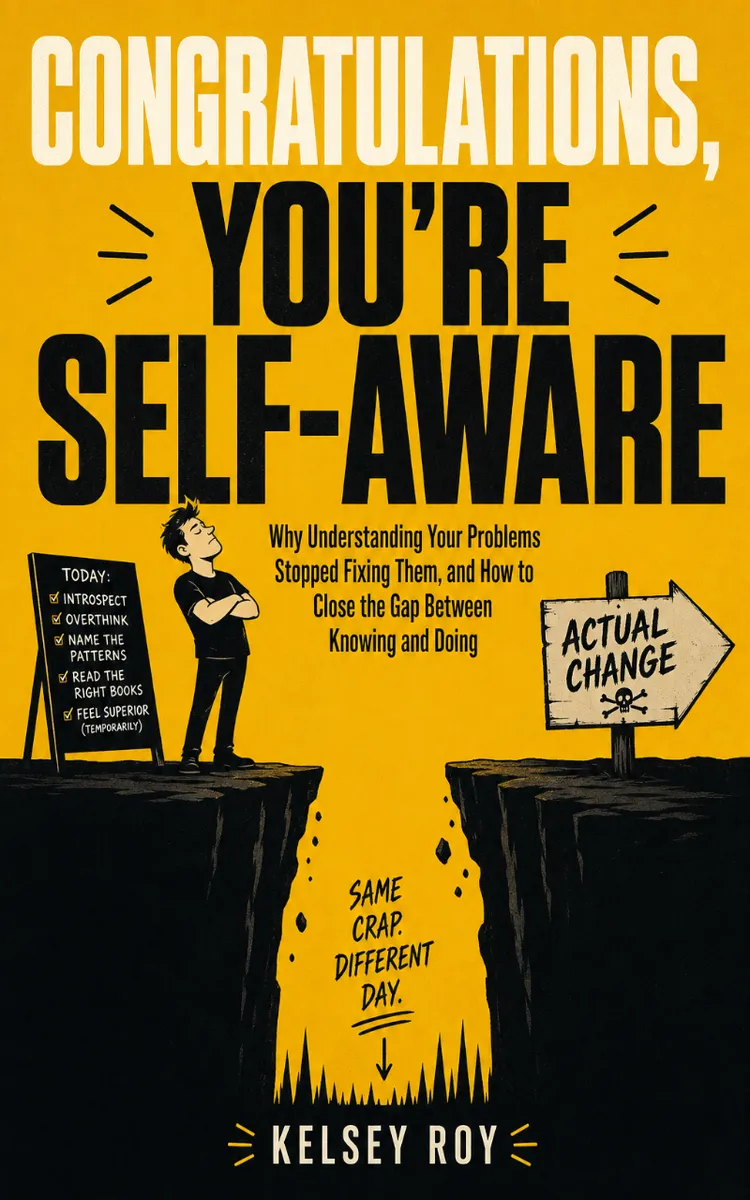
"Congratulations, You’re Self-Aware" is a self-help book by Kelsey Roy with 12 chapters and approximately 18,206 words. Self-help for turning self-awareness into consistent action.
This book was created using Inkfluence AI, an AI-powered book generation platform that helps authors write, design, and publish complete books. It was made with the AI Self-Help Book Writer.
Frequently Asked Questions
What is "Congratulations, You’re Self-Aware" about?
Self-help for turning self-awareness into consistent action
How many chapters are in "Congratulations, You’re Self-Aware"?
The book contains 12 chapters and approximately 18,206 words. Topics covered include THE DIAGNOSIS WAS NEVER THE CURE, INSIGHT IS THE NEW PROCRASTINATION, YOUR ATTACHMENT STYLE IS NOT A PERSONALITY, CONGRATULATIONS ON YOUR TRAUMA VOCABULARY, and more.
Who wrote "Congratulations, You’re Self-Aware"?
This book was written by Kelsey Roy and created using Inkfluence AI, an AI book generation platform that helps authors write, design, and publish books.
How can I create a similar self-help book?
You can create your own self-help book using Inkfluence AI. Describe your idea, choose your style, and the AI writes the full book for you. It's free to start.
Write your own self-help book with AI
Describe your idea and Inkfluence writes the whole thing. Free to start.
Start writingCreated with Inkfluence AI


