

Read the first chapter
The whole of chapter one, free. About 9 min. Turn the pages with the arrows, your keyboard, or a swipe.
Chapter 1
Election and Consecration of the Sphere
Chapter 1: Choosing and Consecrating the Sphere
The Matter That Looks Back
A woman brought a transparent quartz sphere to her first session, bought from a mineral shop. She had wiped it with a cloth, but had not removed the fine oily film left by her fingers or the marks from its packaging. When she lit the candle, every smudge became a shadow. The surface seemed to show shifting shapes; in reality, the crystal mercilessly reflected the disorder she had left on it.
Choosing the sphere matters because each material offers a different symbolic experience and requires different care. Clear quartz lends itself to readings associated with clarity and openness; smoky crystal draws attention to what is veiled, deep, and caught between lights; black obsidian focuses the gaze on a dark surface, like a mirror without an immediate reflection. No stone guarantees visions or answers. The material establishes a language for your practice and shapes how your eyes, imagination, and attention relate to the surface.
By the end of these pages, you will be able to choose a sphere according to your purpose, clean it without damaging it, and perform a simple consecration with moon water and salt. You will also know how to distinguish physical cleaning from a ritual gesture, prepare the elements safely, and recognize when a smudge, crack, or reflection belongs to the object rather than the surrounding gloom.
The Sphere Triad
The Sphere Triad brings together three decisions: material, condition, and connection. Material refers to the type of crystal; condition, to its visible cleanliness and integrity; connection, to the meaning you assign it through consecration. If you confuse these levels, you may try to solve a grease problem with salt, or look for a symbolic sign in a crack you should have noticed before beginning.
Choose your sphere by considering its surface, weight, and the kind of attention you wish to cultivate:
1. Clear quartz: clarity and beginnings. Its transparency lets you observe inclusions, tiny bubbles, and internal reflections. Symbolically, it lends itself to work on order, direct questions, and early practice. Because it reflects more light, it needs controlled lighting: a candle placed about sixty centimeters away may be enough. If you put the flame too close, you will multiply the glints and strain your eyes.
2. Smoky crystal: depth and transition. Its gray, brown, or almost black tone filters light without shutting it out completely. It is well suited to contemplation of memories, doubts, or matters that have not yet taken clear shape. Check its color in natural light before buying it: some pieces look smoky because of a surface coating and lose their uniformity when turned. That irregularity can distract you and make you chase smudges instead of inner images.
3. Black obsidian: silence and dark reflection. Obsidian forms from cooled lava and can have a deep, almost metallic sheen. Its smooth surface returns distinct reflections when lit from the side. For this reason, it requires particular care: frontal light turns the sphere into a mirror and may show your face too clearly. Obsidian can also chip at the edges; examine it with your fingers protected by a cloth, and do not use a piece with a sharp edge.
After choosing the material, inspect the sphere under white light. Turn it slowly and look for cracks, chips, dust around the mount, and cloudy areas. A natural inclusion is not a defect: it is part of the stone. A recent crack, by contrast, may spread during washing or a sudden change in temperature. The Triad begins when you agree to look at the object before asking it to show you something in return.
Physical cleaning always comes before ritual. Place the sphere on a clean towel. Remove dust with a soft natural-bristle brush or a microfiber cloth. Then dampen another cloth with warm water and wipe the entire surface. Do not pour boiling water over it or use alcohol, perfumes, strong detergents, or scouring pads: these products can dull the finish, leave residue, or mark the mount.
If the sphere is water-safe, rinse it for a few seconds under a gentle stream and dry it immediately. Polished obsidian usually tolerates this procedure, but avoid submerging it if it has cracks, a metal setting, or a glued base. Quartz and smoky crystal also require caution when they contain fissures. If you do not know how the piece has been treated, clean it only with a slightly damp cloth. The aim is to remove grease and dust, not to put the stone to the test.
Prepare moon water in a clean glass container, using drinking water and brief exposure to moonlight. You do not need to claim that the moon physically changes the water; within this practice, its purpose is to mark a time and an intention. Fill the container, cover it with a fine cloth to keep out dust, and leave it by a window for one night. Take it in the morning and use it that same day. Discard the water if it contains particles, smells strange, or has been in contact with insects.
Salt has a limited symbolic and practical role here. Do not rub it against the sphere or dissolve it directly on the surface. The grains can scratch the polish, and salt water can affect certain metal mounts or leave a film that is difficult to remove. Put a teaspoon of sea salt in a separate bowl and place the moon water beside it, not on top of it. This lets you include the salt without exposing the stone to an abrasive.
Consecrate the sphere with a simple, repeatable gesture:
1. Prepare the space. Spread a dark cloth and place the sphere in the center, the moon water on the left, and the bowl of salt on the right. This arrangement keeps the elements separate and prevents salt from ending up on the surface.
2. Name the material. Say quietly: “This is a sphere of clear quartz,” “smoky crystal,” or “black obsidian.” Naming the material keeps you from confusing its physical properties with a supernatural promise.
3. Set the purpose. State a single, specific intention with a time limit: “I will use it for twenty minutes to contemplate symbolic images and record my impressions.” A sentence like this limits the session and reduces the tendency to search for signs for hours.
4. Present the water. Slightly moisten the tip of a clean finger and touch the mount or the cloth beneath the sphere, not the stone. If the material has cracks or an unknown treatment, do not wet it. The gesture represents purification without risking the finish.
5. Bring the salt close without contact. Take a pinch between your fingers and let it fall into the bowl. Notice how the grains remain separate from the sphere. The distance is a reminder that a symbol need not damage an object to have meaning.
6. Close the consecration. Dry any nearby moisture, cover the sphere with a black cloth for a few minutes, then remove it. Covering and uncovering marks a clear beginning; it is not an invitation to keep staring without limit.
Consecration does not turn the crystal into an authority. It helps you distinguish an everyday object from an object of practice, just as a bell marks the beginning of a ceremony without creating, by itself, what you hope to perceive. Ask yourself: Can I explain what I cleaned, what intention I chose, and how long the session will last? If you cannot answer, you have not finished preparing the sphere.
A First Consecration, Step by Step
Consider an eight-centimeter smoky crystal sphere placed on a wooden base. The piece has dust on its underside and a fingerprint near the center. The purpose is to spend fifteen minutes in contemplation at dusk, without seeking names, dates, or predictions.
Follow this sequence:
1. Examine the sphere for two minutes. Place it under white light and turn it slowly. Note any crack, inclusion, or darker area. The expected result is to know which marks were there before the session.
2. Clean the surface for three minutes. Use a soft brush, then a barely damp microfiber cloth. Dry it with another cloth. If the wooden base absorbs water, remove the sphere before cleaning it and let the base dry separately.
3. Prepare the moon water. Pour one hundred and fifty milliliters of drinking water into a glass, cover it, and leave it by a window overnight. The next morning, check that the water is still clean and odorless.
4. Keep the salt separate. Put a teaspoon of sea salt in a small bowl. Do not mix it with the water or bring it near the wood. The expected result is to keep both elements intact and ready for the symbolic gesture.
5. Formulate the intention. Write: “For fifteen minutes, I will observe without forcing images and record three impressions when I finish.” The sentence keeps your attention from turning into an endless search.
6. Consecrate without saturating the stone. Touch the cloth beneath the sphere with a finger moistened with moon water, and leave the salt in its bowl. Say the name of the material and your intention. Then cover the sphere for one minute.
7. Check its final condition. Uncover the sphere, place the light source to one side, and make sure there are no droplets, new dust, or direct reflections. If there are, adjust the position before beginning the contemplation.
Quick Checklist
• Surface free of grease, dust, and residue. - Cracks and inclusions noted before looking. - Moon water clean and prepared in a glass container. - Salt kept separate, with no contact with the sphere. - Material identified: quartz, smoky crystal, or obsidian. - Intention written in a single sentence. - Practice time set: fifteen minutes in this example. - Dark cloth available to cover the piece.
Once the preparation is complete, the sphere should feel clean, stable, and familiar - not mysterious by obligation. That matters: the gloom grows more powerful when the material is under control.
Mistakes That Cloud the Sphere
Submerging the stone in salt water
Salt can scratch the polish when you rub it in, and it can leave residue in cracks or mounts. Some bases made of metal also stain easily.
Do this: Put the salt in a separate bowl and use the moon water only on the cloth or mount, unless you know the piece can withstand it.
Not this: Bury the sphere in salt or leave it in salt water all night.
Mistaking an inclusion for a sign
Quartz may contain veils, filaments, or tiny cavities; smoky crystal may show uneven patches of color. These marks are part of the mineral structure.
Do this: Examine the sphere under white light, note the marks, and check them again after the session.
Not this: Interpret every dark spot that was visible before you began as a message.
Using a damaged sphere out of respect for the ritual
A crack does not become safe because the stone has symbolic value. A change in temperature, moisture, or slight pressure may make it grow.
Do this: Remove any sphere with sharp edges, open fissures, or flaking from your practice. Keep it as a mineral specimen, not as an instrument of contemplation.
Not this: Heat it beside a candle or expose it to cold water after it has been warmed.
The choice is complete once you know the material, how to clean it, and its limits of use. Clear quartz opens up the surface; smoky crystal lends it greater gravity; black obsidian returns a silence that may seem profound because it reflects less. None of the three stones replaces your judgment. As you cover them, let one sober question remain: when the surface is clean, what part of what you see will come from the crystal, and what part from your own gaze?
End of chapter one. 6 more chapters and about 13,988 words in the full book.
Swipe or use the arrows to turn the page


What's inside: 7 chapters
- 1. Election and Consecration of the Sphere
- 2. Altar of the Gloaming
- 3. Reading of Mists and Symbols
- 4. Closure and Protective Veil
- 5. Figures Behind the Reflection
- 6. Stopped Clocks and Farewells
- 7. The Uncovered Sphere
About this book
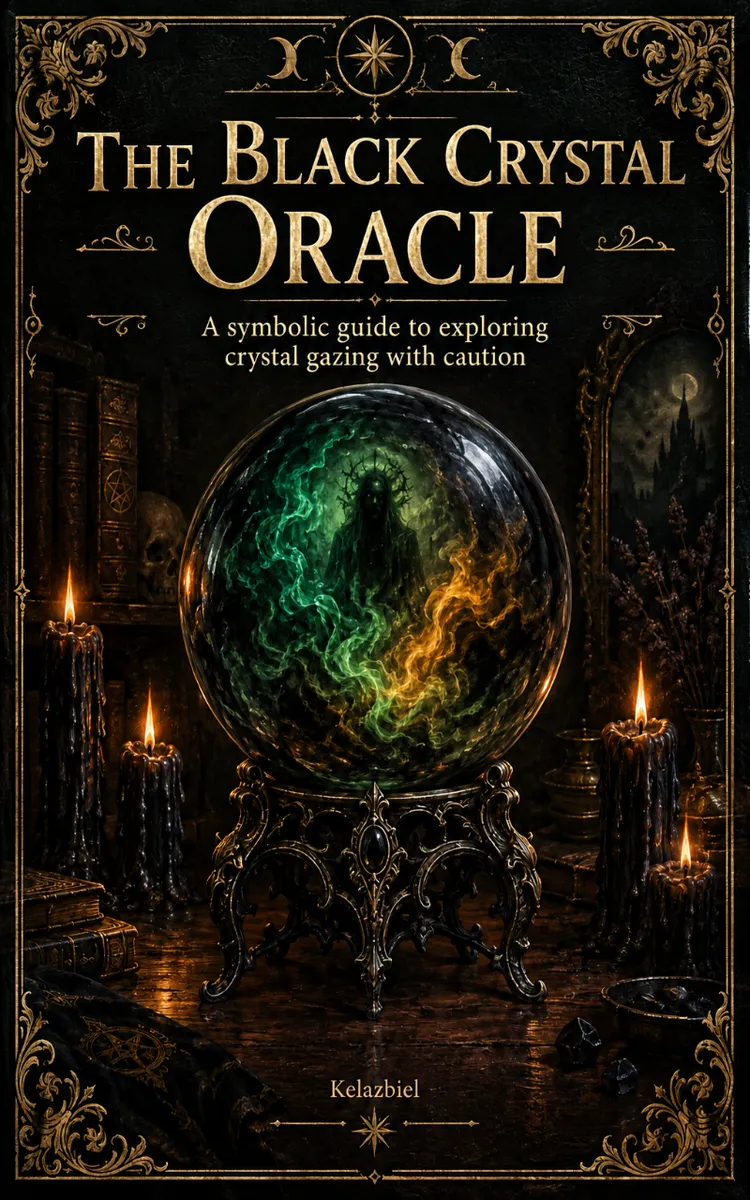
"The Black Crystal Oracle" is a how-to guide book by Kelazbiel with 7 chapters and approximately 13,988 words. Symbolic practices of crystal gazing alongside fictional chronicles of psychological horror.
This book was created using Inkfluence AI, an AI-powered book generation platform that helps authors write, design, and publish complete books. It was made with the AI Ebook Generator.
Frequently Asked Questions
What is "The Black Crystal Oracle" about?
Symbolic practices of crystal gazing alongside fictional chronicles of psychological horror
How many chapters are in "The Black Crystal Oracle"?
The book contains 7 chapters and approximately 13,988 words. Topics covered include Election and Consecration of the Sphere, Altar of the Gloaming, Reading of Mists and Symbols, Closure and Protective Veil, and more.
Who wrote "The Black Crystal Oracle"?
This book was written by Kelazbiel and created using Inkfluence AI, an AI book generation platform that helps authors write, design, and publish books.
How can I create a similar how-to guide book?
You can create your own how-to guide book using Inkfluence AI. Describe your idea, choose your style, and the AI writes the full book for you. It's free to start.
Write your own how-to guide book with AI
Describe your idea and Inkfluence writes the whole thing. Free to start.
Start writingCreated with Inkfluence AI


