

Read the first chapter
The whole of chapter one, free. About 5 min. Turn the pages with the arrows, your keyboard, or a swipe.
Chapter 1
Day 1: The Synoptic Lens-How to Read for Transformation
Scripture Focus
Luke 1:1-4
> Inasmuch as many have undertaken to compile a narrative of the things that have been accomplished among us, just as those who from the beginning were eyewitnesses and ministers of the word have delivered them to us, it seemed good to me also, having followed all things closely for some time past, to write an orderly account for you, most excellent Theophilus, that you may have certainty concerning the things you have been taught.
Luke shows us that faithful reading joins careful investigation with confident trust in the Christ proclaimed by the apostolic witnesses.
The four Gospels do not give us four different Jesuses. Matthew, Mark, Luke, and John bear witness to one Lord, one saving mission, one cross, and one resurrection. Yet each Gospel presents that same Christ with a distinct emphasis. Matthew repeatedly shows Jesus as the promised King and teacher who fulfills Israel’s Scriptures. Mark moves with urgency, presenting the powerful Son of God whose authority is revealed through service and suffering. Luke carefully displays Jesus as the compassionate Savior for all peoples, attentive to the poor, the outsider, women, sinners, and those whom society overlooked. John writes with a more openly theological purpose, declaring that Jesus is the eternal Word who became flesh.
Luke’s phrase “followed all things closely” gives us a helpful method. The Greek verb is parēkolouthēkoti, meaning to investigate carefully, trace faithfully, or follow a matter closely. His Gospel is devotional, but it isn’t careless. It is spiritual, but it isn’t vague. We are invited to read with a praying heart and an attentive mind.
Reflection
A single event can reveal different features when viewed from different angles. Matthew’s account of Jesus’ teaching on the kingdom often gathers His words into great teaching sections, such as the Sermon on the Mount. Mark may emphasize what Jesus did and how quickly the news spread. Luke may linger over a person’s response, a meal, a prayer, or a social boundary being crossed. John may explain the deeper identity behind the sign: Jesus is not merely performing a miracle; He is revealing His glory.
These differences aren’t contradictions to smooth over. They are inspired witnesses to study together. Consider the feeding of the five thousand. Matthew, Mark, Luke, and John all record it, but each highlights something particular. Matthew places the event near Jesus’ compassion for the crowds. Mark emphasizes their helplessness, “like sheep without a shepherd,” and Jesus’ patient teaching. Luke presents the apostles’ involvement in the practical problem of food. John uses the sign to lead into Jesus’ teaching about the bread of life. The same Christ is present in every account. The distinct lenses deepen, rather than weaken, our understanding.
That matters in ordinary Bible reading. We can rush through familiar passages and assume we already know what they say. A comparison of the Gospels slows us down. It asks, “Why did this evangelist include this detail? What does this wording reveal about Jesus? What response does the passage seek from me?” The word synoptic comes from Greek roots meaning “seeing together.” Matthew, Mark, and Luke can be read side by side because they share much material and structure. John stands alongside them as a theological complement, often arranging events and teachings differently while proclaiming the same incarnate Son.
The goal is not merely to collect information about Jesus, but to see Him truly and follow Him faithfully. Scholarly study serves transformation when it brings us into worship, repentance, obedience, and love. Greek terms can clarify meaning, historical background can correct assumptions, and careful comparison can expose our habits of reading - but none of these replaces prayerful submission to Christ.
The Gospels also begin before Bethlehem. John reaches back beyond creation: “In the beginning was the Word” (John 1:1). Jesus did not begin to exist when Mary conceived Him. He lived in eternal fellowship with the Father and entered our world in humility. Matthew and Luke emphasize His birth within Israel’s history; Mark begins with His public ministry; John announces His eternal glory. Together they teach us to see the manger, the ministry, the cross, and the empty tomb as one movement of divine love. The Son loves the Father, obeys the Father, prays to the Father, and gives Himself for humanity.
A useful study guide therefore keeps three questions together: What does the text say? What does it mean in its setting and language? How is Christ calling me to respond? If we ask only the first, our reading may remain shallow. If we ask only the second, it may become a lecture. If we ask only the third without answering the first two, we may turn Scripture into a mirror for our preferences. The four Gospels train us to listen before we apply.
Practice for Today
1. Read one shared event through four lenses. Read Matthew 14:13-21, Mark 6:30-44, Luke 9:10-17, and John 6:1-15. Keep a simple four-column page in your journal. Under each Gospel, write one detail that receives special emphasis. For example, note Matthew’s compassion, Mark’s shepherd imagery, Luke’s practical question about feeding the crowd, and John’s movement toward the bread-of-life discourse. End by writing one sentence: “Together, these accounts show me Jesus as…”
2. Use the three-question method for ten quiet minutes. Set a timer and pray over one of the four passages. Write brief answers to: “What does the text say?” “What did it mean in its original setting?” and “What response does Jesus seek from me today?” If a Greek word helps, record it with a plain translation. For instance, splanchnizomai, often translated “had compassion,” describes deep inward mercy. Don’t chase technical details merely to sound informed. Use them to see the Lord’s heart more clearly.
3. Pray with the lenses open. Thank the Father for giving four Gospel witnesses rather than one compressed account. Ask for grace to receive Matthew’s call to kingdom righteousness, Mark’s call to servant-shaped discipleship, Luke’s call to mercy and welcome, and John’s call to faith in the eternal Son. Then choose one Gospel to read slowly for the next seven days. Keep the others nearby for comparison, not competition.
As you journal, be honest about your usual preference. Do you tend to look for commands, as Matthew often makes especially clear? Do you prefer action and quick results, like Mark’s energetic narrative? Do you notice people at the margins, as Luke repeatedly teaches us to do? Do you reach for John when you need to consider Jesus’ identity and glory? Your preference isn’t a problem. It becomes a problem only when it keeps you from hearing the emphases the Spirit has placed before you.
Closing Prayer
Father, give me a careful mind and a receptive heart as I read Matthew, Mark, Luke, and John. Help me see the one Christ through each faithful witness. Keep my study from becoming mere information, and let it lead me to love Jesus, obey His word, and recognize His mercy. Teach me to see together, listen deeply, and follow faithfully. Amen.
End of chapter one. 14 more chapters in the full book.
Swipe or use the arrows to turn the page

Spirit-Led Whole-Person Renewal

ChurchBased Christian Biblical Counseling Ministry

Anxiety And Panic Counseling Desk Reference
What's inside: 15 chapters
- 1. Day 1: The Synoptic Lens-How to Read for Transformation
- 2. Days 3-4: Before Bethlehem-The Son’s Eternal Love and Heaven’s Mission
- 3. Days 5-6: Matthew’s King-Genealogy, Kingdom Ethics, and the Call to Follow
- 4. Days 7-8: Mark’s Servant-Authority, Urgency, and the Prayer-Driven Ministry
- 5. Days 9-10: Luke’s Compassion-Order, Temple Roots, and the Spirit’s Power
- 6. Days 11-12: The First Teachings-Sermon on the Mount, Kingdom Parables, and Prayer
- 7. Days 13-14: Miracles as Theology-Healing, Authority, and Compassionate Love
- 8. Days 15-16: The Journey North-Discipleship, Confession, and the Cost of Following
- 9. Days 17-18: Parables Unveiled-Seeds, Kingdom Growth, and Hidden Truth
- 10. Days 19-20: John’s Complement-Signs, Glory, and the Father’s Word
- 11. Days 21-22: The Final Week Begins-Hosanna, Cleansing, and Holy Authority
- 12. Days 23-24: Betrayal and Teaching-Last Supper, Watchfulness, and Prayerful Hope
- 13. Days 25-26: Cross and Silence-Suffering, Forgiveness, and the Father’s Will
- 14. Days 27-28: Resurrection Morning-Hope, Belief, and the Living Word
- 15. Days 29-30: Commission, Prayer Life, and the Synoptic Way Forward
About this book
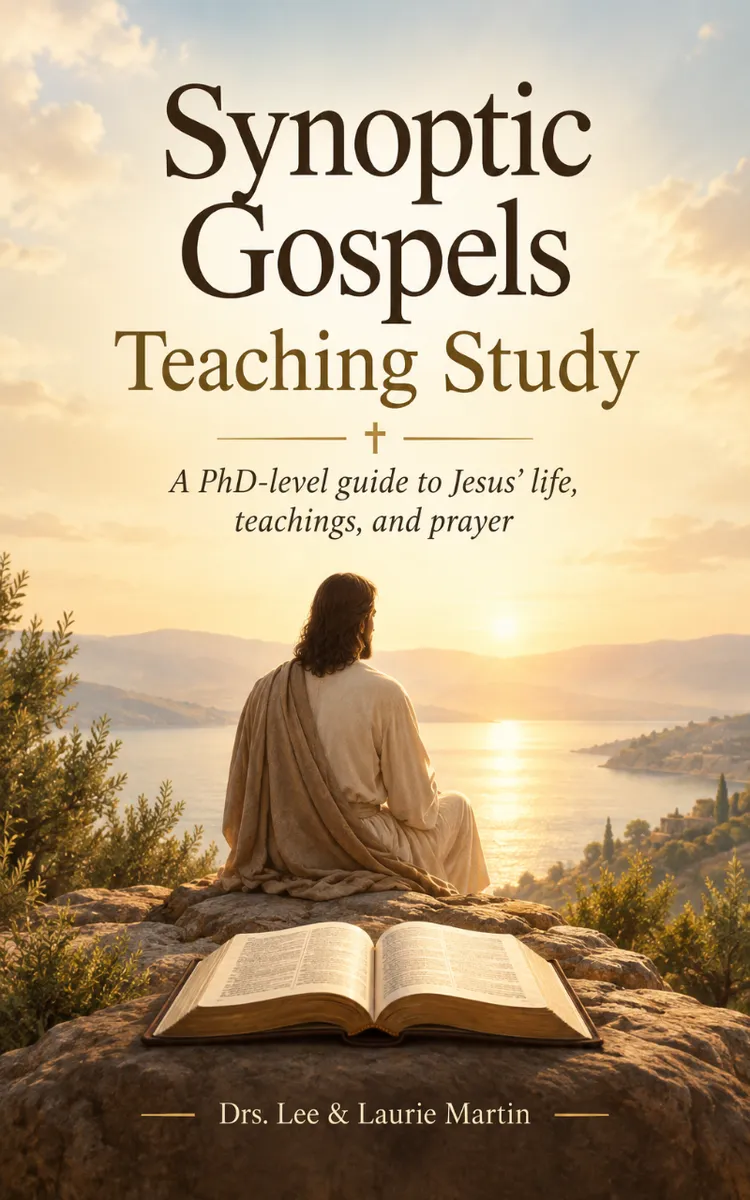
"Synoptic Gospels Teaching Study" is a religious devotional book by Drs. Lee & Laurie Martin with 15 chapters and approximately 19,150 words. In-depth study of Matthew, Mark, Luke, and John.
This book was created using Inkfluence AI, an AI-powered book generation platform that helps authors write, design, and publish complete books.
Frequently Asked Questions
What is "Synoptic Gospels Teaching Study" about?
In-depth study of Matthew, Mark, Luke, and John
How many chapters are in "Synoptic Gospels Teaching Study"?
The book contains 15 chapters and approximately 19,150 words. Topics covered include Day 1: The Synoptic Lens-How to Read for Transformation, Days 3-4: Before Bethlehem-The Son’s Eternal Love and Heaven’s Mission, Days 5-6: Matthew’s King-Genealogy, Kingdom Ethics, and the Call to Follow, Days 7-8: Mark’s Servant-Authority, Urgency, and the Prayer-Driven Ministry, and more.
Who wrote "Synoptic Gospels Teaching Study"?
This book was written by Drs. Lee & Laurie Martin and created using Inkfluence AI, an AI book generation platform that helps authors write, design, and publish books.
Write your own religious devotional book with AI
Describe your idea and Inkfluence writes the whole thing. Free to start.
Start writingCreated with Inkfluence AI


